Krakow is one of my favourite cities in Central Europe. I’ve been three times now, and on one of those trips we explored Poland with our daughter as a baby. Each visit shows me a different side of the city: the pastel facades around the Main Market Square, the candlelit bars of Kazimierz and the raw street art across the Vistula river.
Krakow also carries a heavy history. The Jewish quarter, the former ghetto and the Auschwitz memorial an hour and a half away stay with you long after you leave. All those different sides are why I keep coming back.
In this blog you’ll find the best things to do in Krakow, which neighbourhood to stay in, where to eat and which day trips to take from the city.

What is Krakow known for?
Krakow is known for its medieval Old Town, the Jewish quarter of Kazimierz and its location close to Auschwitz. On top of that, it’s a real student city with a nightlife that won’t break the bank.
The historic centre of Krakow was one of the very first places added to the UNESCO World Heritage List, back in 1978. While Warsaw was almost completely destroyed in the Second World War, Krakow came through largely intact. That’s why you can still wander past Gothic churches, Renaissance palaces and the largest medieval market square in Europe.
Before the war, Krakow was also one of Europe’s great centres of Jewish life. In Kazimierz you can still see it in the synagogues and old cemeteries, and across the river the former ghetto has memorials to what happened there. Schindler’s List, filmed largely in Krakow, put the city on the tourist map in the 1990s.
Jagiellonian University is one of the oldest in Europe, and you feel it everywhere. Tens of thousands of students keep the terraces full, the cellar bars under the Old Town busy and the food and drink scene in Kazimierz buzzing.

How to get to Krakow
Flying is by far the quickest way to get to Krakow. Kraków John Paul II airport has direct flights from all over Europe, including plenty of budget routes. From the airport, a train takes you to the central station in about twenty minutes, and from there you can walk to the Old Town.
We drove there ourselves on a road trip through Eastern Europe, and Krakow is a stop you don’t want to skip on a route like that. Just know that parking is paid everywhere in the centre and in Kazimierz. Book a hotel with its own car park, or leave the car outside the ring road and take the tram in.
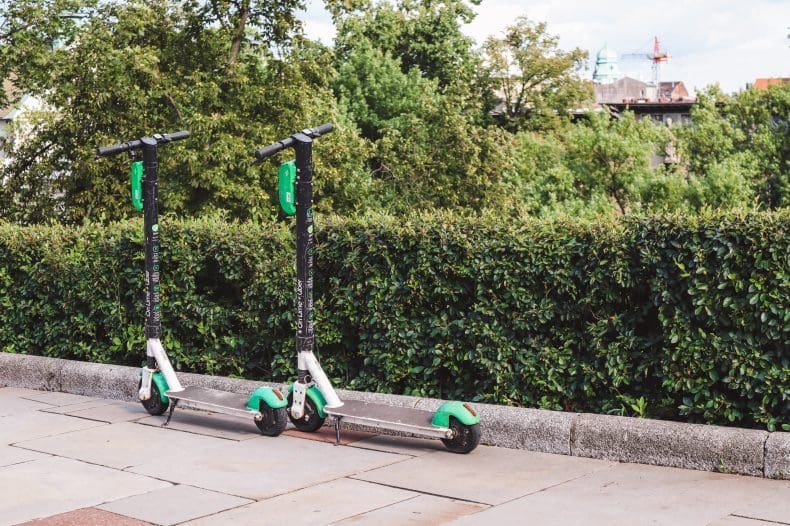
Once you’re in the city, you won’t really need transport. The Old Town and Kazimierz are a twenty-minute walk apart. In a hurry? Hop on a tram or grab an e-scooter, which you park again in one of the marked bays.
Where to stay in Krakow
The two best areas to stay in Krakow are the Old Town and Kazimierz. In the Old Town, inside the green ring of the Planty park, you’re a few minutes’ walk from the Main Market Square and Wawel Hill. Kazimierz lies just south of it, between the centre and the river, and feels much more local.
I’ve stayed in both, and once at a campsite outside the city. My favourite is Kazimierz. It’s calmer during the day than the area around the square, and in the evening you’ll be sitting among Krakow’s own residents in the cafés and restaurants. First time in Krakow and keen to see as much as possible? Then the Old Town is the most convenient choice.
In the Old Town, Hotel Jan is a great-value option in a centuries-old townhouse on Grodzka street. The Main Market Square is a few minutes away, and Wawel Hill is just around the corner.
For a bit more style, try H15 Hotel Francuski, a classic hotel right next to St Florian’s Gate. Rooms have high ceilings and elegant furnishings, and you step straight onto Floriańska street towards the square.
We’re big fans of the Polish hotel chain PURO: modern, colourful and affordable. PURO Stare Miasto sits on the edge of the Old Town near the station, which is handy if you’re arriving by train or from the airport.
In Kazimierz, 1891 Garni Hotel is a good-value pick. It’s in a restored building with a stylish interior, a few streets from Plac Nowy.
Love design? Then INX Design Hotel is your place. Sleek rooms and a location on the edge of Kazimierz, within walking distance of the river.
Want to wake up in the heart of the Jewish quarter? Book Hotel Rubinstein. The hotel is in a fifteenth-century building on Szeroka street, with the old synagogues right outside the door.
There’s a second PURO in Kazimierz: PURO Kazimierz, with colourful rooms, a relaxed lobby to recharge in, and both Kazimierz and Podgórze are within walking distance.
Tip: join a free walking tour
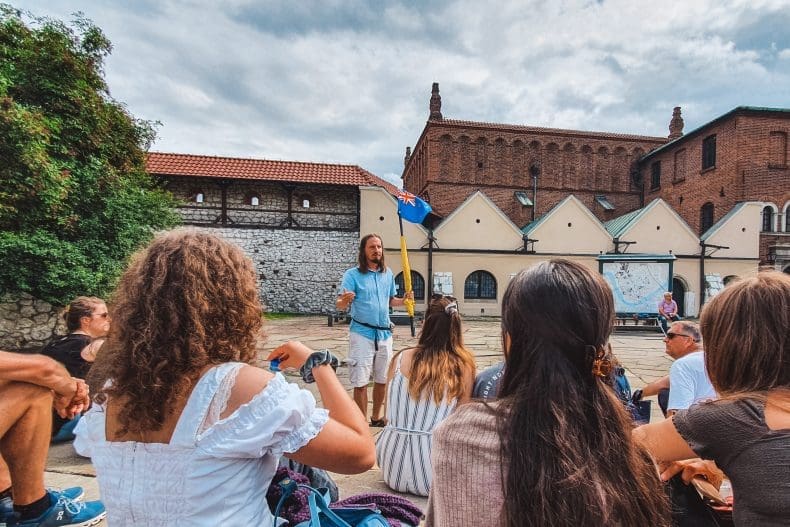
A free walking tour is my favourite way to get to know a new city, and Krakow has loads of them. The idea is simple: a local guide shows you around for a couple of hours, and at the end you pay what you think the tour was worth. The guides live off those tips, so most of them go all out to make it a good one.
I did at least one tour on every visit to Krakow. The classic Old Town route is a great start, but there are also tours of the Jewish quarter, communist Nowa Huta and the city’s street art. Not every tour runs every day, so sign up online in advance.
Things to do in Krakow: 17 must-see attractions
Most of Krakow’s sights are in the Old Town and Kazimierz, within walking distance of each other. For Nowa Huta and the mounds you’ll need the tram. Short on time? These are the highlights at a glance:
- The Main Market Square and Cloth Hall
- St Mary’s Basilica and the trumpet call
- Wawel Castle and Cathedral
- Kazimierz, the Jewish quarter
- Street food on Plac Nowy
- Podgórze and Schindler’s Factory
- Leonardo da Vinci’s Lady with an Ermine
- Street art in Kazimierz and Podgórze
- Nowa Huta
- Day trips to Auschwitz and the Wieliczka Salt Mine
#1 Main Market Square: the biggest square in Poland
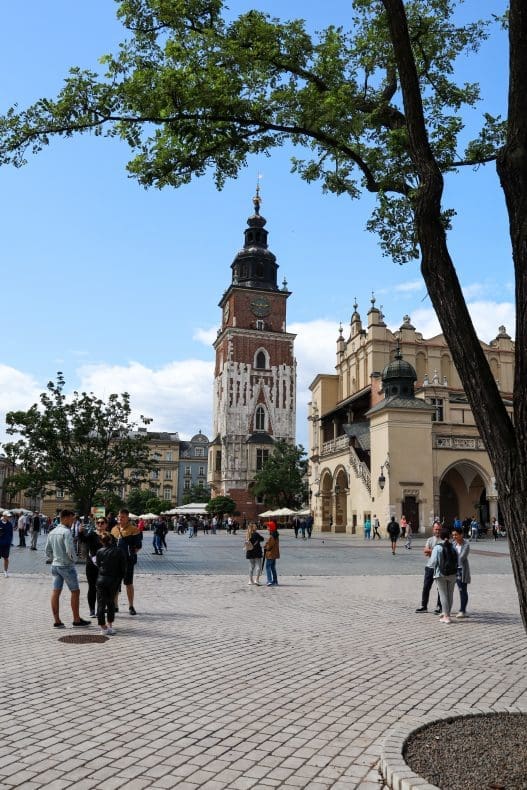
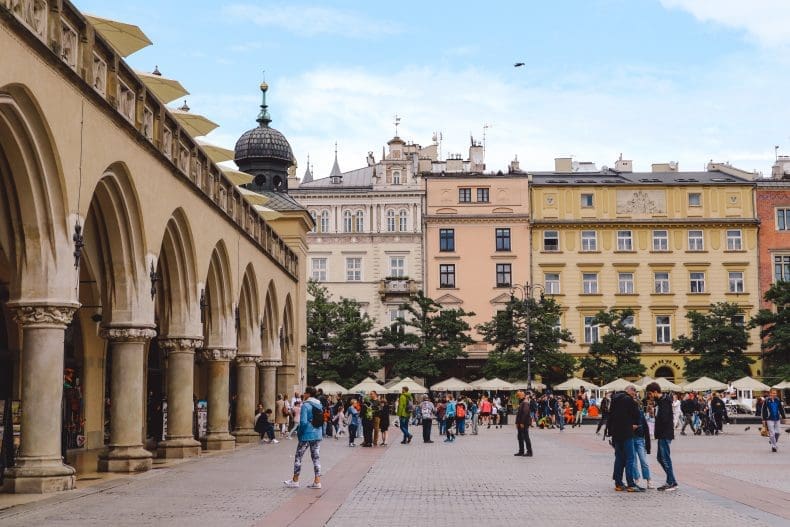
Everything in Krakow revolves around the Main Market Square, Rynek Główny. At about 40,000 square metres it’s the largest medieval market square in Europe, and you feel it the moment you step onto it. Pastel townhouses with café terraces line the edges, the long Cloth Hall sits in the middle, and St Mary’s Basilica and the Town Hall Tower rise up on either side.
During the day the square is a constant flow of tour groups, street musicians and stalls selling obwarzanki, the ring-shaped bread rolls you’ll find on carts all over town. If you want to see the square in peace, come early in the morning. After dinner is lovely too, when the facades are lit up and the terraces fill up.
Only the tower is left of the old town hall. The Gothic building it belonged to was pulled down in the nineteenth century. You can climb the tower for a view over the square.
#2 The Cloth Hall: from spice market to souvenir hall
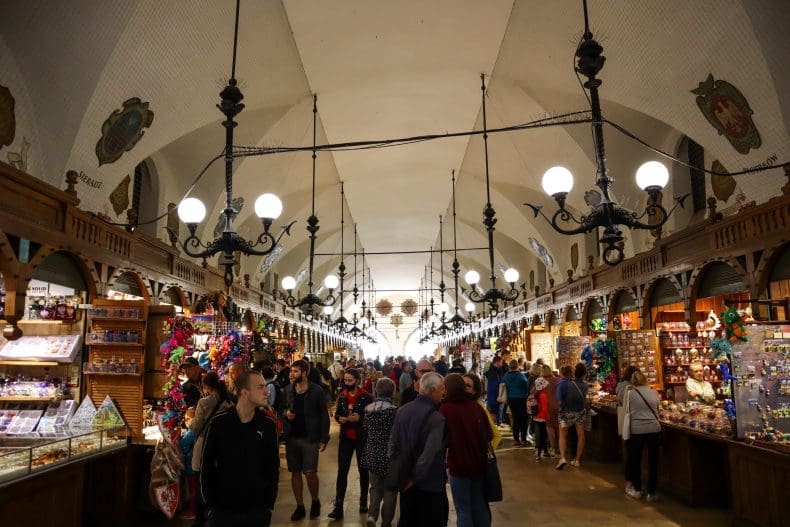
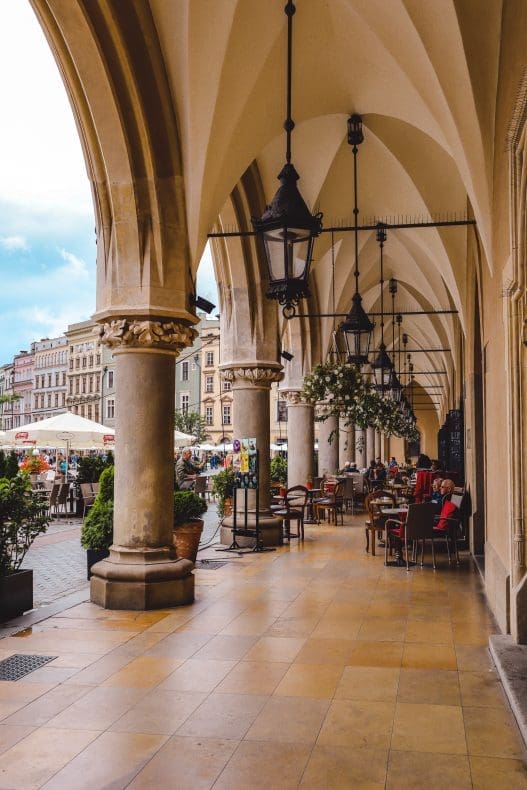
In the middle of the square stands the Cloth Hall, the Sukiennice. There’s been a covered market here since the Middle Ages, where traders sold cloth, spices and salt from the Wieliczka mine. Today’s building, with its Renaissance parapet, is over a hundred metres long.
Inside you’ll mostly find souvenir stalls, from amber to wooden toys. As you walk through, look up at the coats of arms of Polish towns. Upstairs there’s a gallery of nineteenth-century Polish art, and beneath the square lies the Rynek Underground museum, where you walk over the foundations of the medieval market.
#3 St Mary’s Basilica: listen for the trumpet
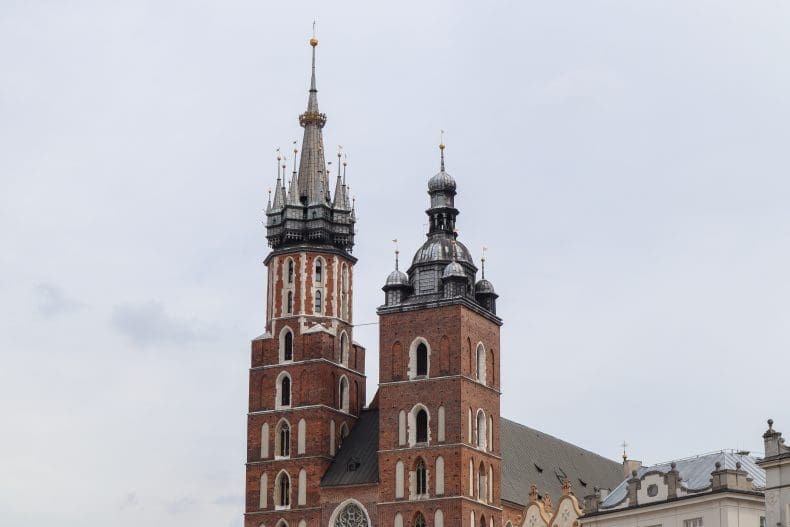
St Mary’s Basilica is the landmark of the Main Market Square, and the first thing you notice is that its two towers don’t match. Legend says two brothers each built one, and one killed the other out of jealousy when his brother’s tower threatened to be taller. The knife supposedly still hangs in the Cloth Hall.
Every hour, a short trumpet melody called the hejnał is played from the taller tower, in all four directions, by a firefighter. It stops abruptly mid-note. The story goes that a trumpeter was hit in the throat by an arrow while sounding the alarm during a Tatar attack. Be on the square when the hour strikes and look up: the trumpeter often waves down afterwards.
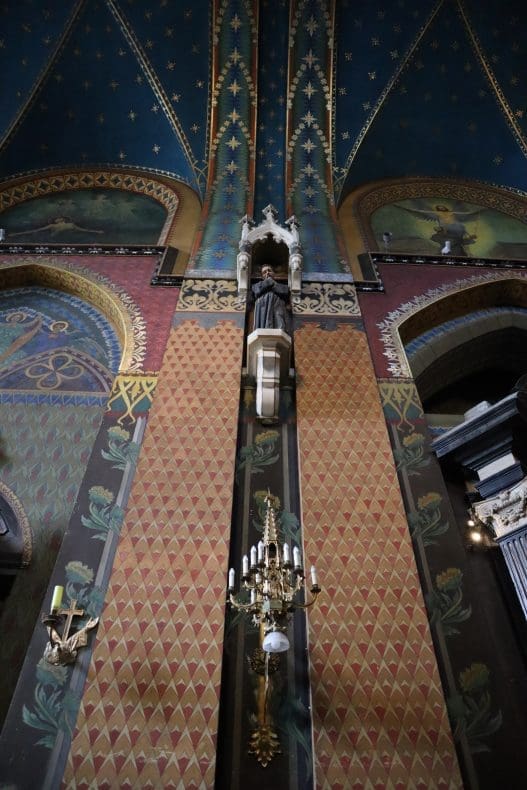
Inside, it’s one of the most beautiful churches in Poland, with a starry blue ceiling and a huge wooden altarpiece by Veit Stoss.
#4 Wawel Hill: castle, cathedral and a fire-breathing dragon
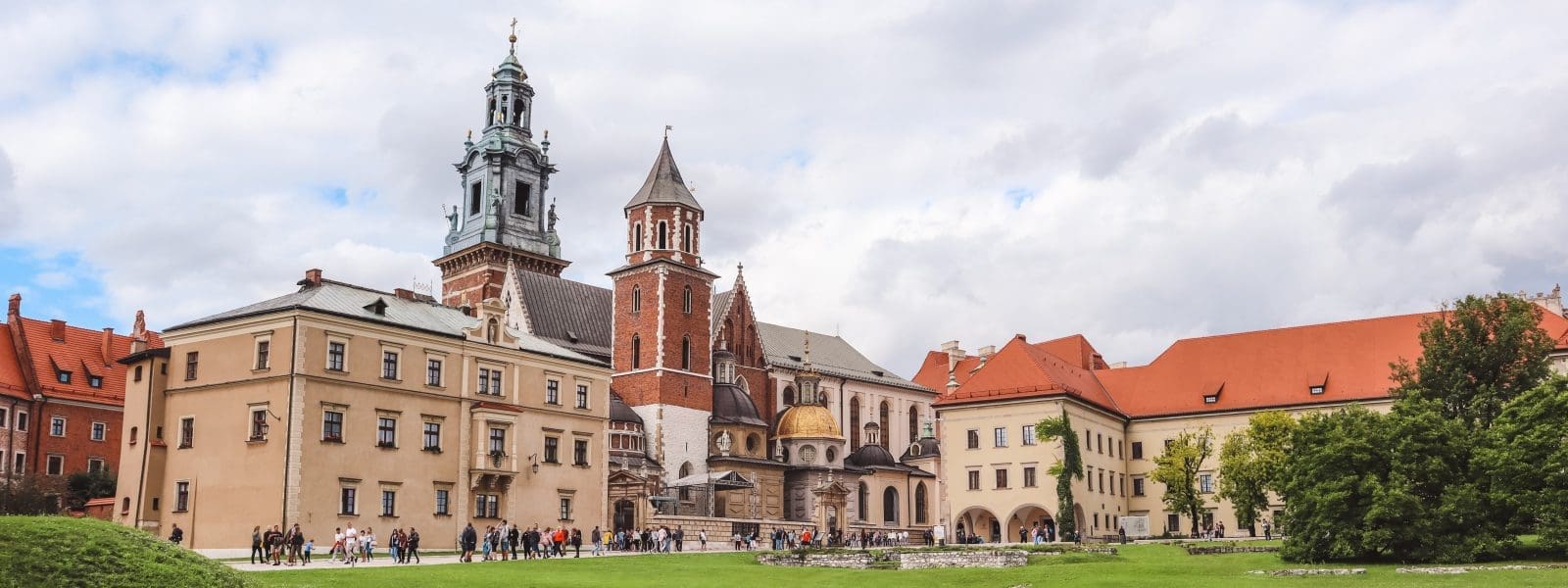
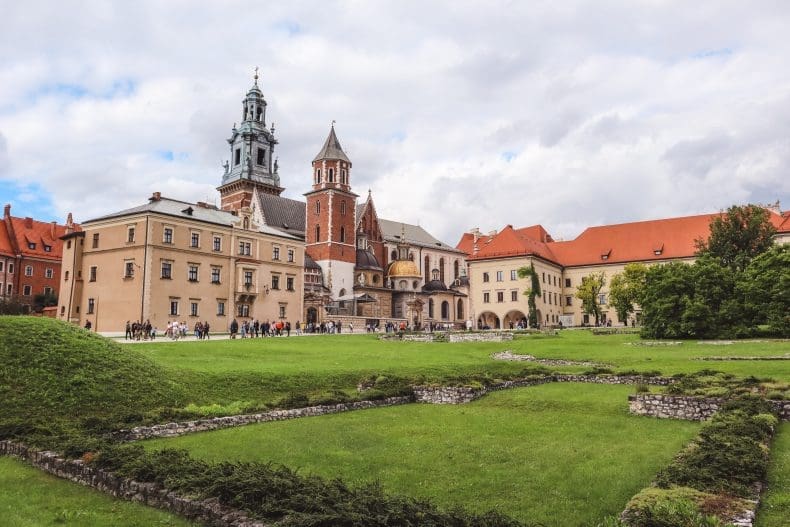
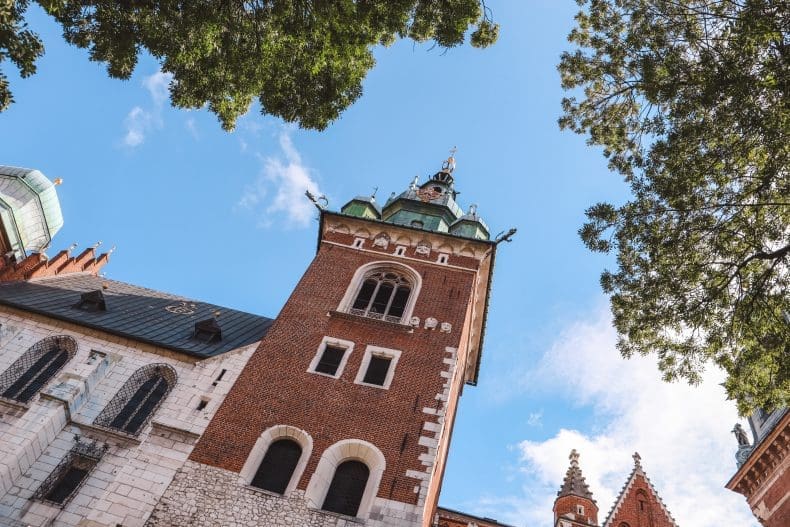
Wawel Hill has been the historic heart of Krakow for centuries. The Royal Castle was home to Polish kings for centuries, and the cathedral next door is where they were crowned and buried. Every ruler added something, which explains the jumble of turrets and domes in all kinds of styles.
Walking around the hill is free. Don’t miss the castle’s Renaissance courtyard, one of the loveliest spots in the city. For the royal chambers and the cathedral you need a ticket, best bought in advance on the official Wawel website.
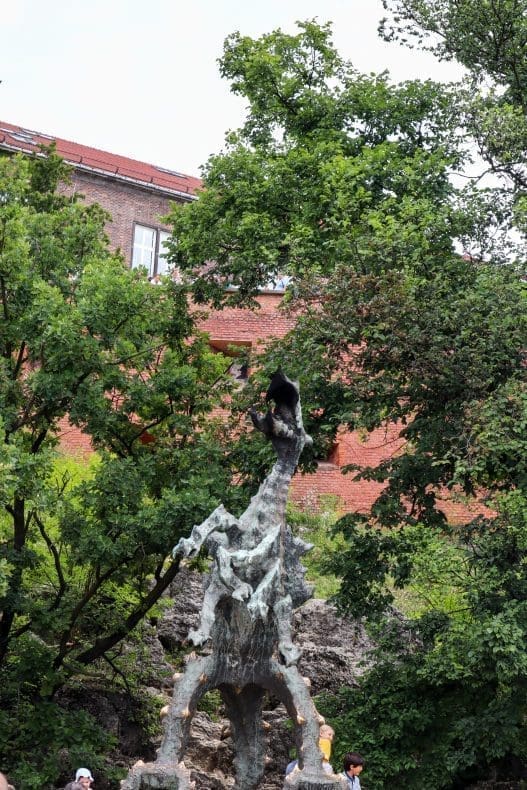
At the cathedral entrance hang a few enormous bones. They’re said to belong to the Wawel dragon, which according to legend lived in a cave under the hill. In reality they belong to prehistoric animals, including a mammoth. Still want to see a dragon? Walk down the river side of the hill, where a bronze dragon breathes fire every few minutes, much to the delight of kids.

#5 Collegium Maius: Poland’s oldest university
Jagiellonian University was founded in 1364, making it the second-oldest university in Central Europe after Prague. Its oldest building is the Collegium Maius, with a Gothic arcaded courtyard you can simply walk into.
The building is now a museum. Copernicus studied here, and so did Karol Wojtyła, the future Pope John Paul II. Marie Curie later tried to get a job here too, but was turned down for being a woman.
#6 The Planty, St Florian’s Gate and the Barbican
Look at a map of Krakow and the Old Town is easy to spot: it’s wrapped in a green ring of parks. That’s the Planty, laid out where the city walls and moat once stood. The park is about four kilometres long, and a loop around it is a nice way to see the Old Town from the outside.
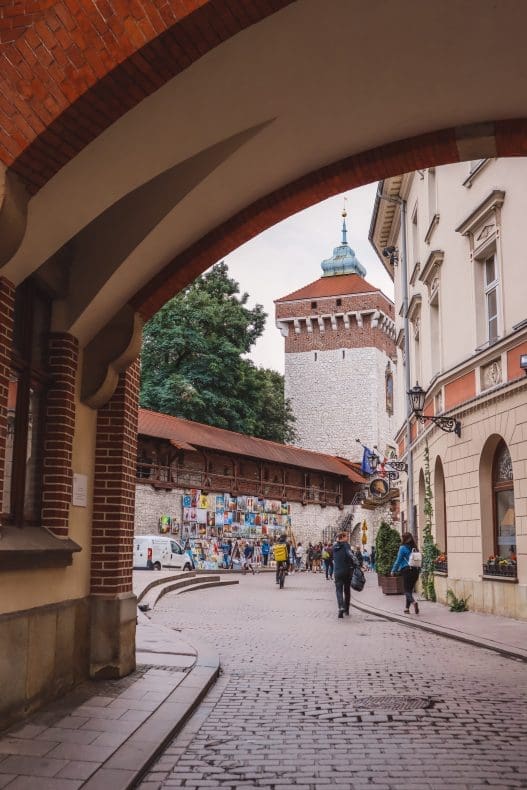
Only a small part of the fortifications survives, on the north side. There you’ll find St Florian’s Gate, with a stretch of wall next to it where artists hang their paintings. Just outside the gate stands the Barbican, a round brick outpost that once guarded the entrance to the city.
Through St Florian’s Gate you walk onto Floriańska street, the old Royal Route that led straight to the Main Market Square and on to Wawel.
#7 The Franciscan Church: art nouveau inside a Gothic church
Krakow has dozens of churches. On the route from the Main Market Square to Wawel alone you’ll pass more than ten. My favourite is the Franciscan Church, Gothic on the outside but full of art nouveau inside.
Around 1900, artist Stanisław Wyspiański covered the walls with large flowers and plants in bright colours. He also designed the stained-glass windows. The window above the entrance, showing God creating the world, is especially striking when the sun shines through it.
#8 Czartoryski Museum: Leonardo da Vinci’s Lady with an Ermine
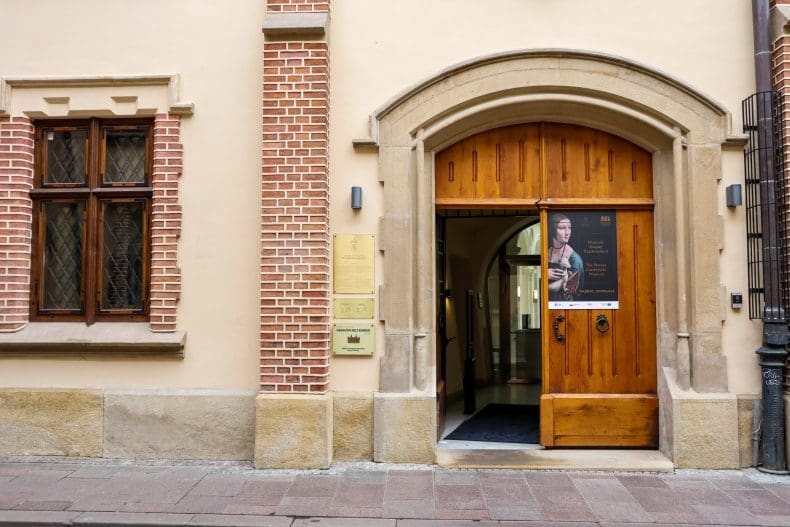
Poland’s most important painting hangs in Krakow. At the Czartoryski Museum you can see the Lady with an Ermine, one of only a handful of portraits Leonardo da Vinci ever painted. The young woman is Cecilia Gallerani, mistress of the Duke of Milan, and the ermine in her arms was his emblem.
The Czartoryski family bought the painting around 1800 and later opened their own museum to show off their art collection. Besides the Leonardo, you’ll find a landscape by Rembrandt, among other things. Tickets are sold in time slots through the National Museum in Krakow. On Tuesdays the permanent collection is free, but that’s also when it’s busiest.
#9 Kazimierz: Krakow’s Jewish quarter
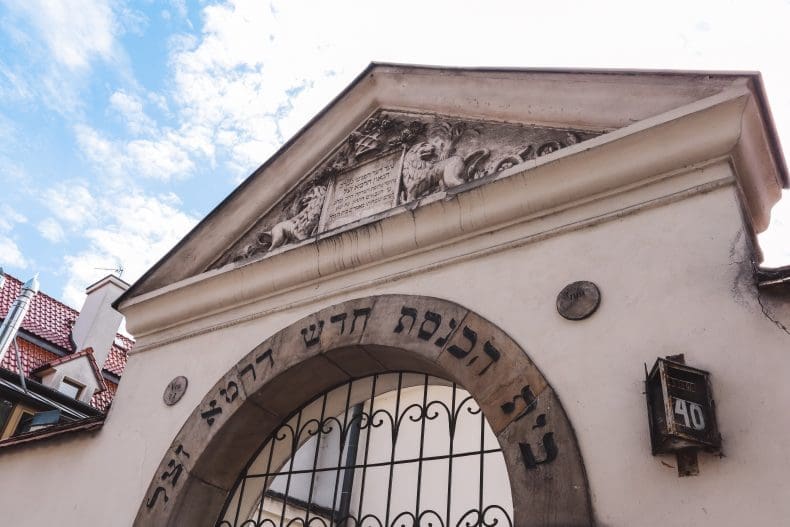
For centuries, Kazimierz was a separate town next to Krakow, with a Christian and a Jewish part. Before the Second World War, tens of thousands of Jews lived here, and the district was full of synagogues, prayer houses and little shops. Krakow’s Jewish community was almost entirely wiped out in the Holocaust, and afterwards the district fell into decline for decades.
These days Kazimierz is my favourite part of the city. The heart of the old Jewish quarter is Szeroka street, a wide square with the Old Synagogue, the Remuh Synagogue and the old Jewish cemetery. The restaurants with Jewish names around the square mainly cater to tourists, as very few Jewish residents live here today.
The district really comes alive with a guide. I joined a free walking tour here, and it was the stories about life in Kazimierz before the war that stuck with me. The guide talked about the different Jewish communities and the tensions between them, something you’d never think about just strolling through the streets. Prefer a fixed time and a small group? A paid guided tour is a good alternative.
→ Book a guided tour of the Kazimierz Jewish quarter
#10 Plac Nowy: zapiekanka and bars in Kazimierz
While the Old Town mostly draws tourists in the evening, locals eat and drink in Kazimierz. On summer weekend nights every terrace is packed, and that’s when the neighbourhood is at its best.
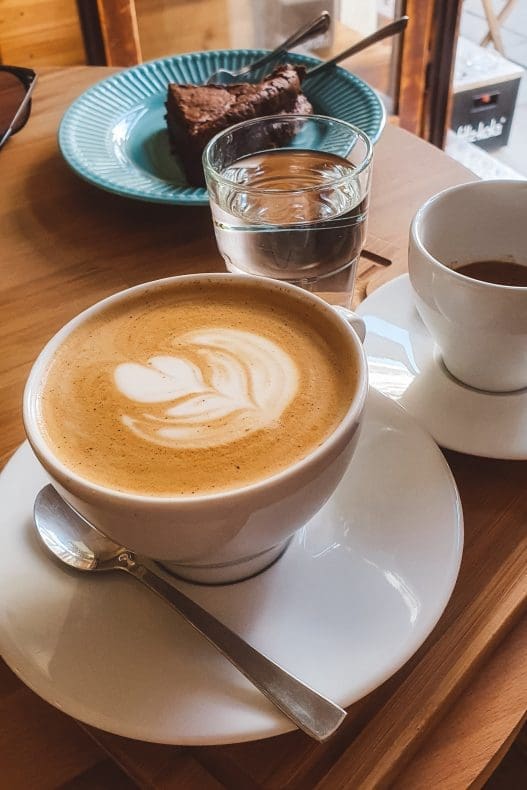
The centre of it all is Plac Nowy, a square with a round building full of food hatches in the middle. This is the place to try a zapiekanka, half a baguette topped with mushrooms, cheese and ketchup and baked in the oven. Fine dining it isn’t, but you have to try one in Poland. As vegetarians, our favourite was Uapami, a fully vegan stall on the square serving seitan burgers and nuggets.
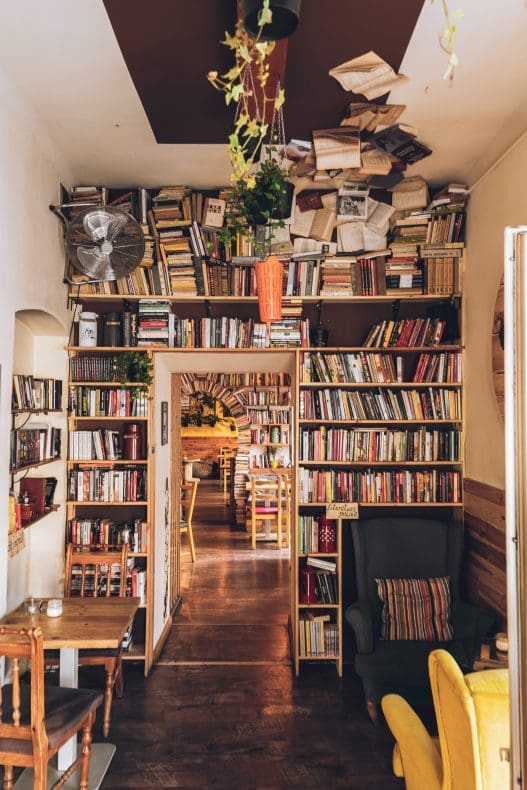
For breakfast and coffee, head to Cytat Cafe, a literary café with bookshelves up to the ceiling. Sebastiaan, our resident coffee lover, tracked down the best coffee bars in the area and ended up at Karma, Knitted Coffee, Coffee Garden, Urban Coffee and Somnium. Fancy a beer? Artefakt Cafe and its little garden are a good shout.
#11 Street art in Kazimierz and Podgórze
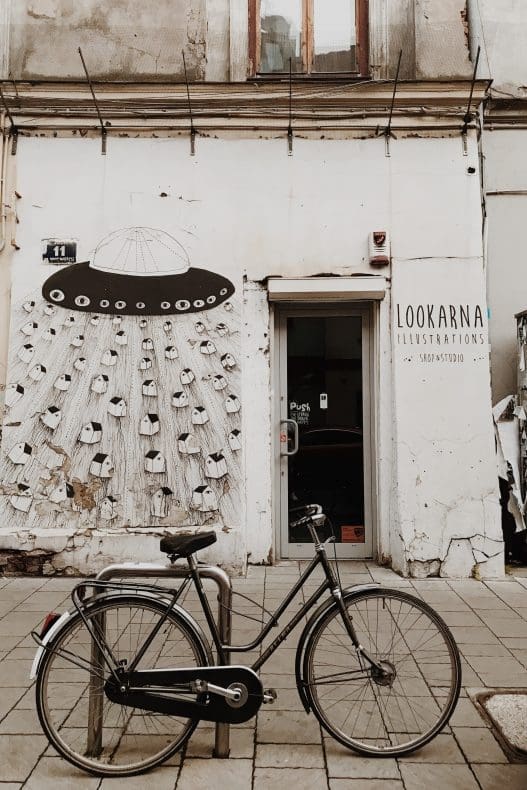
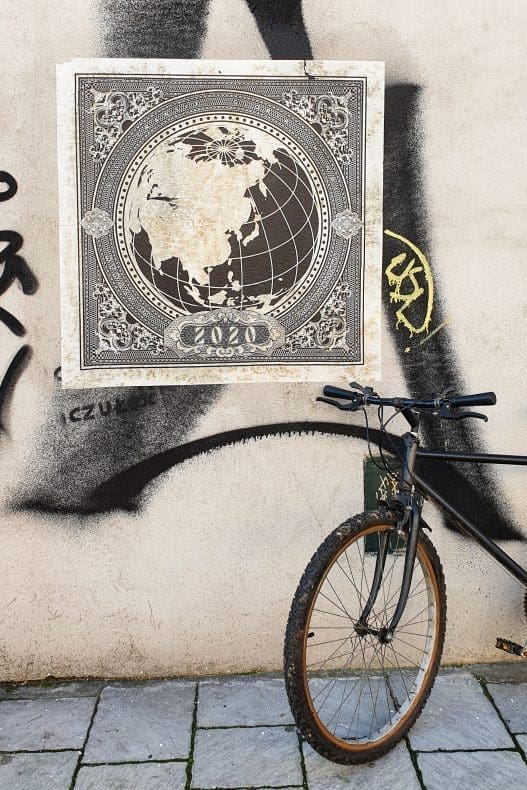
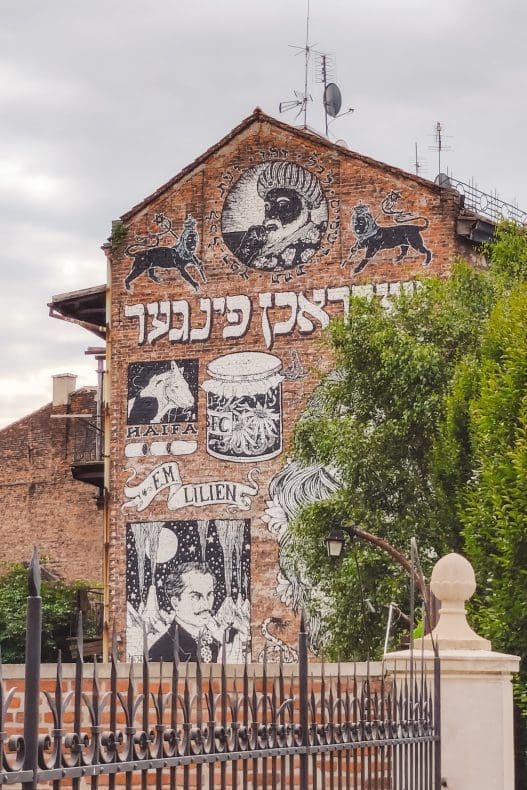
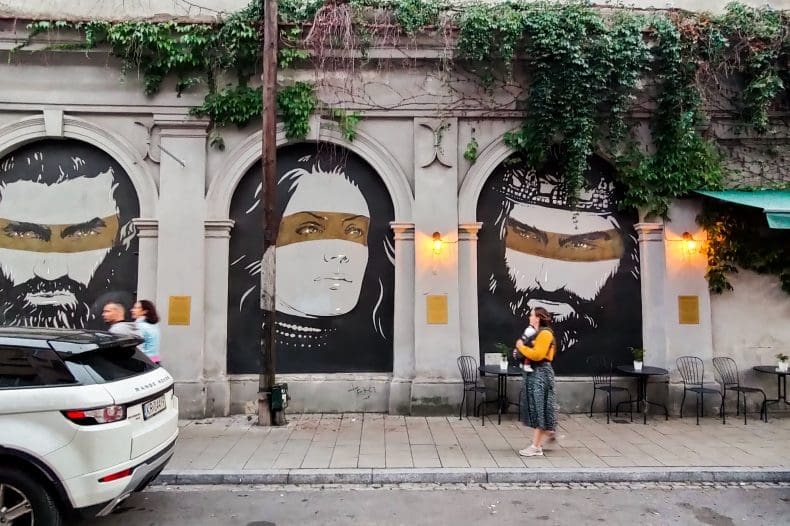
Between the old facades of Kazimierz and Podgórze, murals pop up everywhere. Huge murals cover facades and courtyards, and you don’t even have to look for them.
Józefa street, which runs right through Kazimierz, is the easiest place to start. We loved Ufo by Renata Loj there, and the large portraits of local historical figures by Piotr Janowczyk. The city’s most famous piece is across the river in Podgórze: Ding Dong Dumb by Italian artist Blu, a fierce critique of the Catholic Church. Use this online map to find the best works.
#12 Kładka Ojca Bernatka: Krakow’s prettiest bridge
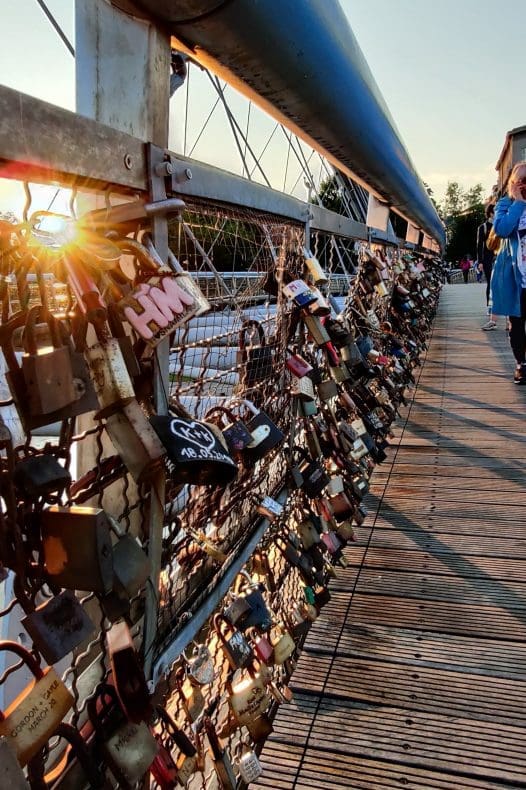
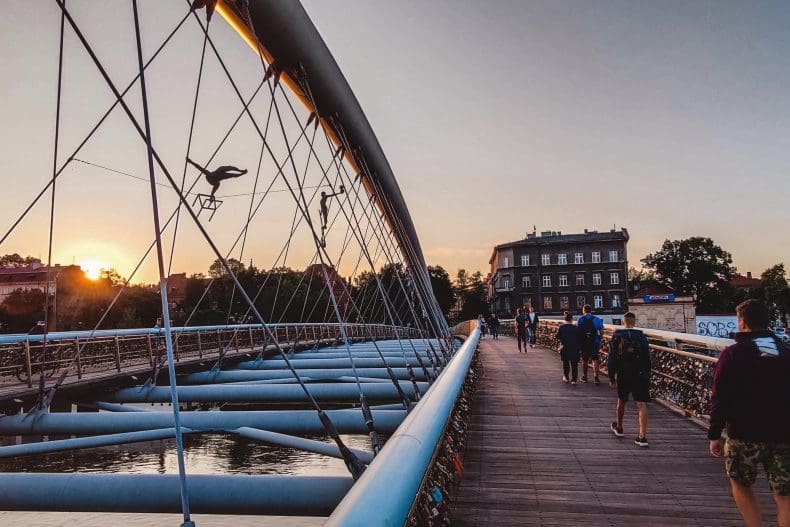
The Kładka Ojca Bernatka is a footbridge and cycle bridge over the Vistula, linking Kazimierz and Podgórze. Like so many bridges in Europe, its railings are covered in love locks. The bridge only dates from 2010, yet parts of the railing are already sagging under the weight.
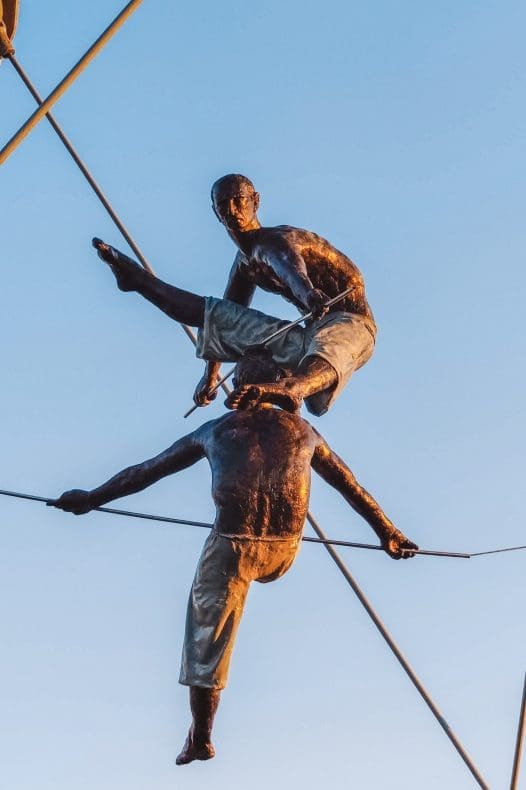
What makes it special are the sculptures between the two walkways. Polish artist Jerzy Kędziora hung tightrope walkers there, balancing on cables. They were meant as a temporary exhibition, but people loved them so much that some of them stayed. When lots of people cross the bridge, the figures gently sway along.
#13 Podgórze: the ghetto and Schindler’s Factory
Cross the bridge and you’re in Podgórze, the district where the Germans set up the Jewish ghetto in 1941. Thanks to the film, many people think the ghetto was in Kazimierz, but it was here, on the other side of the river.
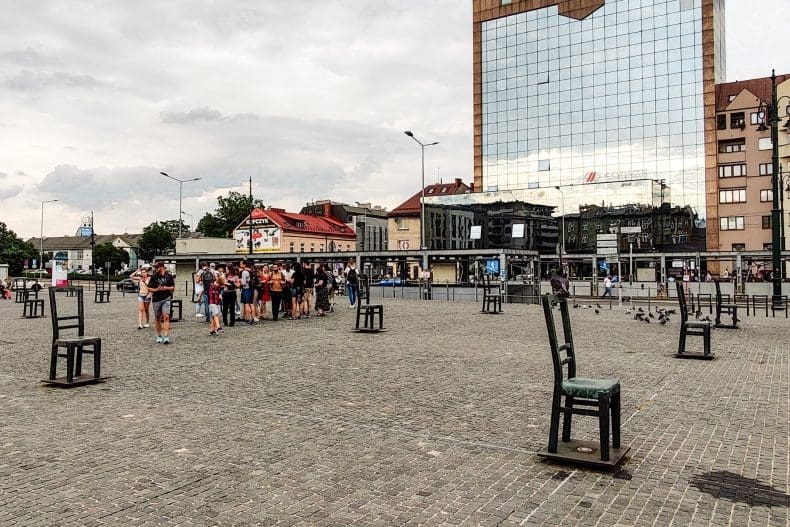
On Ghetto Heroes Square, Plac Bohaterów Getta, dozens of bronze chairs are scattered across the square. They refer to the empty furniture left behind after the last residents of the ghetto were deported. It’s a quiet and moving memorial.
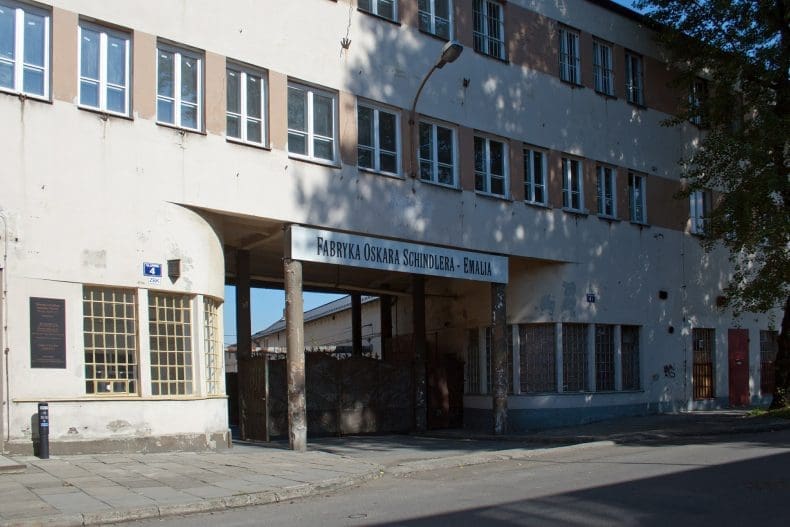
A little further on is Oskar Schindler’s former enamel factory. Schindler saved more than a thousand Jewish workers by putting them on his staff list. The building now houses a museum about Krakow under Nazi occupation, including Schindler’s old office. Want to see the Schindler’s List filming locations too? Most scenes were shot in the courtyards of Kazimierz.
#14 The Krakow mounds
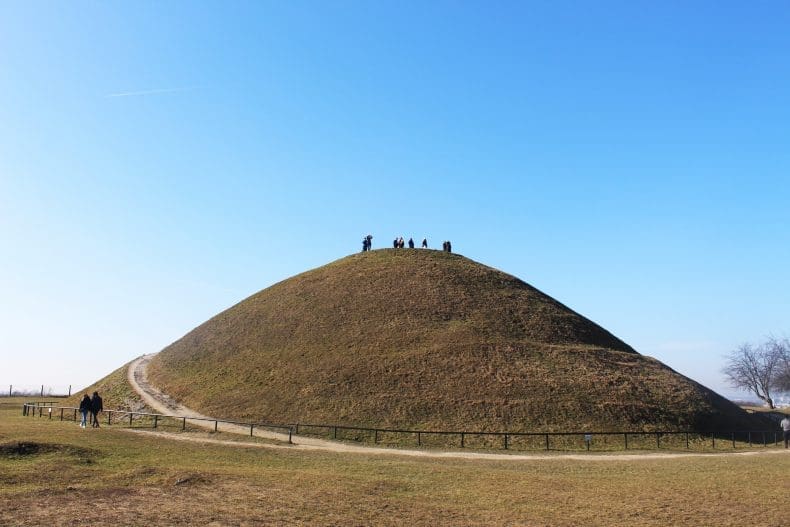
Krakow is surrounded by four large mounds, all raised by hand. Few visitors make it out here, but the views over the city from the top are lovely.
The oldest belong to Krakus, the legendary founder of the city, and Princess Wanda, who according to legend threw herself into the river rather than marry a German prince. Nobody knows exactly how old they are, or whether anyone is really buried inside. The Kościuszko and Piłsudski mounds are much younger, built in honour of Polish freedom fighters. Krakus Mound in Podgórze is especially popular at sunset.
#15 Nowa Huta: the communist model city
Half an hour by tram from the Old Town lies a completely different Krakow. Nowa Huta was built in the 1950s as a model city for the workers of a huge steelworks, with wide avenues, monumental housing blocks and a central square, all by the book of socialist realism.
The irony? The central square is now named after Ronald Reagan. And the remarkable Ark of the Lord church, its walls studded with pebbles, was built by the residents themselves after years of fighting for a church of their own. I went with a guide and found it one of the most interesting trips in Krakow.
→ Discover what to see in Nowa Huta

Day trips from Krakow
Two of Poland’s best-known sites are a short drive from Krakow: the former Auschwitz-Birkenau concentration camp and the Wieliczka Salt Mine. They’re easy to visit on an organised tour, but you can also go on your own by (rental) car or public transport.
#16 Auschwitz-Birkenau
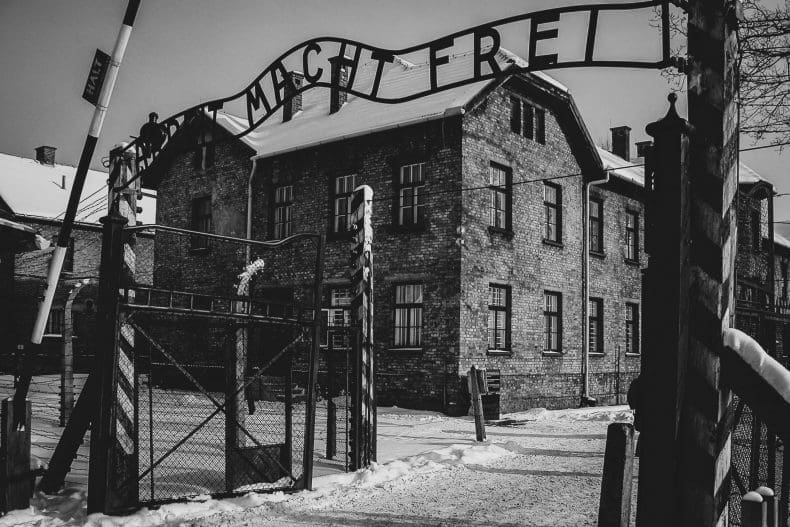
Few people visit Krakow without also going to Auschwitz. The camp lies near the town of Oświęcim, about an hour and a half’s drive away. It was the largest Nazi concentration and extermination camp: of the 1.3 million people deported there, around 1.1 million were murdered.
A visit has two parts. At Auschwitz I, the original camp, you walk through the brick barracks that now house exhibitions. A few kilometres away is Auschwitz II-Birkenau, the vast extermination camp with its infamous gate and railway line.
Entry is free, but you can only get in with an entry pass booked in advance on the official museum website. Without a guide, that’s only possible at certain times, usually at the end of the day. We’d recommend going with a guide. The explanations of what happened at each spot make the difference between walking around and really understanding. A tour from Krakow with transport and a guide is the easiest way to do it.
→ Book a guided tour of Auschwitz-Birkenau from Krakow
#17 Wieliczka Salt Mine
After Auschwitz, the Wieliczka Salt Mine is the most popular day trip from Krakow, and it’s on the UNESCO list too. For centuries, salt was so valuable that the mine was a major source of income for the Polish kings. Commercial salt mining only stopped in 1996.
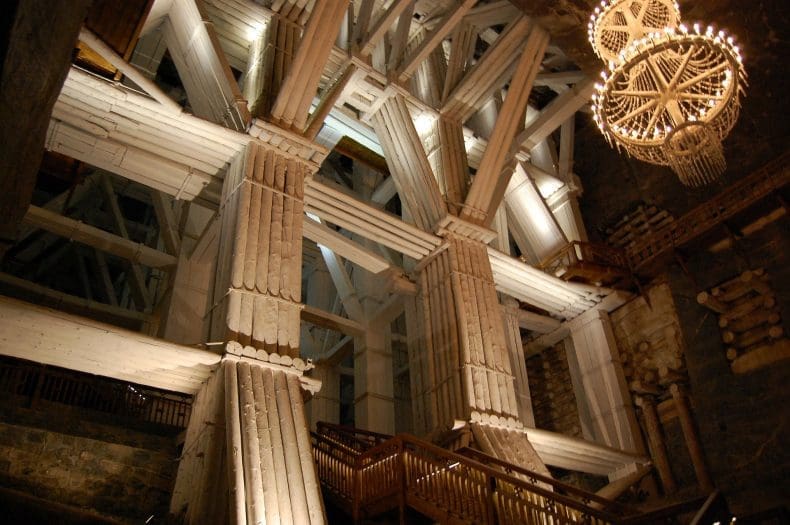
You always visit the mine with a guide. Hundreds of steps take you down to around 135 metres underground, and then you walk about three kilometres through tunnels and chambers and past underground lakes. Everything is carved from salt, from the statues to the chandeliers. The highlight is the Chapel of St Kinga, a vast underground church the miners carved out themselves. Luckily, a lift takes you back up.
Wieliczka is half an hour from Krakow by train or car. Buy tickets on the official salt mine website, or book a tour with transport from the city.
→ Book a tour to the Wieliczka Salt Mine
More tips for your trip to Kraków
 Our pickHotels in Kraków: stay in the Old Town or in our favourite neighbourhood, Kazimierz. Pick your spot on Booking.com
 Head underground near the city: book a Wieliczka Salt Mine tour with fast-track entry on GetYourGuide.
 Prefer everything arranged? Browse Poland tours on TourRadar.
 Kraków is a short flight away. Compare flights to Kraków.
 Discover all our blogs about Poland