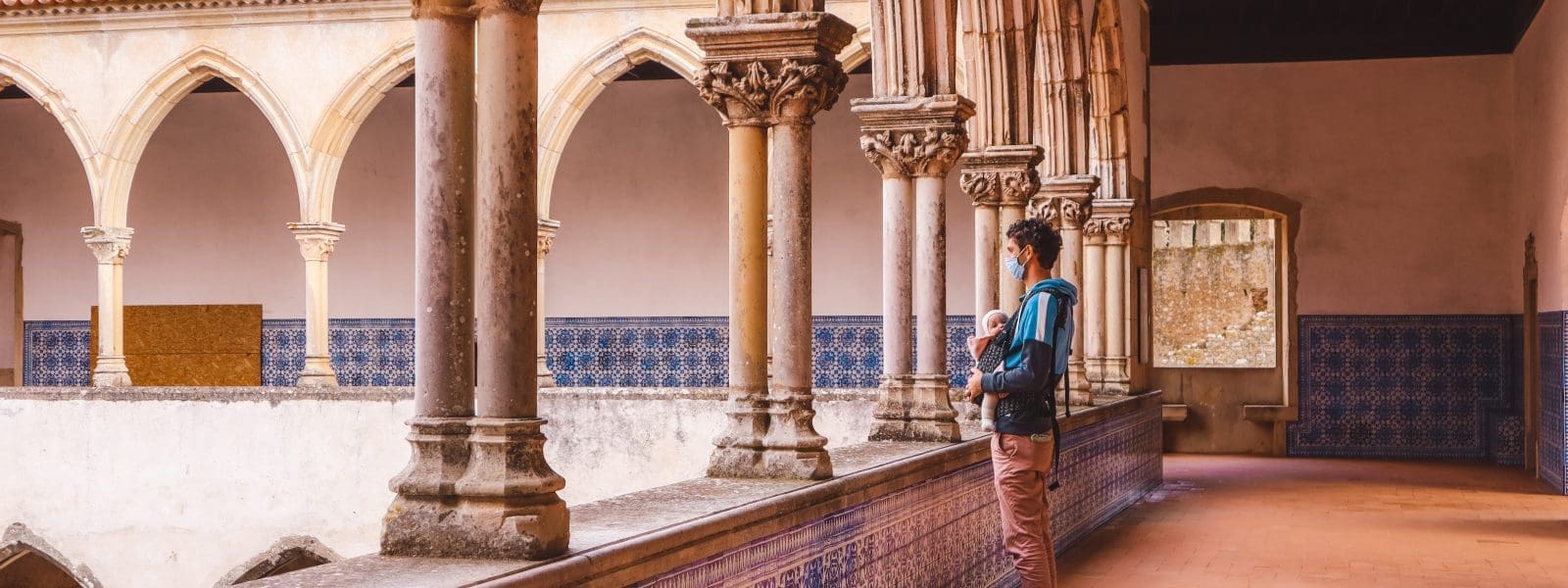
Our visit to the monastery in Tomar, or in full the Convento de Cristo, took us to one of the most impressive places we’ve seen in Portugal. We were blown away by the sheer size of this monastery, church and castle complex, by its unusual mix of styles and by the incredible detail. We’d never seen anything like it, and even after an hour of wandering we kept gaping at yet another cloister. No wonder the complex is on the UNESCO World Heritage list. As far as we’re concerned, the Convento de Cristo belongs on every Portugal itinerary. In this blog we tell you exactly why, share practical tips and show you in photos what kind of splendour awaits.
→ Discover the Monastery of Alcobaça too


Why is the Convento de Cristo in Tomar worth a visit?
We’ve rarely seen a building as unique as the Convento de Cristo. The small town of Tomar lies in the heart of Portugal, south of Porto and north of Lisbon, and is the unlikely home of one of the country’s highlights.
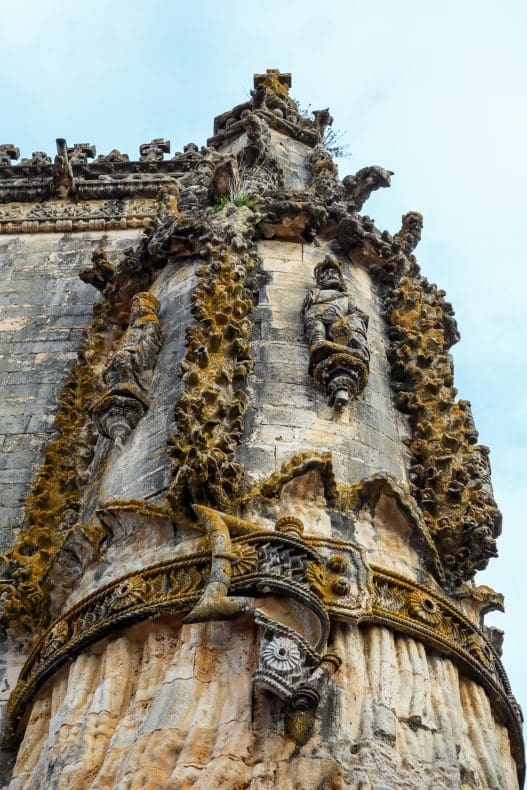
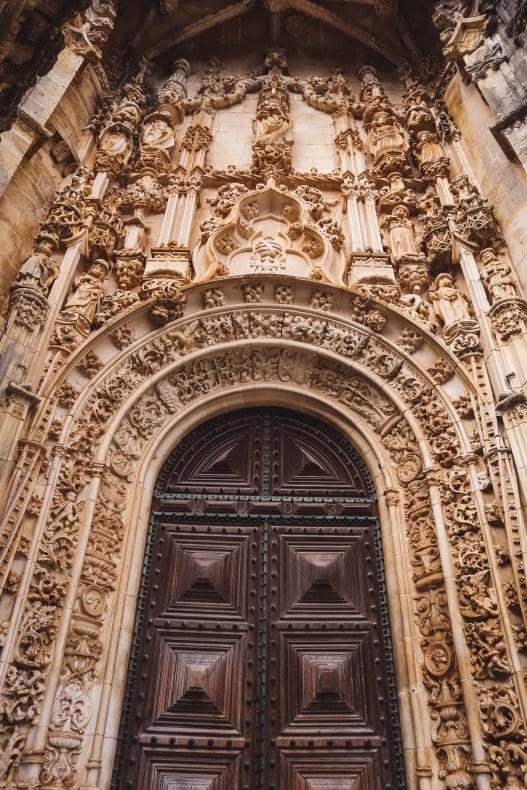
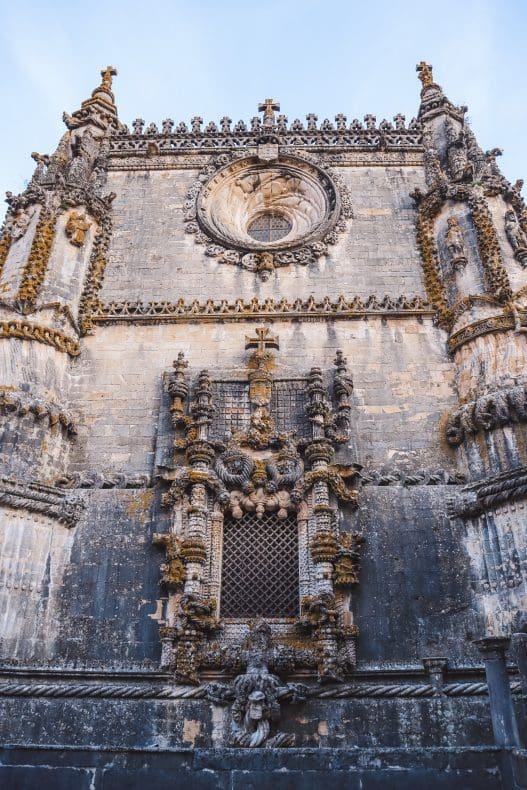
Portugal has its own unique medieval style, and this monastery is one of the best places to see it. We’re talking about the Manueline style, named after King Manuel I, who combined Gothic and Renaissance elements in the buildings he commissioned. As a nod to Portugal’s overseas conquests as a world power, Manueline buildings are full of sea motifs, ropes and coral, plus all kinds of plants and flowers you’d never expect on a classic Gothic building. One of the façades of the central church in Tomar is often called the high point of the Manueline style. Its window is a spectacle of extraordinary details, and we couldn’t stop looking! Look out for the Janela do Capítulo and you’ll see what we mean.
The size of the complex amazed us too. Every time we thought we’d seen it all, we walked into yet another cloister. Over the centuries the complex was extended again and again, each time in the style that was fashionable at that moment, so every part looks different.
The highlight is without doubt the central church, the Charola, and it’s nothing like what you’re used to. It’s round, or rather sixteen-sided, with a round altar of arches, paintings and decorations at its heart. With soaring ceilings, ornaments everywhere and pomp and splendour on every surface, you’ll need a few laps around the altar to take it all in.
Convinced yet? Good! Now for some background, so you can appreciate this architectural masterpiece even more. Because did you know the monastery in Tomar was the headquarters of the mysterious Knights Templar?


A bit of history: the Knights Templar in Tomar
The history of Tomar is inseparable from the Knights Templar. Most of us know them from Dan Brown’s Da Vinci Code, but this order of knights really existed. They protected crusaders and pilgrims and helped free Portugal from Moorish rule, a turning point in Portuguese history. The gratitude was huge, and the Templars were given lots of land and riches, including what is now Tomar.
In the twelfth century the Templars built their castle, church and convent in Tomar, which grew into a magnificent complex and their headquarters. Over the centuries each Grand Master, the head of the order, added something new. In the end the Templars became a little too rich and powerful for the liking of many kings and rulers. In more and more European countries, and even with the Pope’s backing, the knights who had once been so welcome were persecuted, and their wealth was taken over by kings and states.
In Portugal, too, the order was dissolved in the fourteenth century, but the king was still grateful to the Templars for freeing his country. So he came up with a clever solution: he founded the Order of Christ and transferred the Templars’ possessions to this ‘new’ order, with himself as Grand Master. The riches of the Order of Christ then funded Portugal’s voyages of discovery, which kicked off the country’s Golden Age. Happy Templars, happy king: a nice win-win!
Did you know: the old Templars still live on in Portugal, and the current Grand Master of the Order of Christ is the Portuguese president?
That Order of Christ is where the Convento de Cristo gets its name, as the complex was the main stronghold of the Templars and later of the Order of Christ. What started in the twelfth century as a castle, then expanded with a church and convent, grew into a huge complex with ever more cloisters, facilities and galleries. Since 1983 it has been on the UNESCO World Heritage list.
The different parts of the Convento de Cristo
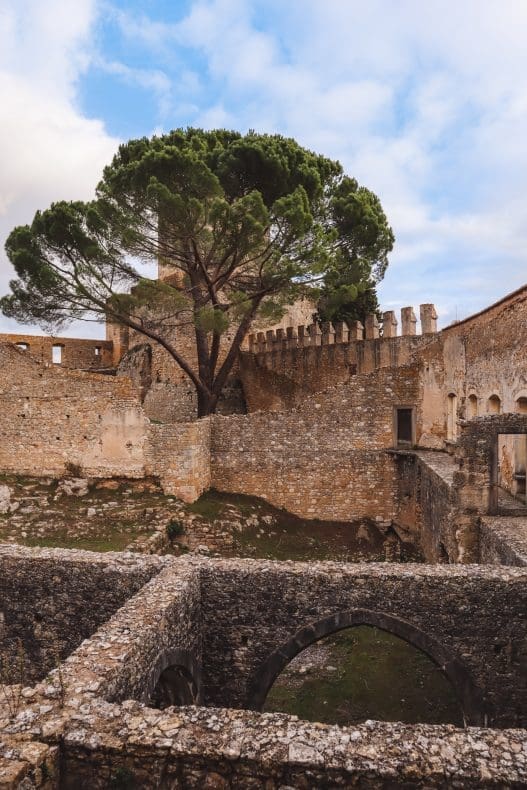
You can see the Convento de Cristo from all over Tomar. High on the hilltop, the old castle walls, complete with classic battlements, are hard to miss. Not much is left of the castle itself, and during your visit you’ll mainly see parts of the high walls and some ruins. The monastery, on the other hand, is remarkably well preserved.
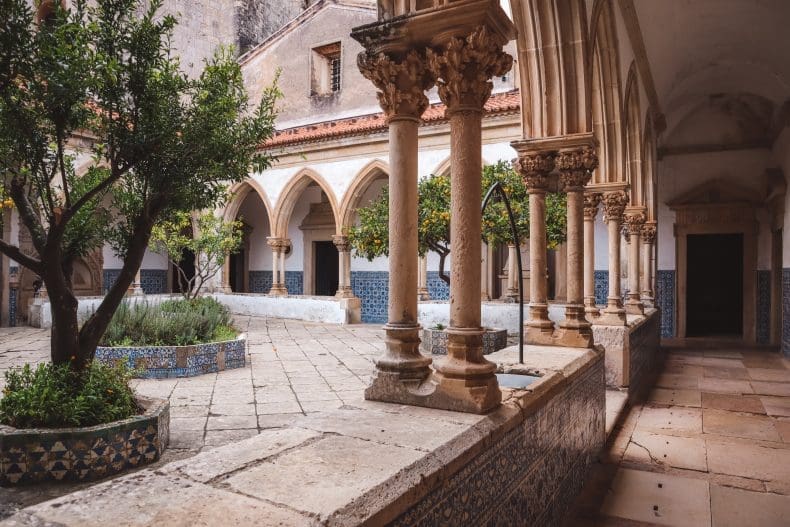
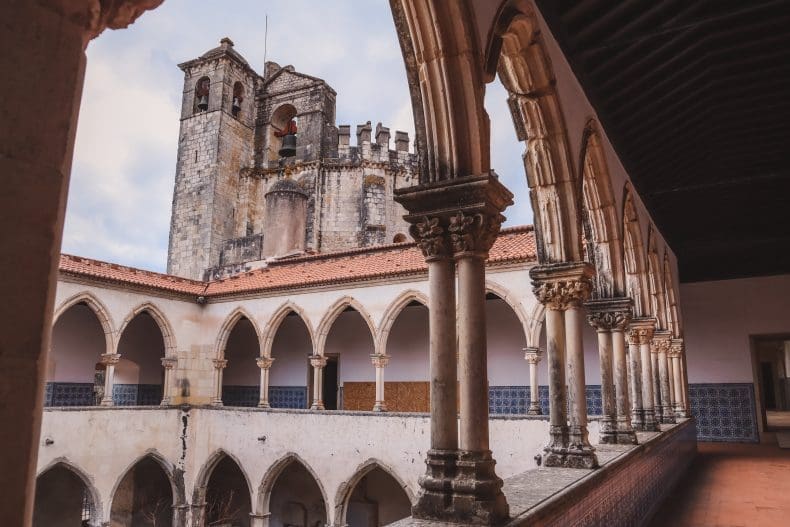
After buying our tickets we walked into the Claustro do Cemitério (Cloister of the Cemetery), where a gallery with sixteenth-century azulejos surrounds a courtyard with citrus trees. A richly decorated tomb holds a brother of the famous explorer Vasco da Gama, the first European to reach India by sea. Next to it lies the Claustro da Lavagem (Washing Cloister), which we thought looked a lot like the first one. As the name suggests, this is where the monks’ clothes were once washed. The tiles and the view of the old castle ruins are the best bits.
Walk back to the Claustro do Cemitério and a few beautiful passageways lead you to the highlight of the monastery: the Charola. Unlike most churches, it isn’t built in the shape of a cross. Its most important part is round, or rather sixteen-sided, supposedly modelled on the Church of the Holy Sepulchre in Jerusalem. The Charola is a colourful, lavishly decorated whole of arches, paintings, gold leaf, statues and more. You walk a loop around it, with the outer wall on your left and the round central altar on your right. Or walk at least two, so you have time to admire the altar, the walls and definitely the ceiling.
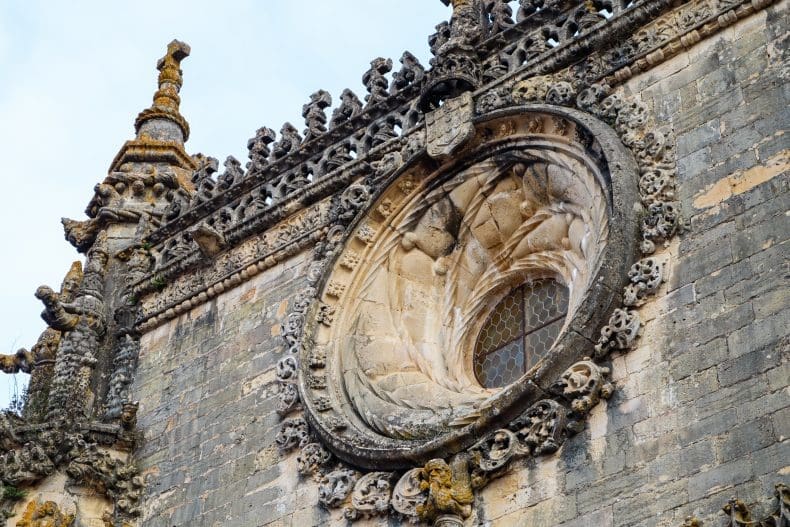
One of the Charola’s highlights is on the outside. The round window you see from inside is even more beautiful from outside and is called the Janela do Capítulo (‘janela’ means window). You get the best view of it later on, from the Claustro Principal or the Claustro de Santa Bárbara. It’s wildly extravagant in the Manueline style, covered in seaweed, coral, the Templar cross, buckles, ropes and more.
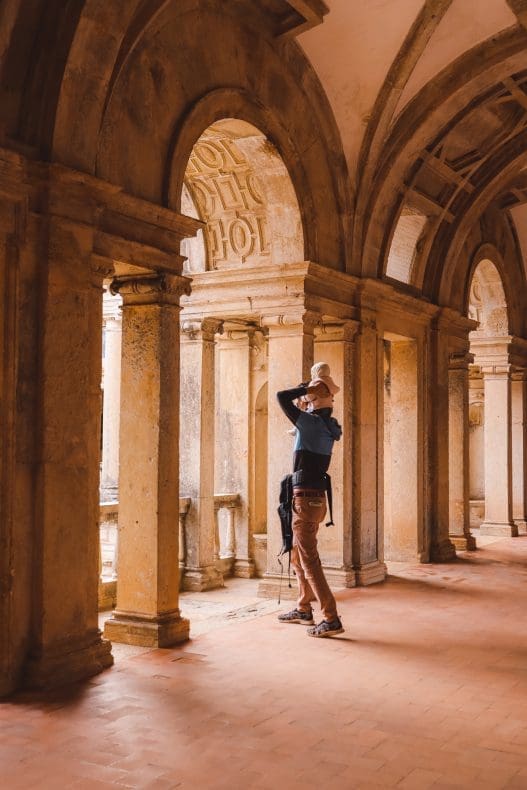
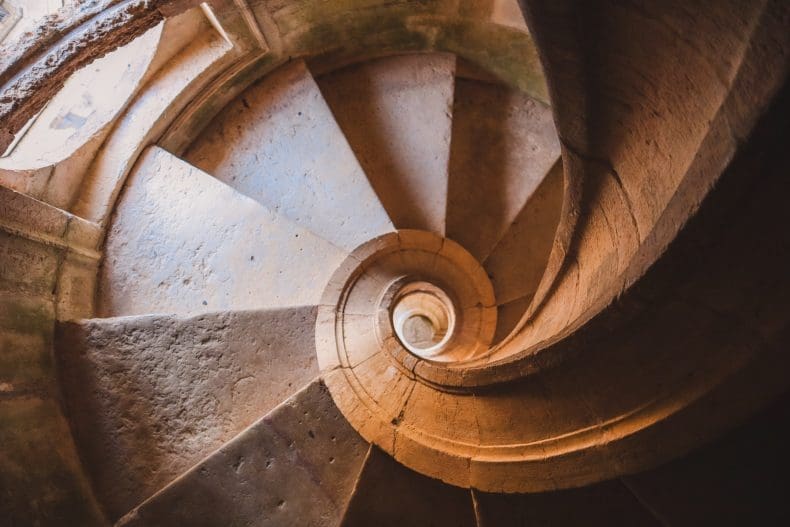
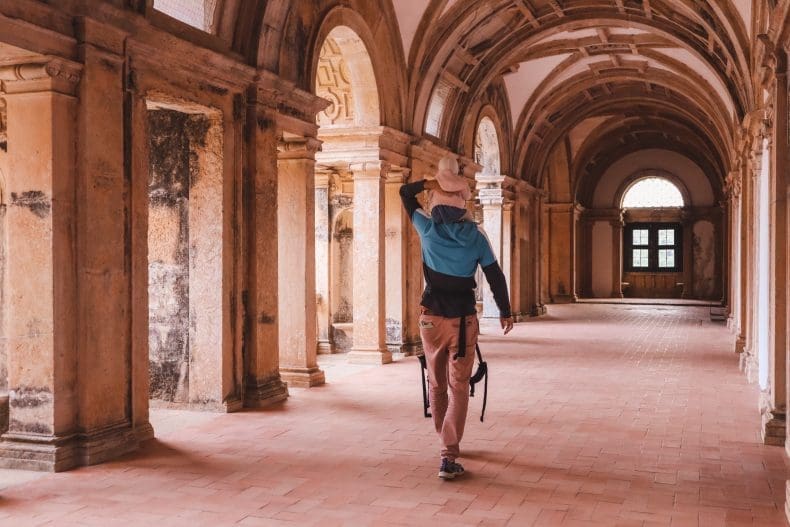
After the Charola you reach the Claustro Principal, or Claustro de Dom João III, built later in the Renaissance style of the sixteenth century. It has two storeys, Greek columns, spiral staircases and a courtyard with a fountain. Next come the monks’ quarters: long corridors of small cells, some of which you can peek into.
Then you continue to the sixteenth-century Claustro de Santa Bárbara (Saint Barbara’s Cloister). It’s not as remarkable as the other cloisters, but it’s the best spot to admire that beautiful window on the west side of the Charola. Thought you were done? There’s still the refectory, the kitchen, the underground cistern and a few less interesting cloisters waiting for you.
Tip: don’t follow the exit signs. The complex is quite a maze, and even with all the signs you’ll sometimes find yourself wandering through corridors and courtyards. If you follow the exit signs, you’ll always take the quickest way out and miss a lot. Follow all the other signs first and only then head for the exit.
Bonus: admire and climb the aqueduct of Tomar
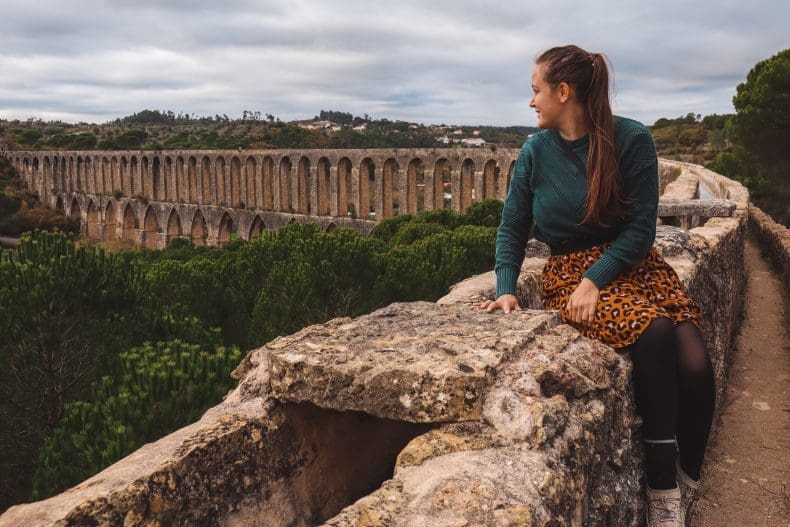
Keep your eyes open during your visit and you’ll spot the aqueduct running towards the monastery from far away. It was built to supply the monks with water and still stands proudly in the landscape around Tomar. It was built between 1593 and 1613 and is six kilometres long in total.
If you have time, go and see the aqueduct in the Pegões Valley. You’ll see signs in Tomar pointing the way to this beautiful stretch, and here’s the exact location on Google Maps. This is where the aqueduct is at its tallest, 30 metres high with a double row of arches. It also makes a bend here, which gives you even better views. This section was declared a National Monument in 1910.
You can climb up at one of the little water houses and walk along the top for a while. Be very careful though: it’s really high, and the path is so narrow that you can barely pass someone coming the other way.
Bonus: visit the Templar castle of Almourol
Still not had enough of the splendour the Templars left behind in this region? Then head to Castelo de Almourol. This photogenic castle sits on a tiny island in the Tagus and can only be reached by boat, and the crossing ticket also gets you into the castle. We admired Almourol from the quay on the riverbank and skipped the boat trip, but even from there it’s a picture.
The island once had a Roman fort and was given to the Templars, fort and all, in 1196. The Grand Master decided to build a large castle on this strategic spot to defend their headquarters in Tomar. When the Templars were dissolved, the castle passed to the new Order of Christ. By then a line of defence was no longer needed, so the castle lost its purpose and fell out of use. Centuries later interest in the building returned, it was restored and eventually opened to visitors.

Practical tips for visiting Tomar and the Convento de Cristo
Where do you buy tickets for the Convento de Cristo?
Want to visit the monasteries of Alcobaça and Batalha as well, like we did? Then ask at the ticket desk about the combined ticket for all three. Otherwise just buy a single ticket at the desk or online in advance.
How much time do you need in Tomar?
Spend at least a full day and a night in Tomar. You’ll need half a day for the Convento de Cristo, and the other half to see the town itself and the aqueduct.
Where to park in Tomar?
You can walk up from Tomar to the castle, but there’s also a (paid) car park next to the monastery. In town you’ll find parking here and along the square in front of the Igreja do Convento de São Francisco.
Our tip: book your rental car through Discover Cars. It compares all the big rental companies in one go, so you can easily find the best deal.
Where to stay in Tomar?
Tomar isn’t very big and there are no large hotel chains here, so finding a nice place to stay takes a little more searching. These are our picks:
For a stylish apartment with a small kitchen, try Flattered to be in Tomar or Arcos 61, both in the heart of town. Just as central is the Thomar Boutique Hotel, one of the more upmarket hotels in Tomar, with beautifully decorated rooms and a generous breakfast. For a pool, a green garden and a spa, go for Hotel Dos Templarios on the riverbank at the north end of the old town.
Tomar also has a nice free motorhome stopover where the town campsite used to be. But for a truly beautiful spot, we recommend parking your camper at Quinta das Lameiras, just outside Tomar. You can use electricity, toilets and hot showers in exchange for a voluntary donation. We woke up here among the sheep and newborn lambs.
More tips for your trip to Tomar
 Our pickStaying the night in Tomar? Browse all hotels in Tomar on Booking.com
 Portugal was made for road trips. Rent a car at Lisbon, Porto or Faro airport with Discover Cars and compare the big rental companies in one go.
 Fancy doing it by camper, like we did? Rent a campervan in Portugal with Campervan Planet.
 Prefer everything arranged? Browse Portugal tours on TourRadar.
 No flight yet? Compare flights to Lisbon or Porto.
 Rather not drive yourself? Join a day trip from Lisbon to Fátima, Batalha, Nazaré and Óbidos on GetYourGuide.
 Discover all our blogs about Portugal


