
The small town of Alcobaça is home to one of Portugal’s great UNESCO wonders: the Monastery of Alcobaça, a vast complex of cloisters, churches and courtyards. It lies not far from the coast between Porto and Lisbon, so it slots perfectly into a road trip along the Portuguese coast. The monastery is famous for the tragic love story of a crown prince and the woman he loved, and it impresses with its architecture, its gigantic kitchen, its quirky details and even a stream running right through it. In this blog we share everything you need to know before visiting the Monastery of Alcobaça.
Where to stay in Alcobaça?
Alcobaça is a small town and most visitors only come for the monastery. Still, staying a night makes sense if you also want to see Nazaré, Batalha and Óbidos, as everything is close by. Nazaré and Batalha are fifteen to twenty minutes’ drive away, Óbidos just over half an hour. These are our picks:
#1 Montebelo Mosteiro de Alcobaça Historic Hotel occupies a wing of the monastery itself, turned into a sleek hotel around an old cloister by architect Eduardo Souto de Moura. The indoor pool among the centuries-old stone columns is an experience in itself, and the monastery is literally round the corner.
#2 Challet Fonte Nova is a nineteenth-century mansion in a leafy garden, a few minutes’ walk from the monastery. With parquet floors, classic furniture and hand-painted tiles it feels like staying with a grand Portuguese family, and with only eight rooms it stays nice and small.
#3 Vale d’Azenha Hotel Rural & Residences is out in the countryside, ten minutes’ drive from Alcobaça, and our pick for families. There are family rooms and spacious residences, an outdoor pool with a children’s pool and wide views over the green hills towards the coast.


The tragic love story of Pedro and Inês
One of Portugal’s kings lies buried in the monastery church of Alcobaça together with his beloved, and their tragic love story is forever tied to this town.
When King Pedro I was still crown prince, he was married to Princess Constance of Castile. Their parents had arranged the marriage, so true love didn’t really come into it. Pedro did find love in the end, but with Constance’s lady-in-waiting and cousin, Inês de Castro. For years he had an affair with Inês, and they had four children together.
When Constance died in childbirth with her third child in 1345, Pedro’s father started to feel the heat. King Afonso IV was terrified that his son’s mistress would gain even more influence and meddle in Portuguese politics, so he had Inês murdered. Too late, according to Pedro, who claimed they had already married in secret. Once he became king, Pedro had his love crowned queen after her death and built her an extravagant tomb in the church of Alcobaça. He reserved a spot for himself as well, so they would be together for ever.


The Mosteiro de Santa Maria de Alcobaça
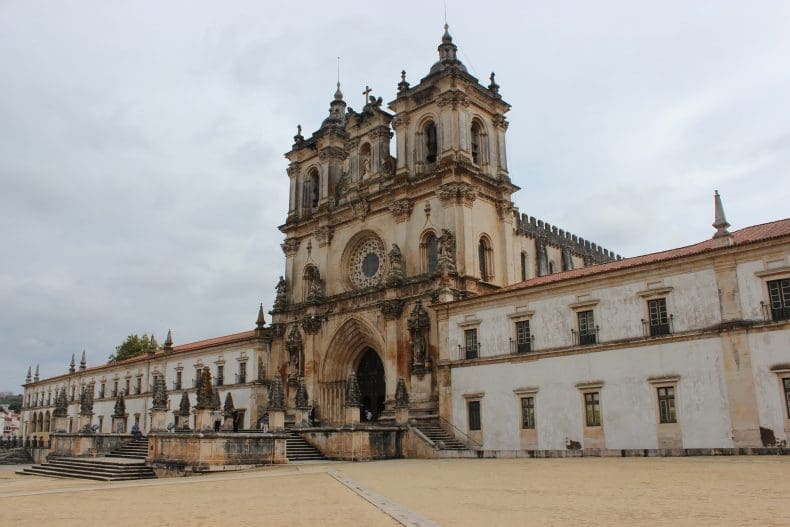
Alcobaça is often described as a pretty, historic town, but any visitor will admit that a trip here is all about one architectural wonder: the Monastery of Alcobaça, or in full, the Mosteiro de Santa Maria de Alcobaça.
The monastery church is free to enter and is an impressively tall hall with a forest of columns. The ceiling and columns are plain, especially compared to other parts of the monastery, but that simplicity combined with the height is exactly what makes it so striking. The nave is 106 metres long and only 23 metres wide, which makes it feel even taller. Looking for pomp and splendour? Then head to the tombs of the lovers Pedro and Inês. Inês’s tomb rests on creatures said to represent her murderers, and it bears the inscription Até o fim do mundo (Until the end of the world).

The monastery church is free to visit. For the cloisters, the dormitory, the kitchen and the rest of the monastery you need a ticket. We visited the monasteries of Alcobaça, Batalha and Tomar on the same trip. Planning the same? Ask at the ticket desk about the combined ticket for all three.
The monastery was founded in the twelfth century by Portugal’s first king, Afonso I, who had promised to build it if he won an important battle against the Moors. He didn’t do things by halves: he kept his promise with a monumental Gothic monastery that grew into one of the richest and most powerful monasteries in Portugal.

You soon realise how many monks lived here, especially in the spectacular kitchen. We were blown away by the enormous oven with its towering chimney, covered in blue and white azulejos and held up by cast-iron columns. This is clearly where hundreds of mouths were fed. Even stranger is the water basin in the floor, where live fish were once kept so dinner could be served as fresh as it gets.
And where did all that water come from? A channel dug from the river that flows past Alcobaça ran right through the monastery, so the monks always had enough water and the fish pond in the kitchen never ran dry. A fun legend says the refectory has a very narrow door in its side wall. Monks who had enjoyed a few too many treats from the kitchen and no longer fitted through it couldn’t get into the dining hall, and simply had to fast.
The cloister was added by King Dinis I in the fourteenth century. It originally had one storey, but in the sixteenth century a second one was built on top in the Manueline style, an exuberant style named after King Manuel I. So do head upstairs and look out for all the odd details, such as gargoyles shaped like a pig or a monkey, beautifully carved window columns and motifs of birds, grapes and ropes.

In the eighteenth century another cloister was added and the church was restored in the then fashionable baroque style, which you can see best in the beautiful façade. In 1811 Napoleon’s troops invaded Portugal and looted the Monastery of Alcobaça, among others. You can still see the damage on Inês’s tomb, and the monastery library suffered too. Nothing of it remains today, but it was once the largest library in the country. In 1834 Portugal’s monasteries were dissolved so the state could take over their property, and the monks left the building.
The monastery was added to the UNESCO World Heritage list in 1989. In 2007 it was also voted one of the Seven Wonders of Portugal in a national poll.
More tips for your trip to Alcobaça
 Our pickStaying the night in Alcobaça? Browse all hotels in Alcobaça on Booking.com
 Portugal was made for road trips. Rent a car at Lisbon, Porto or Faro airport with Discover Cars and compare the big rental companies in one go.
 Fancy doing it by camper, like we did? Rent a campervan in Portugal with Campervan Planet.
 Prefer everything arranged? Browse Portugal tours on TourRadar.
 No flight yet? Compare flights to Lisbon or Porto.
 Rather not drive yourself? Join a day trip from Lisbon to Fátima, Batalha, Nazaré and Óbidos on GetYourGuide.
 Discover all our blogs about Portugal


