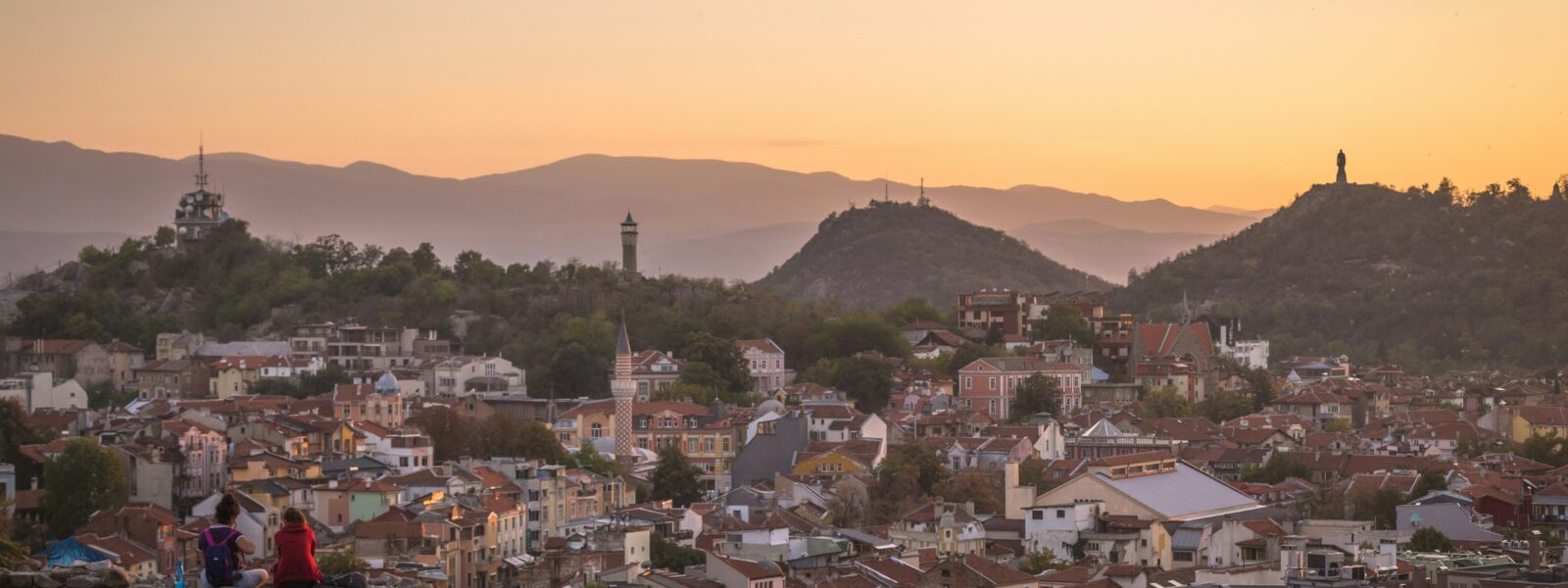
Colourful merchant houses, a Roman theatre that’s almost 2,000 years old and a maze of little streets full of street art and coffee bars, all within walking distance of each other. Welcome to Plovdiv!
Plovdiv is one of the oldest continuously inhabited cities in Europe, and it doesn’t let you forget it. Up in the Old Town, you walk on cobblestones worn smooth over centuries, past ornate mansions, ancient city gates and Roman ruins that pop up between the houses. Down the hill, the Kapana district swaps history for street art, small boutiques and lively terraces.
We stopped in Plovdiv during our road trip through Bulgaria, and it turned out to be one of the highlights of our trip. The pace is relaxed, there’s more to see than you’d expect, and it’s an easy city to explore with young kids. Below, you’ll find our favourite things to do in Plovdiv, where to stay and practical tips for your visit.
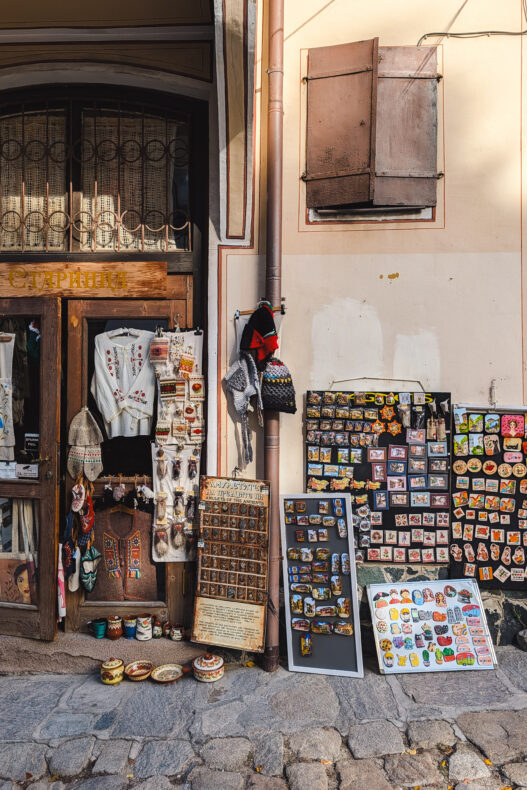
What is Plovdiv known for?
Plovdiv is best known for its age. People have lived here for thousands of years, which makes it one of the oldest cities in Europe. Today, that history comes with a beautifully preserved Old Town, Roman ruins in the middle of the shopping streets and a creative quarter that gives the city a young, artsy feel.
Every era left something behind. The Thracians were here first, followed by the Macedonians, Romans, Byzantines and Ottomans. The Romans built a huge stadium and a theatre that you can still visit today, while the Ottomans left a grand mosque right in the centre.
The real showstoppers, though, are the merchant houses in the Old Town. Most were built in the 18th and 19th centuries by traders who had made their fortune and wanted everyone to know it: think wooden bay windows, painted façades and rooms decorated from floor to ceiling. Stroll through the narrow cobbled lanes and it’s easy to imagine you’ve slipped back a couple of centuries.
And then there’s modern Plovdiv. In Kapana, old workshops have been turned into coffee bars, galleries and restaurants, and the walls are covered in street art. That mix of old and new helped Plovdiv become European Capital of Culture in 2019.
Is Plovdiv worth visiting?
Short answer: yes! To be fair, we only saw a small part of Bulgaria, so we can’t tell you how Plovdiv compares to the rest of the country. But the city won us over pretty quickly. Where else do you walk from a Roman theatre to a 15th-century mosque and a street-art-covered coffee bar in just a few minutes? The centre is compact, many sights are free to admire from the outside and the atmosphere is relaxed. Add a day trip to Bachkovo Monastery and you’ve easily got enough for two or three unhurried days.
Practical tips for visiting Plovdiv
How many days do you need in Plovdiv? We’d give it at least two days. The sights are close together, so you can tick off the highlights in one busy day, but Plovdiv is at its best when you slow down. Wander the lanes, pop into a merchant house or two and leave time for a long coffee in Kapana. With an extra day, the half-hour drive to Bachkovo Monastery is well worth it.
How do you get to Plovdiv? Plovdiv lies in southern Bulgaria, about 150 kilometres from Sofia. Most international flights land in Sofia, and from there it’s roughly one and a half to two hours by rental car. Buses and trains run between the two cities too, but expect the journey to take two to three hours. Plovdiv does have its own airport, though only a handful of airlines fly there.
We did it the long way and drove all the way from the Netherlands, a road trip of more than 2,000 kilometres! If you’re driving too, buy an electronic vignette before you hit the Bulgarian roads. You need one for most cars and light campervans on national roads and motorways, and it only takes a few minutes on the official BG Toll website.
Parking in Plovdiv takes a little planning. The Old Town is a tangle of steep, narrow cobbled streets and largely closed to traffic, so don’t even try to drive in. Park outside the historic centre and explore on foot instead. Everything worth seeing is close together, so you won’t miss the car.
Good to know: Bulgaria is in the EU, has been a full Schengen member since 2025 and switched to the euro on 1 January 2026. So if you’re coming from another eurozone country, there’s no money to exchange, and paying by card is easy in most places.
Where to stay in Plovdiv
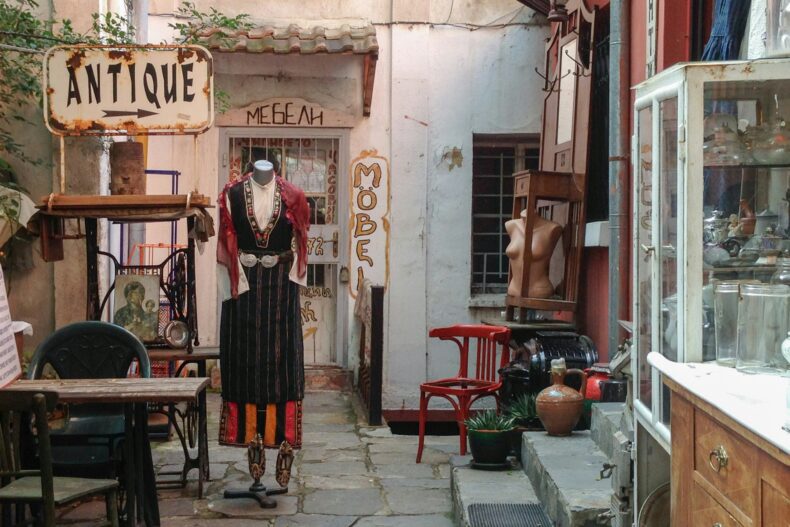
We’d stay in the Old Town or in Kapana. The Old Town puts you right among the historic houses, while Kapana is the place to be for coffee, food and an evening buzz. There’s plenty of choice, from restored merchant houses to a hotel built over Roman ruins. These are our picks:
#1 Villa Flavia Heritage Boutique Hotel lets you sleep above actual Roman baths. They were discovered during construction and carefully preserved, while the rooms upstairs are modern and stylish. The Roman Theatre is just around the corner.
#2 HillHouse Plovdiv puts you right among the merchant houses of the Old Town. Rooms are bright and comfortable, breakfast sets you up for a day of exploring and there are family rooms too. After a day of sightseeing, the courtyard is the perfect place to put your feet up.
#3 Hotel Evmolpia is the one to book if you want to soak up the atmosphere of old Plovdiv. This small hotel is set in a traditional Bulgarian house full of wooden furniture and antique details. The bonus? Guests are treated to a wine and cheese tasting!
#4 Art Boutique Hotel Gallery 37 is for when you fancy a bit of luxury. Think bold wallpaper, warm colours and elegant details, plus a small terrace tucked between ancient stone walls that’s perfect for an evening drink. The Roman Theatre and the Old Town are literally around the corner.
#5 VIZUALIZA Residence Hotel hides a sleek, modern interior behind a grand historic façade. Expect stylish rooms with high ceilings and a restaurant that’s worth staying in for. It’s close to Kapana and the main shopping street, so you’re right in the thick of things.
Best things to do in Plovdiv: our 13 highlights
#1 Old Town: painted houses and cobbled lanes
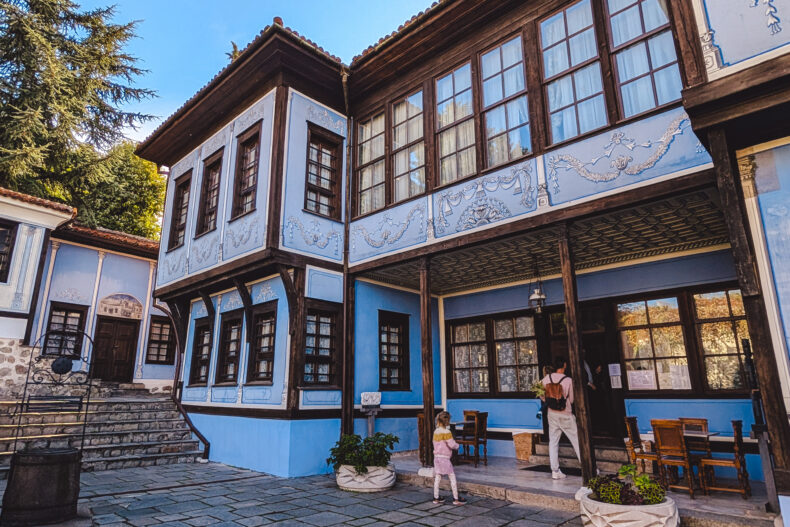
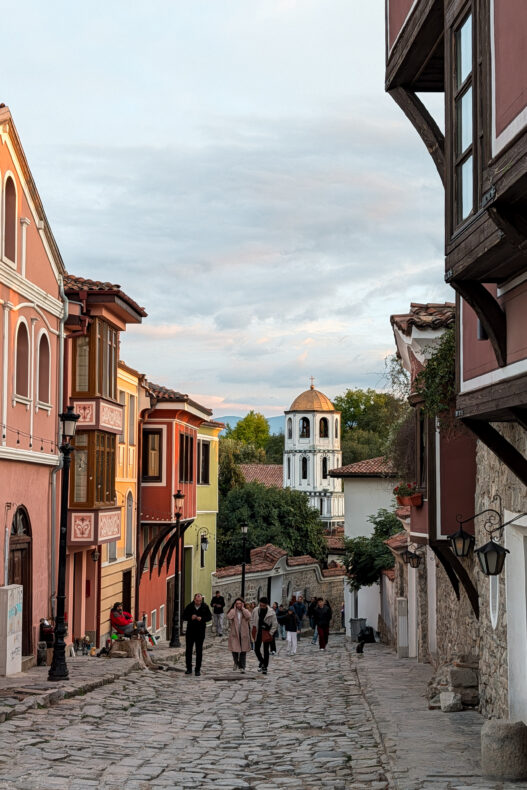
If you only have time for one thing in Plovdiv, make it the Old Town. This is the city’s historic heart, a hilly maze of cobbled lanes lined with merchant houses painted in every shade you can think of. Wooden bay windows lean out over the street, and many of the grandest mansions are now museums.
Most of these houses date from the Bulgarian National Revival in the 18th and 19th centuries, when Plovdiv was booming as a trading town. You’ll quickly start recognising the style: upper floors that jut out further than the ground floor, painted façades and lavishly decorated interiors. Many have been carefully restored, which is exactly why the Old Town is so photogenic.
What makes it special is how much history is squeezed in between the houses. Turn a corner and you’ll find a Roman ruin, an Orthodox church or an old city gate. Just bring comfortable shoes, because the cobblestones are uneven and some lanes are steep. We learned the hard way that it’s no place for a pushchair, but kids will love exploring.
#2 Nebet Tepe: ancient ruins with views over Plovdiv
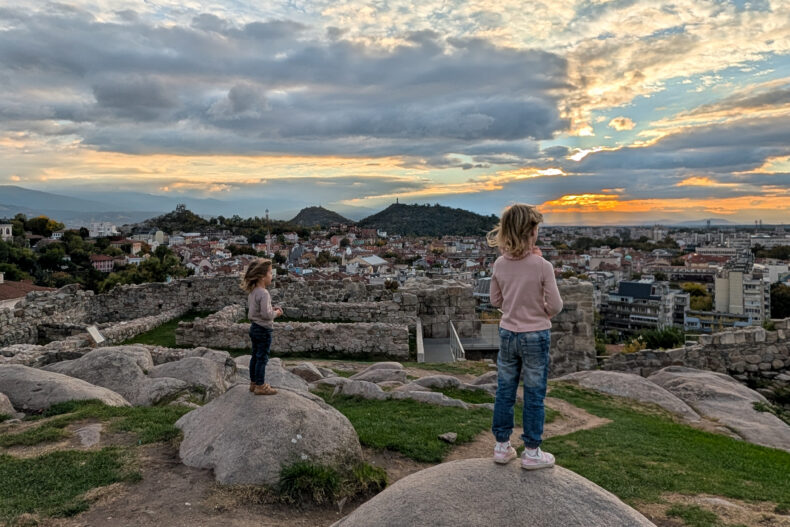
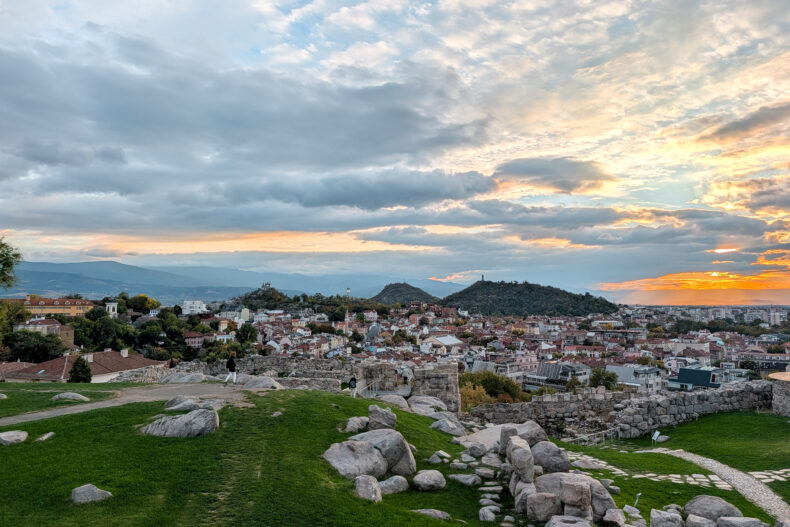
On the edge of the Old Town, Nebet Tepe is one of the hills Plovdiv was built on, and the place to go for views. From up here, you look out over red-tiled roofs, the surrounding hills and the modern city beyond. Come in the late afternoon, when the sun starts to drop and the light softens.
It’s also where Plovdiv’s story began. The Thracians built a fortified settlement on this hill thousands of years ago, and the Macedonians, Romans and Byzantines all made use of it after them. You can still see fragments of fortress walls, towers and other structures from different periods, and the restored sections help you picture what the fortress once looked like.
Nebet Tepe is free and an easy walk from the Old Town, which makes it a nice way to round off your walk. Kids can scramble around the old stones, but keep a close eye on them near the high walls and steep drops.
#3 Hisar Kapia: Plovdiv’s most beautiful city gate
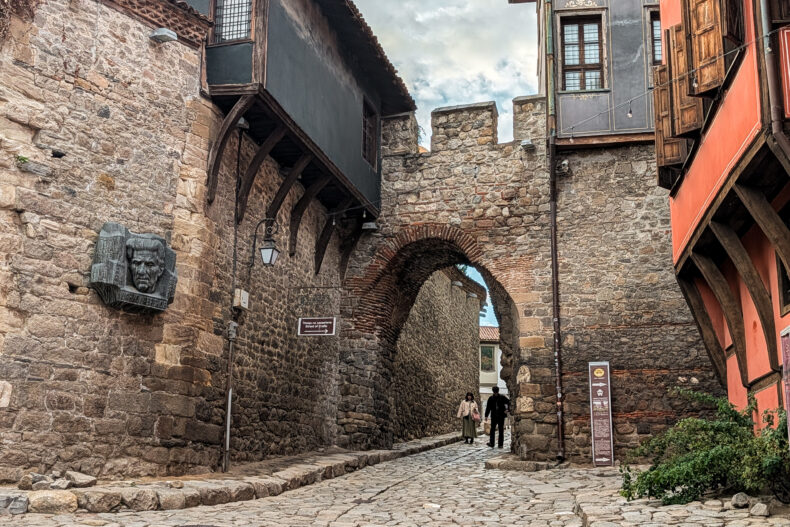
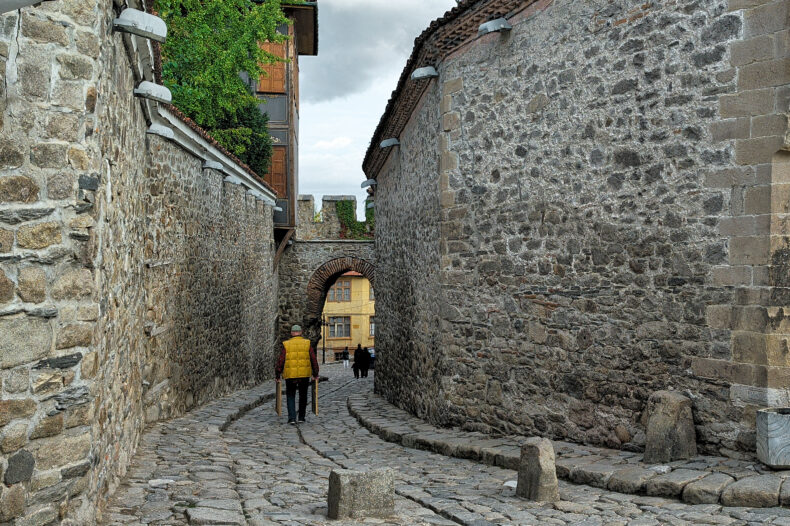
Hisar Kapia is one of the most photographed spots in Plovdiv, and once you see it, you’ll understand why. On one side of this old stone gate, merchant houses with wooden bay windows crowd in so closely that they seem to lean against each other. On the other side, you approach between thick, monumental walls.
The gate goes back to Roman times, when Plovdiv was called Philippopolis, and was one of the entrances through the city walls. What you see today is largely medieval, while the houses around it were added much later, during the National Revival. Centuries of history stacked on top of each other: that’s Plovdiv in a nutshell.
Right next to the gate stands the Church of Saints Constantine and Helena, one of the oldest Christian sites in the city, and the Ethnographic Museum is only a few steps away.
#4 Hindliyan House: step inside a merchant’s mansion
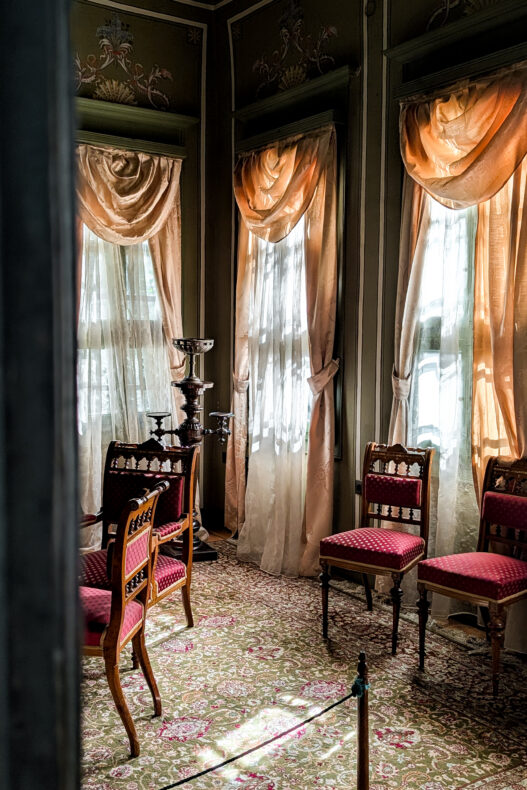
After admiring all those merchant houses from the outside, you’ll probably want to see what they look like inside. Several have been turned into museums, and we picked Hindliyan House, one of the most richly decorated in Plovdiv.
It was built in 1835 for Stepan Hindliyan, a wealthy merchant with trading contacts far beyond Bulgaria, and he clearly wasn’t shy about showing it. The walls and ceilings are covered in paintings, the furniture is elegant and every room is bursting with colour. Look out for the murals of Venice, Constantinople and Alexandria, a nod to the merchant’s international trading world. The historic bathroom, with marble details and a clever heating system, is fascinating too.
Hindliyan House isn’t your only option. Balabanov House is known for its architecture and art exhibitions, while Nedkovich House gives you a glimpse into the daily life of a wealthy 19th-century family. Only have time for one? We’d go for Hindliyan House.
#5 Street of Crafts: traditional crafts in Plovdiv
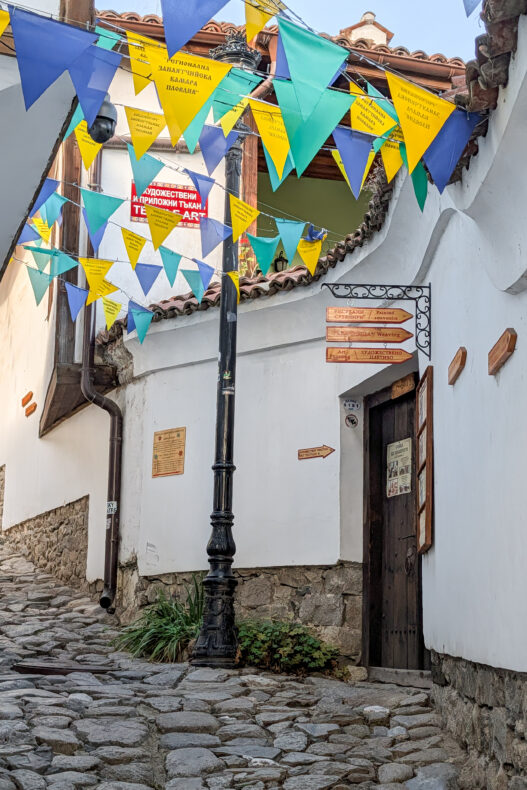
Tucked between the merchant houses of the Old Town, the Street of Crafts (also known as Stramna Street) makes a nice break from the big sights. Instead of monuments, you’ll find small workshops where traditional crafts are kept alive.
It’s part of an initiative to preserve Bulgarian craftsmanship, from pottery and woodcarving to textiles. Depending on which workshops are open, you can watch the makers at work and see how much skill goes into every piece. Most sell their work too, so it’s a good place for a souvenir that was actually made in Bulgaria. We did find the prices on the high side, especially for Bulgaria, but you’re paying for real handwork.
Don’t expect a long shopping street. It’s a tiny, charming corner of the Old Town that’s easy to combine with the other sights nearby.
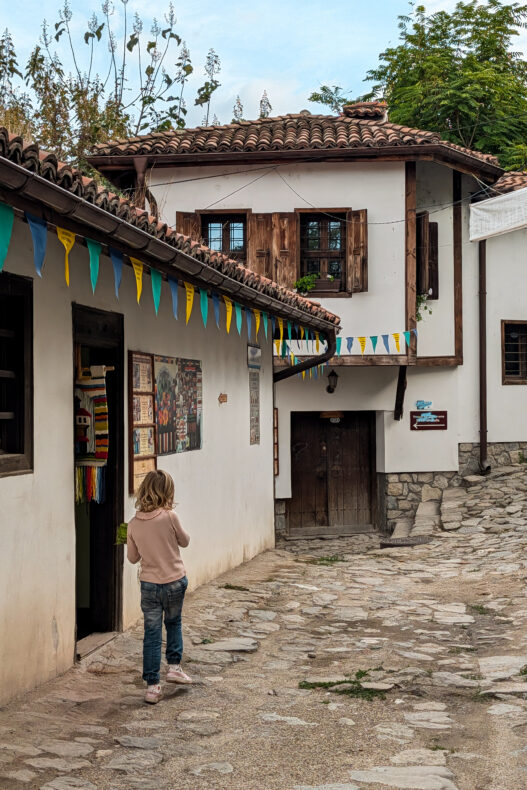
#6 Ethnographic Museum: one of Plovdiv’s most beautiful buildings
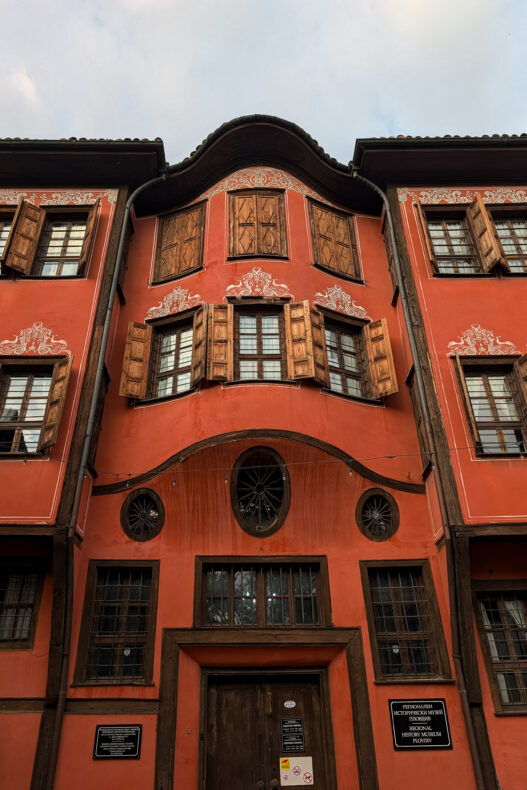
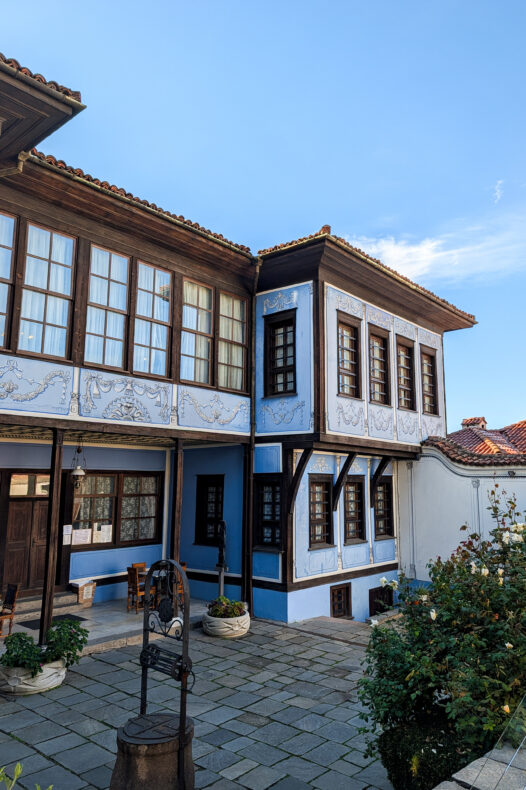
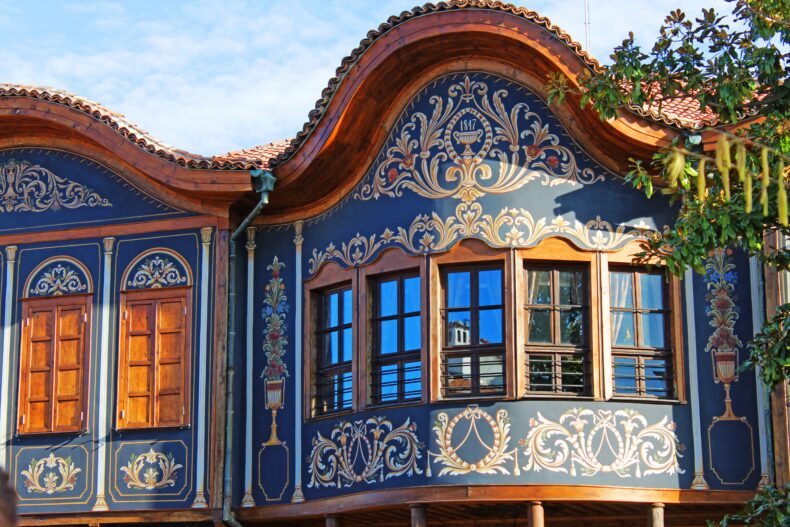
Even if museums aren’t really your thing, don’t skip this one. The Ethnographic Museum is housed in Kuyumdzhioglu House, one of the most striking merchant houses in Plovdiv. From the street, you see a reddish-brown façade with white details, but keep walking into the courtyard. That’s where the famous side of the house awaits: a deep blue façade with elegant white ornaments, sweeping curves and rows of windows.
The house was built in 1847 for the wealthy merchant Argir Kuyumdzhioglu and is a textbook example of National Revival architecture. Its symmetry is what makes it so special, with wide façades curving gracefully outwards on both sides. With more than ten rooms, it feels more like a small palace than a home.
Inside, the Regional Ethnographic Museum tells the story of traditional Bulgarian life through folk costumes, jewellery, musical instruments, furniture and old craft tools. But even if you don’t go in, stop by to admire the building. It’s right next to Hisar Kapia, so it fits perfectly into your Old Town walk.
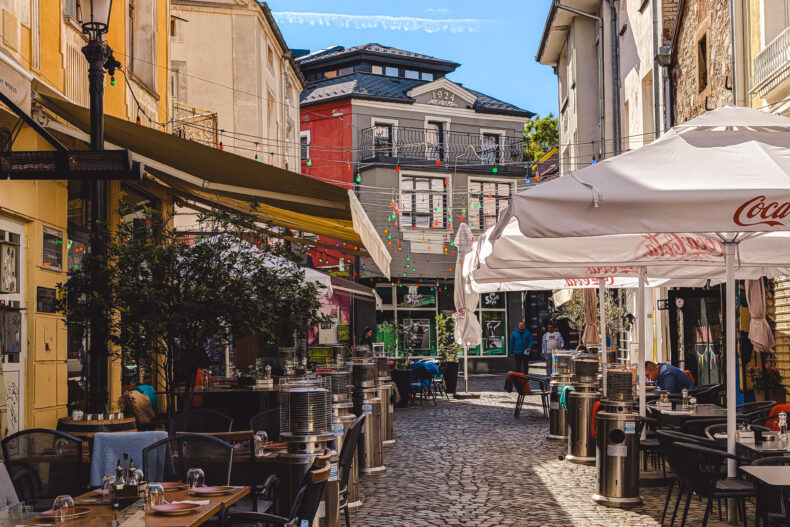
#7 Kapana: street art, coffee and Plovdiv’s creative side
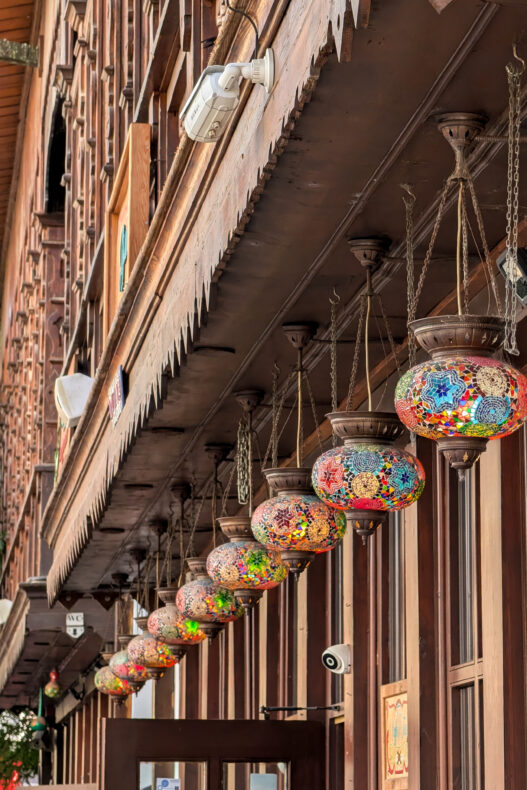
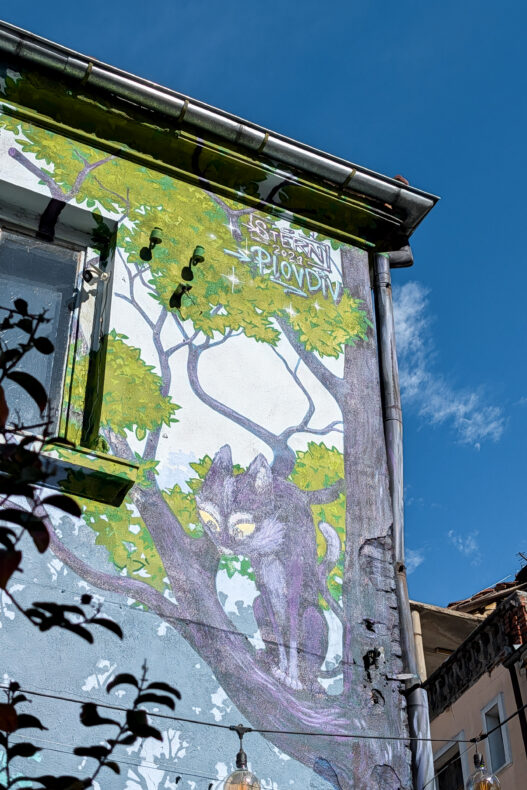
After all those Roman ruins and merchant houses, Kapana feels like stepping into a different city. This tangle of narrow lanes is Plovdiv’s creative quarter, with street art splashed across the walls, specialty coffee bars, small boutiques and terraces wherever you look. Decorations are strung above the streets, and there’s always something new to spot.
Kapana means ‘the trap‘ in Bulgarian, and it’s easy to see why: these lanes are made for getting lost. This used to be the craftsmen’s quarter, where blacksmiths, leatherworkers and other artisans had their workshops. Many of those spaces are now studios, galleries, cafés and restaurants.
We loved just wandering around here. Keep looking up and around, because the street art turns up in the most unexpected places. Craving a proper specialty coffee, a vegetarian lunch or a drink on a terrace? Kapana has you covered. It’s fun during the day, but it really comes alive in the evening when the terraces light up.
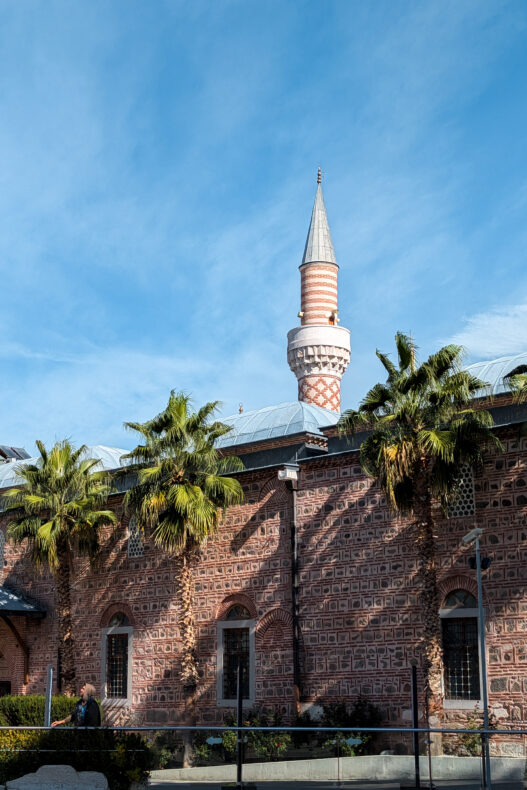
#8 Dzhumaya Mosque: a piece of Ottoman history
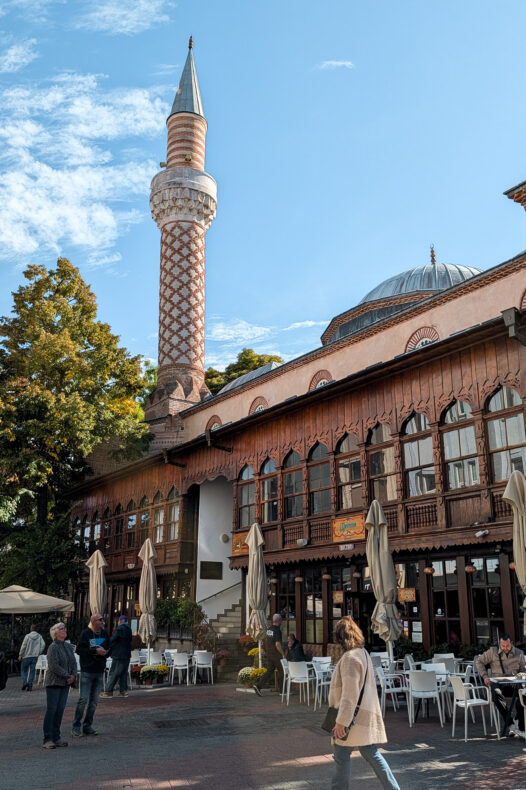
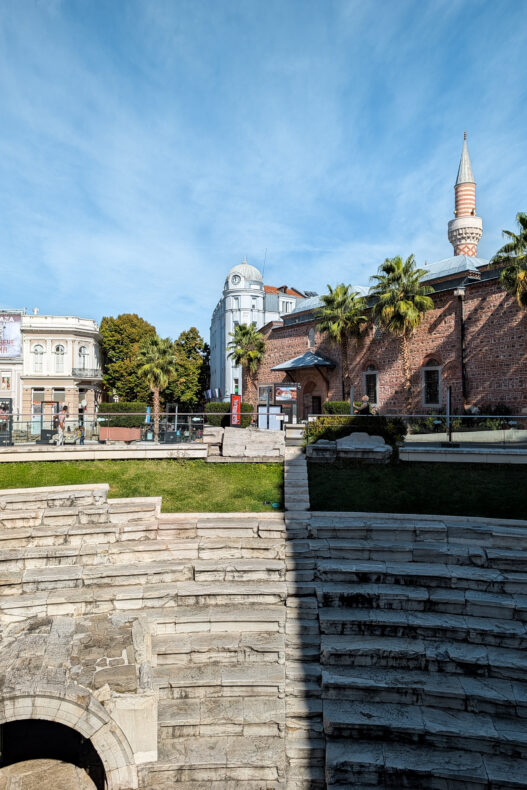
Right in the middle of the shopping streets stands a mosque with a tall minaret and nine domes. The Dzhumaya Mosque is one of the oldest in Bulgaria and a reminder that Plovdiv was part of the Ottoman Empire for centuries. And its neighbour? A Roman stadium. Two completely different chapters of the city’s history, side by side.
The mosque was built in the 15th century on the site of an older 14th-century place of worship. Take a closer look at the outer walls, where bands of red brick alternate with pale stone. Inside, you’ll find colourful paintings, intricate patterns and Arabic calligraphy. It’s still an active mosque and very much part of daily life in Plovdiv.
You can usually visit for free outside prayer times. Take off your shoes and dress modestly, and women are expected to cover their hair. Even if you only admire it from the square, it’s worth a stop. And don’t forget to peek at the Roman ruins right next door!
#9 Roman Theatre: Plovdiv’s most famous landmark
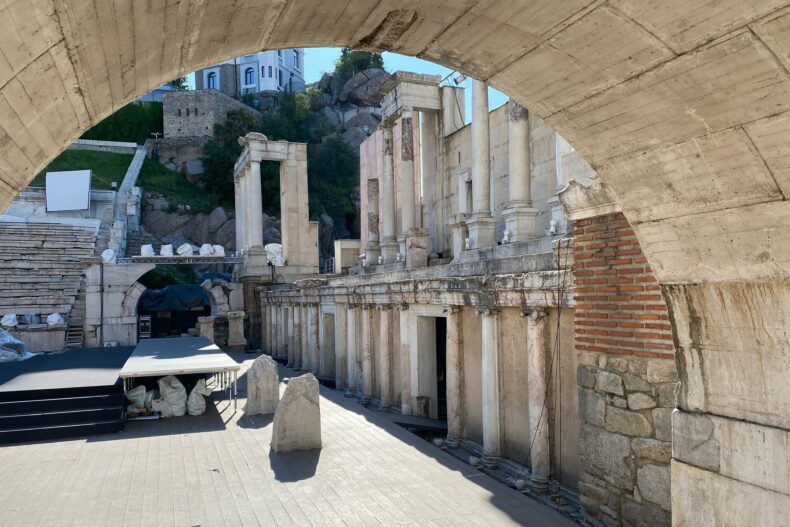
Built into the hillside of the Old Town, the Roman Theatre is the sight everyone comes to see, and it doesn’t disappoint. Rows of marble seats curve steeply upwards, and behind the stage the city stretches out below you. Almost 2,000 years ago, thousands of people sat right here to watch a show. It’s one of the best-preserved ancient theatres in the Balkans and the one thing you really can’t miss in Plovdiv.
The theatre dates from the end of the first century AD, when Plovdiv was the Roman city of Philippopolis, and could hold around 5,000 to 7,000 spectators. For centuries, it lay buried and forgotten, until a landslide in the 1970s revealed it again. The excavations that followed brought this incredible structure back to the surface.
The best part? It’s still in use! In summer, the theatre hosts concerts, operas and other performances. Imagine watching a show from those same ancient seats. You can buy a ticket to walk between the rows yourself, but there’s also a great free view from the street above, with the modern city as a backdrop.
#10 Roman Stadium: ancient ruins in the middle of the shopping street
Walking down Plovdiv’s busy shopping street, you suddenly find yourself looking down at a Roman stadium. Modern city life carries on around you, while a few metres below street level lie ancient stone stands and arches. Nowhere shows better how history pops up all over Plovdiv.
The stadium was built in the second century AD. At around 240 metres long, it could seat no fewer than 30,000 people for sporting events and games, much like the famous games of ancient Greece. Most of it now lies hidden under the shopping street and surrounding buildings, and only part of the northern curve has been excavated. Don’t skip the scale model on site: it helped us picture just how enormous the full stadium must have been.
You’ll find it right next to the Dzhumaya Mosque. Looking down at the ruins from the square is free, and the contrast between the Roman stands and the city around them makes it a fun, quick stop.
#11 Bishop’s Basilica: mosaics almost 1,700 years old
Hidden under a modern museum building lies one of Plovdiv’s most remarkable finds. The Bishop’s Basilica of Philippopolis was a huge early Christian church, and its mosaic floors are almost 1,700 years old. The birds are the stars of the show: dozens of species, from peacocks to tiny songbirds, all made from thousands of little stones.
The basilica was built in the fourth century, as Christianity spread through the Roman Empire, and was one of the largest churches in the region at the time. Over the centuries, it was rebuilt several times and new mosaic floors were laid over the old ones. That’s why archaeologists found several layers of patterns and images stacked on top of each other.
In the visitor centre, raised walkways let you see the mosaics up close, and you’ll learn about the history of the basilica and the meaning behind the images. It’s a short walk from the centre and a great addition to the city’s Roman sites. We skipped it ourselves, as it’s just outside the centre.
#12 Plovdiv with kids: exploring and a Hansel and Gretel sweet shop
Plovdiv is a great city to explore with kids. With its painted houses, winding lanes and old city gates, the Old Town feels a bit like a fairytale. Let them hunt for murals, clamber around the ruins and spot the city from the hills. The Roman Theatre and the fortress remains on Nebet Tepe are perfect for stories about how people lived here thousands of years ago.
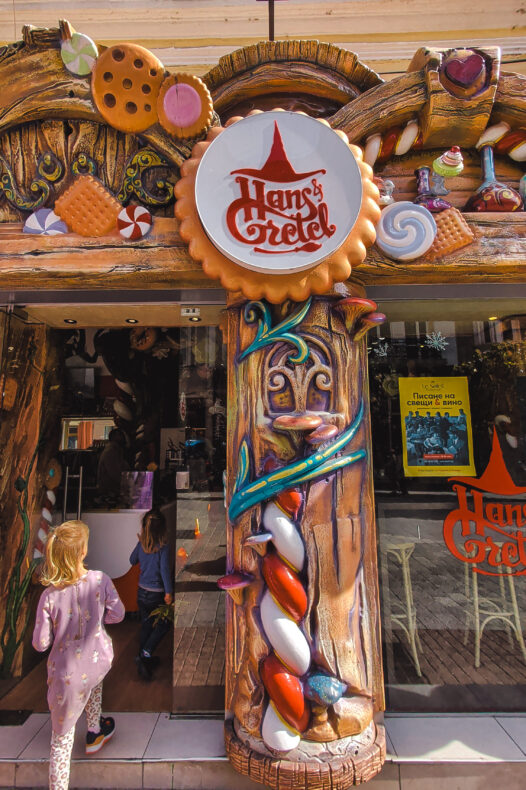
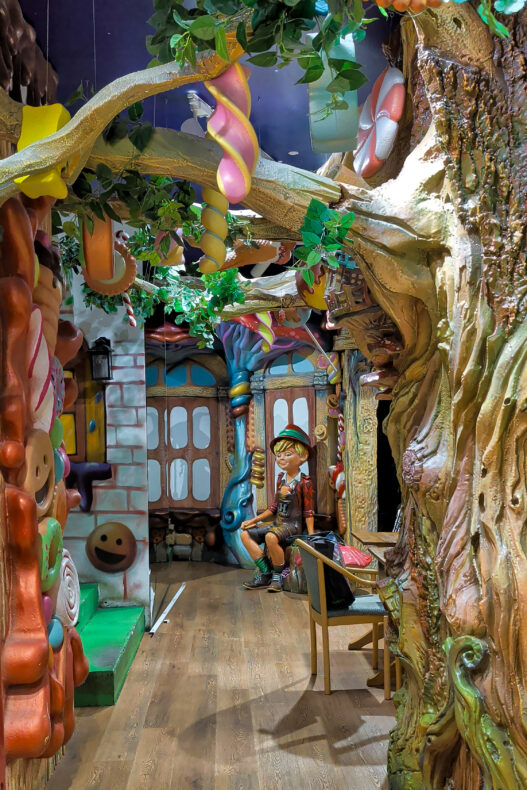
For something sweet, head to the Hansel and Gretel sweet shop, a candy store inspired by the famous fairytale. With all the sweets, bright decorations and fairytale details, it’s a treat just to walk in. Even more so if the kids get to pick something themselves!
Kapana is fun with kids too, with plenty of street art to spot and easy places to stop for a snack or a drink.
Do keep in mind that the Old Town is full of steep, cobbled lanes, and with a pushchair that wasn’t always easy. Need a break? There’s a playground hidden between the old buildings in the Old Town (see it on Google Maps).
#13 Bachkovo Monastery: a beautiful day trip from Plovdiv
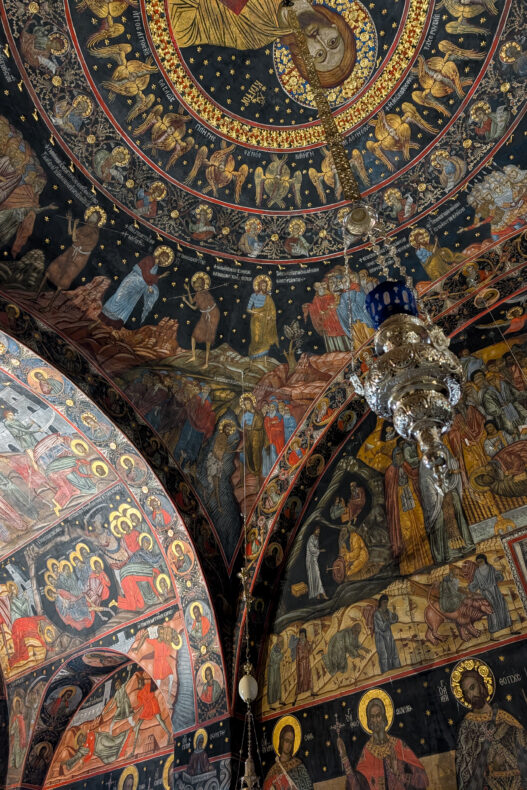
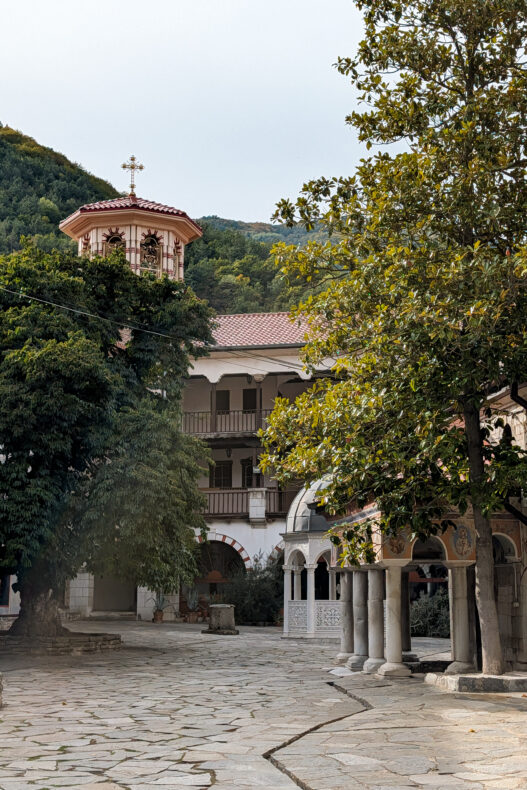
Have an extra day? Then drive out to Bachkovo Monastery, about half an hour from Plovdiv in the green foothills of the Rhodope Mountains. It’s one of the oldest and most important Orthodox monasteries in Bulgaria, with historic buildings set around peaceful courtyards, colourful frescoes, wooden galleries and an impressive monastery church.
The monastery was founded in 1083 by two brothers of Georgian descent who served the Byzantine Empire, so it has almost a thousand years of history behind it. It grew into an important religious centre, monks still live here today and believers come from far and wide to pray. The frescoes are the real highlight: inside the church and around the courtyards, you’ll find vivid biblical scenes and images of saints.
We visited with our kids and found it a great place to tell them about monks and the Orthodox Church. The incense, candles, icons and painted walls make it a memorable visit. Entry to the grounds is usually free, but some of the museum rooms charge a separate fee.