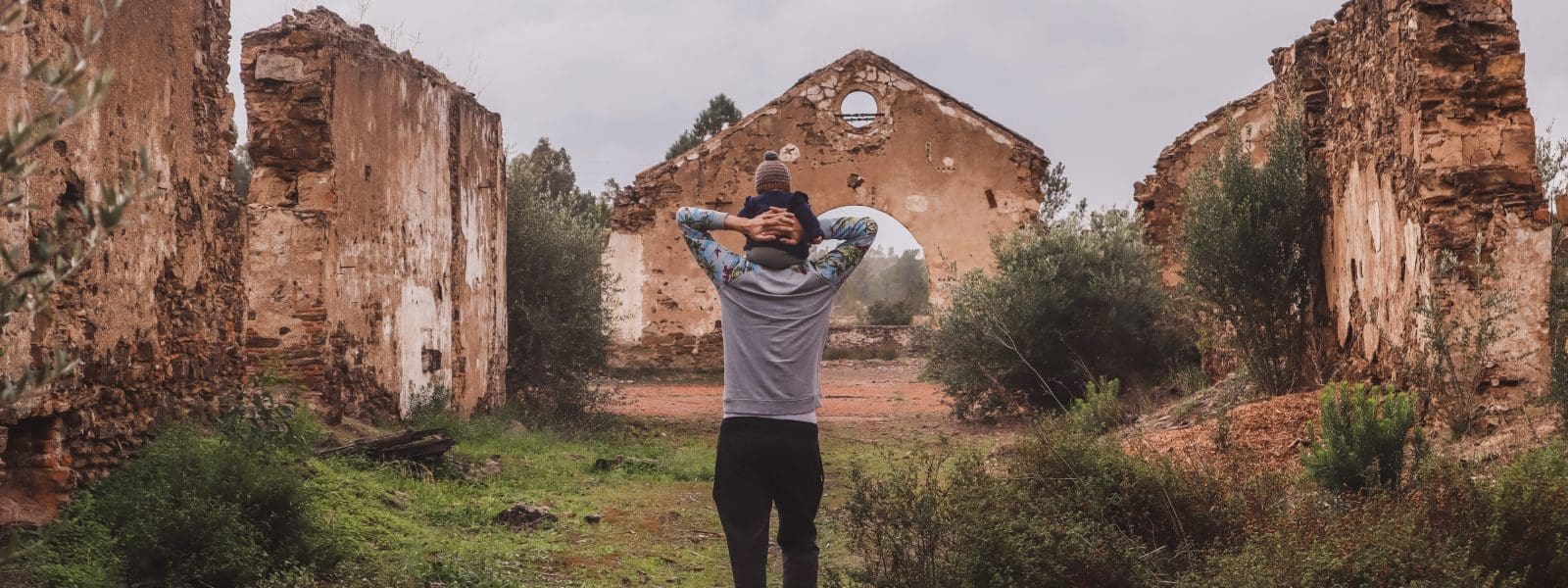
Do abandoned places have a strange pull on you too? Then add the old copper mine of Minas de São Domingos to your trip through Portugal. What was once an important mine with a busy mining village is now a silent place of ruins, rusty remains and a lake in toxic colours. You can visit this little-known spot in the Alentejo completely free of charge, and as far as we’re concerned it belongs on your route if you’re in this part of Portugal. In this blog we tell you exactly what to expect.
→ Discover our road trip through the Alentejo past its best places


A copper mine since Roman times
The Romans already knew the value of the metals at São Domingos and were the first to dig here. Everything that was easy to reach was taken by them and later by the Moors, so it wasn’t until the nineteenth century that people discovered what still lay deeper underground. Soon there was a mining village and copper was being extracted again, followed by other minerals. This time not by the Romans, but by the English company Mason and Barry.
Business was booming. São Domingos was the first village in Portugal to get electricity, and a railway was built to the river port of Pomarão, purely for the mine. Mining sulphur turned out to be a bad idea in the end. The ground became badly polluted and more and more miners fell ill. When Portuguese law started forcing companies to clean up their pollution, Mason and Barry, so we were told, decided to cut their losses. A clean-up on this scale would have cost a fortune, so the mine closed in the 1960s and the company left Portugal.
A free open-air museum
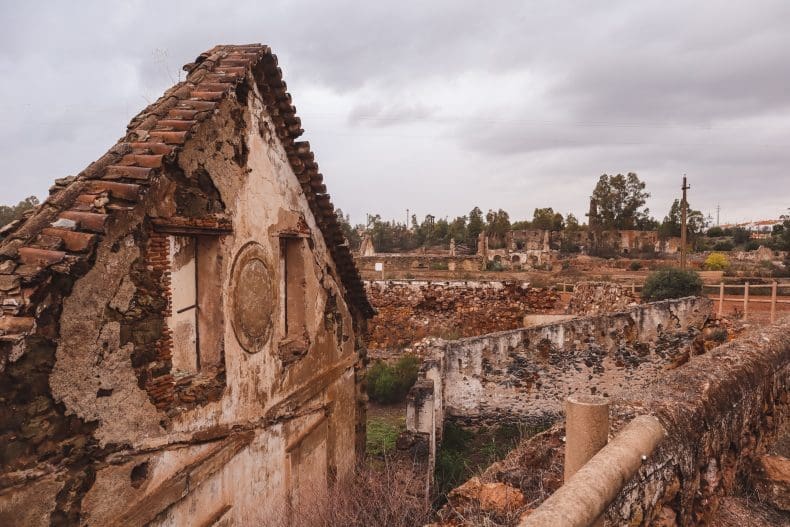
The old Minas de São Domingos are now a sort of open-air museum, and a free one at that. Information boards in Portuguese and English tell you about the metals in the ground and life in the mining village. There’s also a 14-kilometre walking route past everything to do with the mine. If that’s too much, the ruins at São Domingos itself are plenty, as that’s where most of it is.
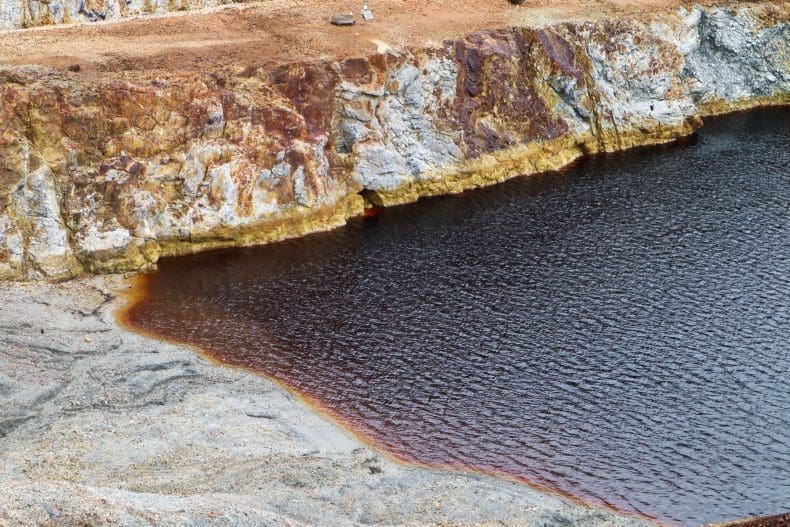
You’ll recognise the main mine shaft straight away. It has filled up with water, forming a small lake surrounded by rocks in every shade of red and ochre. The water itself doesn’t look quite normal either, and that’s because it isn’t: it’s heavily polluted with sulphuric acid. Wooden walkways run along part of the lake, so you can see the water and the coloured rocks up close.
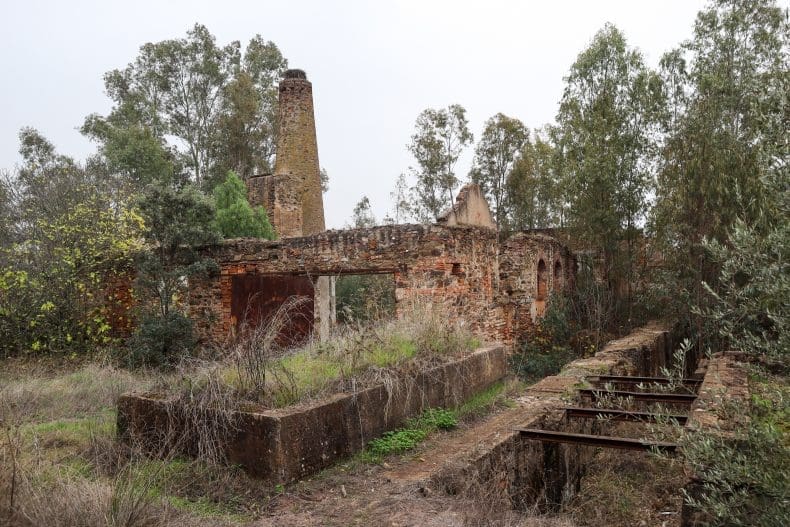
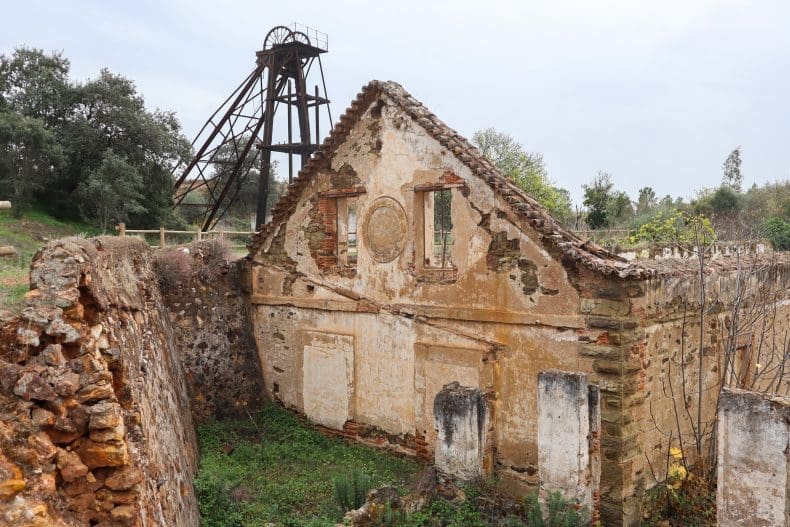
Next to the lake are the ruins of the old mining village. In this ghost town you can still see the remains of old houses, a chimney, the station’s loading platform, the old offices and more. Signs next to the ruins explain what used to stand there, which really brings the place to life.
Where to stay near Minas de São Domingos?
In the mining village itself and in Mértola, under twenty minutes’ drive away, you’ll find a few lovely places to stay. Handy if you want to combine the mine with the swimming lake, Mértola and the Pulo do Lobo waterfall.
#1 Palacete dos Alcaides is a characterful manor house in the middle of the mining village, with a garden, a shared pool and a communal kitchen. The beach on the lake is within walking distance, so after an afternoon among the ruins you’re in the water in no time.
#2 Quinta do Vau sits across the Guadiana river, directly opposite Mértola. From the pool you look out at the white town with its castle on the hill, and it’s a fifteen-minute walk over the bridge into the centre.
#3 Horta da Quintã is a peaceful country house in the nature park, a few kilometres from Mértola, with a garden, a pool and rooms decorated with regional crafts. Perfect if you want to properly unwind between outings.
What to do near Minas de São Domingos?
Fancy cooling off after all those ruins in a lake where you can actually swim? Close by is the Praia Fluvial of Minas de São Domingos, a sandy river beach on the Tapada Grande lake. Here you can go for a proper dip, and in the hot summer months that’s more than welcome.
The mine lies right next to the Parque Natural do Vale do Guadiana, a beautiful nature park around the Guadiana river. In the heart of the park sits Mértola, a white town high above the river known for its Moorish past. We walked around its old centre, and we’d recommend it to anyone. The main church was once a mosque, and you can also visit archaeological excavations and the medieval castle.
Another highlight of the park is the Pulo do Lobo, one of the largest waterfalls in Portugal. The name means wolf’s leap: legend has it the gorge here was so narrow a wolf could jump across. You can visit the waterfall from two sides. On the west bank, towards Mértola, there’s a viewpoint where you see the whole waterfall at its best.
On the Serpa side, a long staircase leads down to the left bank. From the steps you don’t see the waterfall as well as from the viewpoint across the river, but scramble over the rocks to the water’s edge and you’ll see it crashing down with full force.
→ Discover Serpa, the castle town close to the Pulo do Lobo
More tips for your trip to the Alentejo
 Our pickStaying near the mine? Browse all hotels in Mértola on Booking.com
 Portugal was made for road trips. Rent a car at Lisbon, Porto or Faro airport with Discover Cars and compare the big rental companies in one go.
 Fancy doing it by camper, like we did? Rent a campervan in Portugal with Campervan Planet.
 Prefer everything arranged? Browse Portugal tours on TourRadar.
 No flight yet? Compare flights to Lisbon or Porto.
 Discover all our blogs about Portugal