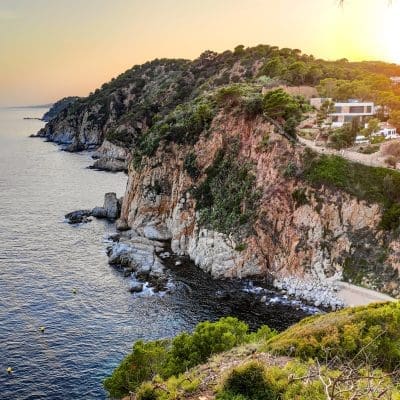
Andalusia packs it all in: fairy-tale Moorish palaces, wild nature parks, picture-perfect white villages, grand historic cities, snowy mountain peaks and the beaches of the Spanish costas. It’s one of our favourite regions in Europe, and we’ve been back so often that it almost feels like a second home.
How much time have we spent roaming around here in total? About a year, we reckon. First just the two of us, later with the kids and our little campervan, and often for a whole winter at a time. We lost our hearts to this place long ago, and we never get bored: there’s always another village, mountain road or beach we haven’t found yet.
In this guide we share our 15 favourite places to visit in Andalusia, with practical tips for planning your trip. Rather find spots with fewer tourists? We rounded those up in a separate guide.
→ Discover Andalusia’s hidden gems off the beaten track


How to get to Andalusia: fly or drive?
Live in Europe? Then driving down to Spain is a real option. You don’t have to worry about airline baggage rules, and you save on a rental car. Just set aside plenty of travel time: from our home in the Netherlands it’s about 22 hours behind the wheel to reach the south of Spain.
Rather skip that marathon drive? Then book a flight to Seville or Málaga, where most international flights land. In our experience, flights to Málaga are usually the cheapest. Pick up a rental car at the airport and start your Andalusia trip from there. A handy place to book is Discover Cars: it compares lots of rental companies in one go, so it’s often where you’ll find the cheapest deal. Do check carefully what is and isn’t covered by the insurance, so you don’t end up paying extra at the rental desk after all.
A relaxed way to explore Andalusia is to pick one home base and visit the highlights of southern Spain from there. No repacking your suitcase every few days, and still all the best places within easy reach.
That’s exactly how we did it on our very first trip to Andalusia. We stayed in the pueblo blanco of Ojén, a pretty white village in the mountains just above the coastal town of Marbella, and drove out to all the highlights from there.


When is the best time to visit Andalusia?
Spain’s deep south works for a holiday pretty much all year round. The most popular time is summer, when the school holidays kick in and high season arrives. You’re guaranteed warm days and hardly any rain, but also higher prices and bigger crowds of both Spanish and international holidaymakers.
We find summer in southern Spain seriously hot, though. Great for a beach holiday, not so great if you want to explore cities on foot or head out on a good hike. For sightseeing in Andalusia, cooler temperatures are far more pleasant, which is why we prefer spring or autumn. We’ve mostly visited in autumn, but we also spent a few months travelling the region by campervan in winter. It isn’t warm then, but compared to a Dutch winter it’s a wonderful place to escape the cold.


How many days do you need in Andalusia?
You could spend months exploring Andalusia, like we did one winter, but a weekend is enough for a city break in Seville or a beach getaway in Marbella. Want to see the best of the region? Then we’d recommend at least two weeks, ideally three. That gives you time for a road trip past the cities, white villages and nature parks.
→ Discover our road trip past the best places in southern Spain


Map of the best places to visit in Andalusia
The 15 best places to visit in Andalusia
#1 The Alhambra in Granada
One of the most famous sights in Andalusia, and in the whole of Spain, is the Alhambra in Granada. This centuries-old palace complex on one of the city’s hills is known for its Moorish architecture, with graceful arches, chapels and gardens. The wall paintings and mosaics inside are just as impressive, making the Alhambra one of the best-preserved Moorish monuments in the world.
→ Discover the 10 best things to do in Granada
The name Alhambra comes from al-Ḥamrā’, meaning ‘the red one’, a nod to the red bricks used to build it. Construction started in 1238, and the complex was expanded several times over the centuries. Its last resident was King Boabdil, the last Moorish king of Granada, who eventually had to surrender himself and his city to the Catholic Monarchs Isabella and Ferdinand. After the fall of Granada in 1492, the Christian kings of Spain used it as their palace. Charles V had part of it torn down to make way for a Renaissance royal palace. A shame about that slice of Moorish palace, although Granada did get a remarkable building with a round courtyard in return.
The Alhambra has been a national monument since 1870 and joined the UNESCO World Heritage List in 1984, a status this palace complex thoroughly deserves.
The complex covers 140,000 m² and is a citadel, so really a city within a city. You need a ticket for the Alcazaba, the Generalife and the Nasrid Palaces (Palacios Nazaríes). The Nasrid Palaces are visited in a fixed time slot printed on your ticket. Alhambra tickets are issued in your name, so bring your ID card or passport. You can book up to three months ahead on the official website, and in high season you really should, because they sell out fast. Part of the complex is free to visit, such as the Palace of Charles V with the Museo de la Alhambra, the Puerta de la Justicia and the Puerta del Vino.


#2 The Real Alcázar of Seville
In Seville you can visit the oldest royal palace in the world that’s still used as one. There may be older palaces, but royals no longer use them the way they do in Seville. Funnily enough, the Spanish king and his family don’t actually sleep in the palace when they’re in town. They stay at the prestigious Hotel Alfonso XIII instead.
→ Discover the 15 best things to do in Seville
Royal credentials aside, the Real Alcázar is one of the most beautiful buildings in Spain. It completely blew us away: an extraordinary piece of architecture where Moorish and European influences are woven together, a textbook example of the Mudéjar style. Mosaics, arches, domes, passageways, carved wood: you don’t know where to look first. Make sure your camera is charged, because you’ll easily take dozens of photos here.
Don’t skip the gardens either. They’re huge and every bit as gorgeous as the palace. As proper Game of Thrones fans we wandered around extra excited, spotting filming locations everywhere. The gardens played Dorne, and in the impressive Baños de Doña María de Padilla, with that beautiful vaulted ceiling, the Sand Snakes hatched their plots.
You can buy tickets on the spot, but it’s smarter to get them online in advance. We went for the budget option: on Mondays you can visit the Real Alcázar for free during the last hour before closing time. You still need to reserve an online ticket for that, and those slots go quickly. A great deal, but it’s busy and an hour flies by. Want to take in all that splendour without rushing? Then a regular ticket at a quieter time is well worth it.


#3 The Mezquita, Córdoba’s mosque-cathedral
Córdoba’s most iconic highlight is without doubt the Mezquita, one of the most popular attractions in Andalusia. Not just because this monument has served as a mosque and later a cathedral for 1,300 years, but also because of its phenomenal architecture. You’ve probably seen photos of the forest of columns inside. We knew those pictures by heart and the Mezquita had been on our list for years, so it was a real thrill to finally walk among them ourselves. It’s on the UNESCO World Heritage List for good reason: you can’t really visit Córdoba without stepping inside!
→ Discover the 12 best places to visit in Córdoba
The Mezquita’s tower rises high above the city skyline, so you can’t miss it. Step inside and quite a spectacle awaits. Those famous columns with their red and white arches stretch as far as you can see. Along the sides you’ll find small Christian chapels. Think that’s it for the Christian touches? Then you’re in for a surprise, because right in the heart of this forest of columns you suddenly stumble upon a cathedral. That unusual mix of mosque and cathedral is exactly what makes the Mezquita so popular.
Afterwards, climb the bell tower too. It’s the tallest building in the old town, so the views over Córdoba are superb. The tower needs a separate ticket with a fixed time slot. Tickets for the mosque-cathedral are sold on site at the ticket desks and machines in the courtyard, but you’ll skip that queue by buying online. A budget tip for Córdoba? From Monday to Saturday you can get in for free between 8.30 and 9.30 am, except on days with special services. Good to know: in August 2025 a fire broke out in one of the side chapels. The damage was limited and the monument reopened the very next day, but restoration of the affected chapels is still ongoing.


#4 The bridge of Ronda
All those iconic photos had us picturing a big town, but Ronda turns out to be pretty small. Still, it’s one of the most popular places in Andalusia, and we get why. It’s a classic pueblo blanco, a village of whitewashed houses, but with a very special location. Ronda sits on a rocky plateau, or rather two plateaus split by a deep gorge. An imposing bridge spans that gorge, and that exact spot is one of the most iconic views in southern Spain.
Beyond that, the town doesn’t have many big sights, but it’s lovely to wander through the old streets lined with white houses. There are plenty of viewpoints over the countryside and along the gorge, looking out at the famous bridge. We found the best view was from below, though. Head down into the gorge and look up: only then do you see how high the bridge really is and how sheer the cliffs are that the town is built on.


#5 The rock formations of El Torcal de Antequera
Less than an hour north of Málaga lies one of the most beautiful patches of nature in Andalusia. The El Torcal de Antequera nature park pairs mountains with remarkable rock formations. It’s a great place for walking, with several marked trails through the park.
Those unique limestone formations make El Torcal a mountain area like no other. You can visit two viewpoints, which are accessible for wheelchairs and pushchairs, or take one of the three walking trails. The green route is a 1.5-kilometre loop, the yellow route a loop of about 3 kilometres, and the orange route is 3.6 kilometres long. That last one is a linear trail from the lower car park to the visitor centre, so you walk the same distance back again. On busy days the road to the upper car park closes. You then park at the bottom and take the shuttle bus up, or walk the orange route.
We recommend the yellow route. Allow about 2 hours for the 3 kilometres, so expect a fair bit of scrambling over rocks. Still, we wouldn’t call it hard. We’ve done it twice now: the first time with our baby, years later with a preschooler and a toddler. The preschooler walked the whole thing and the toddler managed a good chunk. It had rained that second time, so we came back rather muddy, but it was spectacular all over again. It’s the views that slow you down, we kept stopping to take them in. And with a bit of luck you’ll spot Spanish ibex too. On our first walk they came remarkably close. This short hike really is one of the highlights of Andalusia.


#6 The Caminito del Rey
A real highlight of Andalusia is the Caminito del Rey, about an hour’s drive from Málaga. We walked this mountain trail along sheer cliffs on our very first trip to Andalusia, still just the two of us, and were hooked straight away. What views! The hike is 7.7 kilometres long and doable for pretty much anyone.
The path is a century old and was originally built between two hydroelectric plants. Once it fell out of use, it slowly decayed and the walkway along the cliffs crumbled away bit by bit. What was left: one of the most dangerous hikes in the world. It was officially off limits, but that didn’t stop the real daredevils, and several people lost their lives. Today the path has been completely rebuilt: you walk on sturdy wooden boardwalks above the old trail, wearing a helmet. The route runs one way only and you buy your ticket online in advance. Do that in good time, because it’s very popular. We were lucky it was quiet the day we went.


#7 El Rocío, the Wild West village
In the west of Andalusia lies the quirky little town of El Rocío. Another travelling family tipped us off about it during our first long trip with our baby, and were we glad they did. El Rocío is known as a pilgrimage site, but you mostly notice that at Pentecost, when thousands of visitors pour into the village. The rest of the year it’s much quieter, and people mainly come for the one-of-a-kind Wild West feel. El Rocío looks like a set for a western, completely different from the rest of Spain. You half expect a cowboy to ride past at any moment.
→ Discover the best things to do in El Rocío
You won’t actually see cowboys, but they wouldn’t look out of place. The white houses, dusty roads, locals on horseback and old verandas in front of the houses all seem straight out of the Wild West. It’s like stepping back in time. Those dusty roads are down to the lack of asphalt, or any paving at all: El Rocío has almost nothing but sand roads. We explored a good part of town and only saw paving on the promenade along the edge of the main square.
Plenty of wild horses live around El Rocío. They’re hard to miss, because you see them all over the nature reserve around town. Once a year, on 26 June, they’re rounded up and led past the shrine of El Rocío to be blessed. During this Saca de las Yeguas, the herd then moves on to Almonte, where some of the horses are sold. The rest return to the wilds of Doñana a few days later.


#8 The Albaicín quarter in Granada
One of the best things to do in Granada is exploring the old Albaicín quarter. It sits on a hill and is the oldest part of Granada. Did you know the Albaicín is much older than the famous Alhambra? Next to the Albaicín, the Alhambra is practically new.
→ Discover the 3 best neighbourhoods to stay in Granada
The Albaicín is a gorgeous, picturesque quarter we love to wander through every time, including on our most recent trip. It’s on the UNESCO World Heritage List for good reason. The steep lanes are paved with river stones, colourful plants climb the walls, and the squares are full of street musicians and kids playing. You’ll find a surprising number of little fountains dotted around. Do top up your water bottle there: the water comes from the mountains around Granada and is perfectly drinkable. And notice how often a fountain stands right next to a church? Then that church was a mosque in Moorish times, and the fountain was used to wash before prayer.
With kids it’s quite a climb, as the lanes run steeply uphill. Need a breather? One of the parks or little squares is a perfect spot to sit on a bench and people-watch. Fancy a drink? Head to Boabdil Restaurante at the bottom of the Albaicín near Calle Elvira for a traditional Spanish bar. Or look up the Kasbah tea house on Calle Calderería Nueva.
Fun fact for fans of Lucinda Riley’s The Seven Sisters series: in book five, The Moon Sister, Tiggy, the sister who works on a Scottish estate, discovers that her roots lie in Granada’s gitano community. Much of the story plays out in the Albaicín and the cave houses of neighbouring Sacromonte. Read the book? Then you’re walking straight through its setting.


#9 The museums and beaches of Málaga
Andalusia is famous for its sandy beaches, but it also has brilliant city-break destinations. Want both? Then Málaga is your place. Oddly enough, the city didn’t grab us on our first visit, but we’ve now been four times and we’re huge fans. Our son even celebrated his first and his third birthday here. The city is packed with historic buildings, trendy hotspots, world-class museums and buzzing café terraces. And because Málaga is right on the coast, you’ll find great city beaches in and around town.
→ Discover the 14 best things to do in Málaga
Few people realise that Málaga is a real museum city. Its biggest draw is the Picasso Museum. The famous painter was born in Málaga, and his birthplace has been turned into a museum too. The Picasso family’s collection is housed in a historic palace in the old town. His best-known masterpieces don’t hang here, but the museum is still well worth a visit. Other major museums include the CAC for contemporary art, the Museo de Málaga on the city’s history, the Carmen Thyssen Museum, the Centre Pompidou and the Colección del Museo Ruso in the old tobacco factory. Ideal with kids: many museums are free at set times, so you can pop in without feeling it’s a waste when the little ones have had enough after half an hour.
Other Málaga highlights include the cathedral that’s been under construction for centuries, the Alcazaba fortress, the Roman theatre, the old town, the Mercado Atarazanas covered market, the seafront promenade, Gibralfaro castle and its viewpoint over the city, the colourful street art and the trendy Soho district. There are playgrounds everywhere in between, so the kids get their fun too. Málaga can easily fill a city break, or even a whole holiday. Especially if you make the most of its central location and take some great day trips from Málaga.


#10 The Via Verde de la Sierra
One of the best things to do in Andalusia is the Via Verde de la Sierra. It’s one of the many Vías Verdes of Spain, which literally means ‘green ways’. These are old railway lines that fell out of use and were turned into walking and cycling paths. Not far from Ronda and Setenil de las Bodegas you’ll find one of the most beautiful of them all, the Via Verde de la Sierra. It was our first Via Verde and it left us wanting more: after that we went out of our way to cycle much more on our travels, and on a later trip we even brought our own bikes.
→ Discover all our tips for cycling the Via Verde de la Sierra
Where the mountains in this part of Spain usually mean steep climbs and sharp descents on a bike, the Via Verde de la Sierra is mostly flat. Engineers built a level railway with dozens of tunnels and viaducts here, although no train ever ran on it. The full route is 36 kilometres long and runs between the stations of Puerto Serrano and Olvera. Halfway lies the small Coripe station. At the stations you can park your (rental) car and grab something to eat and drink, and you can hire (electric) bikes at several points along the route. Other than that, you won’t pass a single village or town. Just sweeping views over the countryside the whole way.
The highlight of the route is, of course, the string of tunnels through the mountains. You ride through dozens of them. The longer tunnels have lights that switch on as soon as you cycle in. Some are so long you can’t see the end from the entrance, while others are just a few metres. The longest is almost a kilometre!
We hired e-bikes, with a seat on the back for our daughter, who was still a baby then. It was also the very first time we went cycling with her. We could only return the bikes to the station where we’d rented them, so we rode half the route there and back, as far as Coripe station. A great place to stop, because it has one of the longest tunnels and one of the longest viaducts on the whole Via Verde de la Sierra. On the way back it turned out the batteries hadn’t been charged equally: Sebastiaan’s had given up long before, while mine was still going strong after that long ride.


#11 Setenil de las Bodegas, the white village in the rocks
Setenil de las Bodegas is often hailed as one of the most beautiful villages in Andalusia, or even all of Spain. It’s one of southern Spain’s many pueblos blancos. But where these photogenic white villages usually perch on a mountain or hilltop for strategic reasons, this little white town is almost hidden inside the rocks. Its streets wind up against the cliffs, with houses even built into the rock face! That makes Setenil a truly unusual place to visit in Andalusia, and it definitely belongs on your southern Spain road trip.
→ Discover the best things to do in Setenil de las Bodegas
There’s a practical reason for Setenil’s hidden location too. Summer temperatures in southern Spain can soar, but the spaces under and against the rocks stay pleasantly cool, so they were first used to store food. Hence the ‘bodegas’ in its name, which roughly means (wine) cellars in Spanish. The villagers could use that cool shelter of the rocks themselves in the summer heat, so before long houses went up under overhanging rock walls, in caves and against the cliffs.
Today Setenil de las Bodegas is known for those unusual rock houses and has become a big tourist draw. You’ll notice that, but it’s still a remarkable place. The streets twist along the slopes, with some of the houses built against and into the rock. We visited in February, together with my parents, who came out to see us during our long trip through Spain. Even on that grey day, Setenil looked photogenic from every angle, especially from one of its many viewpoints.


#12 Plaza de España in Seville
Seville’s most beautiful square, and one of the most impressive sights in southern Spain, is the Plaza de España. It’s a whopping 160 metres wide and has spectacular architecture: we couldn’t stop looking up at all those tiles, arches and towers.
→ Discover the best neighbourhoods to stay in Seville
The Plaza de España was built for the Ibero-American Exposition, the world’s fair Seville hosted in 1929. The square was given a semicircular shape, an open form chosen on purpose to give visitors a warm welcome to this new symbol of Spain. Along the edge of that semicircle stand a colonnade and, behind it, grand buildings that now house government offices. One of our best tips for Seville is the viewpoint over the square. In two places the façade juts forward a little, and there you can take the stairs up and look out over the square from the balustrade.
Around the edge of the square, all the provinces of Spain are represented in alphabetical order, each with its own tiled bench and mural, where people often sit on sunny days. Spain shows up in the square in another way too: the four bridges. The country was once formed from four kingdoms (León, Castile, Aragon and Navarre), and each bridge stands for one of them. They cross a canal, where you can take a rather touristy boat ride. Afterwards, take a stroll through the Parque de María Luisa around it, a green oasis in the middle of the city.


#13 The Castillo Monumento Colomares
This fairy-tale castle is one of the strangest sights in Andalusia. It stands in Benalmádena on the Costa del Sol, with sea views and not far from Málaga. Castle, though? It’s really more of a fantasy building. Or a monument.
It was built between 1987 and 1994 in honour of the explorer Columbus. Its eccentric owner built it entirely by hand and packed the odd structure with references to Columbus and his discovery of America. All sorts of architectural styles come together here: stained-glass windows, a pagoda, the bow of a ship, fairy-tale turrets and Gothic decorations. When we wandered around with our baby daughter, we couldn’t believe our eyes: it’s totally unlike anything else you’ll see in Andalusia. A weird but also wonderful creation.
Entry is cheap, and since you can’t go inside the castle, you’re done fairly quickly. That makes it an easy stop, and as far as we’re concerned it’s a real must-visit. From Málaga it’s less than half an hour’s drive, so it’s easy to combine with other places on the Costa del Sol.


#14 Frigiliana, the most beautiful village in Andalusia
Often hailed as one of the prettiest villages in southern Spain, whitewashed Frigiliana sits high up in the mountains of Andalusia. It’s close to the busy beaches of the Costa del Sol, yet far enough away to have a character all its own. Narrow lanes twist up the hillside, and flowerpots, blue doors and window frames brighten up the otherwise dazzling white façades. We think it’s one of the most charming villages in Andalusia, and we’re not the only ones: Frigiliana has often been named the most beautiful village in the country.
→ Discover the 8 best things to do in Frigiliana
For us, it’s mainly the mountain setting that makes Frigiliana so special. The village lies in the Sierras de Tejeda, Almijara y Alhama nature park, with gorgeous views over the surrounding area. It’s great walking country too, for example to the even smaller and hard-to-reach village of Acebuchal, or up the hill above Frigiliana for the best view over the village.
Frigiliana’s Moorish roots are special too. Just like most of southern Spain, which the Moors ruled and enriched with their beautiful architecture, Frigiliana was once a Moorish town. The old, historic part of the village is El Barribarto, the Moorish quarter. It’s the higher part against the mountainside, full of charming, narrow and steep lanes. This is where you’ll find that postcard scene of white houses, blue doors and cheerful flowerpots. Wandering these lanes is the best thing to do in Frigiliana. Do expect crowds, as the village is very popular. We got lucky: we came on a sunny, warm winter’s day and it wasn’t too bad at all.


#15 Júzcar, the Smurf village
One of the lesser-known sights in Andalusia is the village of Júzcar. It was once a white village like so many others in southern Spain. But for the filming of a Smurfs movie, every single building in the village was painted blue. The result is a surreal streetscape of houses, churches, restaurants and shops in every shade of blue. Because the residents liked their blue film set, and so did the tourists who suddenly came flocking, the village stayed blue and is now known as Andalusia’s Smurf village.
→ Discover everything about visiting the Smurf village of Júzcar
There isn’t much to do in Júzcar besides wandering the blue streets. A visit is really all about that quirky blue setting. Is it a bit of a gimmick? Absolutely, and the blue does feel rather artificial. But we’d expected only a few streets to be blue, and to our surprise literally every building was painted in some shade of it. That’s unusual enough to make a quick stop worthwhile. When we were here with our baby daughter, the lanes were lovely and quiet too. Walking routes loop through the village, so you start and finish at the car park. Along the way you’ll pass lots of murals, added to give visitors an even better photo.