On our first trip to Prague, my parents could leave the guidebook at home. I’d made my own. I was a teenager, had researched everything and knew exactly where we were going. From the Castle to Malá Strana, from Charles Bridge to the Jewish Quarter, my parents dutifully followed me around. We ticked off every single sight on my list.
Years later I came back, interrailing with my little brother right after I graduated. It was the height of summer, and on Charles Bridge we shuffled forward inch by inch while doing a free walking tour. I still loved Prague just as much. On my third visit I stepped off the night train one morning, at the start of a press trip through Czechia. I had one day in the city and a Prague Visitor Pass to make the most of it. At eight that evening I sat down to dinner on very tired legs, after a day full of places I had walked straight past the first two times.
Below you’ll find the classic sights I’d pick for a first city break, followed by my favourite lesser-known places. Of everything I saw on that last visit, one artwork in a shopping arcade stuck with me most. It’s an equestrian statue where the horse hangs upside down from the ceiling, made by one of the best-known Czech artists of the moment.
What is Prague known for?
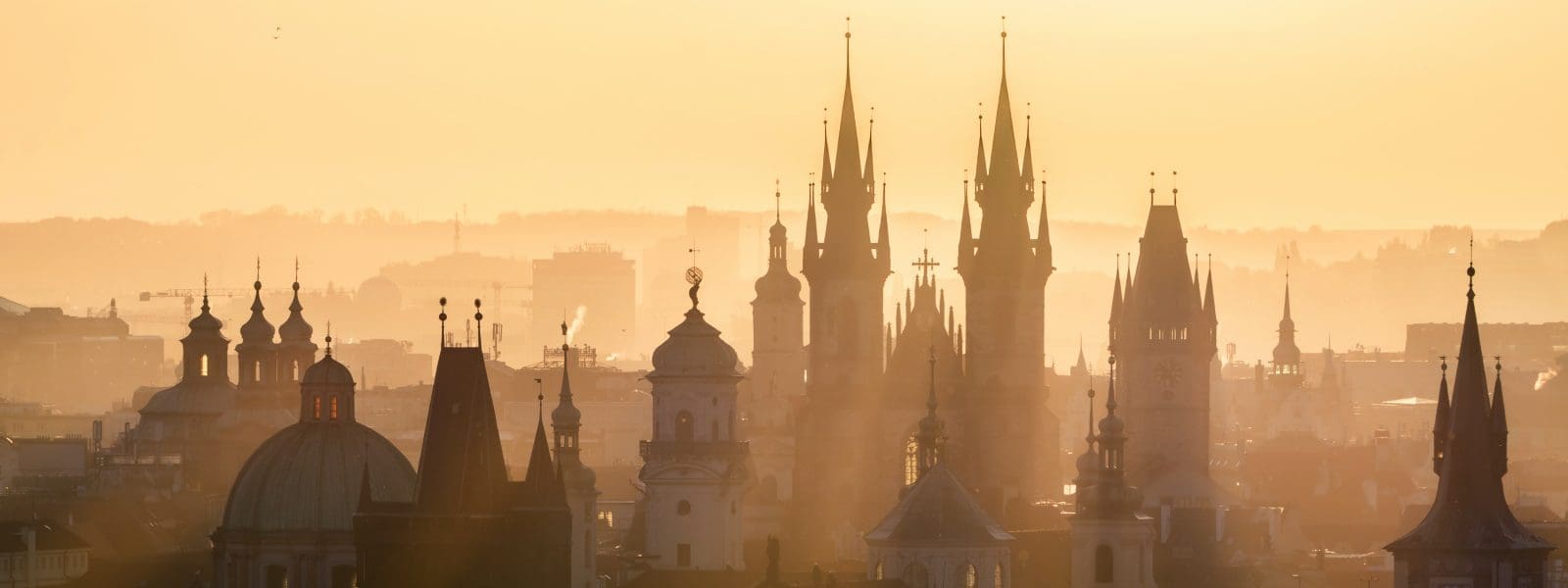
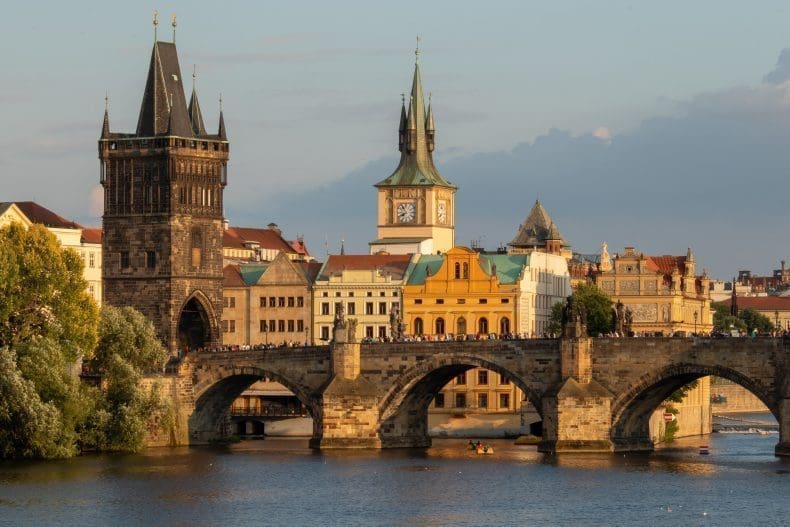
Look out over Prague from one of the bridge towers and you’ll get why it’s called the City of a Hundred Spires. Towers and domes poke up everywhere above the red roofs. In between sit Gothic churches, Baroque palaces and squares lined with pastel façades. The city still looks like this because Prague came through the Second World War largely undamaged. Its historic centre has been a UNESCO World Heritage Site since 1992.
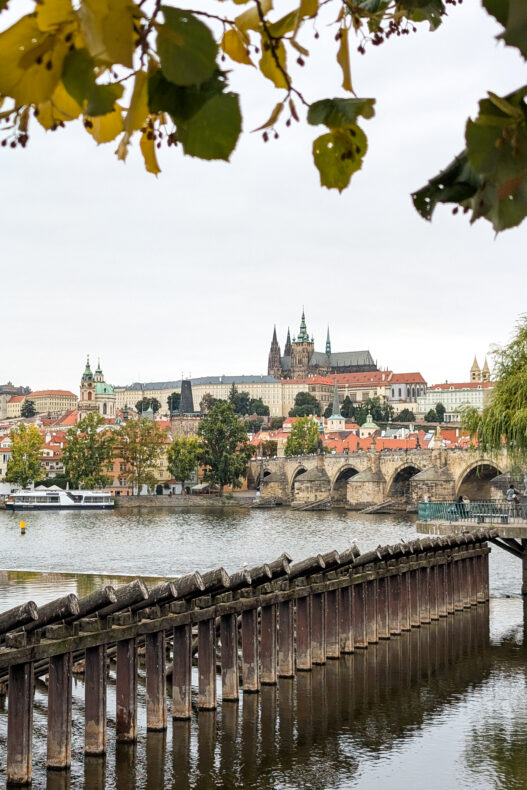
Charles Bridge and Prague Castle are on just about every postcard. From the bridge you look straight up at the castle, one of the largest castle complexes in the world. Its walls hold an entire cathedral, several palaces and a lane of houses so small you almost have to duck to get in.
Beer is part of Prague too. Czechs drink more beer per person than anyone else in the world, and the clear golden pilsner was invented in the Czech town of Plzeň in 1842. No wonder you’ll find beer cellars all over the city.
For a big chunk of recent history, you only need one square. In 1968 Soviet tanks rolled onto Wenceslas Square to crush the Prague Spring, a short period of greater freedom. In 1989 hundreds of thousands of people gathered on that same square and brought down communism without violence. Prague is also where Franz Kafka was born and where Mozart’s Don Giovanni had its premiere.
How many days do you need in Prague?
You can see an awful lot in one day, as I found out myself. You can also end up at the dinner table at eight o’clock completely wiped out. For a first visit I’d rather plan two full days. Day one gives you time for the Old Town and Charles Bridge, day two for the Castle and Malá Strana.
A third day lets you linger in a museum, track down the lesser-known places below or take a trip out of the city. If you’re travelling on through Czechia, head south to Český Krumlov, one of the prettiest towns in the country. Or do what I did and go east to Olomouc and Brno.
→ Discover the 10 best places to visit in Czechia
→ Discover the best things to do in Český Krumlov
Where to stay in Prague?
Stay in the Old Town (Staré Město) and you walk out of your hotel straight into the sights. Across the Vltava, Malá Strana is quieter and more romantic in the evening, with the steep lanes up to the castle as a free workout for your calves. In the New Town (Nové Město) around Wenceslas Square you’re close to the main station and the metro, and you often get a bit more hotel for your money.
I stayed in Nové Město myself, a few minutes’ walk from the station.
#1 MeetMe23 sits between the main station and Wenceslas Square, in a historic building with tiled floors and high ceilings. There’s a vintage car hanging on the lounge wall, which tells you pretty much everything about the interior.
#2 Hotel Residence Agnes is a small hotel in a quiet corner of the Old Town, just under ten minutes’ walk from Old Town Square. Handy with kids, because every child gets their own sofa bed in the family room.
#3 Bishop’s House is in Malá Strana, a stone’s throw from Charles Bridge. The rooms are light and modern, and in the quadruple room the whole family sleeps together.
#4 Golden Well clings to the hillside just below Prague Castle. This small luxury hotel has classic rooms and a terrace looking out over the red roofs. This is where I’d book a weekend for two.
Is the Prague Visitor Pass worth it?
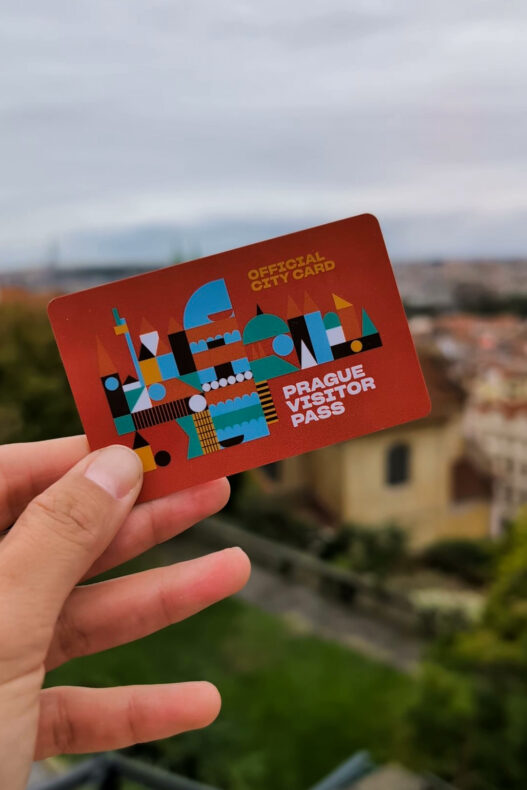
For my day in Prague I was given the Prague Visitor Pass. This official city card gives you unlimited public transport, including the Airport Express and historic tram 42. It also gets you into more than seventy sights, among them the Castle and the Charles Bridge towers. You choose a pass for 48, 72 or 120 hours, and the clock starts the first time you use it.
The pass pays off if you want to climb several towers, visit museums and see the inside of the Castle. I didn’t have to buy a single ticket along the way and simply hopped on whatever tram came past. If you mostly want to wander the streets and end up on a terrace now and then, a regular public transport ticket will do.
My last visit to Prague was at the invitation of #VisitCzechia and Prague City Tourism, as the start of a train journey through Czechia.
→ Get the Prague Visitor Pass with public transport
Things to do in Prague: the classic sights
#1 Old Town Square, the Astronomical Clock and the Týn Church
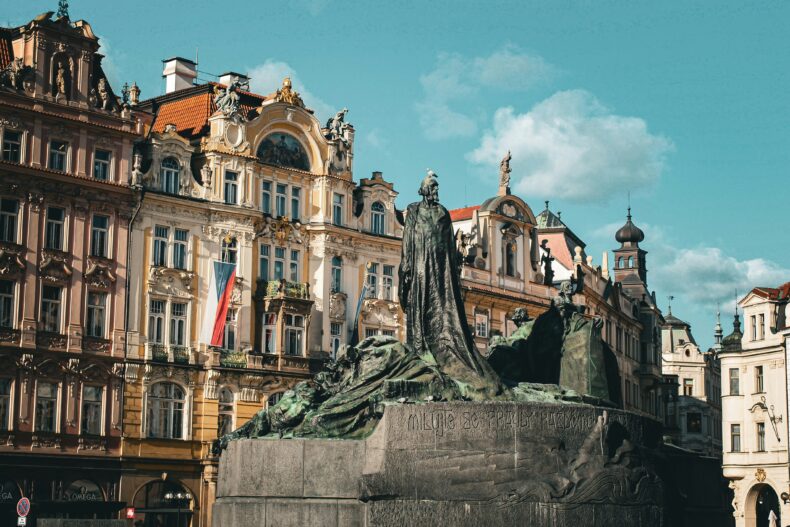
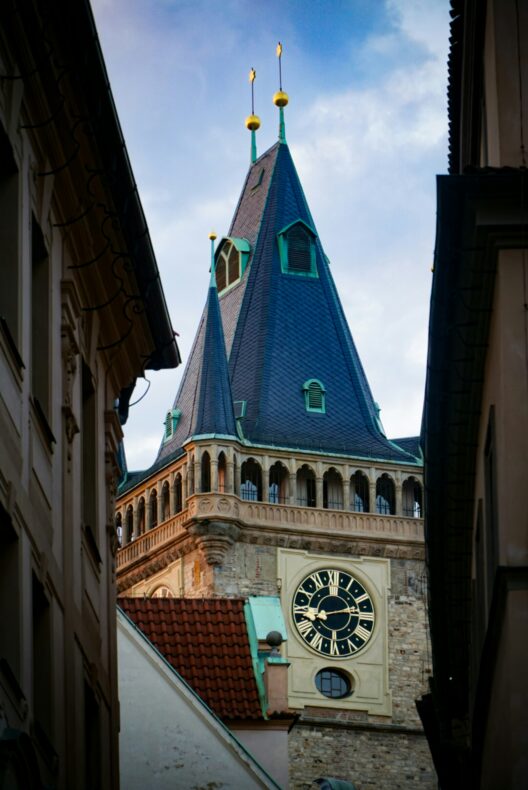
However you wander through the Old Town, you always end up back on Old Town Square (Staroměstské náměstí). Pastel façades and café terraces line its edges, and above them the two dark towers of the Týn Church shoot up more than eighty metres.
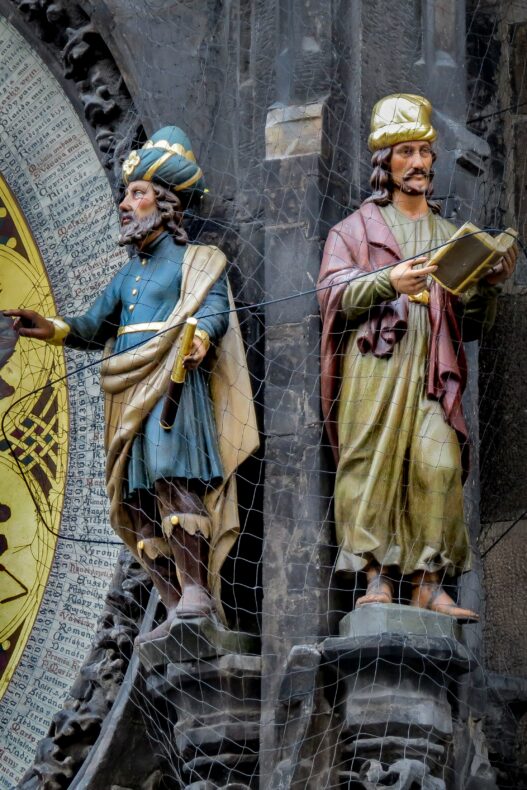
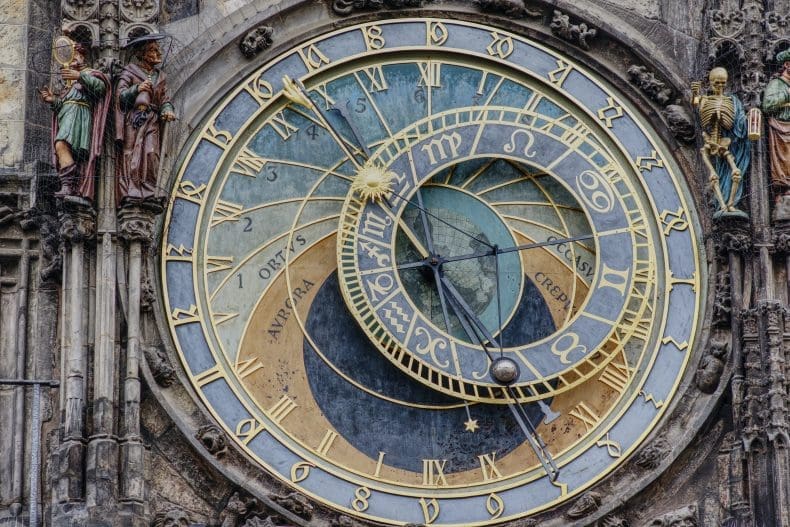
On the Old Town Hall hangs the Astronomical Clock from 1410, the oldest astronomical clock in the world that still works. Besides the time, it shows where the sun and moon are among the constellations. On the hour, the twelve apostles parade past two little windows while a skeleton tugs at its bell. That skeleton is Death, reminding the crowd that their time will run out one day too. The show is over in no time and it gets very busy, so I wouldn’t plan your day around it. Just catch it if you happen to be nearby.
The best spot on the square is up in the town hall tower. A lift takes you to the top, and from there you see the whole square spread out beneath you. In the evening, ghost tours leave from the square to dig into the Old Town’s darker stories.
→ Book your ticket for the Old Town Hall and Astronomical Clock
#2 Clementinum and its Baroque library
Between Old Town Square and Charles Bridge you walk past a complex of buildings that takes up almost a whole neighbourhood. The Clementinum started life as a Jesuit college and, after the Castle, is the largest complex in Prague. Today it houses the National Library. Albert Einstein lectured here and Mozart played here several times.
If you’ve read Dan Brown’s The Secret of Secrets, you’ll know the Baroque Library Hall. Brown calls it Robert Langdon’s favourite room in all of Prague, and perhaps in all of Europe. Antique globes stand between wooden shelves full of centuries-old books, and the whole ceiling is painted. You look into the hall from the doorway, as you’re not allowed to walk in.
The only way in is on a guided tour of about fifty minutes. After the library it takes you through the Meridian Hall with its old astronomical instruments and finishes at the top of the Astronomical Tower, with views over the Old Town and the castle. You’ll find tickets and times on the Prague City Tourism website. The courtyards are open to everyone during the day.
#3 Charles Bridge and its two bridge towers
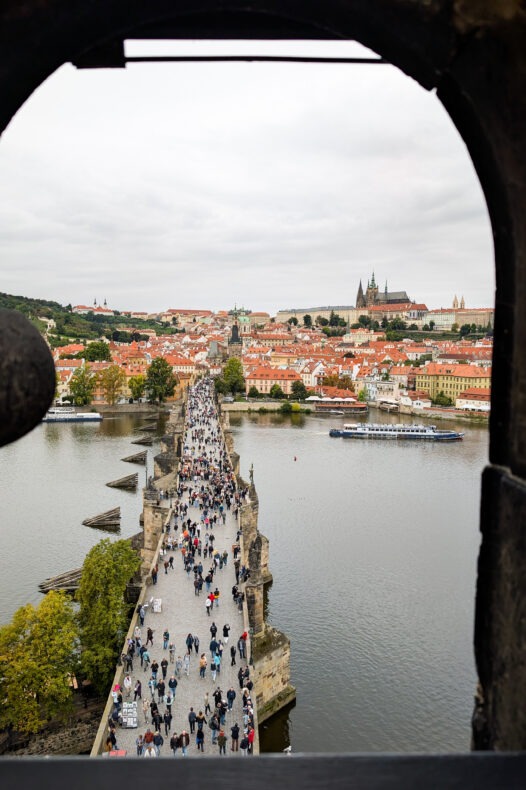
I walked across Charles Bridge on every visit. Only the last time did it occur to me that I could also go up. From the bridge towers I watched the stream of people shuffle from bank to bank, with Prague Castle rising behind the bridge. That view is now my favourite way to see it.
Construction started in 1357 under Emperor Charles IV, and for centuries this was the only way across the Vltava. The towers at either end weren’t decoration but gates built to defend the bridge and the city. Thirty statues of saints line the bridge, most of them copies these days. At the statue of John of Nepomuk you’ll see people rubbing a shiny bronze plaque. On the king’s orders he was thrown off this very bridge into the river in 1393, legend says because he refused to reveal what the queen had told him in confession. Touch the plaque and you’ll have good luck and return to Prague one day.
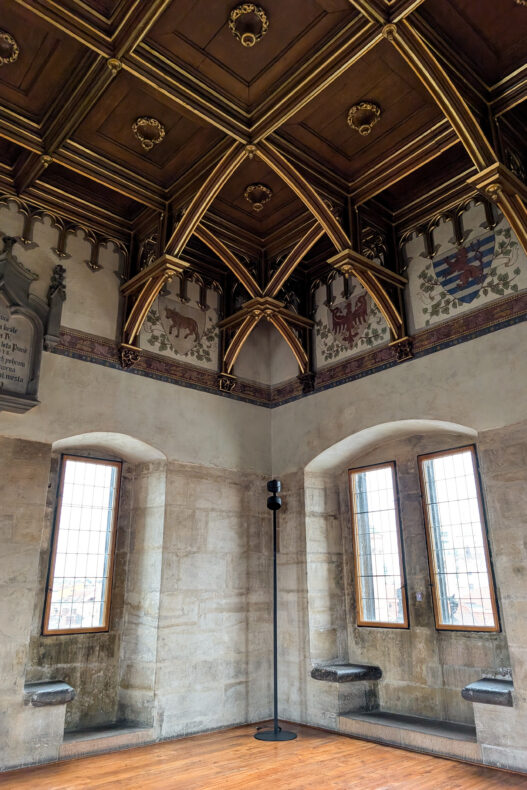
Inside the Gothic Old Town Bridge Tower, look up at the vaulted ceiling with its coats of arms. On the other side you can climb one of the Malá Strana bridge towers. The last flight of stairs there feels more like a ladder, so wear shoes you can trust.
For a calm stroll across the bridge, come early in the morning. My brother and I crossed it on our interrail trip in the middle of a busy summer’s day. We got a great view of the people in front of us and not much of the bridge.
#4 Prague Castle and Golden Lane
A cathedral, palaces, gardens and a street full of tiny houses all fit inside the walls of Prague Castle. Founded in the ninth century, it grew into one of the largest castles in the world. High above Malá Strana, it feels like a town in its own right.
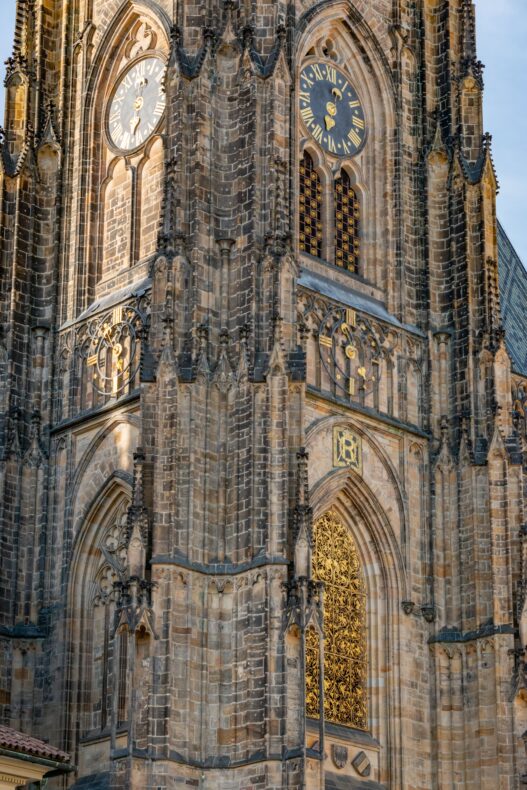
St Vitus Cathedral stands in the middle of the complex. Building started in 1344, but wars and money trouble left it half-finished for centuries, and it wasn’t fully completed until 1929. The standard ticket also gets you into the Old Royal Palace and St George’s Basilica. Another favourite is Golden Lane, a row of brightly painted cottages built against the castle wall. Emperor Rudolf II had them built in the late sixteenth century for the marksmen guarding the castle. Goldsmiths moved in later, which is how the lane got its name. A stubborn legend says Rudolf’s alchemists tried to make gold here. The emperor really was obsessed with alchemy, but his alchemists worked elsewhere in the castle. House number 22 belonged to Franz Kafka’s sister, and he spent a winter writing there.
Walking around the courtyards is free. For the cathedral, the palace and Golden Lane you need a ticket or your Visitor Pass. At noon there’s a formal changing of the guard at the main gate.
→ Book a guided tour of Prague Castle with entry ticket
#5 Malá Strana and St Nicholas Bell Tower
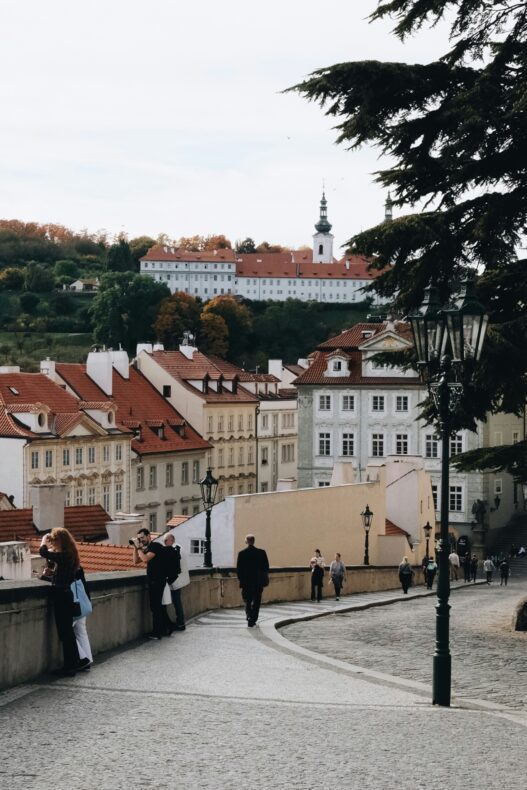
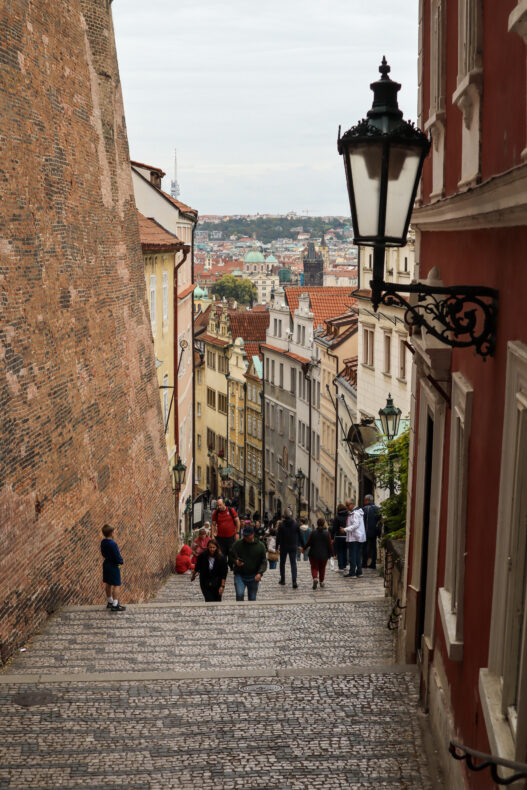
Homemade guidebook in hand, my teenage self quickly picked a favourite neighbourhood. Malá Strana, the Lesser Town, lies between Charles Bridge and the Castle. You stroll past Baroque palaces, little squares and alleys that wind up the hill. Follow Nerudova Street towards the castle and look out for the old house signs: a golden key, a red lion, three violins. Before house numbers existed, that’s how you found the house you were looking for.
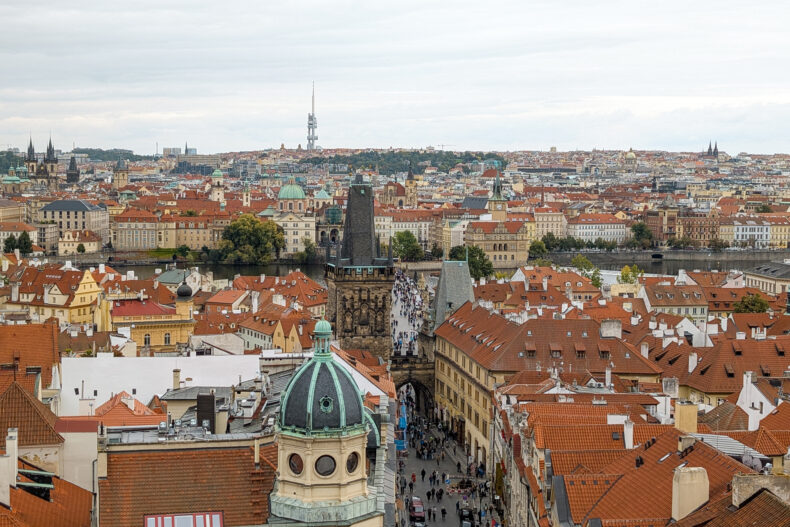
In the middle of the neighbourhood you’ll spot St Nicholas Church by its green dome. On my last visit I climbed the 215 steps of the bell tower next to it. From the top you see the red roofs of Malá Strana, Charles Bridge and the castle.
Fun fact: the tower never belonged to the church but to the town, which is why it has its own entrance on the square. On the way up you pass the rooms of the tower watchman, who lived here and kept an eye on the rooftops day and night. Fire spread like lightning through the tightly packed streets, so if he saw smoke, he rang the bell.
Under communism, the secret police looked out over the neighbourhood with a very different interest. From the tower, agents kept watch on the Western embassies in the surrounding streets.
#6 The Infant Jesus of Prague
In the Church of Our Lady Victorious in Malá Strana stands a statue less than half a metre tall that has its own wardrobe. The Infant Jesus of Prague, made of wood covered in a layer of wax, has been getting dressed for almost four centuries.
The statue came from Spain and was given to the Carmelites in 1628. When Swedish soldiers plundered the city a few years later, they tossed it behind the altar. A priest later found it with its little hands broken off, and after it was repaired, believers credited it with more and more miracles. Anyone who feels their prayer has been answered sends a robe as thanks, and that’s how the wardrobe grew to dozens of little dresses and cloaks. The nuns pick the outfit according to the colours of the church year. Upstairs, a small museum shows part of the collection.
What struck me at least as much was how many pilgrims travel to Prague just for this little statue with its big wardrobe. The church’s website tells you more about its history and the robes.
#7 John Lennon Wall
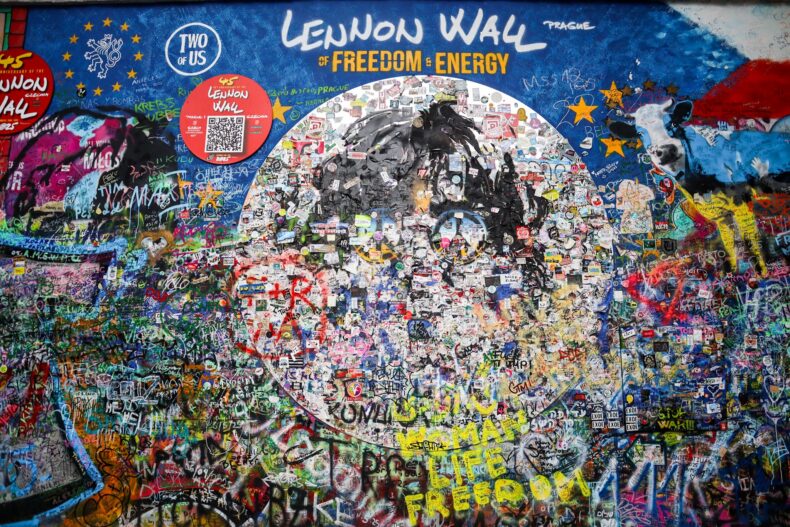
I’ve seen the John Lennon Wall on all three visits and it looked different every time. After Lennon’s death in 1980, his portrait appeared here. To young Czechs he stood for freedom and peace, and lyrics and drawings protesting the communist regime soon followed. The authorities painted over the wall again and again. Within days, new messages would pop up.
The words and pictures still keep changing. From the wall, carry on to Kampa Island. By the water you’ll find giant crawling babies without faces, made by Czech artist David Černý. You’ll come across his work a few more times around the city.
#8 Strahov Library
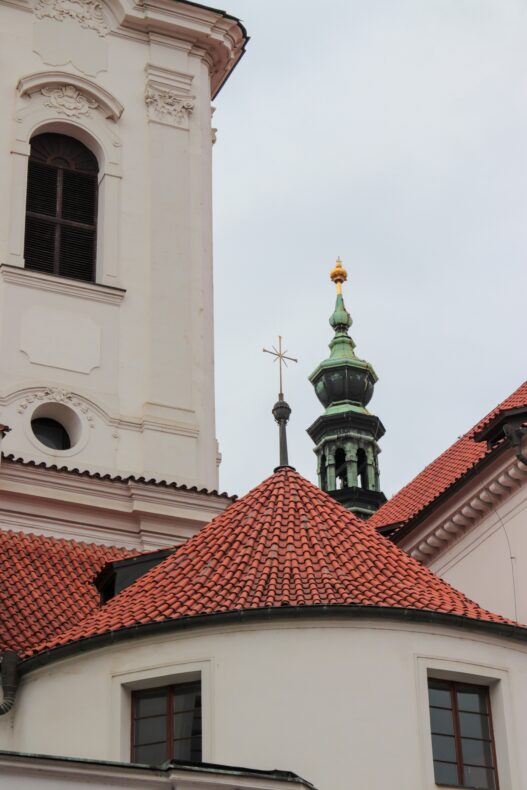
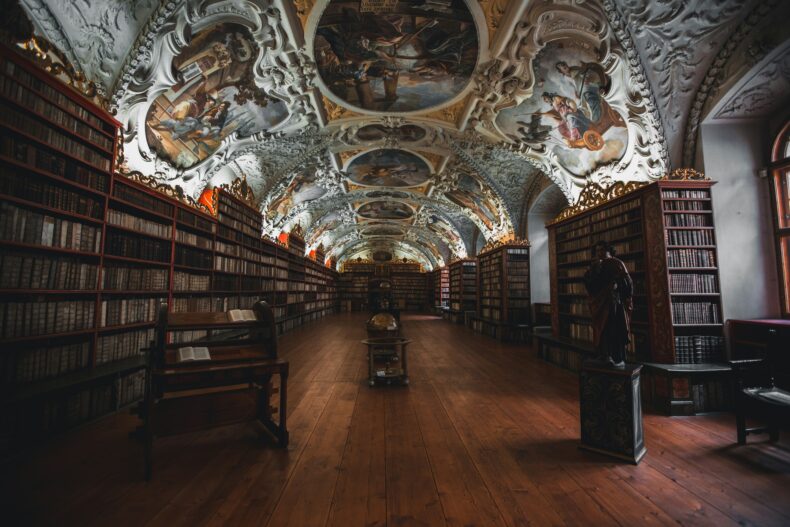
Twice I’ve stood in the doorway of the Strahov Library, and twice I didn’t know where to look first. Wooden bookcases reach all the way up to the painted ceilings. From the endless rows of books to the giant globes and the frescoes overhead, it’s stunning.
The monastery was founded in 1143. The library has two halls, the Theological Hall and the Philosophical Hall. On a regular visit you view them from the doorway, because the warmth and humidity from all those visitors are bad for the centuries-old books. The monastery sits above the Castle. Afterwards, take a walk through the monastery garden, which has one of my favourite views over Prague.
#9 The Jewish Quarter (Josefov)
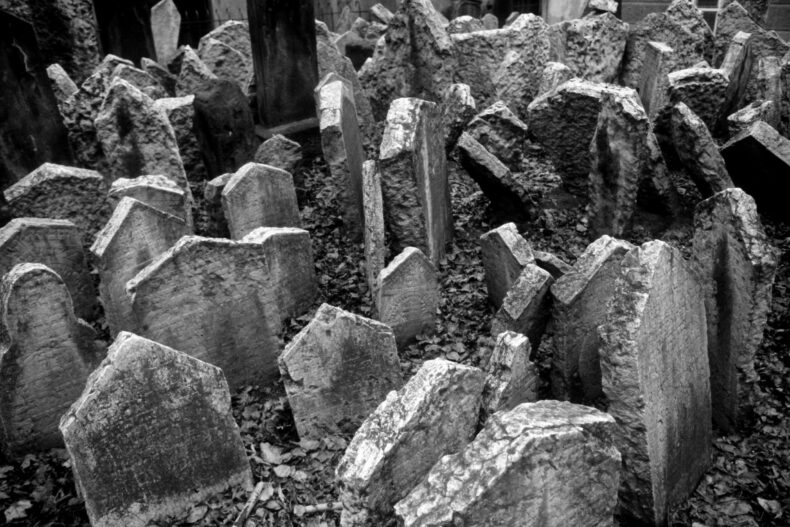
What I remember most from my first visit to Josefov is the Old Jewish Cemetery. Thousands of gravestones stand crammed together, some so crooked they lean against each other. For centuries this was the only place where Prague’s Jews were allowed to bury their dead, and in the Jewish faith a grave may never be cleared. When the ground was full, a new layer of earth went on top and the old headstones were raised. In places there are up to twelve layers of graves.
The quarter is also home to the thirteenth-century Old-New Synagogue, the oldest active synagogue in Europe. Legend has it that the Golem lies in its attic, a clay figure Rabbi Loew brought to life to protect the city’s Jews. In the Pinkas Synagogue, the names of almost 80,000 Czech Jews murdered in the Holocaust cover the walls, name after name.
One ticket from the Jewish Museum gets you into the cemetery and several synagogues. They’re closed on Saturdays for the Sabbath.
→ Book your tickets for the Jewish Quarter and its synagogues
#10 Wenceslas Square
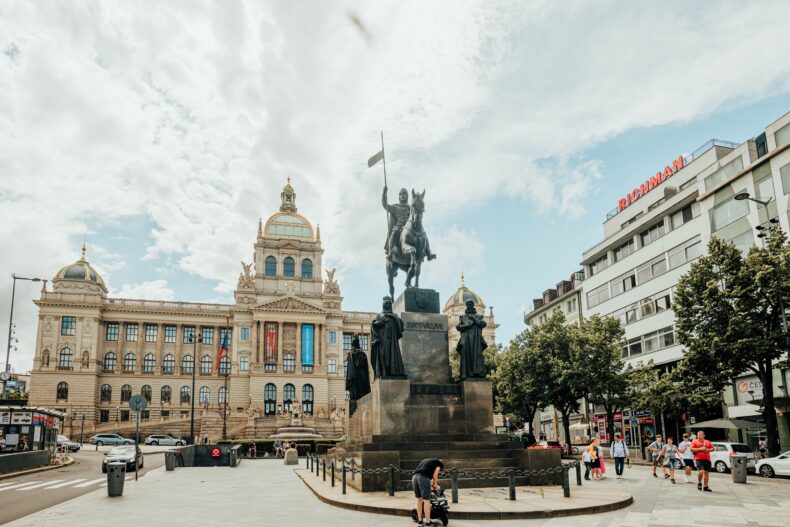
Arrive on Wenceslas Square (Václavské náměstí) and it feels more like a wide shopping boulevard than a square. At the top stands the National Museum, with the equestrian statue of St Wenceslas, the patron saint of Czechia, in front of it.
In November 1989, hundreds of thousands of people gathered here day after day. They jangled their keys as a sign that it was time for the communists to leave. Within a few weeks the regime fell without a single shot being fired, which is why it’s called the Velvet Revolution. Today most people come here to shop. Duck into one of the side arcades on your way. In the Lucerna Passage there’s another Wenceslas on horseback, but more about him further down.
#11 The Dancing House and the Vltava embankment
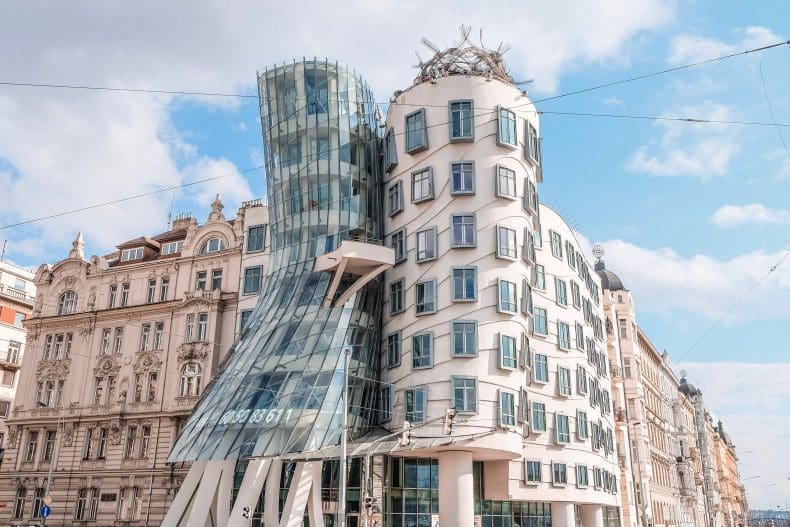
Among the stately nineteenth-century buildings along the Vltava stands one that seems to wobble. Frank Gehry and Vlado Milunić designed the Dancing House in the 1990s. One tower stands straight, the other sways like a twirling skirt, and together they look like they’re dancing. That earned the building the nickname Ginger and Fred, after the famous Hollywood dance duo. There’s a rooftop bar with views over the river and the castle.
From the house, walk along the water to Náplavka embankment. On Saturday mornings there’s a farmers’ market, and in the evening you can grab a drink on one of the boats moored along the quay.
#12 Petřín Hill
From Malá Strana you walk up Petřín Hill through parks and orchards. At the top, there’s yet another climb waiting. The lookout tower looks like a mini Eiffel Tower, and that’s no coincidence: it was built in 1891 by locals who had just seen the real one in Paris. After 299 steps you look out over the whole of Prague. Next to the tower is a mirror maze, a fun stop with kids. Robert Langdon gets lost among those mirrors too, in Dan Brown’s latest book.
Want to skip the uphill walk? Take the funicular, which is part of the regular public transport network.
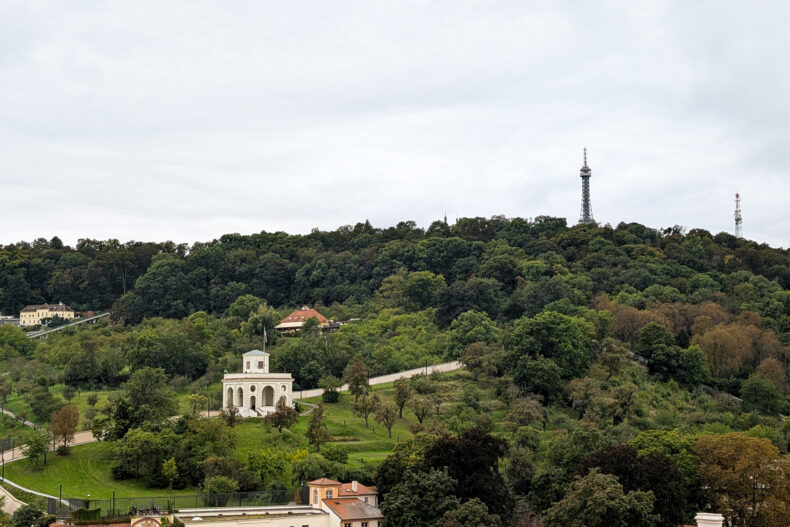
#13 Vyšehrad
For a bit more breathing space, head to Vyšehrad, an old fortress on a rock above the Vltava just south of the centre. Legend says Princess Libuše stood here and predicted a city whose glory would reach the stars. These days you can walk along the ramparts and look back up the river towards the Castle.
Inside the walls stand the neo-Gothic Basilica of St Peter and St Paul and a cemetery where many famous Czechs are buried. Among them are the composers Dvořák and Smetana and the artist Alfons Mucha.
Lesser-known places in Prague
On a solo trip to Thailand I once met a woman from Prague, and we travelled together for a few days. She later came to stay with me in Rotterdam, so on my third visit to Prague I looked her up. We walked through her city for hours. She took me to the photogenic main post office, pointed out street art I’d never have noticed and showed me shopping arcades I’d walked right past. Below are my favourites from that walk, plus a few places I’d already found on my own.
#14 Lucerna Passage, my favourite spot in Prague
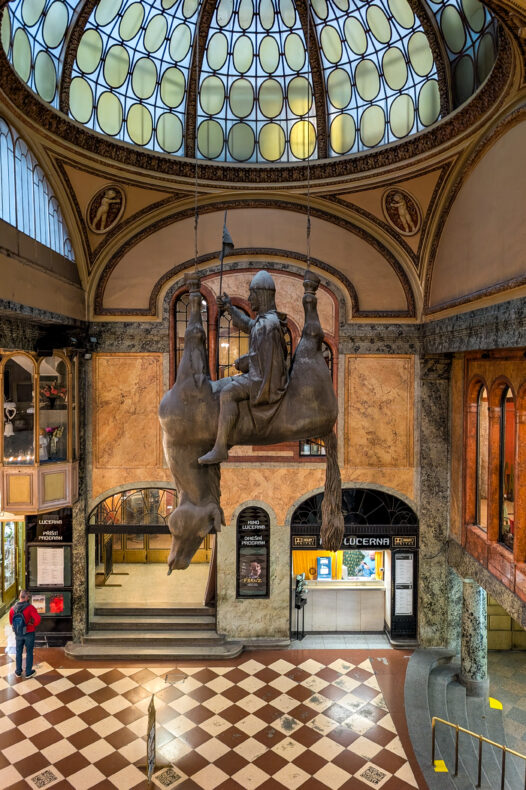
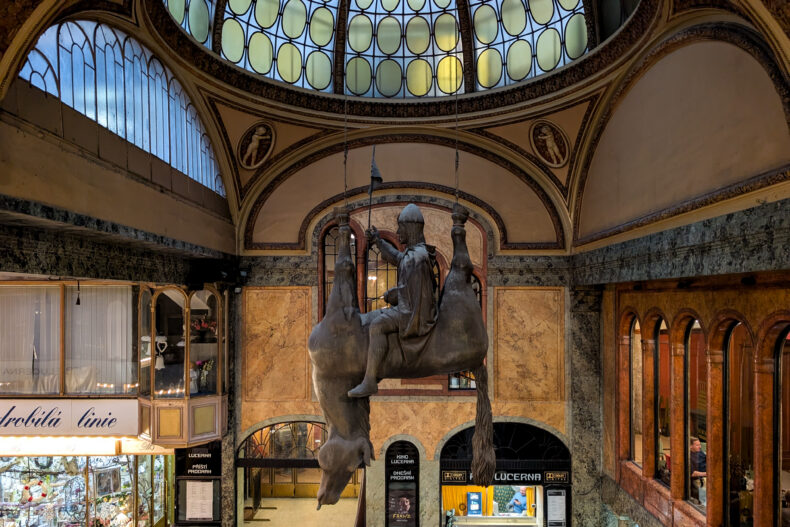
On Wenceslas Square, St Wenceslas sits proudly upright on his horse. In the Lucerna Passage, artist David Černý gives that statue a twist. His Wenceslas sits on the belly of a dead horse hanging upside down from the ceiling, tongue lolling out. Surrounded by the marble and stained glass of this old shopping arcade, it’s quite a sight.
The sculpture is called Kůň (Horse). Černý made it in 1999 as a wink at the heroic statue out on the square. Back then, not everyone saw the funny side. Today it’s one of Prague’s best-known artworks.
The arcade is a former palace, built in the early twentieth century by Vácslav Havel, grandfather of the later president Václav Havel. The communists seized the building, and after 1989 the family got it back. Above the hall you’ll find Kino Lucerna, the oldest cinema in Prague that still shows films. Take the old staircase up to the café, where you look down on that horse again from your table. The passage is free to enter. The Lucerna website has the programme for the cinema and concert hall.
#15 Clam-Gallas Palace
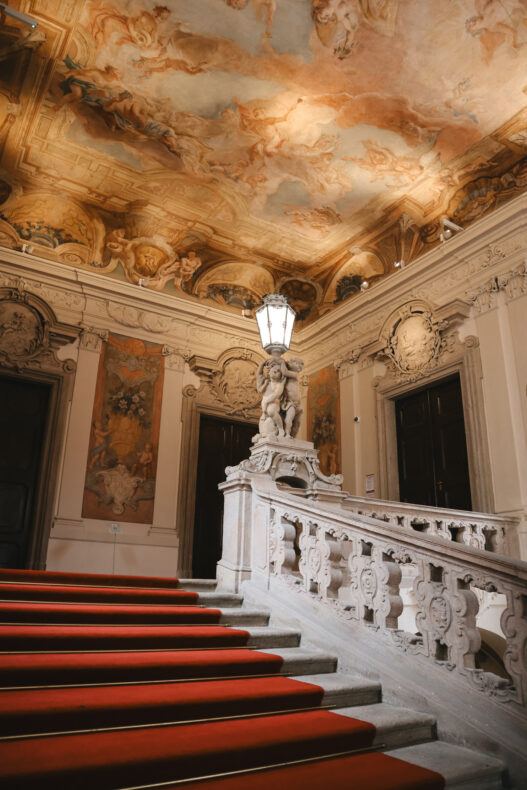
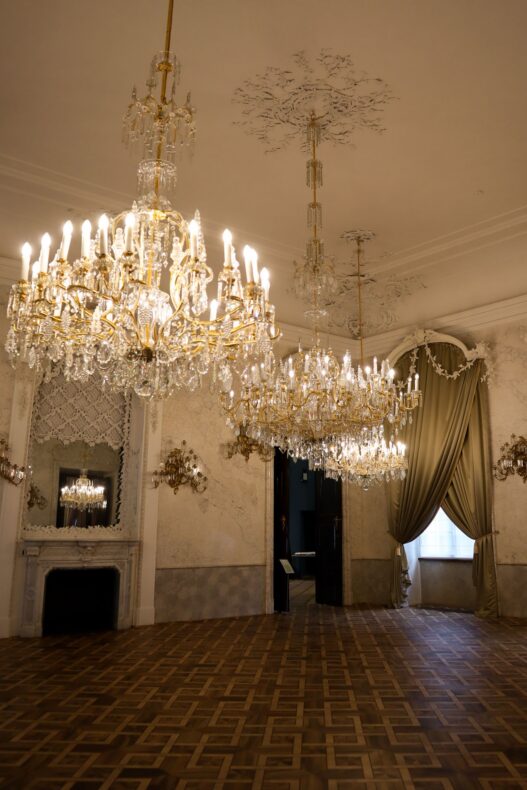
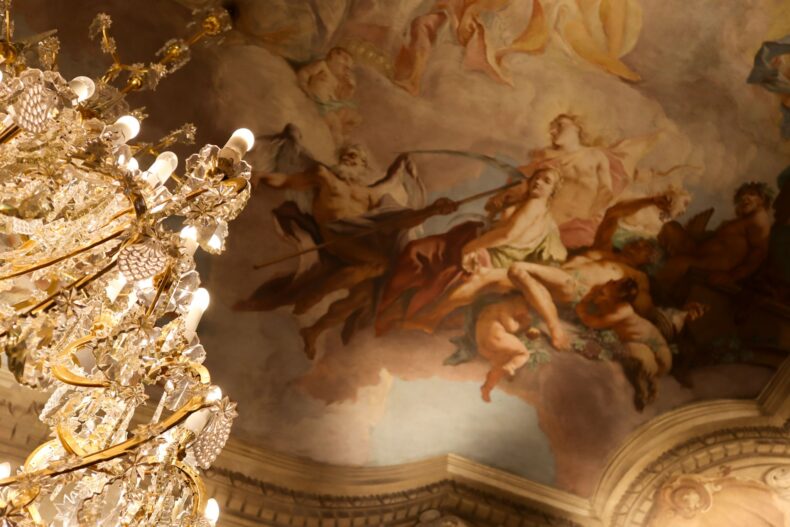
Four muscular giants hold up the entrance of the Clam-Gallas Palace on Husova Street. You only really notice them once you stop for a moment. Inside, it carries on in the same style. On the grand staircase you won’t know where to look, at the statues and stucco along the stairs or at the clouds and angels above your head.
The Viennese court architect Johann Bernhard Fischer von Erlach designed the palace in the early eighteenth century for Count Jan Václav Gallas. The family loved art and music, and Mozart and Beethoven both played here. There’s a reason so few people know the palace: until 2017 it housed the city archives, and only since 2022, after a major restoration, has it been open as a branch of the Prague City Museum, with changing exhibitions. I had it almost to myself, with all the time in the world to take in that staircase and the grand halls.
#16 The book tower in the Municipal Library
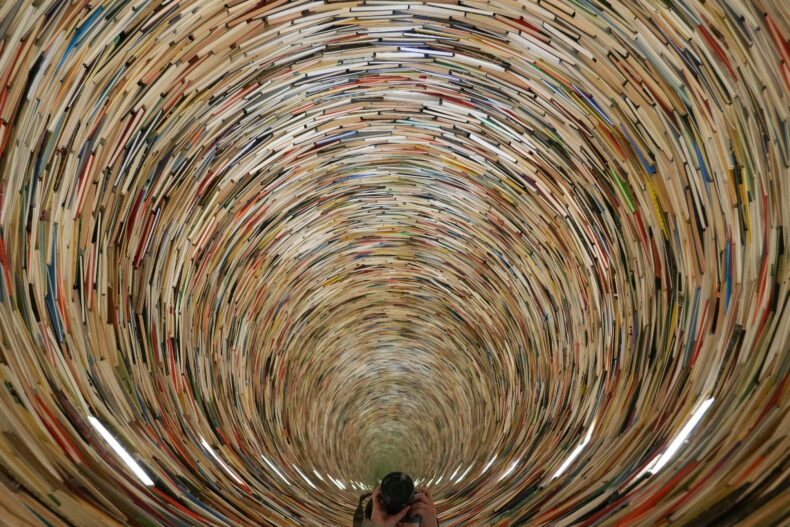
A local tipped me off about one more place around the corner from the Clam-Gallas Palace: the book tower in the entrance hall of the Municipal Library on Mariánské náměstí. When I walked past, the queue was enormous and I was in a hurry, so I gave it a miss. Next time it’s at the top of my list.
The artwork is called Idiom and was made by Slovak artist Matej Krén. He stacked around 8,000 books into a hollow column with a mirror at the top and bottom. Peer inside through the opening and the tower seems to go on forever. Idiom has stood here since 1998, but it was only when videos went viral on TikTok that tourists started pouring in. Krén himself never expected his work to become a tourist attraction.
Entry to the hall to see the tower is free. Come early in the day for your best chance of a short queue.
#17 The main post office
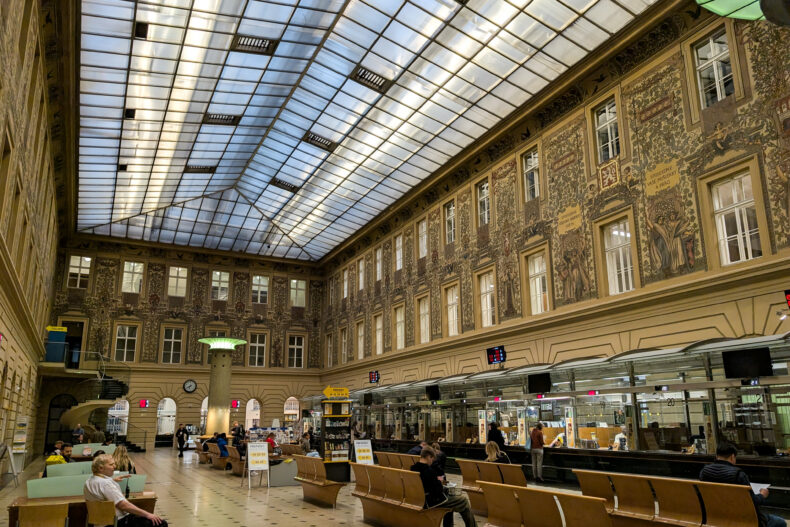
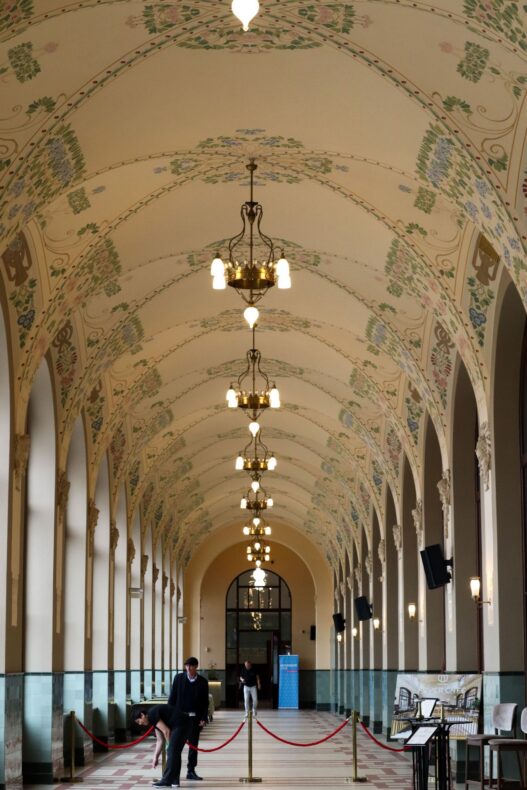
On Jindřišská Street, my friend from Prague took me into the main post office. From the outside I could easily have walked past it. Inside, we stood in a vast hall under a glass roof. Mail coaches used to drive into this courtyard to drop off letters and parcels, and the glass roof was added at the end of the nineteenth century.
Look above the counters at the painted flowers and figures that represent the post and transport. It’s still a working post office, so you can just walk in. And if you’ve been hunting for a postcard anyway, you can send it right here.
#18 Jubilee Synagogue
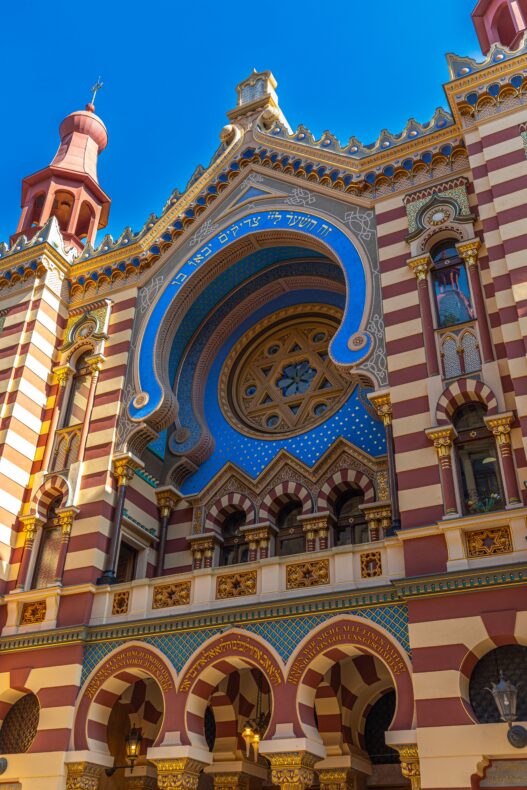
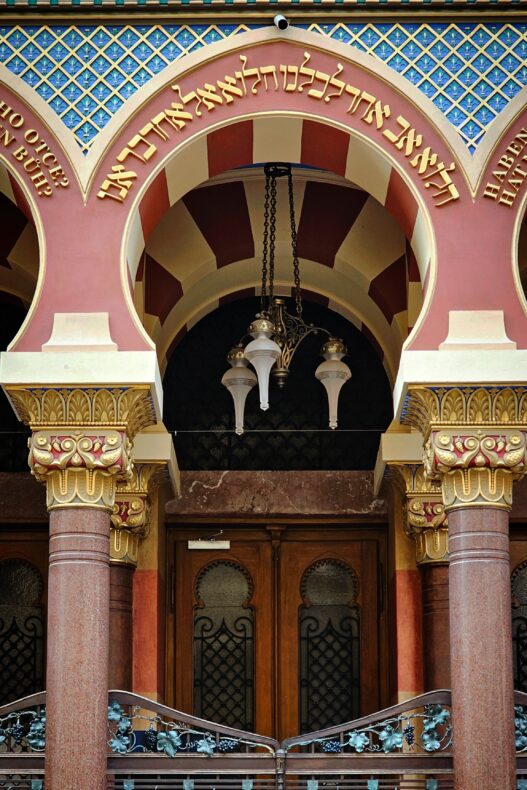
A few streets from the main station, a red-and-white striped façade suddenly appears, with horseshoe arches and a blue and gold Star of David in the middle. This is the Jubilee Synagogue, also called the Jerusalem Synagogue after the street it stands on.
Built in 1906 in a mix of Moorish Revival and Art Nouveau, it’s the largest synagogue in Prague. There’s a reason it stands so far from the Jewish Quarter. Around 1900 most of Josefov was demolished to make way for new streets, and three synagogues disappeared along with it. This one replaced them. The name refers to the fiftieth jubilee of Emperor Franz Joseph’s reign. Because it’s outside the Jewish Quarter, it gets far fewer visitors than Josefov.
#19 The art of David Černý
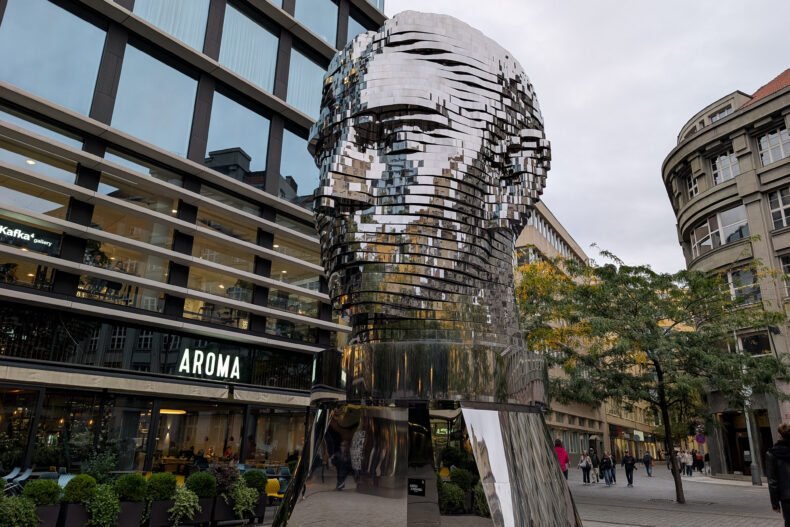
Without either of us planning it, our walk turned into a treasure hunt for the art of David Černý. Outside the Quadrio shopping centre, right by Národní třída metro station, a giant head of Franz Kafka turns itself apart layer by layer. The shiny steel panels rotate independently. Kafka wrote about people losing themselves, and here you watch his own face fall to pieces over and over. Wait a moment until the nose, eyes and mouth click back into place.
So who is this Černý? Born in Prague in 1967, he became famous overnight in 1991 when, as an art student, he painted a Soviet tank pink. The tank stood in the middle of the city as a war memorial. Černý was briefly arrested and the army painted it green again, after which a group of MPs repainted it pink in solidarity. Ever since, he’s been known as the provocateur of Czech art. In 2009 his installation Entropa caused an uproar in Brussels because it showed every EU country as a stereotype. He also founded the MeetFactory arts centre, and besides being an artist he’s a qualified pilot, which makes the Spitfires below that bit more personal.
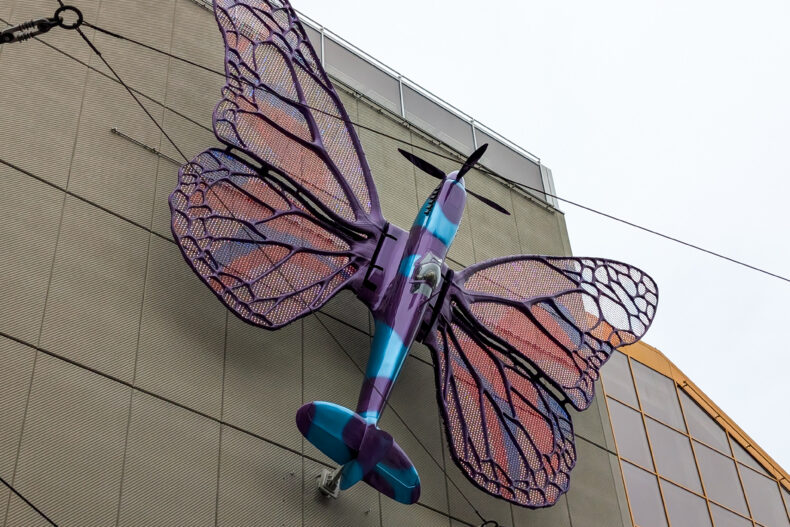
A few hundred metres away, two huge butterflies have hung from the Máj department store since 2024. Up close you’ll see that their bodies are Spitfire fighter planes, a tribute to the Czechoslovak pilots who flew with the RAF in the Second World War. Černý chose butterflies because of the butterfly effect: one small plane with a good pilot can change the course of a war. The wings move slowly and light up at night.
Add the horse in the Lucerna Passage and the crawling babies on Kampa, and you’ve got four stops for a walk past his work. Want to see more? Musoleum in Smíchov, his own gallery since 2023, has a permanent exhibition of his best-known pieces.
#20 Historic tram 42
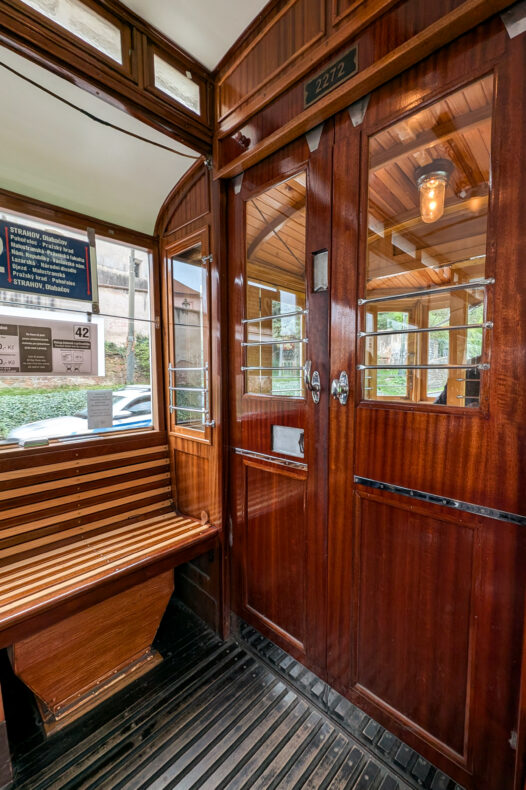
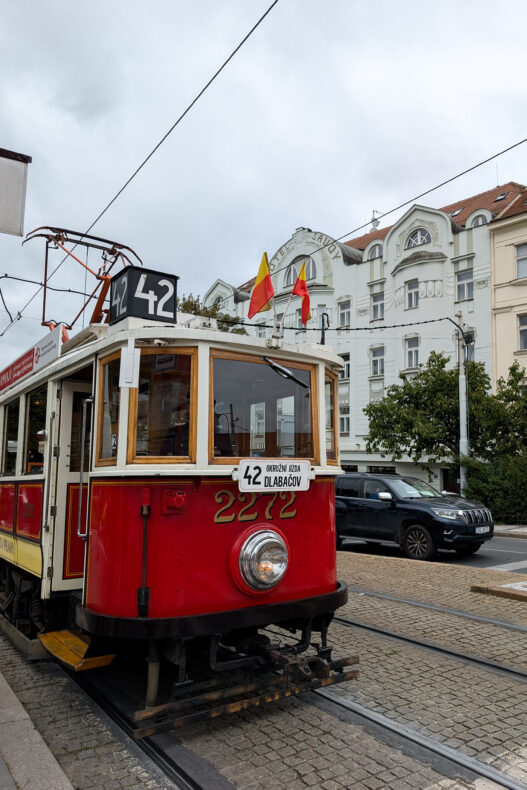
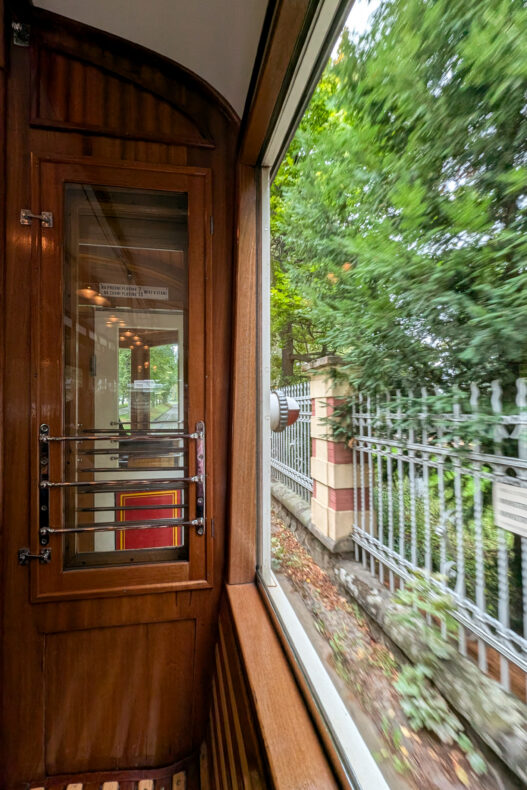
After all those towers, I loved taking historic tram 42 up Castle Hill. Sit down, look out of the window and let the tram do the climbing. Vintage trams run on this line past many of the sights in this blog, the oldest dating back to the days of Austria-Hungary. You can hop on and off wherever you like.
For tram 42 you buy a separate day ticket or use the Prague Visitor Pass. Regular tram 22 also runs past Malá Strana and the castle and is cheaper if you mainly want to get up the hill.
#21 Prague main station
My first lunch in Prague was at the station. I’d got off the night train that morning and sat down at Foyer Café, under the high Art Nouveau ceilings of the old station building.
Architect Josef Fanta designed this part of Praha hlavní nádraží in the early twentieth century, when train travel was still something glamorous. Under the great dome, travellers used to buy their tickets. If you arrive by train, step into that old hall before heading into the city. And make sure you look up.
→ Discover the perfect train route through Czechia in 5 stops
#22 Where to eat in Prague: Kantýna and SIA
On our walk, my friend pointed out Kantýna, a busy restaurant in a nineteenth-century bank building. The original paintings and sculptures by artist Jan Štursa are still there. These days the place is half butcher’s, half restaurant. You pick your meat at the counter and eat at long tables among office workers and locals. You can’t book, so get there early.
My own evening ended at SIA, an Asian restaurant serving dim sum, spring rolls and a creamy curry with poppadoms. That’s where I sat at eight o’clock, exhausted but happy.
Would you rather taste Prague with a guide? Book a beer walk with a traditional Czech dinner past a few old beer cellars in the centre.
Reading tip: Prague in Dan Brown’s The Secret of Secrets
On my last visit to Prague I was reading The Secret of Secrets, Dan Brown’s latest thriller. I couldn’t have picked a better moment. In the book, Robert Langdon races right across the city, and Brown tells you so much about every place he passes that at times it reads more like an ad for Prague than a thriller.
The story opens at sunrise on Charles Bridge, and Langdon stays at the Four Seasons on the Vltava. He passes the Old Jewish Cemetery and the Old-New Synagogue, takes the funicular up Petřín Hill and ends up in the Baroque library of the Clementinum, which Brown calls Langdon’s favourite room in Prague and maybe in all of Europe. The Infant Jesus of Prague gets a part too. Brown describes the little statue as a kind of holy Barbie doll.
Read the book before your trip and you’ll see the city with different eyes. Prague City Tourism even runs walks in Langdon’s footsteps these days.
Our tip for Prague in one day
When I asked my Instagram followers what they thought I’d managed to squeeze into one day, almost half guessed I’d seen the whole city. They weren’t far off. If you only have one day, this is my route.
Start the morning on Wenceslas Square and pop into the Lucerna Passage for Černý’s horse. Walk via the main post office to the Old Town, stop at the Clam-Gallas Palace along the way and be at the Astronomical Clock on the hour.
Next, cross Charles Bridge and climb at least one of the bridge towers. In Malá Strana, climb St Nicholas Bell Tower for the view over the rooftops. From there, take tram 42 or 22 up the hill to the castle and end the afternoon in Golden Lane.
In the evening, ride the tram back to Národní třída for Kafka’s rotating head and the Máj butterflies, which are lit up by then. After that, you’ve more than earned your dinner.
Enjoy our travel tips? Add The Orange Backpack as a preferred source on Google and you'll see us more often in your search results.
More tips for your trip to Prague
 Our pickHotels in Prague: from the Old Town to Malá Strana, find your spot on Booking.com
 Wake up in the heart of Prague: book your train tickets to Prague with NS International.
 Skip the queues in Prague: book a Prague Castle tour with entry ticket on GetYourGuide.
 Prefer everything arranged? Browse Czech Republic tours on TourRadar.
 No flight yet? Compare flights to Prague.
 Discover all our blogs about Czechia