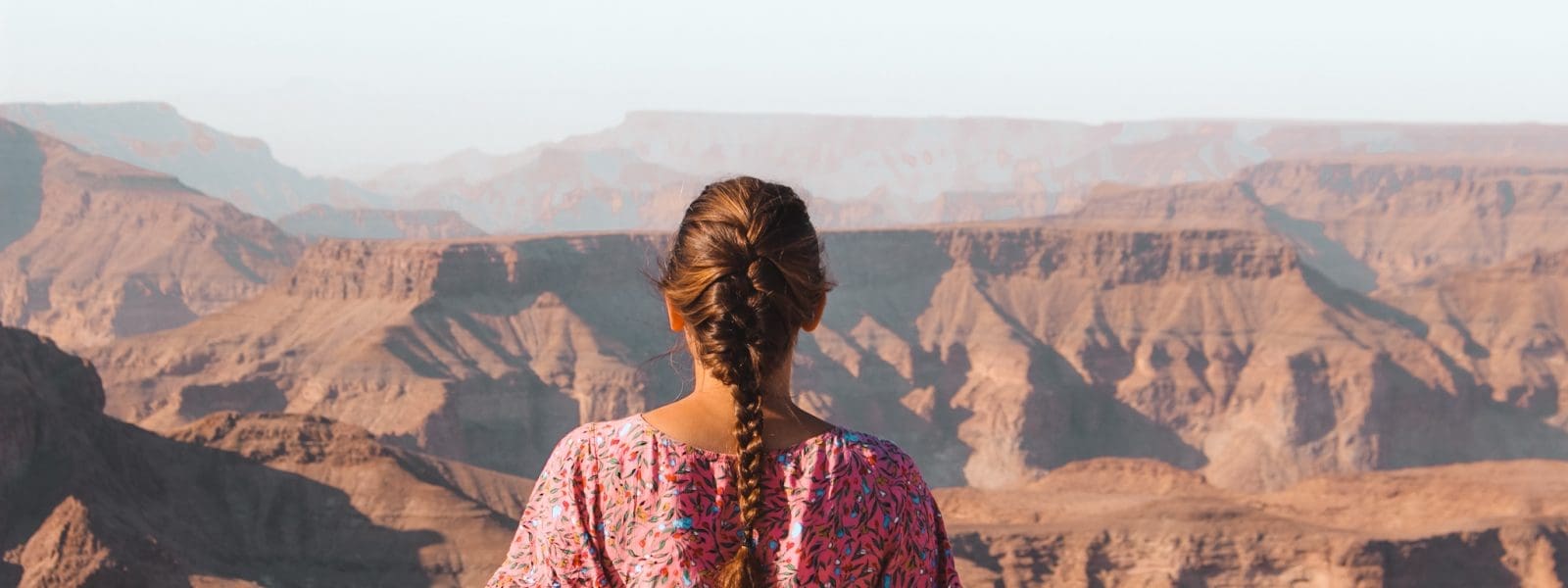
The Fish River Canyon is the largest canyon in Africa. For around 160 kilometres it winds like a snake through the empty landscape of southern Namibia. It is one of the country’s best-known sights, yet it never feels touristy. Go a little further than the main viewpoint and you will often have the rim of the canyon to yourself.
We visited the canyon in January, on our Namibia road trip in a 4×4 with a rooftop tent. We saw it from above and drove from viewpoint to viewpoint, all the way to remote Eagle’s Rock, where we spotted mountain zebras. Afterwards we drove on to Ai-Ais and spent the night at the campsite, where a hot spring heats the pool and the spa. We did not walk the famous multi-day hike through the canyon.


The Fish River Canyon: facts and history
It seems obvious that the Fish River carved out this canyon, but that is not how it started. A shift of the tectonic plates first opened up a deep trench in the mountain plateau. Erosion only came after that. The river took the easiest path, the trench. Because the hard rock of the plateau would not allow a straight line, it meandered through the landscape and cut the gorge deeper and deeper. That is how the canyon got the sweeping bends it is known for.
Glaciers finished the job and deepened the canyon even further during an ice age. Hard to picture in the Namibian heat, isn’t it?
The result is a gorge around 160 kilometres long, up to 27 kilometres wide and roughly 550 metres deep. That makes it the largest canyon in Africa and one of the largest in the world. Namibia’s tourism board calls it the second largest in the world, after the Grand Canyon in the United States. You can argue about that, because what do you measure: length, depth or width?
A place on a world ranking does not make the Fish River Canyon any grander than it already is. What a force of nature this is!
→ Discover the natural phenomena in Namibia you should not miss


How to get to the Fish River Canyon
The Fish River Canyon lies in the far south of Namibia, towards the border with South Africa. From Windhoek it is a long day’s drive. You could do that in one go straight from the airport, but we recommend adding a few stops along the way, if only because there is so much to see on this route.
The largest town in the area is Keetmanshoop, a good 150 kilometres north of Hobas. We came from the west ourselves, after Lüderitz and a night in Aus, and continued to the Orange River on the South African border afterwards.
Any car can handle the road to the main viewpoint. For the furthest viewpoint, Eagle’s Rock, you need a 4×4. In a few places that track is so rough and steep that you really will not get through without four-wheel drive. Want more? See our ideal route through Namibia and our tips on driving and renting a car in Namibia.
→ Compare rental cars in Namibia on Discover Cars
→ Discover the 4×4 road trip with rooftop tent by Namibia Nomads

What is the best time to visit the Fish River Canyon?
That depends on what you are coming for. The viewpoints can be visited all year round. The multi-day hike through the canyon is only possible in the Namibian winter, from 1 May to 15 September. In the summer months the canyon floor gets far too hot and the trail is closed.
We were there in January, right in the middle of the low season. Expect hot afternoons, but also peace and quiet. At Ai-Ais we had the indoor spa entirely to ourselves.
Try to be at the rim early or late in the day. We drove out to the canyon at the end of the afternoon for the sunset.

How much time do you need at the Fish River Canyon?
One day is plenty to visit all the viewpoints. In our Namibia itinerary we plan two nights in this area: one at Hobas, so you can catch the sunset over the canyon, and one at Ai-Ais to unwind in the warm water. The hike is a different story, as most people need five days for it.

Hiking the Fish River Canyon: permit and preparation
Most visitors only see the Fish River Canyon from above. You are only allowed to go down into the gorge with a permit for the multi-day hike. The trail is a little over 80 kilometres long, starts at Hobas and ends at Ai-Ais. Most hikers take five days to complete it.
We did not attempt it ourselves, but it is said to be one of the most beautiful hikes in the world. It is certainly a tough one. There are no facilities along the way, so you carry all your food, water and sleeping gear yourself. You also have to arrange your own transport to the start and from the finish.
If you want to walk the trail, you need to be in Namibia between May and mid-September and sort everything out well in advance. Only a limited number of hikers may enter the canyon each day, a group must consist of at least three people and you need a medical certificate. Permits are booked through Namibia Wildlife Resorts (NWR). Rules and fees for the hike and for park entry change from time to time, so check them with NWR shortly before your trip.

Where to stay near the Fish River Canyon
Options around the canyon are limited, and they are far apart. So the real choice is where you want to wake up: by the hot springs, on the rim of the canyon or as close to the viewpoints as possible.
#1 Ai-Ais: camping by the hot springs and the spa
For hikers who have just spent five days toiling through the Fish River Canyon, the resort at Ai-Ais is paradise at the end of all that sweat, dust and rock. Even without that notorious hike behind you, it is a great place to spend a night. We stayed at the campsite ourselves. The campsite itself is fine, though nothing special. Ai-Ais earned its place among our favourite campsites in Namibia because of the spa.
Besides camping pitches there are rooms and chalets. You book through the Ai-Ais page of Namibia Wildlife Resorts. As a guest you can use the outdoor pool. Just do not expect a refreshing dip: the water is warm thanks to the hot spring. There is also an indoor spa where you can book massages. In low season we had it completely to ourselves.
#2 Fish River Lodge: sleeping on the rim of the canyon
Fish River Lodge has the best view of them all: you sleep right on the cliff edge, with the canyon below you. Set your alarm for sunrise. The lodge does sit on the opposite side of the gorge from the viewpoints, so popping into the national park from here is not a quick drive.
You may not need to, though. The lodge runs plenty of its own activities, from multi-day hikes to 4×4 drives. Do keep in mind that both the stay and the activities come with a hefty price tag.
#3 Hobas: the closest stay to the viewpoints
Right at the park gate is the camp at Hobas, with camping pitches and simple chalets. There is a pool and a restaurant, and baboons roam around your tent. So keep an eye on your belongings. The camp is nothing special, but nowhere else can you stay this close to the viewpoints. That makes it the most practical base if you want to see the sunset over the canyon.
→ Discover the 29 most unique places to stay in Namibia
→ Discover the 11 best campsites in Namibia

How to visit the Fish River Canyon: the viewpoints
Your visit to the canyon starts at Hobas. At the gate you pay the entrance fee for the national park, per person and per vehicle. Your permit is valid for 24 hours. From here you can drive to all the viewpoints in a single day. Our tip: stay the night at Hobas, so you can watch the sunset from one of the viewpoints in the evening.
#1 Main Viewpoint: looking out over Hell’s Bend
From the gate at Hobas it is another 10 kilometres or so to the main viewpoint. This is where you look out over Hell’s Bend, the famous curve in the river. There is a viewing platform, complete with picnic tables and toilets. Information boards tell you more about the canyon, its plants and animals and the peoples who have traditionally lived in this region.
This is the viewpoint where most people stop, so in high season it can get quite crowded here.

#2 Hiker’s Viewpoint: quieter and the start of the hike
A little further on is the Hiker’s Viewpoint. It is a lot quieter here, and this is also where hikers begin their descent into the gorge.
For more viewpoints, drive back to the road between Hobas and the Main Viewpoint. Two smaller roads branch off from it. The first one takes you to the nearest viewpoint after a few kilometres.


#3 Sulphur Springs Viewpoint: named after the sulphur springs
The second side road passes two viewpoints. The first is the Sulphur Springs Viewpoint, named after the sulphur springs down in the gorge. You cannot see or visit the springs themselves from here, but you do get the view over the canyon.

#4 Eagle’s Rock: by 4×4 to the furthest viewpoint
From Sulphur Springs a long track leads to the furthest viewpoint: Eagle’s Rock. This is what you need your 4×4 for. It is a bumpy ride through wonderful scenery. With a bit of luck you will spot the mountain zebras that live in this area, just as we did.
The road ends here, so you take the same way back to Hobas.

#5 Ai-Ais: the hot springs at the end of the canyon
From Hobas you drive on to the southernmost point of the Fish River Canyon: Ai-Ais, where the multi-day hike also finishes. You can walk a short way into the final stretch of the trail here, but sadly this part of the gorge is not that impressive.
The spa, on the other hand, is well worth it. Ai-Ais means ‘burning water’ in a local indigenous language and refers to the hot spring that rises here. It heats an outdoor pool and an indoor spa.

Fish River Canyon map
Our map shows the viewpoints and the places to stay from this blog.
Tip: open the map on your phone with the square at the top right, while signed in to Google. You can then find it again in the Google Maps app under You > Maps.
Enjoy our travel tips? Add The Orange Backpack as a preferred source on Google and you'll see us more often in your search results.
Plan your trip to Namibia
Everything you need to book your trip, in one place. From desert lodges to a 4x4 with a rooftop tent.
 Our pickLodges and hotels in Namibia: from a desert lodge near Sossusvlei to a safari camp right outside Etosha. Pick your spot or browse all of Namibia on Booking.com
 Namibia is made for a self-drive trip. Staying in lodges? Compare rental cars with Discover Cars. Rather camp? Book a road trip with a 4x4 and rooftop tent from Namibia Nomads, route and campsites sorted.
 Prefer everything arranged? Browse Namibia tours on TourRadar.
 No flight yet? Compare flights to Windhoek.
 Discover all our blogs about Namibia


