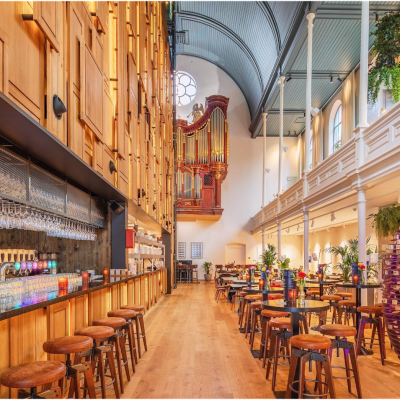
What is there to do in Almere? A lot more than you’d think! We’d never pictured this modern city in Flevoland as a place for a city break or even a day out, but we’ve changed our minds. While house-sitting in one of Almere’s newer neighbourhoods for a week and a half, we explored all its sights and hotspots, and we were won over by the bold architecture, the endless nature and the fun attractions. In this guide we share all our tips for a day trip, a weekend or even a whole holiday in Almere, including where to stay.


Where is Almere?
Almere lies in the south of the province of Flevoland, close to Amsterdam and Utrecht, which are both easy to reach from the city. If you’re flying in, Amsterdam Schiphol is the nearest airport.
Flevoland is the youngest province in the Netherlands, reclaimed from the water only last century to create more land. The plan was mostly farmland, but Amsterdam and the rest of the Randstad were bursting at the seams, so a brand-new city was built in the far southwestern corner of the polder: Almere. The first homes were finished in the 1970s in what is now Almere Haven. Since then the city has grown into several centres that together cover the whole tip of Flevoland, between the Markermeer, IJmeer and Gooimeer lakes.


Where to stay in Almere
Almere was built as a city of fairly independent centres. That plan was later dropped, and in the 1990s the firm of star architect Rem Koolhaas designed a proper city centre, which you’ll now find in Almere Stad. Even so, districts like Almere Haven and Almere Buiten still have their own shops, restaurants and little town centre.
In Almere Centrum you’ll find the city’s best hotels, such as Hotel Leonardo in its eye-catching building or PLAZA Premium Almere right next to the station. Travelling with kids? Then Van der Valk Hotel Almere on the edge of the city is a good bet, with family rooms and an indoor pool. Rather have a roomy apartment near the beach? Take a look at this two-bedroom apartment in Almere Poort.
For the quirkiest places to stay, head to the district of Oosterwold, where residents are free to build whatever they like. Here you can sleep in a hobbit-like cabin or a revamped Wikkelhouse at Pigs & Pillows, both with a private hot tub and sauna, or in one of the four wooden chalets of B&B Eemhouses.


Almere sights on a map
8 best things to do in Almere
#1 Oostvaardersplassen
The Oostvaardersplassen might just be Flevoland’s biggest attraction. When the polder was reclaimed some fifty years ago, a vast wetland formed between Almere and Lelystad, full of unique plants and wildlife. That makes it the largest man-made nature reserve in the world! It’s part of Nieuw Land National Park, the youngest national park in the Netherlands.
Birdwatchers are in for a treat, because this watery reserve is packed with special birds. Even the white-tailed eagle has been around since 2006. Keep an eye out for Heck cattle, red deer and Konik horses too. There are plenty of them, so your chances of spotting some are good. And if they stay out of sight, the endless lakes, reed beds and grasslands are reason enough to come.
Visiting from Almere is easy. The Natuurbelevingscentrum (nature experience centre) is just a few minutes from the city and the starting point of several walking and cycling routes. To get there, you walk right through a huge wooden structure shaped like a bird. A little further north, towards Lelystad, Buitencentrum Oostvaardersplassen is another handy starting point with its own routes, about half an hour’s drive from Almere.


#2 Architecture of Almere Stad
Almere is also famous for its architecture. As the newest city in the Netherlands, it has no historic buildings, cosy canals or centuries-old churches. Everything here is new, newer, newest. In return, the city is full of modern architecture, and some of it is truly special.
The best-known building in the centre is probably the photogenic The Wave. Its apartments seem to roll outwards like a wave, a design by architect René van Zuuk that was completed in 2004. The curve is strongest on the Weerwater side, while from the other side you see it together with the cycle bridge over the Olstgracht, another great photo spot that looks a bit like a ship with several masts.
Right next door stands Side by Side. We found it less spectacular than The Wave, as you have to look a little harder to see what makes it special: two tall, narrow buildings on the Weerwater, set at right angles to each other, with the windows scattered unevenly across the facades.
Almere’s New Library is in the heart of the city on Stadhuisplein. Its design was inspired by the rice terraces of Indonesia, with floors of bookshelves rising in steps. Right at the top you’ll find the children’s books and a fun play corner for little ones, and there’s a café and a pleasant garden too.
Our personal favourite is La Defense, just north of the city centre. From the outside, this office complex doesn’t look like much. Step into the courtyards, though, and you’re surrounded by colour, created by a special film on the windows that catches the daylight.
Want more? Try this free audio tour past Almere’s most photogenic buildings. You’ll hear the stories behind the architecture, and a photographer shares tips on how to capture each building.


#3 Eat and drink at the hotspots of Almere
The centre of Almere is full of great places to eat and drink, from poke bowls and pancakes to pizza and ice cream. These are our favourite hotspots in Almere:
- De Bierfabriek for beer brewed right here in Almere.
- Oh My Pancakes for the best pancakes in town.
- Woodstone for tasty pizza.
- Poké Perfect for the ultimate poke bowl.
- ANNO for cocktails on the terrace.
- Meat in the City for meat lovers.
- Madame Jeanette for Surinamese food in a trendy interior.
#4 Shopping in Almere Centrum
Love shopping? Then Almere Centrum will make you very happy. The huge shopping area is packed with big chains and fun little boutiques. We’re not big shoppers ourselves, but we still enjoyed a wander through the centre.
While you’re there, look out for the clever way the centre is built: in layers. The car parks are hidden underground, the shops are at street level, and above them are homes with green gardens and roof terraces.

#5 Almeerderstrand and the other beaches of Almere
Almere might not be the first place you’d think of for a beach day, yet its 42 kilometres of shoreline hide some lovely city beaches. The best known is Almeerderstrand, the biggest and widest beach in Almere. Festivals and events are held here, and the beach pavilion is the place for a drink and a bite.
We can also recommend Noorderplassenstrand on the edge of the Waterwijk district. The Noorderplassen lakes are a great place for a day outdoors anyway, so you might as well finish it lazing on the beach. Another popular choice is Lumièrestrand on the Weerwater, part of Lumièrepark on the edge of the centre, which makes it one of the most central beaches in town. You’ll find more beaches along the Esplanade in Almere Centrum and in Almere Haven.

#6 Stadslandgoed De Kemphaan
You can’t skip Stadslandgoed De Kemphaan, a city estate full of woods and open space. It’s one of the most child-friendly places in Almere, where kids could happily spend a whole holiday, but it’s just as nice without little ones.
So what is there to do? Besides forests and nature, the estate is home to some of Almere’s most unusual attractions. The best known is Dierenpark Almere Jungle, a mix of an indoor botanical garden and a zoo. At the Stadsboerderij (city farm) you can peek into the stables or shop at the organic farmers’ market. There’s also a pancake farm, the enclosures of the AAP primate sanctuary, a treetop climbing park, and animals and nature education at Stad & Natuur.
Want to stay the night? At Natuurcamping De Kemphaan you can sleep in a forest cabin, a pipowagen (a traditional Dutch wooden wagon) or a tiny house. Bringing your own tent, caravan or campervan is fine too.


#7 Oosterwold self-build district and the Green Cathedral
It’s not just the city centre that’s full of striking buildings. Almere even has a whole district devoted to the creations of its residents. Oosterwold is a green eco-district east of the city where people have free rein: no rules about uniform housing blocks, just plots that owners fill in as they please. It’s well worth exploring on foot, by bike or, if you must, by car. We passed wooden cabins, Mongolian yurts, clay houses, a building shaped like a UFO and much more. It’s one of the most unusual neighbourhoods in the world, and even the international press has written about it.
Right next to Oosterwold lies the Kathedralenbos, a forest whose highlight is the Green Cathedral, a remarkable piece of land art. Artist Marinus Boezem felt that a new city like Almere needed its own church, just a new kind of church. In the 1980s, 178 poplars were planted following the floor plan of Reims Cathedral. A few years later, a counter-cathedral followed nearby. This time no trees were planted; instead, a clearing in the same shape was cut out of the forest, with stones on the ground marking where the trees stand in the other cathedral. The shapes are clearest from the air, but walking through these green churches is still a lovely outing.
#8 The land art of Flevoland
The Green Cathedral is far from the only land art in Flevoland. These are artworks that interact with their surroundings, hence the name. Close to Almere you’ll also find Polderland Garden of Love and Fire. Seen from above, it’s five lines cutting through the landscape: three small canals, a footbath and a strip of black gravel with a sculpture of aluminium columns. We were a lot less impressed by this one, because it looks rather bare from the ground, and the weeds around it gave it a slightly neglected feel. If you happen to be nearby, though, it’s worth a quick stop.
There’s more striking land art elsewhere in Flevoland. One of the most popular pieces is Exposure by Antony Gormley in Lelystad, a 26-metre-tall crouching man gazing out over the Markermeer. Its frame refers to the straight lines Gormley saw in Flevoland’s man-made landscape.
Still high on our wish list is Riff, PD#18245. It was made in 2018 to mark 100 years of the Zuiderzee Act, the law that made Flevoland possible. The artwork is a huge concrete cast, created by pouring concrete into a hollow in an enormous hill. You can walk right through the middle, climbing a staircase past the remains of the old Zuiderzee seabed.
Want to see more land art in Flevoland? You’ll find every location on the official website.