
Paris is pretty enough from the pavement, but you only really understand the city once you see it from above. The Eiffel Tower rising over everything else, the Seine winding between the rooftops, and in the distance the domes, towers and chimney pots that make up that instantly familiar skyline.
The good news is that the best views in Paris don’t always come with a ticket. Some viewpoints are free and open to anyone, such as a rooftop terrace on top of a department store or a park on a hill. Others take a serious climb or a booked time slot.
In this blog we take you to the best viewpoints in Paris, from towers and stairways to rooftops, bridges, a park and a museum clock. At the bottom you’ll find which ones are free, when to go and what to book ahead.
Map of the viewpoints
Tip: open the map on your phone with the square at the top right, while signed in to Google. You can then find it again in the Google Maps app under You > Maps.
The 10 best views in Paris
#1 Eiffel Tower: the most famous view in Paris
The Eiffel Tower is the best-known landmark in Paris and the most obvious viewpoint too. That doesn’t make the view any less impressive. The tower was built for the World’s Fair of 1889 and was meant to be taken down again after twenty years. Luckily that plan changed. Gustave Eiffel’s iron structure was heavily criticised at the time, yet today it is admired all over the world.
You can visit the tower at different heights. On the first floor you walk across a glass floor, the second floor already gives you a wide view, and if you want to see it all, you take the lift to the summit. From there you look out over the whole city, from the golden dome of Les Invalides to the Sacré-Cœur in the north. On a clear day you can see for miles.
Book your tickets online in advance through the official Eiffel Tower website. You choose whether to go up to the second floor or all the way to the top, and whether you take the stairs or the lift.
→ Discover 7 hotels with an Eiffel Tower view

#2 Arc de Triomphe: looking down the Champs-Élysées
The Arc de Triomphe sits at the top of the Champs-Élysées, in the middle of one of the busiest roundabouts in Paris. Napoleon ordered the triumphal arch in the early nineteenth century as a tribute to his army after the victory at Austerlitz. He never saw the result himself, because it took decades before the monument was finished. The arch is decorated with reliefs of military victories and allegorical figures.
Beneath the arch, the eternal flame burns at the Tomb of the Unknown Soldier. It is rekindled every evening during a short ceremony. Whatever you do, don’t try to cross the roundabout: an underground passage leads you to the entrance, after which a long spiral staircase takes you up to the viewing platform. Buy your tickets in advance on the official Arc de Triomphe website.
At the top you look out over Baron Haussmann’s star-shaped street plan. The Champs-Élysées runs in a straight line towards the Louvre, while the skyscrapers of La Défense loom up on the other side. You can also see the Eiffel Tower, Montmartre and the Bois de Boulogne. And that is the big advantage over the tower itself: here the Eiffel Tower is actually in the picture.

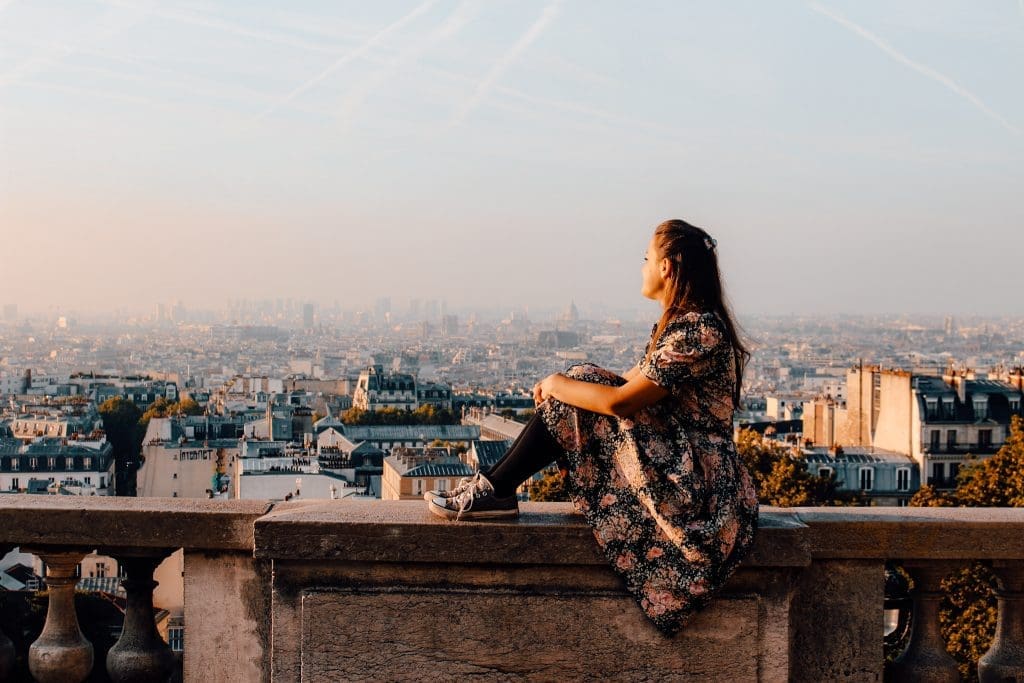
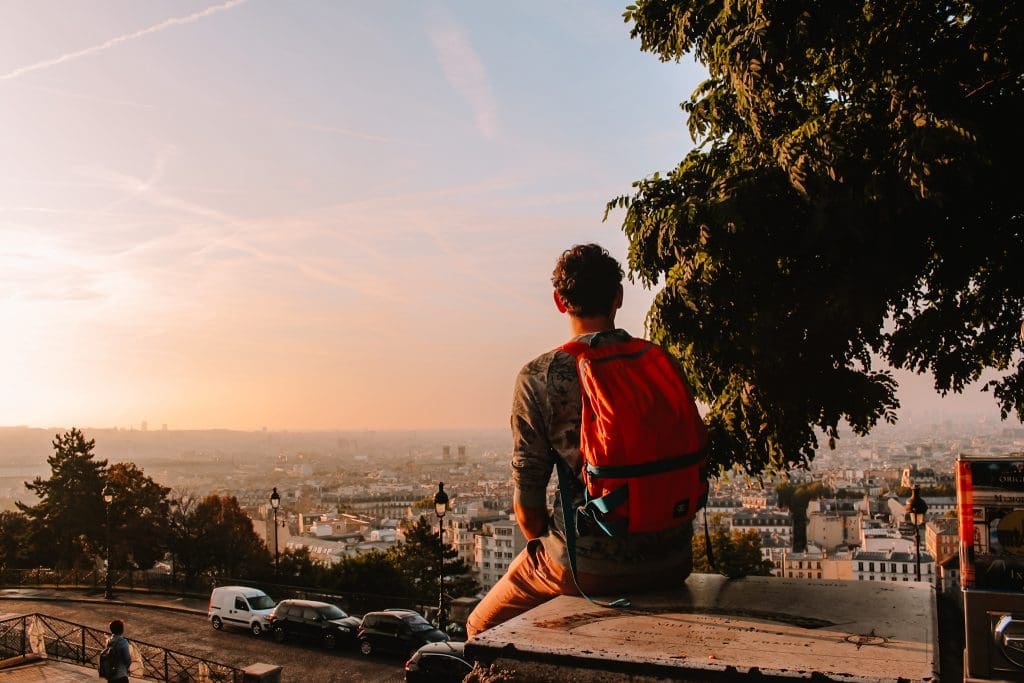
#3 Steps of the Sacré-Cœur: a free view from Montmartre
Looking for a view without an entrance ticket? Head to Montmartre, where the steps in front of the Sacré-Cœur give you one of the finest panoramas in Paris. The white basilica sits on the highest hill in the city, and building work started at the end of the nineteenth century.
From the steps you look out over a sea of rooftops, with the Tour Montparnasse and the rest of the skyline in the distance. The view is at its most spectacular around sunrise or sunset. You don’t need to go inside or buy a ticket, although you can climb the dome of the basilica for an even higher vantage point. That means a narrow staircase of almost three hundred steps.
The steps of Montmartre are always open and draw tourists and locals alike. Musicians, artists and street sellers keep the atmosphere lively. Still, it can be peaceful here too, especially if you come a little earlier in the day, as we did. Not keen on the walk up the hill? Take the funicular, the little cable railway that runs alongside the steps.
→ Read our guide to Montmartre: where to stay and what to see
#4 Towers of Notre-Dame: views over the Seine and its islands
After years of restoration you can climb the towers of Notre-Dame again, which means Paris has one of its classic viewpoints back. The cathedral stands on the Île de la Cité, in the middle of the Seine, so from the top the river lies below you on both sides, surrounded by the bridges, the quays and the rooftops of the Latin Quarter and the Right Bank.
You do have to earn this view. There is no lift: you climb hundreds of steps up through the tower, so you need to be reasonably fit. On the way up and at the top you see the cathedral itself from very close by, including the new spire that once again rises above the roof.
The cathedral itself is free to visit, but the towers have their own entrance and their own ticket. Book that ticket online in advance on the official website of the towers of Notre-Dame.
#5 Galeries Lafayette: free rooftop terrace overlooking the Opéra
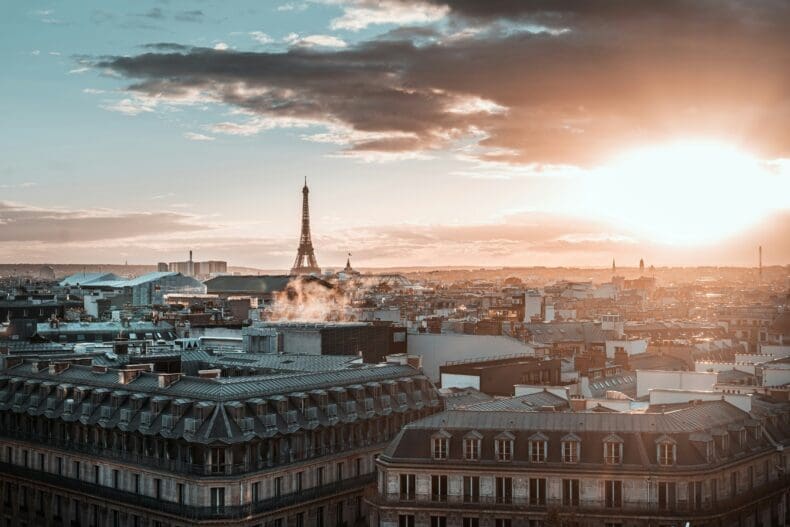
On top of the Galeries Lafayette department store on Boulevard Haussmann you’ll find one of the nicest free viewpoints in Paris. Take the lift or the escalators to the upper floors, walk up the last flight of stairs and you step out onto a large open rooftop terrace with a view of the skyline. There is nothing to pay and no need to buy anything.
On one side you see the Eiffel Tower and Montmartre. On the other you look almost straight down onto the dome of the Opéra Garnier and those typically Parisian zinc roofs. Have a wander around inside as well, because the department store’s famous glass dome is a sight in its own right.
#6 Pont des Arts and Pont Alexandre III: free views from the Seine
In Paris you don’t even have to go up for a good view. From the bridges over the Seine you look along the water in both directions, taking in the quays, the sightseeing boats and the monuments lining the banks. Two bridges stand out, and both are open day and night at no cost.
The Pont des Arts is a footbridge between the Louvre and the Institut de France. No traffic, in other words, and all the peace you need to linger. Looking upstream you see the tip of the Île de la Cité and the Pont Neuf, the oldest bridge in the city.
A little further along is the Pont Alexandre III, which is worth stopping for even without the view, with its rows of lamps and gilded statues. From here you have the Eiffel Tower on one side and the dome of Les Invalides on the other. Both bridges are at their best around sunset, when the light skims across the water.

#7 Institut du Monde Arabe: free terrace on the Seine
One viewpoint that many visitors miss is the rooftop terrace of the Institut du Monde Arabe. The building by architect Jean Nouvel stands right on the Seine in the fifth arrondissement and catches the eye with a façade full of metal diaphragms, a modern nod to Arabic latticework. Inside is a museum about the Arab world, but you don’t need a museum ticket for the view.
You take the lift up and step out onto a terrace that is free to visit. It is a good deal lower than the Eiffel Tower or the Arc de Triomphe, and that is exactly the charm: you look across the Seine from close by, towards the back of Notre-Dame and the whole of the Right Bank. The institute is closed on Mondays.
The terrace combines well with a walk through the Latin Quarter. The Great Mosque of Paris is only a short stroll away.
#8 Trocadéro: directly opposite the Eiffel Tower
The square at Trocadéro lies directly opposite the Eiffel Tower and may well offer the best-known view in Paris. You stand above the level of the Seine here, with a clear view of the tower, the fountains and the Champ de Mars. Around sunrise or at dusk, this is the place to be for photos. There is a reason this image appears on thousands of postcards.
Trocadéro is part of the Palais de Chaillot, a 1930s world’s fair building that now houses several museums. Most visitors only come for the panorama, which costs nothing, and the metro drops you at Trocadéro station, a few minutes’ walk from the viewpoint.
During the day it is busy with tourists, street sellers and photographers. Come early, though, and you have the view almost to yourself. It is well worth a visit in the evening too, especially when the Eiffel Tower starts to sparkle. That happens once it is dark, at the start of every hour, for a few minutes.

#9 Parc de Belleville: a free view among the Parisians
For a view without selfie sticks, head to the east of the city. The Parc de Belleville clings to a steep hill in the twentieth arrondissement and is one of the highest parks in Paris. Right at the top, at the belvedere on the edge of the park, the city spreads out in front of you like a panorama, with the Eiffel Tower in the distance.
It is a very different experience from Trocadéro or the Sacré-Cœur. Here you are mostly surrounded by people from the neighbourhood, and the surrounding area is known for its street art. The park costs nothing, but it is a city park that closes in the evening, earlier in winter than in summer.
Arrive by metro at the top of the hill (Pyrénées is one option) and stroll downhill through the park, so the metro does the climbing for you.
#10 Musée d’Orsay: a view through the station clock
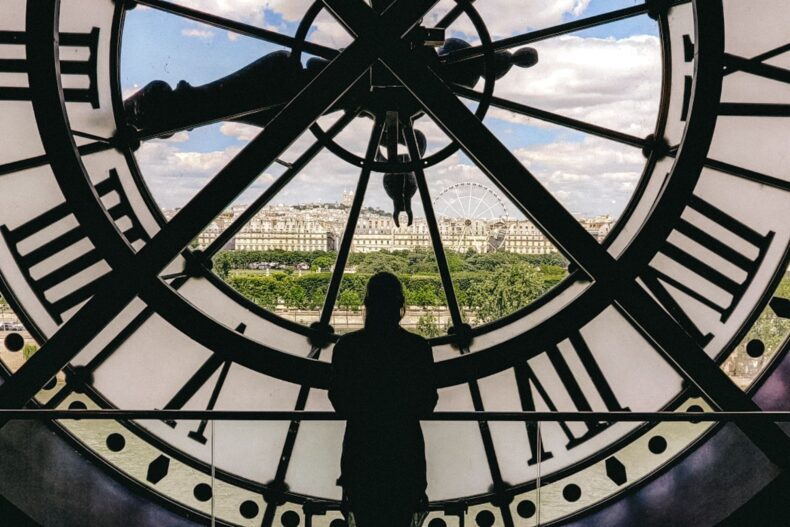
The Musée d’Orsay is housed in a former railway station on the Seine and is best known for its paintings by Monet, Degas and Van Gogh. Yet many people forget that it has a rather special view as well. Not from the roof, but from behind the huge station clocks on the top floor!
Through the glass of the clock you look north, towards Montmartre and the Sacré-Cœur. The hands stand out as a silhouette in front of it, which makes the view even more photogenic. We didn’t visit the museum for this view in particular, but it was a very nice extra on top of a collection that is wonderful enough already.
No extra ticket needed: you pass the clock anyway when you visit the top floor of the museum.
Practical tips for visiting these viewpoints
Which viewpoints in Paris are free? More than you might think. The steps of the Sacré-Cœur, the square at Trocadéro, the rooftop terrace of Galeries Lafayette, the bridges over the Seine, the terrace of the Institut du Monde Arabe and the Parc de Belleville cost nothing. You need a ticket for the Eiffel Tower, the Arc de Triomphe, the towers of Notre-Dame, the dome of the Sacré-Cœur and the Musée d’Orsay.
Those tickets are best arranged online in advance, through the official website of the sight itself. For the Eiffel Tower and the towers of Notre-Dame the popular time slots can sell out quickly, and for the Arc de Triomphe and the Musée d’Orsay an online ticket saves you the queue at the ticket desk.
The best time for a view over Paris is early in the morning or around sunset. Mornings are quietest everywhere and the light is soft. Towards evening the city turns gold, and after that the lights come on one by one. Trocadéro, the steps of the Sacré-Cœur, the bridges over the Seine, the Arc de Triomphe and the Eiffel Tower itself are the spots for that hour. The rooftop terrace of Galeries Lafayette, the Institut du Monde Arabe and the Musée d’Orsay follow the opening hours of the building, so plan those for the daytime.
All the viewpoints are easy to reach by metro, and a few are so close together that you can combine them. Trocadéro and the Eiffel Tower face each other across the Seine, and from Notre-Dame you can walk along the water to the Institut du Monde Arabe, or the other way to the Pont des Arts.
→ Discover the 8 best neighbourhoods to stay in Paris
→ Discover Paris off the beaten track: unusual things to do
Enjoy our travel tips? Add The Orange Backpack as a preferred source on Google and you'll see us more often in your search results.


