
After a visit or two, you’ve ticked off the Eiffel Tower, Notre-Dame and the Louvre. So what next? This is where Paris gets really fun, because the city is full of original activities that show you a completely different side: a vineyard on top of a hill, a museum inside a sewer, an old railway viaduct that is now a walk through the greenery.
We keep coming back to Paris, and every time we look for new experiences beyond the famous hotspots. In this blog we share fifteen non-touristy things to do in Paris, from a picnic in a park full of rocks to mint tea next to a mosque. First, a quick look at what you need to book and when to go.
→ Read also: Paris off the beaten track: 17 unusual things to do in Paris


What do you need to book in advance for these Paris activities?
The good news about this list: most of it needs no planning at all. You simply walk into the Buttes-Chaumont park, along the canal and the Coulée verte, down Rue Crémieux, through the passage, around the market and into the bookshop. The artists of 59 Rivoli and the oval reading room of the library don’t require a ticket either.
Three places work differently. You can only visit the Catacombs with a time slot booked online beforehand, the Montmartre vineyard only opens for guided tours by reservation, and Hôtel de la Marine asks you to pick one of several tickets online. Visiting rules change quite often in Paris, so have another look at the official websites we link to in the tips just before you go.

When is the best time for non-touristy Paris?
Weekdays and mornings are quieter in most of the streets and passages. You notice it most in Rue Crémieux, where you can still walk straight through at that hour. The market in the Marais is at its busiest around lunchtime, Canal Saint-Martin only really comes alive on a sunny evening, and the Montmartre vineyard celebrates its harvest festival in October. The mosque is closed to visitors on Fridays.
Is it raining? The sewer museum, the Catacombs, the library and Passage Brady are all fine indoor plans. Many of the tips are also close together, so you won’t spend the whole day on the metro. Rue Crémieux and the first stretch of the Coulée verte are both in the 12th arrondissement, Passage Brady and Canal Saint-Martin in the 10th. You’ll find more practical tips for your city trip in our Paris travel guide.
15 non-touristy things to do in Paris
#1 Musée des Égouts: walk through the sewers of Paris
A museum inside a sewer that is still in use: it doesn’t get much more unusual than that in Paris. The Musée des Égouts de Paris sits by the Pont de l’Alma, not far from the Eiffel Tower, and takes you underground. You walk through tunnels with the waste water flowing beneath your feet and read how the city struggled over the centuries with disease and a fast-growing population.
Along the way you see the machines and tools the sewer workers used to set out with, and you follow how the network was extended step by step. So this is not a classic museum with display cases. You are literally standing in the underworld of Paris. A good pick if you already know the city and want to see how it works beneath the cobblestones.
#2 Rue Crémieux: stroll down the most colourful street in Paris
Pink, blue, yellow: every house in Rue Crémieux has its own pastel shade. This short, car-free street in the 12th arrondissement is right by Gare de Lyon and feels more like a village than a world city. Many of the fronts are decorated with flower boxes, murals and other details.
The street stopped being a secret long ago. Thanks to Instagram it has become one of the most photographed spots in Paris. So come early and on a weekday, and remember that people simply live here: keep the noise down and don’t take photos through anyone’s window. A visit doesn’t take long, so combine it with the Coulée verte from tip 8, which runs close by.
#3 Parc des Buttes-Chaumont: picnic among the rocks
Forget neatly raked lawns and straight gravel paths. Here you get hills, rocky outcrops, winding trails and a lake in the middle. The Parc des Buttes-Chaumont in the 19th arrondissement opened in 1867 on the site of an old quarry, which makes it far more rugged than the well-known city parks in the centre.
On sunny days the slopes fill up with Parisian families, groups of friends and couples with a blanket and a bag full of food. Do join in: pick something up at a bakery nearby and find a spot on the grass. Expect a bit of climbing though, because nothing here is flat.
#4 59 Rivoli: see free art in a former squat
In the middle of one of the best-known shopping streets in Paris, not far from the Louvre, stands a building that artists squatted in 1999. The city later made it legal, and since then 59 Rivoli has been a creative hub with dozens of studios spread over several floors.
You can wander in and out for free. The staircases and walls are covered from top to bottom in paintings and graffiti, and in the studios you watch the artists at work. Feel free to have a chat with them. It makes a welcome change from the city’s polished museums and expensive galleries. The building is closed on Mondays.
#5 Marché des Enfants Rouges: lunch at the oldest covered market
The Marché des Enfants Rouges dates back to the early seventeenth century and is considered the oldest covered market in Paris. You’ll find it in the north of Le Marais, one of the best neighbourhoods in Paris. You can still do your food shopping here, but most people come for the food stalls.
There is plenty to choose from: French crêpes and cheeses, Moroccan couscous, Lebanese mezze and much more. Grab a seat at one of the little tables between the stalls or take your lunch to a small park nearby. Around midday there are queues at the most popular stalls, so come a little earlier or later if you want to eat quickly.
#6 Canal Saint-Martin: drinks by the water with the Parisians
Canal Saint-Martin was dug in the nineteenth century for shipping, but today it is mostly where Parisians settle down after work. They sit along the quay with a drink and a few snacks, under the trees and with a view of the iron footbridges and the locks.
For us this was one of the nicest things to do in Paris, and we loved the relaxed, local atmosphere. It is at its liveliest on sunny summer evenings. Find a spot on one of the low walls and watch the boats slowly sink down through the locks. Fancy a coffee? There are good coffee bars around the canal too.
→ Read also: Coffee in Paris: The 16 Best Coffee Shops
#7 Clos Montmartre: discover the vineyard on the hill
A vineyard in the middle of Paris? On the northern side of the Montmartre hill lies the Clos Montmartre, one of the few vineyards within the city limits. It was planted in 1933 and recalls the days when Montmartre was still a village outside the city. Each year the harvest produces a small amount of wine.
You can’t roam freely between the vines: the vineyard only opens for guided tours by reservation. From the street, though, you get a clear view through the fence over the vines and the houses behind them. In October the neighbourhood celebrates the harvest with the Fête des Vendanges, a festival full of tastings, parades and music.
→ Read also: Where to Stay in Montmartre, Paris: Best Hotels and Tips
#8 Promenade Plantée: walk along an old railway line
Long before New York got its High Line, Paris had already turned a disused railway line into a park. The Promenade Plantée, officially the Coulée verte René-Dumont, runs for almost five kilometres from the Bastille to the Bois de Vincennes. The first stretch takes you high above the street along an old viaduct, between trees, roses and pergolas and with views of the house fronts of the 12th arrondissement.
Start at the Viaduc des Arts, where craftspeople have their workshops and shops in the arches below the path. Further on, the route drops down to street level and leads through gardens and quiet residential areas you would otherwise never see as a visitor. There is no need to walk the whole route: the raised first section is the best known and the closest to the centre.
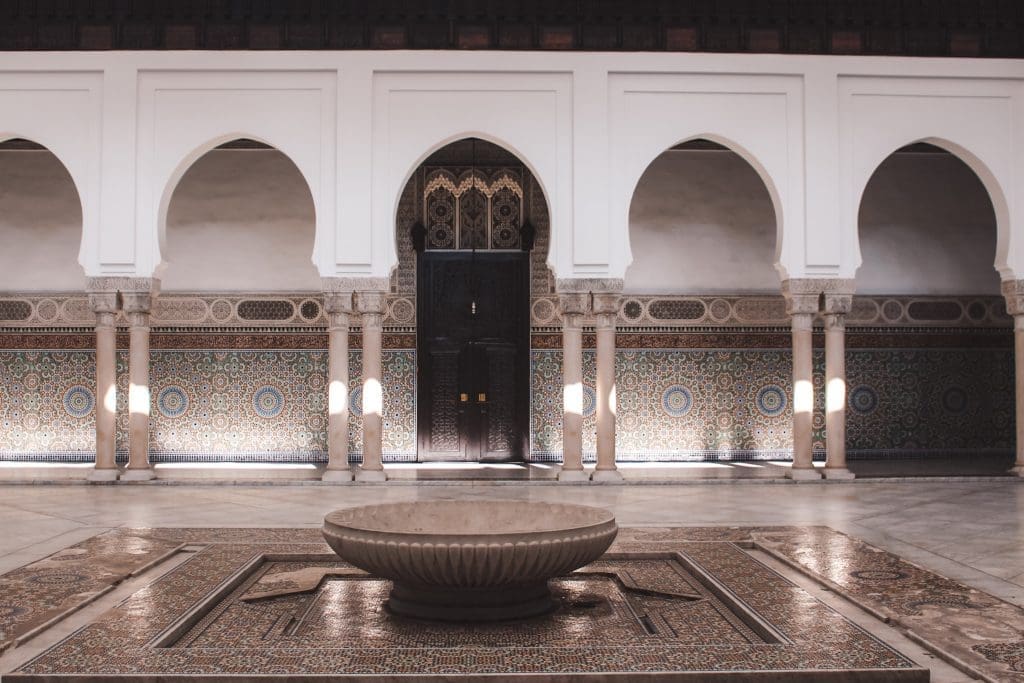
#9 Great Mosque of Paris: drink mint tea on the terrace
The Great Mosque of Paris sits next to the Jardin des Plantes in the 5th arrondissement and opened in 1926. Behind its walls you’ll find green courtyards, fountains and walls covered in colourful mosaics. You buy a ticket at the entrance and then wander around at your own pace. The mosque is closed to visitors on Fridays and on Islamic holidays.
The mosque also has a tea room with a terrace under the trees. This is where you order fresh mint tea with baklava or one of the other sweet pastries. A moment of doing nothing at all, right in the middle of the city.
#10 Bibliothèque Richelieu: marvel at the oval reading room
The Bibliothèque Richelieu is the historic home of the Bibliothèque nationale de France, right in the centre and close to the Palais-Royal. After a major restoration, the complex is open to everyone again. The showpiece is the Salle Ovale: a huge oval reading room with bookcases climbing high up the walls and a glass roof that lets the daylight pour in.
The best part: you need neither a membership nor a ticket, as the Salle Ovale is free and open to all. If you’d like to see more, you can buy a ticket for the library’s museum, which holds rare manuscripts, old coins and ancient art among other things. Afterwards, walk on to the Galerie Vivienne right next door, one of the prettiest covered passages in Paris.
#11 Passage Brady: feel like you’re in India
Paris still has a good number of covered shopping passages from the nineteenth century. The most famous ones, such as the Galerie Vivienne and the Passage des Panoramas, are rather elegant, with small shops and cafés. Passage Brady in the 10th arrondissement is something else entirely: this narrow arcade from 1828 is known as Little India.
Under the glass roof, Indian, Pakistani and Mauritian shops and restaurants stand side by side, with spices, fabrics and jewellery laid out by the door. You mainly come here to eat: curries, samosas and biryani are on every menu. Parisians pick up their spices here or sit down for a quick lunch, and you’ll see very few tourists.
#12 Shakespeare and Company: buy a book opposite Notre-Dame
On the Seine, directly opposite Notre-Dame, is the most famous English-language bookshop in Paris. Shakespeare and Company has been around since 1951 and grew into a meeting place for writers such as Allen Ginsberg and Anaïs Nin. Inside it is a maze of narrow corridors, wooden bookshelves and corners where an hour slips by before you know it.
The shop sells new and second-hand books, sometimes in special editions of literary classics, and regularly hosts readings. It is hardly unknown, so come early in the day if you want to browse in peace. A book from here is also one of the nicest souvenirs you can take home from Paris.
#13 Catacombs of Paris: get the shivers among millions of bones
By the end of the eighteenth century the cemeteries of Paris were so full that the city had to come up with a solution. The remains of millions of Parisians were moved to old limestone quarries beneath the city. A small part of that enormous network of tunnels can now be visited as the Catacombs of Paris.
The entrance is in the 14th arrondissement. A long staircase takes you down to dark, narrow passages where skulls and bones are stacked in tidy patterns. Grim, but impressive as well. Bring a jumper, because it stays cool down there all year round. Book a time slot online in advance through the official Catacombs website: no regular tickets are sold at the door, and the time slots are only released shortly beforehand.
#14 Jardin Albert Kahn: unwind in a Japanese garden
Just outside the city limits, in Boulogne-Billancourt, banker and philanthropist Albert Kahn had a remarkable garden laid out at the start of the twentieth century. It is really several gardens in a row, each inspired by a landscape from a different part of the world. The Japanese garden of the Jardin Albert Kahn is the best known.
You walk past ponds, over traditional Japanese bridges and between blossoming trees and carefully placed stones. The garden is part of the Musée Albert-Kahn. The metro gets you there from the centre in no time, and it is a peaceful place for a stroll.
#15 Hôtel de la Marine: travel back to the eighteenth century
On the Place de la Concorde stands an eighteenth-century palace that housed the French navy for more than two centuries. After a major restoration, Hôtel de la Marine opened to the public in 2021. You walk through the dining room and the salons, complete with gilded woodwork, crystal chandeliers and furniture from the period.
An audio guide tells you the stories behind the building and the people who lived there. You choose beforehand between a short route, a long route or a ticket for the exhibition. An unusual activity for anyone who, like me, is interested in the history and splendour of Paris, without the crowds of the big museums and Versailles.
Enjoy our travel tips? Add The Orange Backpack as a preferred source on Google and you'll see us more often in your search results.


