
Think of Alsace and you think of Colmar, Strasbourg or the half-timbered villages of Riquewihr and Eguisheim. Hardly anyone has Sélestat on their list, even though it’s one of the bigger towns in the region. And that’s a bit of a shame.
Let’s be upfront: Sélestat can’t compete with its famous neighbours. But the town has a laid-back feel, an old centre full of towers and churches, some fun independent shops and one rather special claim to fame: the Christmas tree tradition is said to have started right here. That’s reason enough to give it an afternoon or a full day.
In this blog you’ll find where Sélestat is, where to stay, how the town celebrates Christmas and the best things to do.
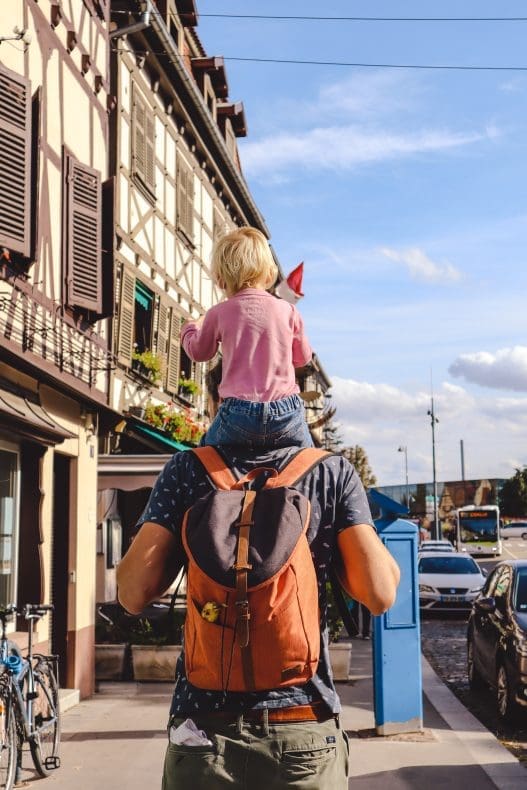

Where is Sélestat?
Sélestat is in Alsace, in north-eastern France, roughly halfway between Colmar and Strasbourg. Both cities are about half an hour’s drive away. The train is quick too, as Sélestat sits on the railway line between the two.
That location makes it a handy base. The mighty Château du Haut-Kœnigsbourg is just around the corner, and Kintzheim, Ribeauvillé, Riquewihr, Kaysersberg and Eguisheim are all within half an hour’s drive.
→ Discover the 10 best Beauty and the Beast villages in Alsace
→ Discover 6 things to do in Eguisheim


Where to stay in Sélestat
There are hardly any hotels in the old town itself, so you’ll be staying on the edge of the centre or just outside town.
#1 Hôtel Vaillant sits on the edge of the old town, close to the station and within walking distance of all the sights. The rooms are bright and colourful, and there’s a restaurant with a terrace downstairs.
#2 Best Western Plus Les Humanistes is a few kilometres outside the centre, towards the Haut-Kœnigsbourg. It’s handy if you’re driving: parking is free and there’s an outdoor pool in summer.
Travelling by campervan? Camping Les Cigognes is within walking distance of the old town. A little further out there’s also a free motorhome area.

The best time to visit Sélestat
The same goes for Sélestat as for the rest of Alsace: every season has its charm. We’ve been to the region in March, September and October. It’s quiet then, great for walking around, and in autumn the vineyards are at their most beautiful.
Summer brings the warmest weather and the busiest villages. And in the last weeks of the year the whole region turns into one big Christmas market. In Sélestat, that comes with an extra story.
Christmas in Sélestat: the town of the Christmas tree
Sélestat is proud to hold the oldest written record of a Christmas tree. The town accounts of 1521 mention a payment to forest guards who had to watch over the fir trees in the woods around Christmas. According to the locals, that means the tradition started here, and they make sure you know it in December.
From late November to early January, the Église Saint-Georges hosts an exhibition on the history of the Christmas tree. Trees hang upside down from the ceiling, decorated the way people did it centuries ago, showing how Christmas decorations changed over time. During the same period there’s a huge chandelier made of glass baubles from Meisenthal, the glassworks behind Alsace’s iconic Christmas baubles.
There are also Christmas markets and a Christmas trail past different spots in the old town. Everything is smaller and calmer than in Colmar or Strasbourg, and that’s part of the charm. Combine Sélestat with one of the larger Christmas markets nearby, and book your accommodation early: Alsace is hugely popular in December.
Things to do in Sélestat: 6 tips
#1 The old town: towers and pastel façades
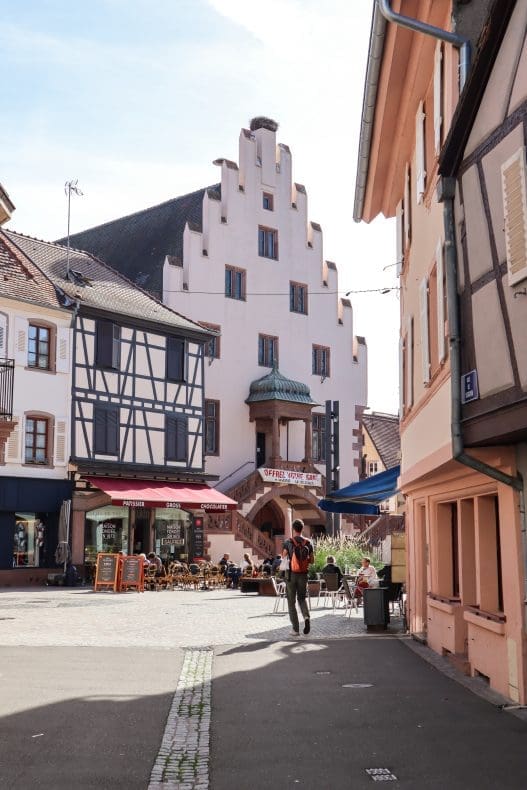
Sélestat’s old town is a web of cobbled streets lined with houses in all sorts of styles and pastel shades. You’ll pass medieval half-timbered houses, Renaissance façades, little squares and richly decorated homes. Follow the signposted town trail if you like, which takes you past the most important buildings.
Make sure you walk to the Tour Neuve, also known as the Tour de l’Horloge because of its clock. The tower is pretty, but the buildings around it are just as photogenic. Look out for the old pharmacy with its pink painted façade and the house next door with a wooden oriel window and a little corner turret. On the other side of the centre stands the Tour des Sorcières, a leftover from the old town walls.
Where the old centres in Alsace are often full of souvenir shops, Sélestat has more independent spots. Browse Emmaüs Etikette, a big second-hand shop on the Place de la Victoire. For vegan food and good coffee, head to L’Amandier, opposite the Humanist Library.

#2 Église Saint-Georges: the town’s biggest church
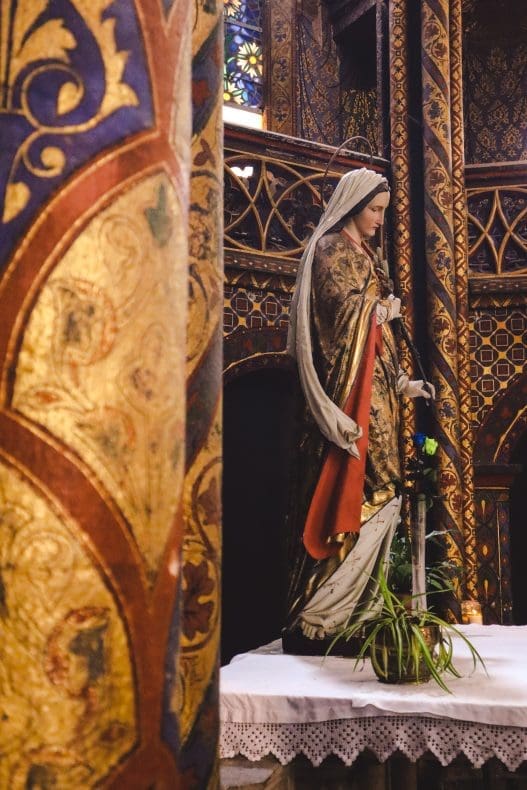
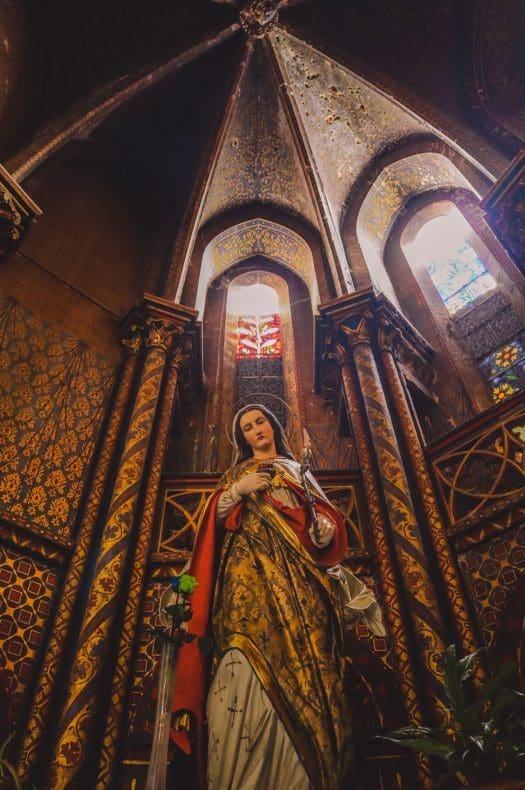
The Église Saint-Georges is often called Sélestat’s cathedral, and it certainly feels like one. It’s a Gothic church with tall columns, rib vaults and big stained-glass windows. Our favourite bits were the two painted side chapels next to the main altar. Perhaps the whole church was once that colourful, but in places it now looks a little weathered.
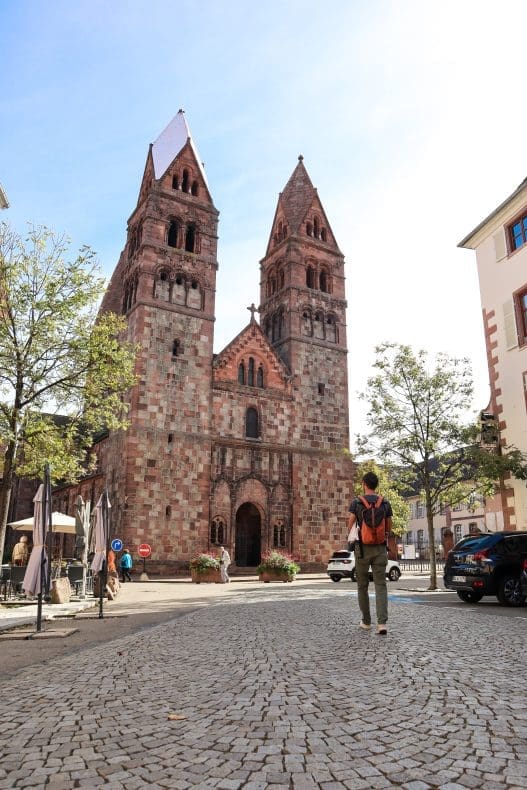
A few minutes away is the Église Sainte-Foy, a Romanesque church with square towers and a richly carved pulpit. A narrow staircase takes you down to the crypt.
#3 The half-timbered houses: worth a search
Alsace is famous for its half-timbered houses, and Sélestat gets praised for them too. Still, we found there were fewer than we’d hoped. Where you walk from one timber-framed house to the next in villages like Eguisheim and Riquewihr, in Sélestat you really have to go looking.
You’ll find the best ones on Rue Sainte-Barbe and Rue des Chevaliers. Also walk to the bridge over the Ill on the Route de Marckolsheim for a lovely view of the town and the Tour Neuve. Only have time for one or two places in Alsace and want that classic half-timbered picture? Then pick one of the villages instead. If you’ve got more time, like we did, Sélestat makes a great addition.

#4 The Humanist Library: the town’s treasure chest
Sélestat’s pride and joy is the Bibliothèque Humaniste. In the 15th and 16th centuries the town was a centre of humanism, and the library still holds centuries-old books and manuscripts, including the town accounts with that Christmas tree entry.
After a major renovation the library has become a modern museum where you can see the old writings up close. We skipped it ourselves, but do walk past: the building is worth a look from the outside too.

#5 Maison du Pain and FRAC Alsace: bread and modern art
Close to the library is the Maison du Pain d’Alsace, a museum all about the history of bread and grain in Alsace. You can also pop into the bakery downstairs without visiting the museum, for a kugelhopf or a pretzel for the road.
On the edge of the centre you’ll find the FRAC Alsace, a contemporary art museum with changing exhibitions. The water and the old town are reflected in the glass façade of its modern building.

#6 Haut-Kœnigsbourg and the Wine Route: day trips from Sélestat
From Sélestat you’re at the Château du Haut-Kœnigsbourg in no time, one of the best-known sights in Alsace. The castle sits on a mountaintop and you can see it from much of the region.
Around the town lie the vineyards of the Alsace Wine Route, with villages like Kintzheim, Ribeauvillé, Riquewihr and Kaysersberg. Many winemakers offer tours and tastings. Our favourites nearby? Colmar and Eguisheim. Rather not drive yourself? Day tours of the best-known villages leave from Colmar.
→ Check out the day tour of Alsace’s prettiest villages

Enjoy our travel tips? Add The Orange Backpack as a preferred source on Google and you'll see us more often in your search results.
More tips for your trip to Alsace
 Our pickStaying the night? Browse all hotels in Sélestat on Booking.com
 Not driving your own car? Rent a car in Strasbourg with Discover Cars and compare the big rental companies in one go.
 Fancy doing it by camper, like we did? Rent a campervan in Strasbourg with Campervan Planet.
 Prefer everything arranged? Browse France tours on TourRadar.
 No flight yet? Compare flights to Strasbourg.
 No car? Join a day tour of the prettiest villages from Colmar, booked on GetYourGuide.
 Discover all our blogs about Alsace


