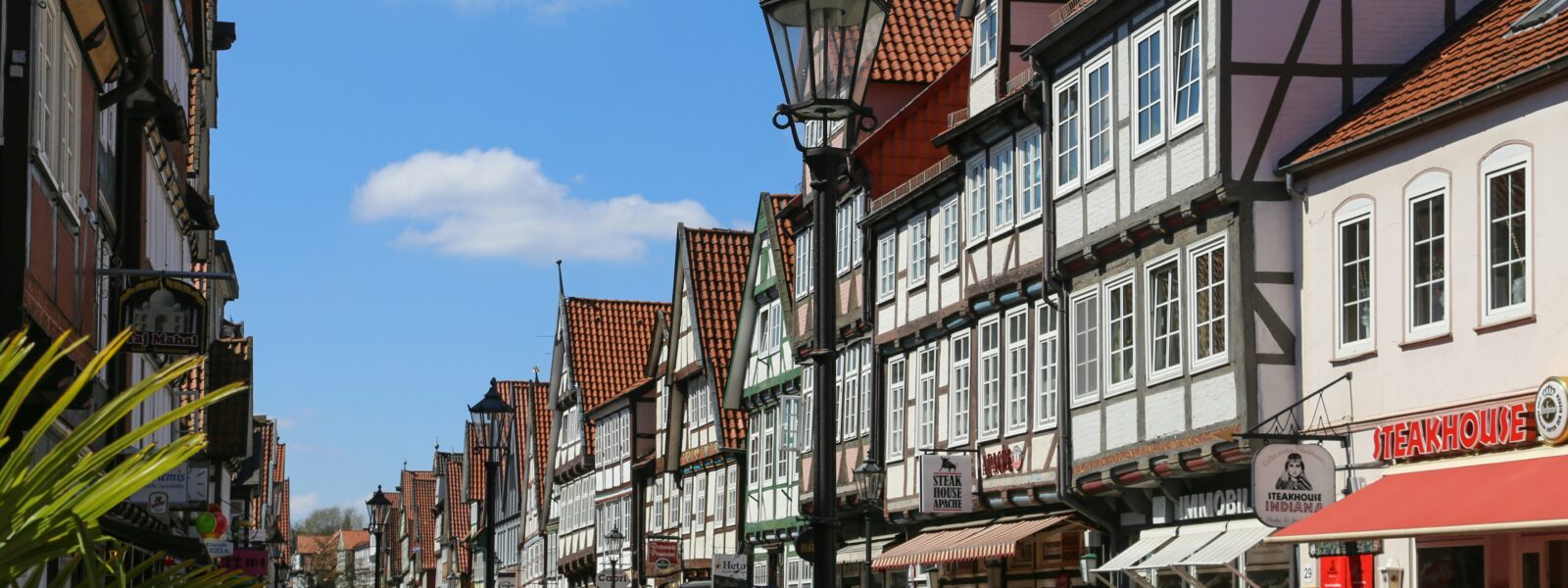
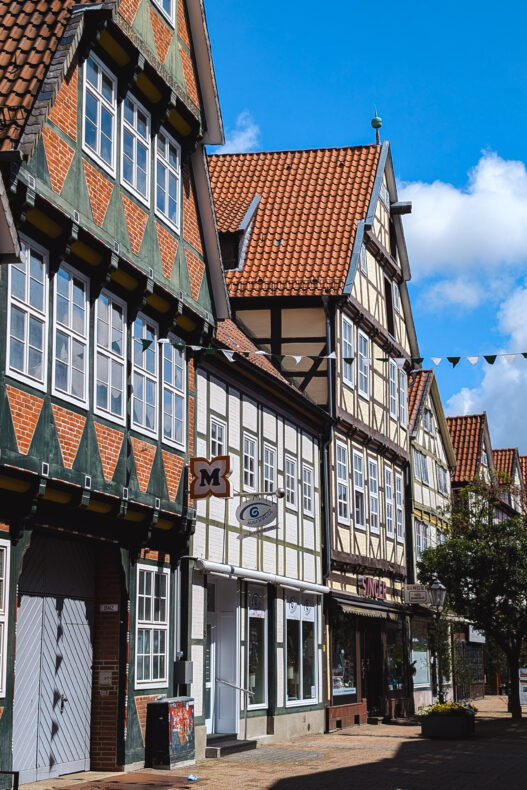
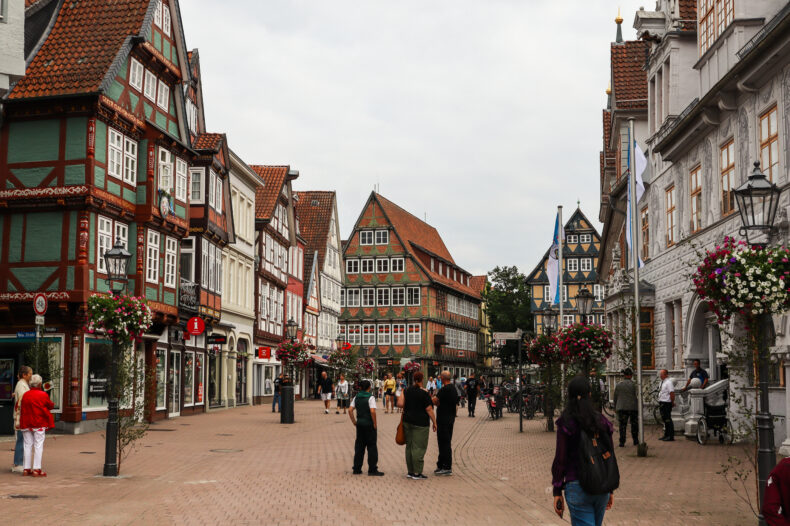
Celle might not be the first German city that comes to mind when you start planning a city break. But as soon as you walk into its historic old town, it is easy to see why so many people enjoy visiting this charming place. Nearly 500 half-timbered houses line the streets of the centre, standing side by side in an impressive mix of shapes, colours and styles. Some are centuries old and have become slightly crooked over time, while others are beautifully decorated with detailed woodwork, carvings or bright colours. Almost every street seems to have another interesting building to stop and admire.
And the half-timbered houses are not the only reason to visit Celle. Just outside the old town stands the beautiful white Celle Castle, which has a long and fascinating history. Together, the castle and the historic streets give Celle a very different feel from many other German cities. It is compact and easy to explore, but there is still plenty to see and discover.We visited Celle during a train journey through Lower Saxony and quickly found out that there is much more to this pretty town than its photogenic façades. For centuries, Celle was the home of the dukes of Brunswick-Lüneburg, and this royal past has left its mark all over the city. Celle also has an interesting connection to the British royal family, which adds another surprising chapter to its history.
One of the highlights can be found inside Celle Castle, where you can visit a beautiful Baroque theatre dating back to 1675. It is a remarkable place and a lovely reminder of the time when Celle was an important ducal residence. The castle itself is worth taking your time for as well, especially if you enjoy history, architecture and stories about royal families.But what we liked most about Celle was the combination of history and atmosphere. You can spend hours simply wandering through the old town, looking at the unusual façades, walking along quiet little streets and discovering charming corners along the way. There are inviting squares, colourful buildings and plenty of details that make you want to slow down and take a closer look.
Then there are Celle’s famous talking street lamps, which are probably among the more unusual sights you will come across in a German town. They are quirky, playful and very much part of Celle’s character. Together with the historic buildings and cosy streets, they give the city a fun and slightly unexpected side. Celle turned out to be a really enjoyable first stop on our journey through Lower Saxony. It is the kind of place that is easy to explore without feeling rushed, and where the historic centre itself already feels like one big attraction. Around almost every corner, there seems to be another beautifully decorated house, an unusual detail or a story that makes you want to learn more.
In this travel guide, we share the best things to do in Celle, the sights and attractions you should not miss, the stories behind some of the city’s most interesting landmarks, and our personal tips to help you make the most of your visit.
Why Celle Is Worth Visiting?
At first glance, Celle is all about colourful half-timbered houses and charming old streets. But behind those beautiful façades lies a surprisingly rich royal history. For centuries, the town was the residence of the dukes of Brunswick-Lüneburg, who ruled from Celle Castle. What began as a medieval fortress was slowly expanded and transformed over the years, eventually becoming the large white palace that still stands beside the historic centre today.
That royal story became even more interesting when the ducal family of Celle developed a direct connection with the British royal family. The daughter of the last Duke of Celle married her cousin George Louis. Through a rather unusual chain of family ties and succession rules, George Louis later became King of Great Britain in 1714. Their son would go on to become the next British king.
From that moment on, the family line of the dukes of Celle became closely connected with the British monarchy. Great Britain and Hanover, which also included Celle, were ruled by the same monarchs for more than a century. This arrangement continued until 1837, when Queen Victoria became queen of Great Britain. Hanover followed different succession rules, so the two crowns could no longer pass to the same person and went their separate ways. You can still see many reminders of Celle’s royal past around the city today. Right next to the Altstadt stands Celle Castle, one of the town’s main landmarks. Inside, you will even find a beautiful Baroque theatre dating back to 1675. It is one of those details that immediately shows just how important Celle once was as a ducal residence.
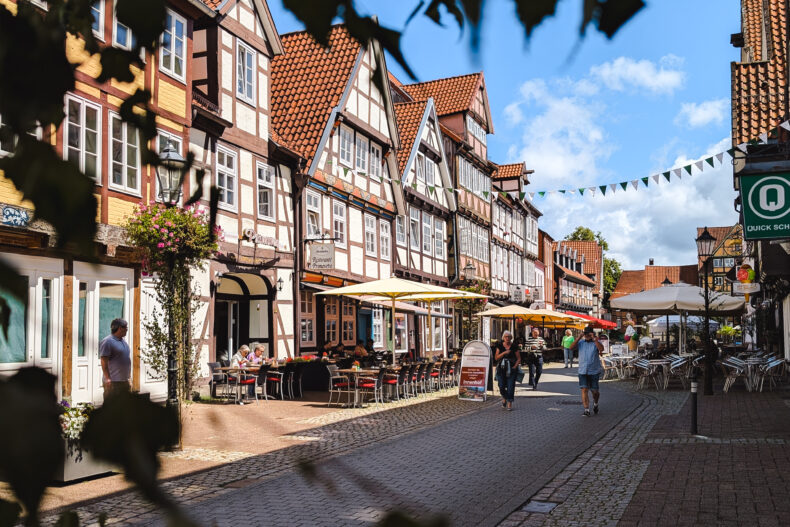
The city itself developed around the castle, and over time the streets filled with the half-timbered houses that now give Celle its distinctive character. Today, the historic centre has almost 500 half-timbered buildings, creating an impressive collection of different colours, shapes and decorative styles. Celle is proud to have what is considered the largest continuous group of half-timbered buildings in Europe. Walking through the centre, it is easy to understand why this is such an important part of the city’s identity. Entire streets are lined with historic houses, some carefully decorated and brightly painted, while others lean slightly to one side after standing here for hundreds of years.
Another reason the old town feels so complete today is that Celle came through the Second World War relatively undamaged. While many historic centres in Germany were heavily destroyed, a large part of Celle’s centuries-old city centre survived. Because of that, much of the original streetscape and architecture has been preserved, making it possible to experience the old town much as it developed over the centuries. So yes, Celle is a wonderful place to wander without much of a plan, following narrow streets lined with colourful and slightly crooked half-timbered houses. There is always another beautiful façade, unusual detail or charming corner to discover.
But what makes Celle especially interesting is that there is much more to the city than its picture-perfect appearance. Behind those pretty buildings are stories of dukes, royal marriages, British kings, family connections and centuries of court life. Once you know a little about that history, the old town becomes more than just a beautiful place to photograph. It becomes a city full of stories, with traces of its royal past still visible everywhere you look.
Visiting Celle on a Train Trip Through Lower Saxony
We visited Celle as part of a multi-day train journey through Lower Saxony, combining it with stops in Goslar and Hameln. It turned out to be a great route, especially because the three towns are fairly close to one another but each feels completely different. Celle is all about colourful half-timbered houses and ducal history, Goslar is known for its emperors and long mining tradition, and in Hameln you will, of course, find reminders of the famous Pied Piper all over town. That variety was exactly what made this train trip so enjoyable for us. Each stop offered a different side of Lower Saxony, from royal history and medieval streets to industrial heritage and local legends. It also meant that the journey never felt repetitive, even though the distances between the towns were relatively short.
If you are travelling from the Netherlands, the direct train from Utrecht to Hanover is a very convenient way to reach the region. From Hanover, you can continue to Celle by regional train in around 45 minutes. If you are planning a similar trip, we would recommend organising your route around this direct connection, as it makes the journey much easier.We would also suggest reserving a seat for the longer international part of the trip. We did not do this ourselves, and we soon discovered that finding a free seat for the entire journey was not always easy, especially on the busier stretches. You may find a seat at first, only to realise later that it has been reserved from another station along the route. Having a reserved seat would definitely have made that part of the journey more comfortable.
Of course, travelling by train is not always the easiest or most predictable option. You have to take connections into account, and during our trip Deutsche Bahn did not exactly have a perfect record when it came to running on time. Delays can quickly make a carefully planned route a little more complicated, particularly if you have a short connection between trains.That is one of the main advantages of travelling by car instead. With your own car, you have much more flexibility and can easily add extra stops elsewhere in Lower Saxony or in the Harz Mountains. You can leave whenever you like, stop in smaller towns and villages along the way, and change your plans more easily if you spot somewhere interesting or simply feel like taking a detour.
Still, we really enjoyed travelling through the region by train. There is something very relaxing about being able to sit back, watch the landscape pass by and not have to think about traffic, directions or finding somewhere to park once you arrive. The fact that train travel is also a more sustainable way to explore the region made it even more appealing to us.Another big advantage is that Celle, Goslar and Hameln are all very easy to explore without a car. Their train stations are close enough to the historic centres that you can simply arrive, walk into town and spend the rest of the day exploring on foot. For a trip focused on old towns, museums, historic streets and local sights, we never really felt that we were missing a car.
Tip: We stayed at Hotel Celler Hof, and its location worked very well for our visit. From Celle train station, it takes around 15 minutes to walk to the historic Altstadt, and the hotel itself is right in the middle of the old town. That means you can step outside and immediately start exploring, without needing public transport or a taxi.
Celle Castle is practically around the corner, and many of the town’s main sights are within easy walking distance. For us, that made the hotel a very convenient base, especially since we were only in Celle for a limited amount of time and wanted to make the most of our stay.Our room overlooked the central square and the historic half-timbered houses, which was a lovely view to wake up to. It also made us feel as though we were staying right in the heart of Celle rather than somewhere on the edge of town.
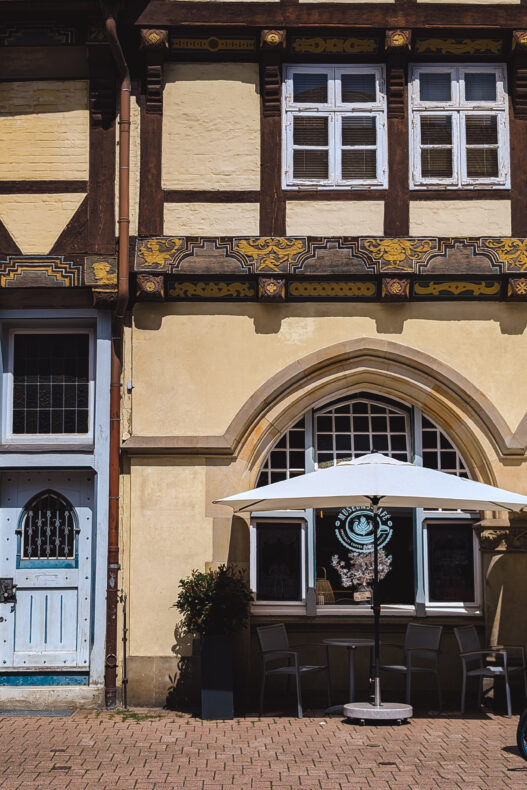
Another nice bonus was the museum directly opposite the hotel, where you will also find a lovely specialty coffee café. Being able to start the day with good coffee before heading out to explore was definitely a plus.For us, Hotel Celler Hof was an ideal choice if you want to discover Celle on foot, stay close to the main sights and have the historic centre right outside your door. Combined with the easy train connections, it made Celle a very comfortable and enjoyable first stop on our journey through Lower Saxony.

Top 10 Things to Do in Celle
#1 Wander Through the Half-Timbered Streets of the Altstadt
There is really only one thing you need to do in Celle to understand its charm straight away: walk into the Altstadt. Nearly 500 half-timbered houses stand closely packed together here, from grand former merchants’ homes to narrow, slightly crooked buildings painted in cheerful colours. Together, they form the largest continuous collection of half-timbered buildings in Europe.
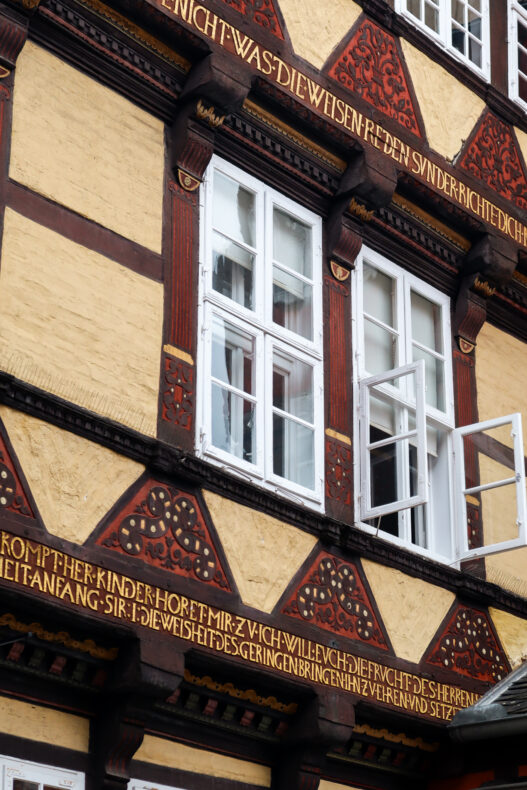
We explored the historic centre with a guide, which made walking around even more interesting. The façades are not only beautiful to look at; they are also full of small details and stories. Look closely and you will spot golden inscriptions, carved wooden decorations, family coats of arms and all kinds of symbols that reveal something about the people who once lived here.
Even the style of the buildings can tell you a lot. From the façade and construction methods, you can often see whether a house is largely original or has been restored over the years. Certain decorative symbols and building details can even help identify the century a particular house dates from. Once you know what to look for, wandering through the old town becomes almost like reading the history of Celle directly from its buildings.
One house worth looking out for is Am Heiligen Kreuz 26, the oldest dated half-timbered house in Celle, built in 1526. It is a lovely reminder of just how old some of the buildings in the Altstadt really are.That said, we would not recommend following only a checklist of famous sights. One of our favourite things to do in Celle was simply wandering through the smaller streets without much of a plan. Around almost every corner, there is another colourful façade, beautifully carved detail or slightly leaning house to discover. The old town is compact enough that you can easily explore it this way without worrying about getting lost.
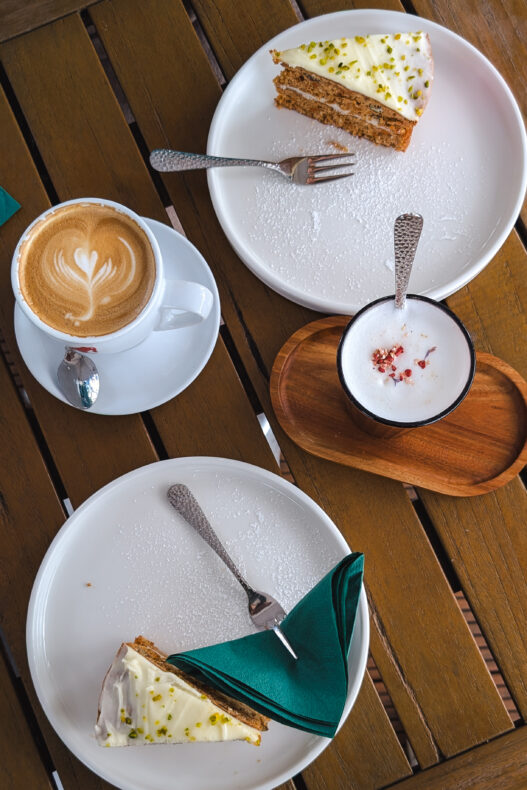
Tip: If you are curious to see what life inside one of these historic half-timbered houses once looked like, visit the Bomann Museum, located opposite Celle Castle. Part of the museum has been recreated as historic living spaces, giving you a much better idea of how people lived here in the past.There is another nice reason to stop by the museum as well. Its café is located in the historic former Löwenapotheke, an old pharmacy building with plenty of character. You can enjoy good specialty coffee inside this centuries-old setting, and when the weather is nice, there is also a small courtyard garden where you can sit outside. It is a lovely place to take a break after exploring the streets of the Altstadt.
#2 Visit Celle Castle
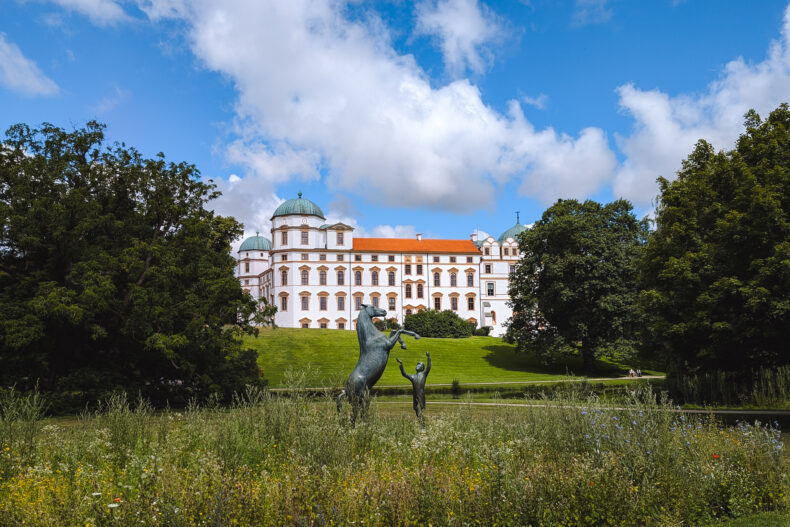
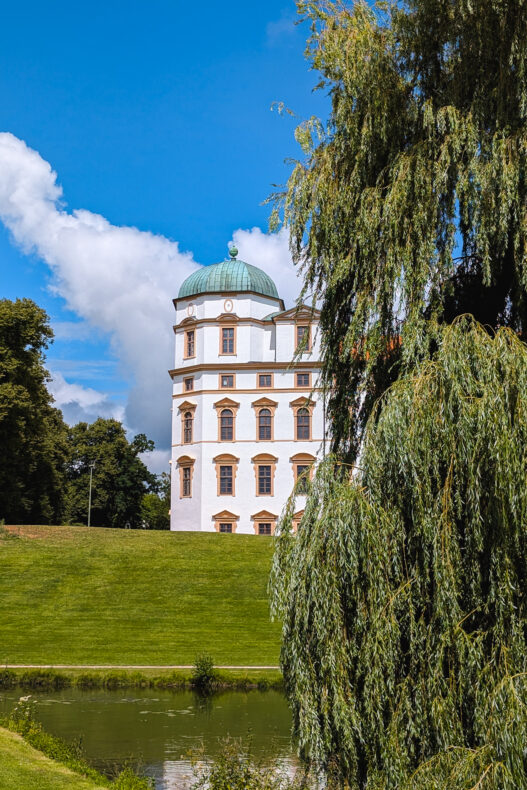
Right beside all those centuries-old half-timbered houses, you suddenly come across a green park with a huge white palace at its centre. This is Celle Castle, one of the city’s main landmarks and a place that played a major role in Celle’s history. For centuries, it was the home of the dukes of Brunswick-Lüneburg, and in many ways, it was the starting point of the town that later grew around it. The castle began as a medieval fortress, but over the centuries it was expanded, rebuilt and gradually turned into a much more elegant residence. The result is the impressive white palace you see today, with a mix of architectural styles that reflect the different periods in its long history.
Two people who had a particularly strong influence on the castle were the last Duke of Celle, George William, and his French wife, Éléonore d’Olbreuse. During the seventeenth century, they transformed the court in Celle and gave the castle much of the character that still makes it so interesting today. Éléonore brought a strong French influence with her, and with that came more of the culture of the French court. Music, art and theatre became an important part of life at Celle Castle, giving the ducal residence a more refined and international atmosphere. That cultural influence can still be felt when you explore the castle today.
We visited the interior with a guide, and we would definitely recommend doing the same. The rooms themselves are beautiful and worth seeing, but what really brought the castle to life for us were the stories behind them. Celle Castle has seen its fair share of drama over the centuries. There are stories of love affairs, family disputes, court tensions and a queen who was sent into exile. And then, through a complicated chain of marriages and family ties, the history of Celle even became directly connected to the British royal family.
Those stories and royal intrigues made the visit much more interesting than simply walking through a series of historic rooms. With a guide, you start to understand who lived here, how the different family members were connected and why Celle once played such an important role in the region. It also helps you see the castle as more than just a beautiful building. Once you know some of the stories behind it, the rooms, portraits and decorative details suddenly have much more meaning. For us, that made Schloss Celle one of the most memorable places to visit in the city.
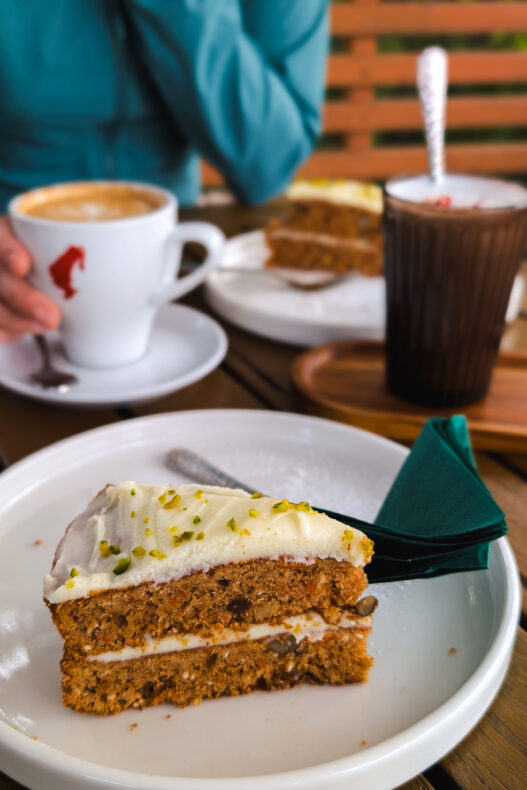
Tip: In the mood for coffee and cake after your castle visit? Close to Celle Castle, you will find Betty’s Café, where we stopped for a break on the terrace afterwards. There is a generous choice of homemade cakes and pastries, making it a very pleasant place to sit down and recharge during a day of exploring Celle. For us, it was the perfect follow-up to the castle: first a dose of royal history and family drama, then coffee and cake just a short walk away.
#3 Step Inside the Baroque Theatre from 1675
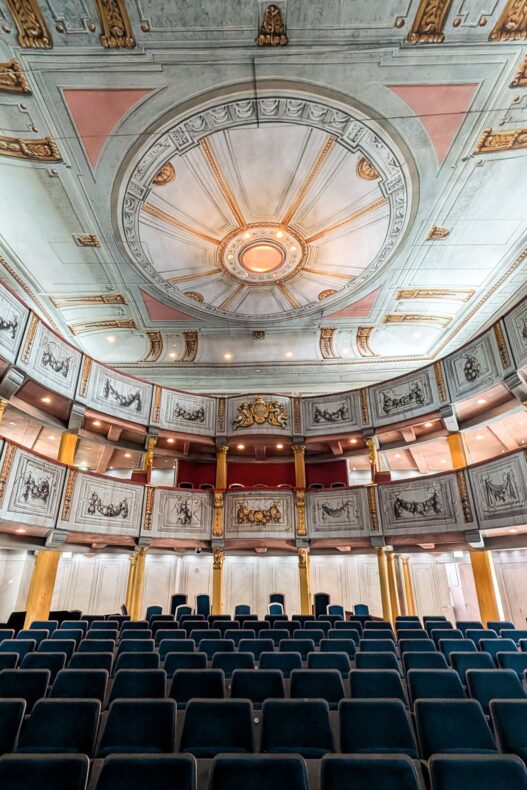
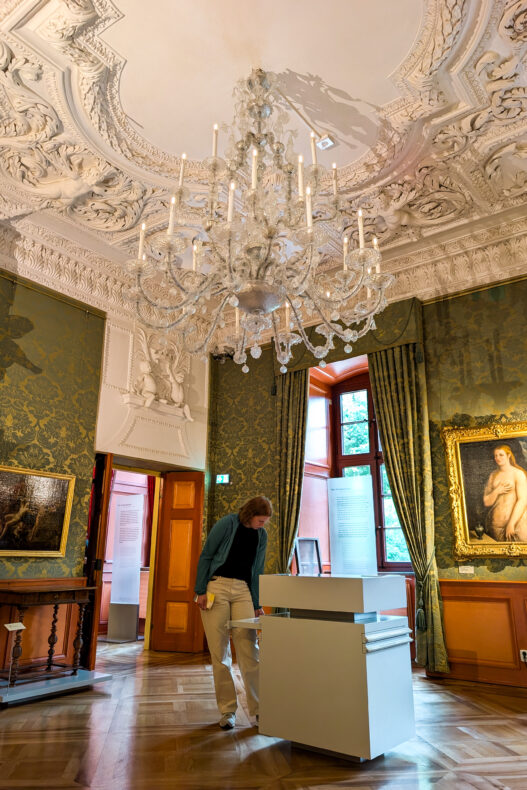
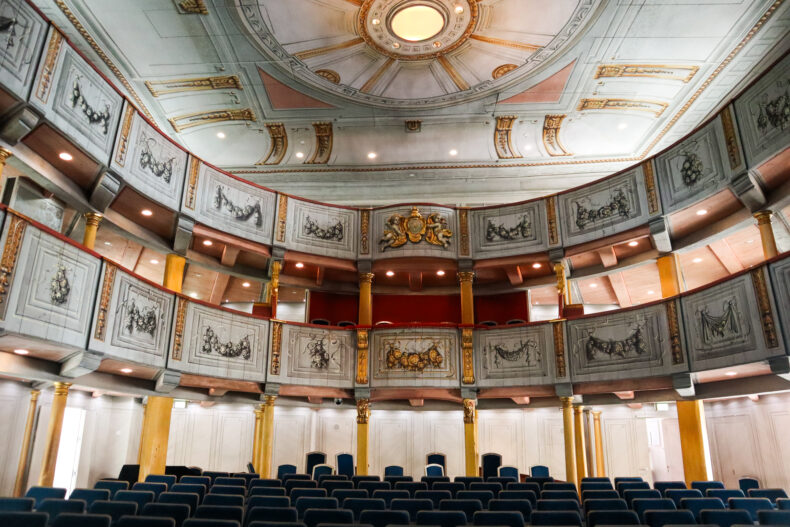
One of our favourite places inside Celle Castle was the Schlosstheater, the beautiful castle theatre hidden behind the palace walls. You would hardly expect to find a complete Baroque theatre here, which makes stepping inside feel like discovering one of the castle’s best-kept secrets. The theatre dates back to 1675 and was built during the time of Duke George William and his French wife, Éléonore. It is considered one of the oldest Baroque theatres in Europe that is still in use today, which makes it much more than just another historic room inside the castle.
In the seventeenth century, around 300 courtiers lived at the court in Celle, and entertainment played an important part in daily court life. Having a private theatre was a sign of status and culture, and performances were regularly staged here for the duke, his family and their guests. The theatre was not only used for plays and performances. The space also hosted balls and other social gatherings, so it was once one of the liveliest rooms in the entire palace. It is easy to imagine the court dressed in formal clothes, gathering here for an evening of music, theatre and dancing.
When you visit, make sure to look up. The painted wooden ceiling is one of the most beautiful details in the room, and the decoration adds to the intimate atmosphere of the theatre. The elegant boxes along the sides are another striking feature, although they were not part of the original seventeenth-century design. They were added later, during the eighteenth century. What we especially liked about the Schlosstheater is that it does not feel like a room frozen in time. This is not a historic space that has simply been preserved and left untouched for visitors to look at. The theatre is still actively used for performances today, which gives it a very different feeling from a typical museum room.
Knowing that actors and audiences still gather here centuries after the first performances took place makes the history feel much more real. It is one thing to admire an old theatre, but it is quite another to realise that the same space is still doing exactly what it was built for nearly 350 years ago. We visited the Schlosstheater as part of our guided tour of Celle Castle, and we would definitely recommend doing the same. In fact, we would say that seeing the theatre alone makes the guided tour worthwhile.
Without a tour, this part of the castle is not normally open for you to simply walk into on your own. Joining a guided visit is therefore one of the best ways to make sure you get to see the theatre and hear more about the people, events and traditions that shaped its history.
For us, stepping inside this hidden Baroque theatre was one of the most memorable moments of our visit to Celle. It is beautiful, surprisingly intimate and full of history, but the fact that it is still a working theatre today is what really makes it special.
#4 Discover the Remarkable Story of Caroline Matilda
One of the most fascinating royal stories connected to Celle Castle is that of Caroline Matilda, a British princess whose life took a dramatic turn at a very young age. When she was only fifteen, Caroline Matilda was promised in marriage to King Christian VII of Denmark. She did not have to leave Britain immediately, but she did not have much time either. At sixteen, she travelled to Denmark to begin a new life at the Danish court, entering a marriage that would turn out to be anything but a fairytale.
Caroline Matilda was deeply unhappy in Denmark. Life at court was difficult, her marriage was troubled and she eventually began an affair with Johann Friedrich Struensee, her husband’s personal physician. What makes the story especially remarkable is that Struensee was not just a secret lover. While his relationship with Caroline Matilda developed, he was also becoming more and more powerful at court. For a period, he effectively governed Denmark on behalf of the king and introduced major political reforms, making him one of the most influential figures in the country.
The affair between Caroline Matilda and Struensee is also believed to have resulted in the birth of a daughter. Despite the rumours surrounding her paternity, the child was officially recognised by the Danish king as a princess, adding even more drama to an already complicated royal situation. Unsurprisingly, such a powerful mix of romance, politics and court tension could not continue forever. Struensee was arrested and later executed, while Caroline Matilda was stripped of her title and removed from the Danish court.
In 1772, she was sent into exile in Celle, far away from Denmark and from the life she had known there. The most painful part of her exile was that she had to leave both of her children behind. Celle Castle became the setting for the final chapter of her life. Here, Caroline Matilda tried to create a fresh start for herself and slowly brought some energy back to the palace. Music, theatre and social gatherings once again became part of court life, giving the castle a livelier atmosphere.
For Caroline Matilda, Celle offered something she had rarely experienced during her years in Denmark: a little more freedom and space to shape her own life. Even though she was still living in exile, her time here seems to have been calmer than the years that came before it. Sadly, this new beginning was very short-lived. Only three years after arriving in Celle, Caroline Matilda died at the age of just 23.
Her story still forms an important part of the castle’s history today. During a guided tour of Schloss Celle, you will come across references to her life, her unhappy marriage, her affair, her exile and her final years in the palace.
Knowing her story adds another layer to a visit to the castle. The rooms are not just beautiful historic spaces; they are also connected to a young woman whose life was shaped by royal duty, political drama, forbidden love and exile.
For us, Caroline Matilda’s story was one of the most memorable parts of the tour. It is dramatic, tragic and surprisingly personal, and it makes Celle Castle feel much more alive than a typical royal residence.
#5 Find the Hoppener Haus
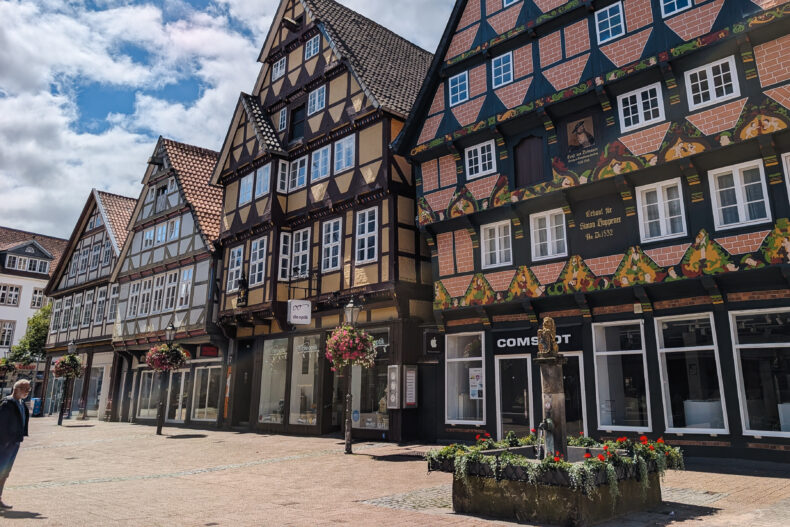
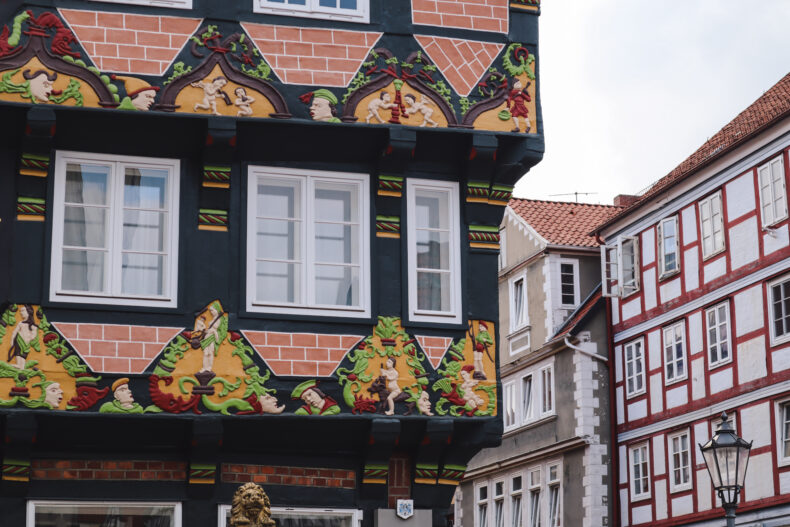
With nearly 500 half-timbered houses in Celle, it is almost impossible to choose the most beautiful one. Still, the Hoppener Haus is definitely one of the best places to start. Dating back to 1532, this striking six-storey building is covered from top to bottom in detailed wood carvings and is one of the most memorable façades in the old town. The house was built for Simon Hoppener, an official at the ducal court, and it is easy to see that a lot of care went into its design. At first glance, the façade is already impressive, but the real fun starts when you slow down and look closely at all the small details worked into the wood.
Among the carvings, you will find faces, human figures, strange creatures, decorative patterns and all kinds of unusual shapes hidden between the beams. Some details stand out straight away, while others are easy to miss unless you really take your time. That is what makes the Hoppener Haus so enjoyable to look at. The longer you stand in front of it, the more you begin to notice. What first looks like one richly decorated building quickly turns into a collection of small scenes, symbols and curious figures spread across the entire façade.
It almost feels like the house was designed to reward anyone who stops for a few extra minutes instead of simply walking past. Every section seems to have something different going on, which makes it one of those places in Celle where looking up really pays off. And while you are standing in front of the Hoppener Haus, make sure to look to the right as well. There you will see a row of colourful street lamps that feel slightly out of place next to such an old and historic building.
Their bright colours and playful shapes form a funny contrast with the centuries-old timber façade behind them. But their appearance is not the strangest thing about them.These lamps can actually talk. It is one of those quirky little details that makes Celle feel more playful than you might expect from such a historic town, and it adds a surprising modern twist to this very traditional corner of the Altstadt.
#6 Listen to Celle’s Talking Street Lamps
Celle has one of the quirkiest attractions we came across during our trip: talking street lamps. Right in front of the Hoppener Haus, you will find five colourful Sprechende Laternen that suddenly start talking to one another when you are nearby. Each lamp has its own personality and represents a different type of local from Celle. Together, they tell stories about the town, make jokes, share opinions and sometimes even argue with one another. It is a little strange, of course, but that is exactly what makes it so much fun.
The lamps are especially amusing because they stand in such a historic setting. You have the richly decorated Hoppener Haus on one side, centuries-old streets all around you, and then these bright, colourful lamps chatting away in the middle of it all. The contrast is unexpected and gives this part of the old town a playful twist. It is one of those small attractions that you probably would not expect to remember, but that somehow stays with you because it is so different from everything else around it. Celle has plenty of beautiful historic sights, so the talking lamps add a welcome bit of humour between all the castles, old houses and royal stories.
Just make sure you pay attention to the time, because even talking street lamps apparently need a lunch break. They tell their stories every day from 10:00 a.m. to 1:00 p.m. and again from 3:00 p.m. to 6:30 p.m. Unfortunately, we did not check the schedule carefully enough and ended up missing the actual conversations ourselves. We saw the lamps, but not the part that makes them truly special.
So if hearing the Sprechende Laternen is on your list, plan your visit around those time slots rather than simply hoping they will start talking when you arrive. Next time, we would definitely pay more attention to the schedule, because seeing Celle’s famous talking lamps without actually hearing them talk felt like missing half the fun.


#7 Step Inside the Stadtkirche St. Marien
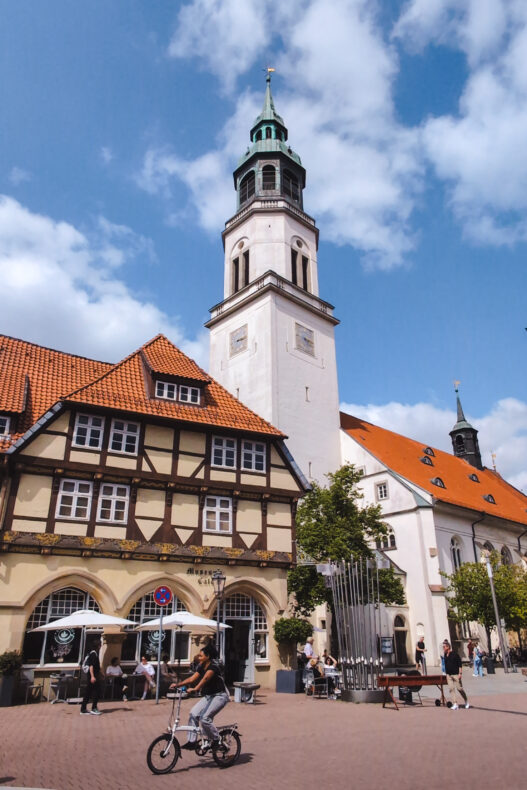
Right in the heart of Celle’s old town, surrounded by rows of half-timbered houses, stands the Stadtkirche St. Marien. Its history reaches back almost as far as the city itself. Construction began around the time Celle was founded in 1292, and the church was officially consecrated in 1308. From the outside, the church looks fairly simple and understated, especially compared with the colourful and highly decorated houses around it. But once you step inside, the mood changes completely. The interior is far more impressive, with rich Baroque decoration that gives the church a much grander feel than you might expect from the exterior.
That contrast makes St. Marien especially interesting to visit. It is easy to focus all your attention on the famous half-timbered streets when exploring Celle, but the church offers a very different look at the city’s long history. Inside, the ornate details and historic atmosphere add another layer to the old town experience. If you still have enough energy after walking around the Altstadt, you can also climb the 74.5-metre-high church tower. Reaching the top means tackling 235 steps, so it is a bit of a workout, but the view makes the effort worthwhile.
From above, you can look out over the rooftops of Celle’s historic centre, with its colourful half-timbered houses spread out below you. You also get a lovely view towards Celle Castle, giving you a completely different perspective on how closely the old town and the former ducal residence sit together. The tower is also linked to one of Celle’s nicest old traditions: the Turmbläser. At set times, a trumpet player climbs the tower and plays a chorale in all four directions, sending the sound out across the city.
It is a simple tradition, but one that adds a lot of atmosphere to the old town. Hearing live trumpet music carry over the rooftops feels wonderfully fitting in a place with so much history. If your timing is right, it is well worth pausing for a moment to listen. Between the church, the tower views and the Turmbläser tradition, St. Marien offers much more than you might expect from its modest appearance on the outside.
#8 Stroll Through the Französischer Garten
After spending hours surrounded by half-timbered façades, a bit of greenery makes a nice change. Just south of the Altstadt lies the Französischer Garten, a peaceful park that was first laid out in the late seventeenth century by French gardeners working for Duke George William. One of the park’s most striking features is its long double avenue of linden trees, planted in 1695 and 1696. More than three centuries later, it still forms the main structure of the garden and gives the park a strong sense of symmetry and history.
And once again, the story of Caroline Matilda appears here. When the exiled Danish queen arrived in Celle in 1772, the garden was renovated especially for her. A monument dedicated to her can still be found in the park today, making this another place in Celle where her short but dramatic life is remembered.
Over time, the garden itself changed as well. The original French design was much more formal and carefully arranged, but it was later transformed into a looser English-style landscape park. As a result, the Französischer Garten now combines elements from different periods, which makes it feel less like one perfectly preserved historic garden and more like a place that has evolved along with the city. That mix gives the park a relaxed atmosphere today. It is a pleasant place to slow down after exploring the busy streets of the old town, take a walk beneath the trees or simply sit for a while and enjoy a quieter side of Celle.
Tip: On a sunny day, Café Müller am Französischen Garten makes a lovely stop during your walk through the park. You can sit down for coffee and cake, and in summer it is also a nice place to pick up an ice cream before continuing your stroll.

#9 Admire the Alte Rathaus
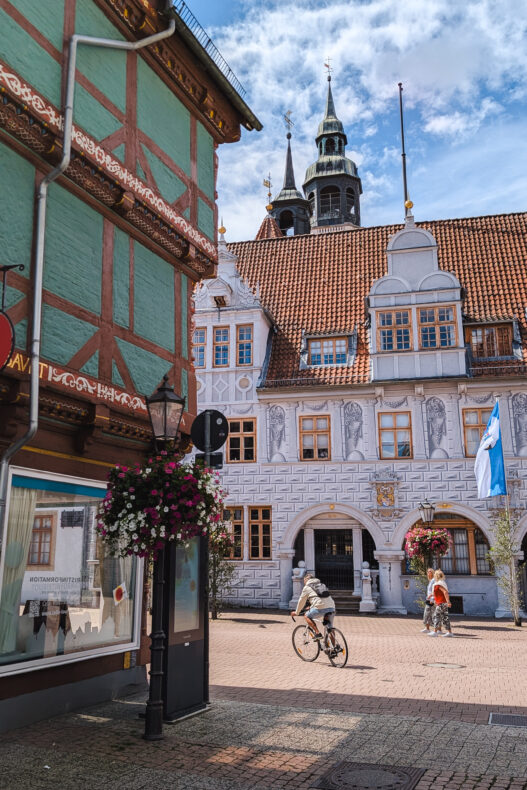
Right on the Markt, in the heart of Celle’s old town, stands the Alte Rathaus, one of the city’s oldest and most important historic buildings. Together with Celle Castle and the Stadtkirche, it dates back to the earliest days of the city, with its history reaching all the way back to Celle’s founding in 1292. The building is especially worth noticing for its richly decorated façade, which fits beautifully among the half-timbered houses surrounding the square. It is easy to focus on the castle and keep walking, but this is definitely one of those places where it pays to stop for a moment and look up.
The Alte Rathaus also tells a different side of Celle’s story. The city may be best known for its dukes, royal connections and elegant castle, but Celle was not only a ducal residence. It was also a busy town where people traded goods, made local decisions and managed everyday life. That makes the Rathaus an important part of the city’s history in its own right. While the castle reflects the world of nobility and court life, the town hall represents the civic side of Celle: the merchants, officials and residents who kept the city running from day to day.
Its location on the Markt makes that role easy to picture. This central square would once have been an important meeting point for trade, administration and public life, with the Rathaus right at the centre of it all. For us, that contrast is what makes the building interesting. Celle’s history is often told through stories of dukes, queens and royal families, but the Alte Rathaus is a reminder that there was also a whole city growing and working around them.
So while it may not be as grand as Celle Castle, the Alte Rathaus is still well worth a closer look. Its beautiful façade, long history and central place in city life add another layer to the story of Celle and help show how the town developed over the centuries.

#10 Have a Glass of Wine in Zapfhahn’s Tiny Courtyard
One of our favourite discoveries in Celle was hidden behind a small shop in the middle of the old town. Zapfhahn is a cosy delicatessen and wine shop set inside a half-timbered house that is almost 450 years old. Even before you find the courtyard, it is already a lovely place to browse, with shelves filled with wine, liqueurs, oils, vinegars and all kinds of tempting treats. But the real surprise is waiting at the back. Walk through the shop and you will find a tiny hidden courtyard with only a few tables. It feels wonderfully quiet and tucked away, even though you are still right in the middle of Celle’s Altstadt.
This is the kind of place where you will probably want to stay longer than planned. Find a table, order a glass of wine, add a little cheese on the side and simply enjoy the atmosphere for a while. What we liked most was how hidden it felt. Just outside, you are surrounded by busy streets, historic façades and people exploring the old town. Step through the shop, however, and suddenly you are sitting in a peaceful little courtyard that feels completely separate from everything around it.
That contrast is part of what makes Zapfhahn so charming. You are still surrounded by centuries of history, but instead of looking at another landmark, you get to enjoy the setting in a much more relaxed way. It is also exactly the sort of place you could easily walk past without ever knowing what is hidden behind the front door. From the street, there is little to suggest that such a lovely little courtyard is waiting inside. And that is why we wanted to include it in this list. Celle has plenty of well-known sights, but some of the nicest moments often come from these smaller discoveries in between.
For us, sitting down with a glass of wine and some cheese in a hidden courtyard behind a centuries-old half-timbered house was one of those simple travel moments that stayed with us. It was relaxed, unexpected and a perfect way to slow down after a full day of exploring Celle.
We made this trip at the invitation of ‘9 Cities + 2 in Lower Saxony’, a partnership between some of the most interesting and enjoyable cities in Lower Saxony. Feeling inspired to explore the region for yourself? You can find plenty of ideas, travel inspiration and useful information for planning your own trip at https://9staedte.de/en/.