
Do you need a visa, which side of the road do they drive on, and will your bank card work in the middle of the desert? Plan a road trip through Namibia and questions like these pile up fast. We spent just over three weeks in January driving around the country in a 4×4 with a rooftop tent, and these are our 20 Namibia travel tips to help you prepare.
Namibia means empty gravel roads, nights under a ridiculous number of stars and a rhino that suddenly turns up at the waterhole. It also means hours without passing a single village, changing a tyre yourself and campsites where the braai seems to matter more than the shower. A self-drive trip here simply takes a bit more planning than your average holiday.
From travel documents and health to driving, money, mobile data and what to pack: below is everything worth sorting out before you go.

20 Namibia travel tips to prepare your trip
#1 Visa: do you need a visa for Namibia?
Yes. Travellers from the Netherlands and other EU countries now need a visa for Namibia, even for a road trip of just a few weeks. You can apply online for an e-visa before you leave, or get a visa on arrival at the airport or the border. Either way there is a form to fill in, so expect a queue at immigration. The Namibia Tourism Board explains how the application works.
Your passport needs to be valid for at least another six months and have enough blank pages. Border officials sometimes ask for proof of your return or onward flight, so keep that booking to hand. Travelling with children? Each child needs their own passport, and it is wise to bring a birth certificate too.
Visa rules change more often than you might think. Check the current requirements for your nationality shortly before you leave, especially if you plan to pop into Botswana or South Africa and re-enter Namibia afterwards.

#2 Vaccinations and malaria: what do you need for Namibia?
There are no compulsory vaccinations if you fly in straight from Europe. Only travellers arriving from a country with yellow fever have to show a vaccination certificate. DTP and hepatitis A are the jabs usually recommended.
Malaria is a little less straightforward, because the risk depends on both the region and the season. It is highest in the north and north-east, such as the Kavango region around Rundu and the Zambezi region, formerly known as the Caprivi Strip. Etosha also lies within the area where malaria occurs, mainly during the rainy season and the months that follow. On the coast, in the Namib Desert and in the south it is hardly an issue. The Namibia Tourism Board’s health page gives an overview.
So whether you need malaria tablets comes down to your route and your travel dates. Book an appointment with a travel clinic well before departure and let them advise you personally. Covering up in the evenings and using a repellent with DEET is sensible in the north whatever they say.
Take out travel insurance that covers medical costs and repatriation as well. In a country where the nearest hospital can be a very long drive away, that is not something to skip.

#3 Safety: is Namibia safe to travel?
We never felt unsafe in Namibia, not once. People are friendly and helpful, and outside the towns the country is mostly empty and quiet. Petty crime and muggings do happen though, mainly in urban areas. In Windhoek and Swakopmund, leave nothing on show in the car and avoid walking around after dark. Your own government’s travel advice describes the risks per region.
The biggest risks are the roads and the distances. You can drive for hours on gravel without seeing another soul, and if the car breaks down you are on your own for a while. Make sure you know how to change a tyre, and always carry plenty of water and a charged phone or power bank. Tell someone where you are heading that day, too.
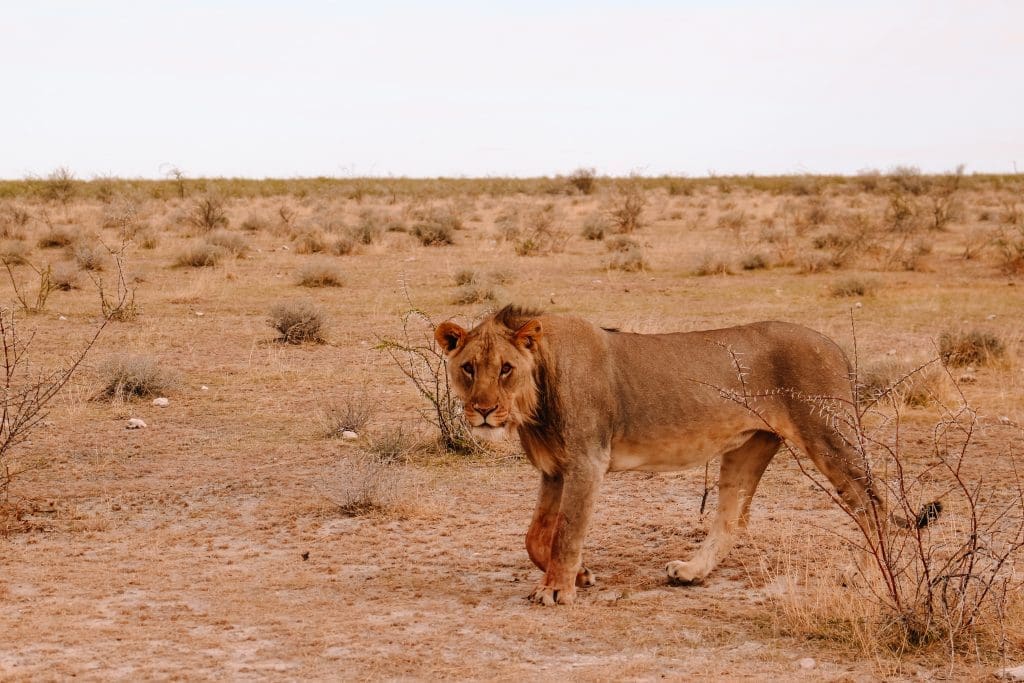
And then there is the wildlife, which does not stay neatly inside the national parks. On our very first night with the 4×4, a warthog, small antelope and a honey badger wandered through the campsite. Great to watch, but they are wild animals: keep your distance, don’t leave food lying around and stay close to your tent or car after dark.
#4 Best time to visit: when should you go to Namibia?
We travelled in January, right in the middle of the rainy season, and never regretted it. It did get seriously hot, so we skipped long hikes in the middle of the day. Wildlife was no problem at all: in Etosha National Park we found ourselves among elephants and rhinos and watched a lion with its kill. It was also pleasantly quiet at the best places to visit in Namibia and on the campsites.
Officially, the dry season from May to October is the best time to visit. Days are pleasantly warm, nights are cool and it barely rains. Animals gather around the waterholes, which makes them easier to spot. It is high season though, so expect higher prices and fuller campsites and lodges.
The rainy season runs roughly from November to April, with the heaviest showers in January and February. They tend to be short and fierce, although roads in the north can become hard to pass after a lot of rain. In return you get a green landscape and, often, a smaller bill for your rental car and accommodation.

#5 Rental car: hire a 4×4 or go backpacking?
If you really want to see Namibia, you need your own wheels. Distances are huge, public transport is limited and the best places are a long way from anywhere. We went for a 4×4 with a rooftop tent and would do exactly the same again: you choose your own route, stop wherever you like and always have your bed with you.
Backpacking Namibia is hard work. There are few buses, and none of them will drop you at the dunes of Sossusvlei or the waterholes of Etosha. If you would rather not drive, an organised group tour is the only decent alternative. For us, though, a big part of the adventure was in those long drives through empty landscapes, with the odd zebra by the roadside.
Together with your flights, the rental car will be the biggest expense of the trip. Prices drop considerably in the low season, so keep that in mind when you pick your dates.
→ Compare rental cars in Namibia at Discover Cars
→ Discover the 4×4 with rooftop tent from Namibia Nomads
→ See our travel budget for Namibia

#6 Driving: left-hand traffic, licences and gravel roads
Namibia drives on the left, with the steering wheel on the right. If you are not used to that, it clicks sooner than you would expect, helped by the fact that there is hardly any traffic outside the towns. A national licence is normally accepted, but because a Dutch licence like ours is not in English, an International Driving Permit is worth having. Ask your rental company when you book. For the deposit you will almost always need a credit card in the main driver’s name.
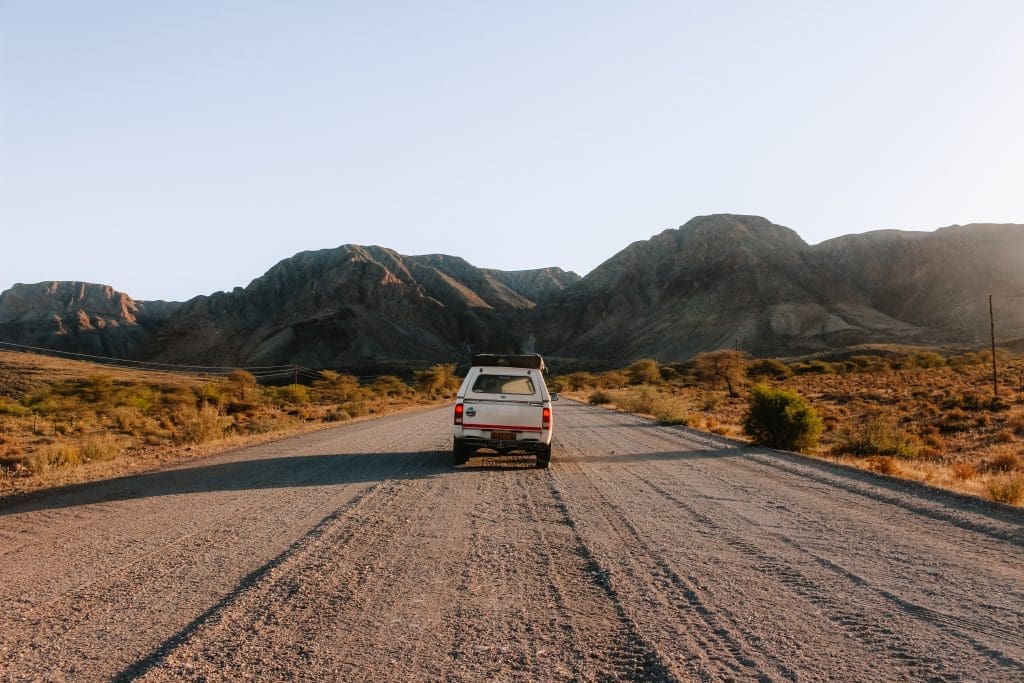
The main roads are tarred, but a large part of your route will be on gravel. The limit is 60 kilometres per hour in built-up areas and 120 on tar. On gravel the official limit is higher than you would like, so go much slower than the maximum: cars slide easily on loose stones and a puncture happens in no time. When you collect the car, check that the spare wheel and jack are there, and look over your tyres regularly along the way.
Don’t drive after dark. The roads are unlit and animals cross without warning. On our first day behind the wheel we had already given way to monkeys, cows, a snake, ostriches and warthogs, with a giraffe standing by the roadside for good measure. Fill up whenever you get the chance as well, because petrol stations can be far apart. You don’t have to do it yourself: an attendant fills the tank and often washes your windows while you wait.
We covered more than 5,000 kilometres in just over three weeks. So count on long hours at the wheel on driving days and plan generously rather than tightly.
→ Read all about renting a car and driving in Namibia
#7 Itinerary: how long do you need and which route do you take?
Almost every trip starts in Windhoek, where you land and pick up your rental car. Allow at least two to three weeks for Namibia. We were on the road for just over three weeks and never felt we had time to spare.
Broadly speaking, there are two ways to go. One route focuses on the north, with Etosha National Park, Damaraland and possibly the Caprivi Strip, where you add extra safari days to your trip. The other makes a big loop past Etosha and the coast before heading south to Sossusvlei, Kolmanskop and the Fish River Canyon.
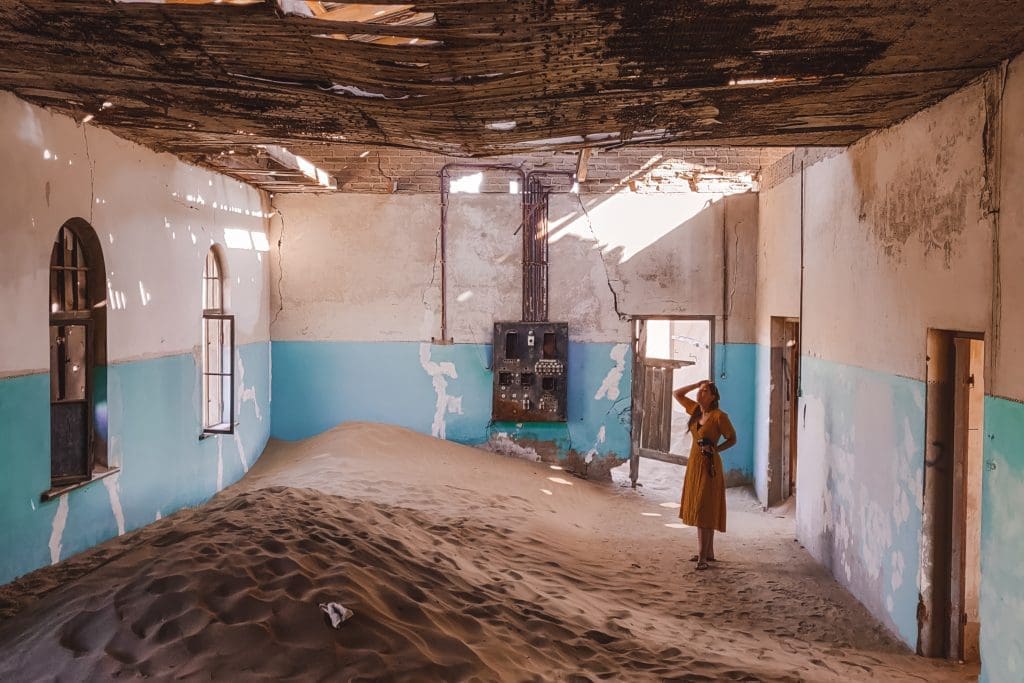
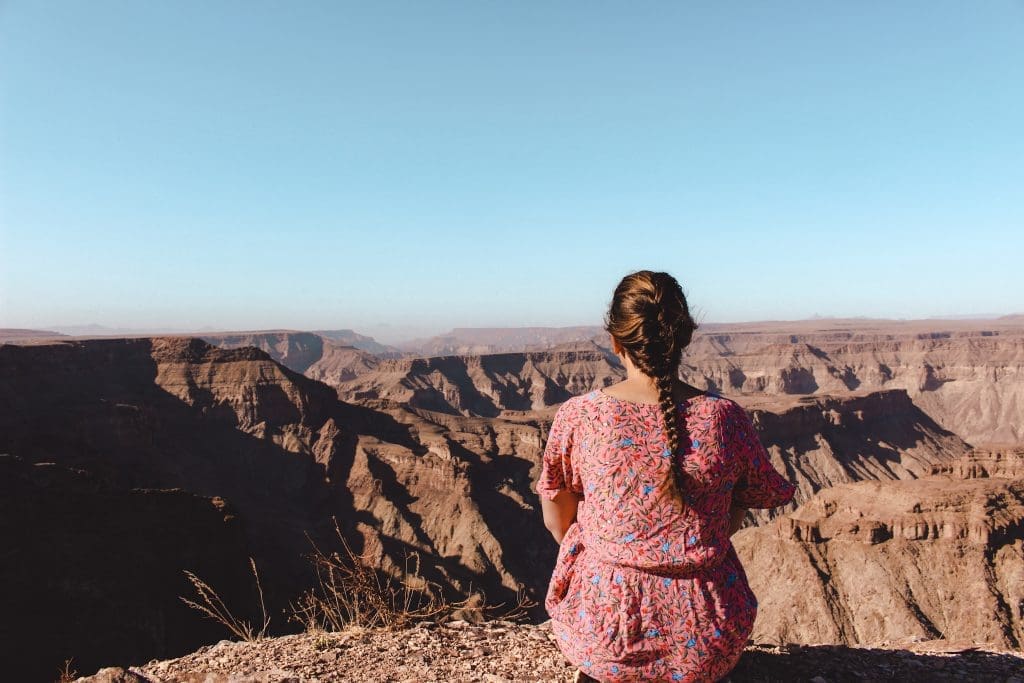
We chose that southern loop, because we did not want to miss the ghost town of Kolmanskop and the Fish River Canyon. Whatever you pick, don’t underestimate the distances. A stretch often looks shorter on the map than it turns out to be, so stay a little longer in fewer places rather than packing up every single day.
→ Map out your Namibia itinerary
→ Discover the natural phenomena in Namibia you should not miss

#8 Where to sleep: camping or lodges?
Camping was the highlight of our trip. With the rooftop tent we slept next to a waterhole in Etosha, on the Brukkaros volcano and on the Skeleton Coast. Campsites are usually basic, but clean and well organised, and far cheaper than a lodge.
Lodges come in every shape and size in Namibia, often in remarkable spots, such as a terrace overlooking a canyon or a pool in the middle of the desert. That comes at a price, certainly in high season. Can’t decide? Mix it up, with a few nights of camping and a lodge in between to wash the dust off.
If you travel between May and October, book in good time. The campsites and lodges in Etosha and around Sossusvlei in particular fill up early. The camps inside the national parks are booked through Namibia Wildlife Resorts.
→ Read all about camping in Namibia
→ Discover the 11 best campsites in Namibia
→ Discover the 29 most unique places to stay in Namibia

#9 Money: cash, cards and ATMs in Namibia
The currency is the Namibian dollar, which is pegged one to one to the South African rand. You can simply pay with rand in Namibia, so if you have some left over from an earlier trip, bring it along.
Paying by debit or credit card is possible in far more places than we had expected, right up to the gate of a national park. Just don’t rely on it everywhere. ATMs are mostly found in the larger towns, and not every petrol station or village shop takes cards. Withdraw money in town and always carry enough cash for a full tank and some groceries.
Before you leave, make sure your bank card is enabled for use in Africa, or the first ATM will leave you empty-handed.

#10 Tipping: how much do you tip in Namibia?
Tipping is part of daily life in Namibia. In restaurants, ten per cent is the norm. At the petrol station you give some small change to the attendant who fills your tank and cleans your windows, and the same goes for the car guards who keep an eye on your car outside supermarkets.
A tip is also appreciated when you head out with a guide or stay at a lodge. Lodges often have a tip box at reception, so the staff behind the scenes get their share. The amounts are small, but do make sure you always have some coins and small notes in your pocket.
As soon as you leave Windhoek, your signal will come and go. In the national parks, along the Skeleton Coast and on long gravel stretches there is often no coverage with any provider. So download offline maps before you set off. Google Maps works fine if you save the maps in advance, and the Maps.me app navigates without a connection too.
We also kept an old-fashioned road map in the car, which comes in handy when navigation drops out. We used it in the morning to go through the day’s route, including the stops and petrol stations along the way. With a rented 4×4 you sometimes get a GPS or route book as well.
For mobile data, buy a local SIM card when you arrive at Windhoek airport. MTC is one of the big providers. A prepaid bundle is enough for navigation, messaging and contacting your accommodation. If you would rather not swap SIM cards, an eSIM with a data bundle for Namibia is an alternative, provided your phone supports it. And if you would feel better with a safety net in remote areas, ask your rental company about a satellite phone.
#12 Plugs: which travel adaptor do you need?
We forgot our travel adaptor and were lucky to find one in Windhoek. Outside the city that would have been a lot harder, so bring one from home. Sockets in Namibia are mostly type M, with three thick round pins. Plenty of universal adaptors don’t include it, so check before you buy.
If you are camping with a rental car, pack an inverter or 12V charger too. It lets you charge your phone and camera through the cigarette lighter while you drive. On a campsite you would rather not leave your electronics unattended at a power point. Add a power strip and you can charge several devices at once.

#13 Time difference: what time zone is Namibia in?
Coming from Europe, you won’t have to deal with jet lag. Namibia is on UTC+2 all year round and does not change its clocks. That means it is the same time as in the Netherlands during European summer time and one hour ahead in winter. From the UK, it is one hour ahead in summer and two in winter.
So you step off the plane and can get straight on with it. Rather nice when you want to be up early the next morning for a game drive or a sunrise hike.
#14 Packing: layers and sun protection
Dress for Namibia as if you will meet several seasons in a single day. It can be scorching in the afternoon, but once the sun goes down the temperature drops quickly. In the winter months, from June to August, nights can get properly cold. On an early morning game drive you will be glad of a fleece and a scarf, only to be in a T-shirt a few hours later.
So pack layers: shorts and light shirts, but also a warm jumper, long trousers and a windproof jacket. Sturdy shoes are useful for climbing the dunes or scrambling over the rocks at Spitzkoppe. And don’t forget the sun, which is fierce here. You will need sun cream, sunglasses and a cap or hat every day. A buff or scarf also helps against the dust on the gravel roads.
#15 Binoculars: essential on safari
Binoculars belong in your bag in Namibia. The landscape in Etosha is open and dry, so you can see animals coming from a very long way off. Thanks to ours we saw elephants, a rhino and lions long before others noticed them.
They are useful outside the parks too. Giraffes and ostriches turn up by the roadside when you least expect it, and with binoculars you don’t just see that they are there, you see what they are up to.
→ Read our 25 practical tips for Etosha National Park

#16 Tap water: can you drink it?
In towns like Windhoek and Swakopmund, the tap water is generally fine to drink. We really liked being able to refill our bottles straight from the tap, which we had not expected beforehand.
On campsites and in remote areas the quality varies, and you don’t always know where the water comes from. If in doubt, use bottled water or a water filter.
Whatever you drink, always keep a good supply of water in the car. The climate is dry, the distances are long and there is not always somewhere to buy anything. With car trouble you could easily be stuck for a few hours, and that is when you will be happy with a full jerrycan in the back.

#17 Food: what do people eat in Namibia?
We ate springbok on our very first day in Windhoek. Game is perfectly normal in Namibia: zebra, kudu and oryx are on the menu too, and you will find them at the butcher’s and in the supermarket. Restaurants, by the way, are mostly found in the towns in this sparsely populated country.
Fresh vegetables are trickier. An affordable pepper is a rare sight in a desert country where little grows, so your shopping will mainly consist of long-life products and meat. Vegetarians will need a bit more planning and more cooking for themselves.
Meat goes on the braai, the Namibian barbecue. Every campsite has one, however basic it is. A shower or toilet was sometimes missing, a braai never. One more tip for the road: many petrol stations sell rather good cakes and pastries, so do step inside when you stop for fuel.
→ Read the 12 ways Namibia amazed us

#18 Greetings: start every chat with ‘How are you?’
In Namibia you don’t get straight to the point. Whether you are paying at the supermarket, pulling into a campsite or asking a park ranger something, ‘How are you?’ comes first, and a real answer is expected. Ask the other person how they are doing in return.
It feels a little formal at first, but you get used to it quickly and it makes striking up a conversation easy. English is the official language and will get you everywhere. You will also hear a lot of Afrikaans, which sounds oddly familiar if you speak Dutch, and German in places like Swakopmund.

#19 Beaches: can you go to the beach in Namibia?
Namibia has a long coastline, but a beach destination it is not. The Atlantic is cold and rough here, and fog often hangs over the coast.
Swakopmund is as close as it gets to a beach holiday. There is a sandy beach, a promenade to stroll along and a beach bar where you sit with your feet in the sand. We camped just around the corner, at Tiger Reef Campsite.
Along the Skeleton Coast the beaches are endless, rugged and deserted. We slept at Torra Bay, right by the sea. A special spot, although the water was so cold that only Sebastiaan dared to jump in. So think of the beach in Namibia as a backdrop for a walk or a beer at sunset, not as a place to spend an afternoon swimming and sunbathing.

#20 Border crossings: on to Botswana or South Africa
Many travellers add Botswana or South Africa to their Namibia trip. Dutch passport holders don’t need a visa for a short stay in either country, but the passport requirements differ per country, such as the validity and the number of blank pages.
With a rental car you need extra paperwork. Tell your rental company in advance that you want to cross the border: they arrange a letter of authorisation and the vehicle documents, and sometimes separate insurance is added.
Keep an eye on what is in your cool box as well. Fresh products such as meat, dairy, eggs and vegetables are strictly checked at the borders. That works both ways, as Namibia itself is strict about meat and dairy brought in from South Africa. Use up your supplies before you cross.
Not every border post is open day and night. Plan your crossing for the morning or around midday, so you have plenty of time and don’t end up driving on in the dark.
Enjoy our travel tips? Add The Orange Backpack as a preferred source on Google and you'll see us more often in your search results.
Plan your trip to Namibia
Everything you need to book your trip, in one place. From desert lodges to a 4x4 with a rooftop tent.
 Our pickLodges and hotels in Namibia: from a desert lodge near Sossusvlei to a safari camp right outside Etosha. Pick your spot or browse all of Namibia on Booking.com
 Namibia is made for a self-drive trip. Staying in lodges? Compare rental cars with Discover Cars. Rather camp? Book a road trip with a 4x4 and rooftop tent from Namibia Nomads, route and campsites sorted.
 Dunes that tumble straight into the ocean? Book the Walvis Bay boat trip with a 4x4 ride to Sandwich Harbour with GetYourGuide.
 Prefer everything arranged? Browse Namibia tours on TourRadar.
 No flight yet? Compare flights to Windhoek.
 Discover all our blogs about Namibia


