
One of Spain’s most underrated regions is Murcia, tucked away in the southeast of the country between the popular Costa Blanca and Andalusia. It is the kind of place where you can easily combine sunny beaches, rugged nature, and historic cities in a single trip. What makes Murcia especially appealing is that it still feels much quieter than many of Spain’s better-known regions. You can explore beautiful places without constantly running into large crowds. That makes the whole region feel more relaxed, authentic, and surprisingly easy to enjoy.
Along the coast lies the Costa Cálida, known for its long beaches, peaceful coves, and warm seawater. Head inland, and the landscape changes quickly from dry badlands to green river valleys, rolling hills, and mountain scenery. This variety makes Murcia a wonderful region for a road trip, especially if you like mixing beach days with nature and scenic drives. One day can be spent by the sea, while the next might take you through dramatic inland landscapes. The changing scenery keeps the region interesting from start to finish.
Murcia also has plenty to offer if you love culture and history. In its cities and towns, you can wander through Baroque squares, admire centuries-old buildings, and discover traces of both Roman and Moorish history. At the same time, many places still feel calm and wonderfully local. Because the region is less famous among international travelers, it is still possible to find real hidden gems that feel far removed from the usual tourist routes. That sense of discovery is one of the things we enjoyed most about exploring Murcia.
In this article, we take you to the 18 most beautiful places in the Murcia region. Some are well-known highlights, while others are quieter spots that many visitors easily miss. Together, they show just how varied this part of Spain really is, from beaches and historic towns to mountains and unusual natural landscapes. Whether you are planning a road trip or simply looking for inspiration, these are the places we think deserve a spot on your Murcia itinerary.

Where Is the Murcia Region in Spain?
Murcia is tucked away in southeastern Spain, right along the Mediterranean coast. It sits between two much better-known areas: the Costa Blanca in the province of Alicante and the province of Almería, where Andalusia begins. That location makes Murcia a very easy region to include in a longer road trip through southern or eastern Spain. You can move from beaches to historic cities and inland nature without spending endless hours in the car. It is a practical base for exploring several very different parts of the country.
The coastline of Murcia is known as the Costa Cálida, which literally means “Warm Coast.” The name refers to the mild climate and the large number of sunny days the region enjoys throughout the year. Along the coast, you will find quiet beaches, protected natural areas, rocky coves, and the unusual Mar Menor lagoon. Compared with some of Spain’s more famous beach destinations, this coastline often feels calmer and less crowded. That makes it especially appealing if you enjoy relaxed beach days and a slightly slower pace.
The main airport is Murcia International Airport (Corvera), around 25 kilometers from the city of Murcia. It is a convenient choice if you can find a good flight, especially when the Murcia region is the main focus of your trip. Many travelers also fly into the larger Alicante Airport, about an hour away by car, because it offers many more international connections. Renting a car from either airport makes exploring the region much easier, especially since many of the best places are spread out across the coast and countryside. Having your own transport also gives you more freedom to stop in smaller towns and nature areas along the way.
Thanks to its location, Murcia is also very easy to combine with other parts of southeastern Spain. You can continue north toward places along the Costa Blanca for colorful seaside towns, beaches, and mountain scenery. In the other direction, you can turn your trip into a road trip toward Almería and the rest of Andalusia, with its desert landscapes, historic cities, and beautiful Mediterranean coast. That position between several popular regions makes Murcia especially useful if you want a varied trip without constantly changing base. For us, that mix of accessibility and variety is one of the region’s biggest advantages.

What Murcia Is Known For
Murcia is best known for its sunshine, beaches, natural landscapes, and excellent food. The region combines the peaceful coastline of the Costa Cálida with the unique Mar Menor lagoon, striking inland scenery, and a local cuisine that makes the most of fresh regional produce. It is a destination where you can easily move from the coast to the countryside and experience a completely different side of southeastern Spain. That mix of sea, nature, and food is a big part of what makes Murcia so appealing.
One of the first things you notice about Murcia is the warm climate. The region is one of the sunniest parts of Europe, with more than three hundred sunny days a year. Winters are mild, while summers are hot and dry, which means outdoor activities are possible almost all year round. You can enjoy beach days, mountain walks, or a relaxed afternoon on a city terrace in almost any season. We visited Murcia several times in early spring ourselves, and it turned out to be a wonderful time to explore the region.
The coast also plays a major role in Murcia’s identity. Along the Costa Cálida, you will find wide sandy beaches, small coves, and quiet seaside towns that feel more relaxed than many of Spain’s better-known resorts. The most famous natural feature is the Mar Menor, a huge lagoon separated from the Mediterranean by a narrow strip of land. The water is shallow and warms up quickly, which makes it especially pleasant for swimming. It is also a popular place for sailing and other water sports.
The inland areas of Murcia surprised us with just how varied they are. You will find green river valleys, mountain landscapes, and dry badlands where erosion has carved unusual shapes into the earth. Places such as Barrancos de Gebas and the Desierto de Abanilla show a side of Spain that many travelers do not expect to find in this region. The contrast between these dry landscapes and the greener areas nearby makes road-tripping through Murcia especially interesting. There is much more natural variety here than you might guess at first.
The local cuisine is another important part of what Murcia is known for. The region has strong farming traditions, especially in the fertile huerta around the city of Murcia, where large amounts of fruit and vegetables are grown. These fresh ingredients appear throughout the local food scene, often in simple dishes and tapas that let the produce speak for itself. Rice dishes, vegetables, fish, and seafood all play an important role on local menus. For food lovers, Murcia is a great place to discover regional flavors without the crowds you might find in more famous Spanish destinations.

Things to Do in Murcia: Exploring Spain Off the Beaten Path
#1 Murcia
The city of Murcia is the lively heart of the region and often the first place you will visit when exploring this part of southeastern Spain. It sits along the Segura River and was founded by the Moors in 825, giving the city a long and fascinating history. One of their most important contributions was an extensive irrigation system that turned the surrounding land into a fertile farming area. You can still see that influence today in the huerta, the green agricultural belt around the city. This mix of history, local life, and fertile countryside gives Murcia a character that feels very different from Spain’s better-known tourist cities.
The historic center is compact, which makes it perfect for exploring on foot without needing a strict plan. At the heart of the old town is Plaza del Cardenal Belluga, one of the city’s most beautiful squares and home to the impressive Murcia Cathedral. The cathedral was built between the fourteenth and eighteenth centuries, so you can see several architectural styles in one building. Its grand Baroque façade is the first thing that catches your eye, while the 93-meter-high bell tower rises above the rooftops and can be seen from many parts of the city. It is one of those places where you naturally want to stop, look around, and take in the details.
From the square, you can wander straight into Murcia’s old shopping streets, including Calle Trapería and Calle Platería. These narrow streets are lined with shops, cafés, historic buildings, and small plazas, so there is always something to see as you walk. Nearby, you will also find the Real Casino de Murcia, one of the city’s most elegant historic buildings and well worth a visit for its richly decorated interior. The surrounding streets are a great place to simply wander and enjoy the atmosphere without rushing from one sight to the next. Murcia feels especially pleasant when you allow yourself time to explore slowly.
The old center really comes alive in the late afternoon and evening, when terraces fill up and locals head out for drinks, tapas, and dinner. The atmosphere becomes warmer and more relaxed, and the small squares feel much livelier than during the middle of the day. This is a great time to stop for a drink, try some local food, or simply watch city life unfold around you. For us, Murcia is not just about ticking off historic sights, but about enjoying the rhythm of the city itself. That relaxed mix of culture, food, and everyday life is what makes it such a pleasant place to spend time.
Discover the most beautiful sights in Murcia →

#2 Real Casino de Murcia
The Real Casino de Murcia sits right in the heart of Calle Trapería, one of the oldest and most atmospheric streets in the city. Despite the name, this is not a place for gambling. The building was founded in 1847 as a private social club for Murcia’s wealthier gentlemen, who came here to read, talk, meet friends, and attend social events. Over time, it became one of the city’s most important gathering places for the local elite. Today, it is still one of Murcia’s most beautiful historic buildings and a fascinating place to explore.
From the outside, the building looks fairly understated, but the moment you step inside, everything changes. Behind the entrance is a series of richly decorated rooms, each with its own style and atmosphere. The most famous space is the Neo-Moorish courtyard, inspired by Islamic palaces and covered with geometric patterns, elegant arches, and thousands of pieces of gold leaf. You will also pass the beautiful library with its wooden galleries, stylish salons with large windows facing the street, and the grand ballroom where parties and formal gatherings were once held. Every room has a completely different look, which makes walking through the building feel like moving from one world into another.
One of the nicest things about visiting is how many small details you start to notice as you walk around. Painted ceilings, decorative tiles, carved wood, mirrors, columns, and ornate furniture all add to the feeling that this is much more than just a historic club. The building feels elegant without being cold, and the different rooms tell you a lot about the style and social life of Murcia in the nineteenth century. It is the kind of place where it is worth slowing down instead of rushing from room to room. Even if you are not usually interested in historic interiors, there is a good chance this place will still impress you.
The Real Casino is still a private club today, but visitors are allowed to explore a large part of the building. With an audio guide, you can walk through the historic rooms at your own pace and learn more about the architecture, design, and stories behind each space. Personally, I found this one of the most memorable places in the entire Murcia region. It is elegant, surprising, and much more impressive inside than you might expect from the street. If you enjoy beautiful architecture, historic interiors, or unusual places with plenty of character, this is absolutely worth adding to your visit.
Read our full guide to the Real Casino de Murcia →

#3 Cartagena
Cartagena sits on the Mediterranean coast and feels noticeably different from most other cities in the Murcia region. The city is built around a natural harbor and surrounded by hills, which gives it a dramatic setting and a strong connection to the sea. That location has made Cartagena strategically important for thousands of years, and you can still sense that long history throughout the city. Even today, the harbor remains one of its defining features and gives the center a lively maritime atmosphere. It is the kind of place where history and everyday life sit very naturally side by side.
The city was founded by the Carthaginians in 227 BC and later taken over by the Romans, who renamed it Cartago Nova. Under Roman rule, Cartagena became an important port and a major center for trade and military activity. A surprising amount of that ancient past is still hidden beneath the modern streets, while other remains are clearly visible as you walk around the center. Archaeological sites appear between shops, squares, and residential buildings, which makes exploring the city feel especially interesting. You are never far from another reminder of how old Cartagena really is.
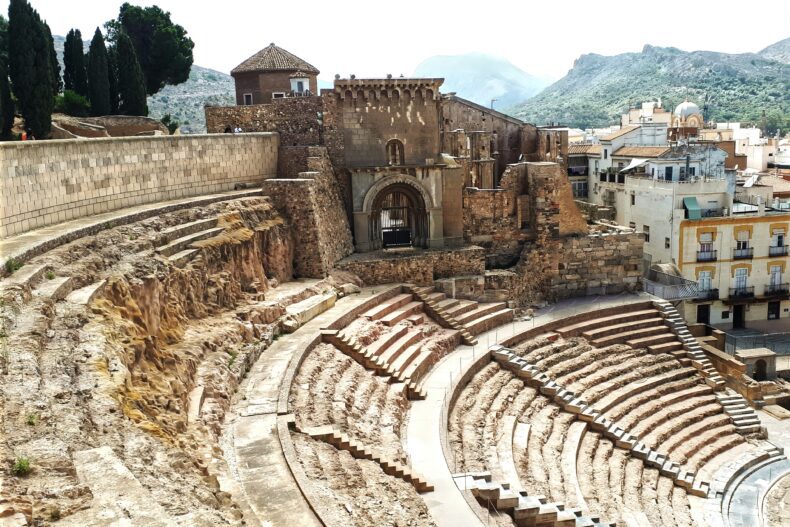
The city’s most famous attraction is the Roman Theatre, which dates from the first century BC. This huge structure was only discovered in 1987 during construction work, making its rediscovery almost as fascinating as the monument itself. Since then, the theatre has been carefully restored and is now one of the most important archaeological sites in Spain. Walking through it gives you a much clearer idea of the scale and importance of Roman Cartagena. It is easily one of the highlights of the city and a place you should not miss.
Around the harbor, a wide promenade is lined with museums, historic buildings, cafés, and terraces, making it a pleasant place to slow down and enjoy the city. The waterfront is especially attractive later in the day, when the light softens and the views across the harbor become even better. Above the center, Castillo de la Concepción sits on a hill and offers one of the best viewpoints in Cartagena. From here, you can look across the rooftops, the harbor, and the surrounding fortifications. The mix of sea views, ancient history, and lively streets makes Cartagena one of the most rewarding places to visit in the Murcia region.
#4 Mar Menor & La Manga del Mar Menor
The Mar Menor is a huge saltwater lagoon along the Costa Cálida and one of the most unusual landscapes in the Murcia region. It is separated from the Mediterranean Sea by a narrow strip of land around 22 kilometers long known as La Manga del Mar Menor. This creates a very special setting, with the open Mediterranean on one side and a calm inland lagoon on the other. The contrast between the two gives the area a completely different feel from the rest of the coast. It is one of those places that immediately stands out and is easy to recognize on the map.
Because the lagoon is so shallow, the water warms up quickly and often stays warmer than the Mediterranean. That makes the Mar Menor a popular place for swimming, sailing, kayaking, and other water sports. Several seaside towns sit around the lagoon, including Los Alcázares and San Pedro del Pinatar, where beaches, promenades, and water activities are all close together. The calm water also makes the area feel especially relaxed and easygoing. If you prefer gentle swimming conditions and a quieter beach atmosphere, this is a lovely part of Murcia to explore.
The southern side of the lagoon, especially around Los Alcázares and Los Urrutias, feels much quieter and more peaceful. One of the details we loved most here were the long wooden piers stretching far out into the water, decorated with striking geometric wooden panels. These jetties are often used by swimmers, but they are also some of the most photographed spots around the Mar Menor. The narrow walkways lead straight across the calm water and create simple but beautiful views. They look especially impressive around sunrise and sunset, when the soft light reflects across the lagoon and the whole scene feels almost completely still.

#5 Embalse de Algeciras
Embalse de Algeciras lies inland in the Murcia region, between the towns of Librilla and Alhama de Murcia. The reservoir was built in 1944 to store water for irrigation in the surrounding farmland, which is especially important in such a dry part of Spain. For travelers, though, the main reason to visit is the scenery. The reservoir sits in a dramatic landscape that feels completely different from Murcia’s beaches and historic towns. If you enjoy quiet places and unusual nature, this is a wonderful stop to add to a road trip through southern Spain.
What makes Embalse de Algeciras so memorable is the landscape surrounding the water. Pale clay hills rise around the reservoir, shaped over time by wind and rain into deep gullies, sharp ridges, and strange natural formations. In some places, the scenery looks almost like a true badlands landscape, with dry slopes stretching out in every direction. The rough shapes and soft colors give the area a very dramatic and almost otherworldly feel. It is one of those places where the landscape itself becomes the main attraction.
The contrast between the bright blue water and the dry, pale hills makes the reservoir especially photogenic. Because it is quite remote and rarely visited by large numbers of tourists, the whole area feels peaceful and untouched. Reaching it involves driving along a fairly rough and bumpy road, which makes the journey feel like a small adventure in itself. Once you arrive, though, the quiet surroundings and wide views make the effort completely worthwhile. For us, Embalse de Algeciras is exactly the kind of hidden place that makes exploring the Murcia region so rewarding.

#6 Erosiones de Bolnuevo (Las Gredas de Bolnuevo)
Just outside Mazarrón, along the beautiful Murcia coastline, you’ll find the impressive Erosiones de Bolnuevo, also known as Las Gredas de Bolnuevo. These unusual sandstone formations have been shaped by wind and rain over thousands of years. Because the rock is relatively soft, erosion has slowly carved it into rounded pillars, narrow bases, and flowing, wave-like shapes. Some formations almost look as if they have been carefully sculpted by hand. It is a small but fascinating natural sight that is well worth stopping for while exploring this part of the coast.
The formations are made from layers of compacted sand and clay that were deposited on the seabed millions of years ago. Over a very long period, the land rose and the softer layers were gradually exposed to the elements. Wind, rain, and changing weather conditions continued to wear away the rock, creating the striking shapes you can see today. The different textures and curves make the formations especially interesting to photograph from several angles. Today, Las Gredas de Bolnuevo is considered one of the most unusual and photogenic natural attractions along the coast of Murcia.
One of the best things about visiting Las Gredas de Bolnuevo is how easy it is to include in your itinerary. The area is fairly compact, so you do not need much time to walk around and admire the formations. There is a large parking area right next to the rocks, making them very easy to reach by car. On the other side of the parking area, you’ll find Bolnuevo Beach and the Mediterranean Sea. Many visitors therefore combine a short walk around the rock formations with a relaxing afternoon on the beach, making it an easy and enjoyable stop during a road trip through the Murcia region.

#7 Batería de Castillitos
Batería de Castillitos is perched high in the hills of Cabo Tiñoso, just west of Cartagena. This impressive coastal fortress was built between 1933 and 1936 as part of a larger military defense system created to protect the important port of Cartagena. Standing around 250 meters above sea level, the fort had a perfect position overlooking the Mediterranean Sea. Its remote setting also made it difficult to reach and gave the military a wide view of the surrounding coastline. Today, that same location makes it one of the most spectacular places to visit in the area.
What makes Batería de Castillitos especially memorable is its unusual design. The entrance gate, stone towers, and decorative details look much more like a medieval castle than a twentieth-century military battery. That mix of dramatic architecture and military history gives the place a very distinctive atmosphere. Inside the complex, you can still see the enormous Vickers guns that were once used to defend the coast. These huge cannons were powerful enough to hit targets many kilometers out at sea. Walking among them gives you a good idea of just how important and impressive this military site once was.
The fortress is no longer in use and can now be visited freely. The drive up to Batería de Castillitos is part of the experience, as the narrow road winds through the mountains and offers beautiful views along the way. Keep in mind that campers and other large vehicles are not allowed on the final 10 kilometers of the road because it becomes too narrow. Once you arrive at the top, the views make the journey more than worthwhile. From here, you can look out over the rugged coastline, steep cliffs, surrounding mountains, and the endless blue waters of the Mediterranean.
#8 Senda de la Cuerda
The Senda de la Cuerda, also known as the Path of the Ropes, is a beautiful coastal walk just south of the Mar Menor. The route starts at Cala Reona, a small bay close to Cabo de Palos, and follows the rocky coastline along the Mediterranean Sea. As soon as you leave the beach behind, the trail quickly takes you alongside the cliffs with wide-open views over the water. The scenery is wonderfully rugged, with rocky headlands, quiet coves, and clear blue sea all around you. It is a great walk for anyone looking for a bit of adventure without committing to a long or difficult hike.
Cala Reona is a lovely place to begin the walk, with a particularly attractive bay and a parking area close to the beach. From here, you can easily pick up the coastal trail and follow it in the direction of the smaller coves farther along the coast. We walked a shorter section of the route ourselves with our young children, heading towards Cala Dorada, a peaceful sandy bay a little farther away. Once we reached Cala Dorada, we stopped for a picnic and even went for a swim in the sea. The water was still quite cold at the beginning of March, but the quiet beach and beautiful surroundings made it a perfect place for a break.
The best-known section of the Senda de la Cuerda lies between Cala Cocón and Cala Dorada. Here, ropes have been attached to the rock face along parts of the trail where the path runs close to the cliffs. The name may sound quite adventurous, but in reality this section feels much less intimidating than you might expect. The path is easy to follow, and we found it less scary or dangerous than the name suggests. That is exactly what makes this walk so enjoyable: you get dramatic coastal scenery, hidden little bays, and a touch of adventure without the route becoming too difficult. It is a short but memorable hike and one of the nicest ways to experience this stretch of Murcia’s coastline.


#9 Salinas y Arenales de San Pedro del Pinatar
At the northern end of the Mar Menor, you’ll find the beautiful nature reserve of Salinas y Arenales de San Pedro del Pinatar. This protected area combines salt flats, dunes, sandy beaches, and shallow lagoons, creating a surprisingly varied landscape. Salt has been collected here from seawater since Roman times, and the tradition is still very much alive today. The large geometric salt ponds are one of the most striking features of the reserve. Together with the open landscape and bright blue sky, they give the area a very distinctive character.
The reserve is also famous for its rich birdlife. Flamingos, wading birds, and many other waterbirds use the shallow lagoons as a place to rest and feed during their migration along the Mediterranean coast. Because of this, the area is especially popular with birdwatchers and nature lovers. We are definitely not serious birdwatchers ourselves, but even we enjoyed seeing so many flamingos during our visit. Our children had great fun looking for them in the distance and pointing them out whenever they spotted another group.
Another special feature of the area is the famous mud baths of Lo Pagán, located along the edge of the reserve. Visitors cover themselves with dark, mineral-rich mud taken from the Mar Menor and then leave it to dry in the sun. Once the mud has dried completely, they rinse it off again in the warm, shallow water of the lagoon. Many people come here especially for this traditional experience. The mud is said to be good for the skin and joints, although for most visitors the unusual experience itself is already part of the fun.
Even if you decide not to try the mud baths, they are still interesting to see while walking through the area. You will often spot people completely covered in mud relaxing in the sun before heading back into the water. Combined with the salt flats, flamingos, and nearby beaches, it gives this part of Murcia a character you will not find in many other places. The scenery feels peaceful and open, and there are plenty of opportunities to stop and enjoy the views. It is an easy place to explore without needing a full day.
With its mix of wildlife, beaches, salt ponds, walking routes, and the unusual mud baths of Lo Pagán, Salinas y Arenales de San Pedro del Pinatar is one of the most unique and accessible nature areas in Murcia. It is especially enjoyable for families, as there is plenty to see without requiring a long or difficult hike. You can combine a walk through the reserve with a beach visit, some flamingo spotting, or a stop at the mud baths. That variety makes it an easy and memorable addition to any trip around the Mar Menor. It is a great place to experience a quieter and more natural side of the region.


#10 Castillo de Monteagudo
Just outside the city of Murcia, a steep rocky hill rises suddenly from the flat landscape. At the top stands Castillo de Monteagudo, crowned by a large statue of Christ that can be seen from far across the surrounding countryside. Its dramatic setting makes it one of the most recognizable landmarks near Murcia. The castle seems to balance high above the plain, which makes the view especially striking when you approach it from a distance. Together, the rock, fortress, and statue create a silhouette that is hard to miss.
The castle was built in the twelfth century during the Moorish period, when this area played an important role in defending the fertile valley around Murcia. From the top of the hill, there was a clear view over the huerta, the agricultural land surrounding the city. Thanks to an advanced irrigation system, this fertile landscape supplied the region with food for many centuries. The history of the hill itself goes back much further than the medieval castle, however. Archaeologists have found remains from Roman times and possibly even older settlements, showing that Monteagudo had already been used as a strategic lookout point long before the fortress was built.
Today, the large Christ statue is the most eye-catching part of Monteagudo’s skyline. It was added in the twentieth century and can be seen from many places around the city and surrounding valley. Standing high above the castle, the statue gives the site an unusual and almost dramatic appearance. From certain viewpoints, the combination of the figure and the steep hill may even remind you a little of Christ the Redeemer in Rio de Janeiro. Together with the historic fortress below, it makes Castillo de Monteagudo one of the most distinctive and memorable sights in the Murcia region.

#11 Desierto de Abanilla
In the northeast of Murcia, the landscape changes almost without warning. Around the small town of Abanilla, the green fields slowly disappear and are replaced by dry hills, deep gullies, and unusual clay formations shaped by erosion. This dramatic area is known as the Desierto de Abanilla. The scenery feels wild, open, and very different from many other parts of the region. It is one of those places where the landscape itself quickly becomes the main reason to stop and explore.
Despite its name, the Desierto de Abanilla is not a true desert, although it certainly has the look and feel of one. Over many centuries, wind and rain have slowly worn away the soft rock and clay, creating rugged hills, narrow ravines, and strange shapes in the landscape. In some places, the scenery even resembles the famous badlands found elsewhere in the world. The colors also change throughout the day, from pale beige and grey in bright sunlight to warm orange and golden shades when the sun is lower. This gives the area a completely different atmosphere depending on the time of day.
One of the nicest things about this area is how quiet it still feels. The Desierto de Abanilla is relatively unknown among international visitors, so you will not find busy tourist attractions or large crowds here. Instead, small roads and walking paths cross the landscape, allowing you to explore the area at your own pace. You can drive through part of the scenery via the A-21, which already gives you plenty of great views from the car. We recommend stopping at this parking spot and continuing on foot from there.
From the parking area, follow the path towards the north for just a short distance. You do not need to walk far before the landscape opens up and you are rewarded with some of the best views over the desert-like hills and valleys. From here, you can clearly see the deep channels, layered slopes, and dry terrain stretching out in front of you. It is an easy stop to add to a road trip through this part of Murcia and does not require a long or difficult hike. The peaceful surroundings also make it a lovely place to slow down for a while and take in the scenery.
There is also a fun photo stop on the northern side of the area, where you will find a Route 66 sign painted on the road. It feels slightly unexpected in the middle of this remote Spanish landscape, which makes it all the more fun to see. You can find the exact spot here on Google Maps. With the rugged hills in the background, it makes a playful final stop while exploring the Desierto de Abanilla. It is a small detail, but one that adds a bit of character to an already unusual landscape.

#12 Cueva del Puerto
Just outside the town of Calasparra, you’ll find one of the largest cave systems in the Murcia region: Cueva del Puerto. From the outside, there is not much more to see than an opening in the rocky hillside, but underground a completely different world is waiting. The cave stretches through a maze of chambers, tunnels, and impressive limestone formations. It is the kind of place that feels much bigger once you are actually inside. Exploring it gives you a fascinating look at a landscape that has been shaped slowly over thousands of years.
During a visit, you follow a guide along a route of around 700 meters through different chambers and passageways. Along the way, you’ll see stalactites hanging from the ceiling and stalagmites rising from the cave floor. These formations grow extremely slowly as mineral-rich water drips through the limestone. In some places, they have eventually grown together to form large stone columns. The variety of shapes and textures makes every section of the cave look slightly different and gives you plenty to look at along the way.
The temperature inside the cave stays at around eighteen degrees throughout the year, which makes it especially pleasant during the hot summer months. Even when it is very warm outside, the cave feels cool and comfortable without being too cold. The main visitor route is well lit and easy to follow, so you do not need any previous caving experience. This makes Cueva del Puerto suitable for regular visitors as well as families looking for something different to do. The guided route is also a nice way to learn more about how the cave was formed.
If you are looking for a more adventurous experience, there are also special speleology tours available. During these tours, you wear a helmet and headlamp and travel deeper into parts of the cave system that are normally closed to regular visitors. It is a much more active way to explore the underground world and gives you a better sense of how large the cave really is. These tours are a great choice if you enjoy adventure and want to go beyond the standard route. Altogether, Cueva del Puerto is one of the most interesting underground attractions in Murcia.
Join a speleology tour through underground and volcanic landscapes →
Visit the impressive Cueva del Puerto on a guided cave tour →
#13 Cañón de Almadenes
North of Cieza, the Segura River cuts its way through a narrow gorge in the landscape. This impressive natural area is known as Cañón de Almadenes, a dramatic canyon with steep rock walls and surprisingly green scenery along the river. The contrast between the dry cliffs and the lush vegetation beside the water makes the landscape especially beautiful. In some places, the gorge feels peaceful and almost hidden from the world around it. It is one of the most striking natural sights in this part of Murcia.
The canyon was formed as the Segura River slowly carved its way through the limestone over thousands of years. In some sections, the rock walls rise dozens of meters above the river, creating a narrow and dramatic passage through the landscape. Between the cliffs, the river flows calmly past reeds, trees, and small beaches along the banks. The greener scenery around the water gives the canyon a completely different feel from the dry countryside nearby. As you move through the gorge, the views change constantly with every bend in the river.
One of the most popular ways to experience Cañón de Almadenes is from the water. Kayaking and rafting tours regularly depart from the Cieza and Calasparra area and take you gently through the gorge with the current. Along the way, you pass high rock walls, small caves, and quiet stretches of river surrounded by nature. Birds are often seen around the canyon, so there is plenty to look out for while you paddle. Exploring the gorge from the water gives you a very different perspective from the walking trails above.
Go rafting through the spectacular Almadenes Canyon near Murcia →
We chose to explore the canyon from land instead. We started near the hydroelectric power station at the entrance to the gorge and first stopped at a viewpoint overlooking the impressive waterfall. From there, we followed the path beside the canyon towards another beautiful viewpoint higher up. The walk offers wonderful views over the cliffs, the river, and the rugged landscape surrounding the gorge. It is a great alternative if you prefer walking or simply want to enjoy the scenery at your own pace.
The canyon is also home to several caves containing prehistoric rock art, including the Cueva de la Serreta. These ancient paintings show that people were already living in and using this area thousands of years ago. That history adds another interesting layer to a place that is already impressive because of its natural scenery. Knowing that people once lived among these cliffs makes the canyon feel even more special. Cañón de Almadenes is therefore not only a beautiful place to explore, but also an area with a long and fascinating human story.
#14 Cieza (Peach Blossom)
The small town of Cieza sits in the north of Murcia, right along the Segura River. For most of the year, it is a peaceful place with a relaxed atmosphere, but in early spring the surrounding countryside changes completely. This is when the famous peach blossom begins to appear, covering the landscape in shades of pink. For a few weeks, the area becomes one of the most colorful places in the region. It is a lovely surprise if you are visiting Murcia at the right time of year.
Thousands of hectares of orchards surround Cieza, and when the peach trees start to bloom, usually between February and early March, entire valleys are transformed. From a distance, the fields look almost like a huge patchwork quilt, with bright pink sections spread across the countryside. This seasonal event is known as the Floración de Cieza and attracts many visitors every year. The exact timing depends on the weather, so the best weeks can vary slightly from one season to another. When the flowers are at their peak, the views are absolutely beautiful.
Most of the blossom fields lie across the fertile plains around the Segura River. From different roads and viewpoints, you can look out over long rows of trees flowering at the same time. We initially searched for specific places that were supposed to offer the best views of the blossom. In the end, that turned out to be almost unnecessary. Once you drive through the countryside around Cieza during peak bloom, the pink fields seem to be everywhere and are very hard to miss.
During the flowering season, the town also organizes special routes, guided walks, and excursions through the orchards. These are a nice option if you want to learn more about the area and the local farming tradition while enjoying the scenery. That said, it is also very easy to explore the region on your own. You can simply drive along the smaller country roads around Cieza and stop whenever you find a beautiful field or viewpoint. This gives you plenty of freedom to enjoy the blossom at your own pace.
If you are visiting Murcia in late winter or early spring, the Floración de Cieza is definitely worth adding to your route. The mix of rolling countryside, the Segura River, and endless rows of flowering peach trees creates a landscape that feels completely different from the rest of the region. It is especially beautiful in soft morning or late-afternoon light, when the pink tones become even warmer. Even a short drive through the orchards can be incredibly scenic. For us, it was one of the most memorable seasonal sights in Murcia.

#15 Santuario de Nuestra Señora de la Esperanza
Not far from Calasparra, you’ll find one of the most unusual religious sites in the Murcia region: the Santuario de Nuestra Señora de la Esperanza. The sanctuary is built into a rocky cliff beside the Segura River and sits in the middle of a beautiful green valley. Its setting is what makes it so special, as the buildings seem to blend naturally into the surrounding rock and landscape. Trees, steep cliffs, and the river create a peaceful atmosphere around the entire site. It feels very different from a typical church visit.
Part of the sanctuary is built inside a natural cave, which gives the place an almost hidden feel. The chapel is tucked between the rock face and the greenery, making it seem like a secret spot in the valley. The contrast between the stone walls, trees, and flowing river makes the setting especially beautiful. Even before you step inside, the location itself is already worth the visit. It is the kind of place where you naturally want to slow down and take a little time to enjoy the surroundings.
Inside the sanctuary, you’ll find the image of the Virgen de la Esperanza, an important religious figure and patron of the local area. Pilgrims from nearby towns and villages have been visiting this site for centuries, and it still plays an important role in local traditions today. During religious festivals and special celebrations, the sanctuary can become quite busy with visitors. At quieter times, however, the atmosphere is calm and peaceful. This makes it easier to take in both the religious history and the unusual setting of the chapel.
The area around the sanctuary is also worth exploring. Walking paths run along the Segura River, and there are several picnic areas where you can stop and enjoy the scenery. Many visitors combine their visit with a short walk through the valley or some time relaxing by the river. The green surroundings make it a lovely place to stay a little longer rather than simply visiting the chapel and leaving again. It is also a great spot for families thanks to the open space and easy walking options nearby.
You can also easily combine a visit to the sanctuary with other sights around Calasparra. The nearby Cueva del Puerto, for example, makes a great addition if you want to explore more of the area in the same day. Together, the river, caves, rock formations, and sanctuary create a varied and interesting landscape. That mix of nature, culture, and local history is what makes this part of Murcia so enjoyable to explore. The Santuario de Nuestra Señora de la Esperanza is therefore much more than just a religious stop.


#16 Barrancos de Gebas
West of Murcia lies a landscape that looks completely different from much of the rest of the region. The Barrancos de Gebas is made up of a network of dry ravines, eroded hills, and bare clay formations shaped by the elements. In some places, the scenery feels almost lunar, with pale ridges and deep channels stretching across the landscape. The lack of trees and buildings makes the area feel especially open and dramatic. It is one of the most unusual natural landscapes you can find in this part of Murcia.
These striking badlands were formed by erosion over thousands of years. Rainwater slowly carved its way through the soft clay soil, creating deep gullies, steep slopes, and irregular ridges. Because the ground is so soft, the landscape continues to change little by little after heavy rain. The different layers and shapes make the area especially interesting to see from above or from one of the nearby viewpoints. It is a great example of how water can completely reshape a landscape over time.
The colors of the Barrancos de Gebas also change depending on the light and time of day. In bright sunlight, the hills often look pale grey or beige, while warmer ochre and golden tones become more visible when the sun is lower. These changing colors make the landscape particularly beautiful in the early morning or late afternoon. The shadows also make the deep ravines and ridges stand out more clearly. For photographers, this is one of the most interesting times to visit.
What makes the Barrancos de Gebas so memorable is the contrast with the greener and more fertile parts of Murcia. Within a relatively short drive, you suddenly find yourself surrounded by dry hills and rugged formations that feel much more remote. There is a quiet, almost otherworldly atmosphere here, especially when there are few other visitors around. You do not need a long hike to appreciate the scenery, as several roads and viewpoints already offer impressive views. It is an easy and worthwhile stop during a road trip through inland Murcia.
#17 Playa de los Cocedores del Hornillo & Playa de la Carolina
On the southwestern coast of Murcia, close to the town of Águilas, you’ll find two of the most beautiful beaches in the region: Playa de los Cocedores del Hornillo and Playa de la Carolina. Both lie in a relatively peaceful stretch of coastline surrounded by rocky hills and clear Mediterranean water. The landscape feels much less developed than in many larger Spanish beach resorts. That gives these beaches a quieter and more natural atmosphere. They are especially lovely if you prefer small bays and scenic surroundings over busy promenades.
Playa de los Cocedores del Hornillo sits in a very picturesque little bay between rocky cliffs. The sheltered setting makes the beach feel almost hidden from the rest of the coast. Behind the sand, you can see small caves carved into the rock, which were once used by fishermen to prepare and dry their catch. These caves are also where the beach gets its name. Together with the clear water and rugged rock formations, they give the bay plenty of character.
On the other side of the rocky hill lies Playa de la Carolina. This beach forms part of a protected natural area and is known for its fine sand and beautiful turquoise water. Because this part of the coastline has less development than many other places along the Mediterranean, the scenery still feels open and largely natural. Rocky slopes rise behind the beach, while the clear sea stretches out in front of you. It is a lovely place to swim, relax, or simply enjoy the quieter side of Murcia’s coast.
The two beaches are easy to combine during a visit to Águilas. You can spend some time at one bay before continuing to the other, making it a relaxed beach stop without having to drive far. A short walk over the surrounding hills also rewards you with beautiful views across the coastline and the small bays below. From higher up, you can really appreciate the contrast between the rocky landscape and the bright blue sea. It is one of the nicest stretches of coast to explore around Águilas.


#18 Castillo de Galeras
On the edge of Cartagena, high on a hill overlooking the harbor, stands Castillo de Galeras. This historic fortress was built in the eighteenth century as part of the military defenses that protected the port city. Its location was carefully chosen, as the hill offered a wide view over the sea and the entrance to the harbor. Even today, the fort still feels impressive because of its high position above the city. It is an interesting place to visit if you want to discover a quieter and more historical side of Cartagena.
For centuries, Cartagena was one of the most important naval bases in Spain, which made the harbor a key place to defend. Several forts and military structures were built on the hills around the city to protect it from attacks from the sea. Castillo de Galeras was one of these important defensive points. From the top of the hill, soldiers could watch the coastline and spot ships approaching the harbor from far away. The location clearly shows how important this part of Cartagena once was for military strategy.
The fortress itself is a large stone complex with thick walls, defensive bastions, and a strong, practical design. Unlike some castles that were built to impress, Castillo de Galeras was mainly created for military use. Its solid construction gives it a powerful and slightly austere appearance. For a long time, the area was used by the military and was not open to regular visitors. Today, you can walk through the surrounding area and admire the fort from the outside while learning more about its role in Cartagena’s history.
The walk around the hill is also worth doing for the views alone. From several points, you can look out over Cartagena, the harbor, the surrounding mountains, and parts of the Mediterranean coast. The contrast between the historic fortress and the modern port below makes the scenery especially interesting. It is also a peaceful place compared with some of the busier attractions in the city center. If you enjoy viewpoints, military history, and scenic walks, Castillo de Galeras is a worthwhile stop.
What makes this place especially appealing is the combination of history and landscape. You can imagine how important the hill must once have been while at the same time enjoying one of the best views over the wider Cartagena area. The setting gives you a different perspective on the city and its strong connection with the sea. It is not one of the most famous attractions in Cartagena, but that is part of its charm. For travelers who like discovering lesser-known historic places, Castillo de Galeras is well worth adding to the itinerary.


