The Canary Islands are home to an incredible variety of beaches, and no two islands feel exactly the same. One day, you can relax on a wide golden beach with clear blue water, while the next you might find yourself walking along a dramatic black volcanic shore or exploring huge sand dunes that seem to stretch forever. But which Canary Island really has the most beautiful beaches, and which ones are so special that they are worth a detour or even planning an entire holiday around?
To find out, we spent more than four months island-hopping across the Canary Islands during the winter of 2025–2026, visiting every island one after another and giving us the perfect chance to compare their beaches while the experiences were still fresh in our minds. Along the way, we explored famous places such as Playa de Cofete, Playa de Papagayo, and the dunes of Maspalomas, but we also discovered quieter beaches and unexpected coastal spots that many travelers easily miss. In this guide, we share our 15 favorite beaches in the Canary Islands, together with practical tips, useful information, and our own experiences from visiting them.
Useful tips for visiting the beaches
Before you start exploring the most beautiful beaches in the Canary Islands, there are a few useful things to keep in mind. The beaches are incredibly varied, and the conditions can be very different from one place to another. Some are perfect for a relaxed swim, while others are much better for surfing, walking, or simply enjoying the views. A little preparation can make your beach days much easier and more enjoyable. These are the most important things we learned during our time on the islands.
Protect yourself well from the sun
The sun in the Canary Islands is stronger than many visitors expect, even during the winter months. You can get sunburned surprisingly quickly, and the constant breeze often makes it difficult to notice just how strong the sun really is. Make sure to apply sunscreen regularly and look for shade whenever possible during the hottest part of the day. Natural shade is limited on many beaches, so bringing a parasol or another form of sun protection can be very useful. It is especially important if you plan to spend several hours by the sea.
We also really like using clothing with extra UV protection, especially when spending long days outside with our two young children. It gives us much more peace of mind because we do not have to rely only on sunscreen all day. Of course, we still use sunscreen on exposed skin, but UV clothing gives an extra layer of protection that feels much more reliable. It is especially useful for children who are constantly running in and out of the water. For us, it makes beach days much more relaxed.
Take the ocean seriously
Not every beach in the Canary Islands is suitable for swimming, even if it looks beautiful and inviting at first sight. Some beaches are known for powerful waves, strong currents, and rough surf that can quickly become dangerous. Playa de Famara, for example, is especially popular with surfers because of its waves, while Playa de Benijo and Playa de Cofete are best visited for their dramatic scenery. At beaches like these, we would normally avoid swimming altogether. The ocean is often part of what makes them so impressive, but it also deserves respect.
Even at beaches where swimming is normally safe, you should always check the warning flags and pay attention to the conditions before entering the water. The Atlantic Ocean can change much faster than you might expect, especially during storms or periods of strong wind. During our four months in the Canary Islands, we experienced several severe storms on Tenerife, with huge waves crashing over promenades and parts of the coastline. Sadly, there were also several fatal accidents during these periods. Red flags and beach closures should therefore always be taken seriously, even when the sea looks fairly calm from the shore.
If you see a red flag or a beach that has been closed off with tape, do not go into the water. It can be tempting when the waves do not look particularly dangerous, but conditions further out can be completely different from what you see from the beach. Strong currents are often invisible, and even experienced swimmers can get into trouble very quickly. It is always better to choose another beach or simply enjoy the coastline from a safe distance. There are plenty of beautiful places where swimming conditions are much calmer.
That does not mean you should skip the wilder beaches, though. In fact, many of our favorite beaches in the Canary Islands are memorable precisely because they feel so raw and untouched. Wild waves, steep cliffs, volcanic landscapes, and empty stretches of coast are what make these places so special. They may not be the best choice for a traditional swimming day, but they are still wonderful places to explore and photograph. Sometimes the most beautiful beach experience has nothing to do with getting into the water.
Don’t expect sunbeds and restaurants everywhere
Many of the beaches in our top 15 are located in natural areas, far away from the busy resorts and tourist centers. At some of them, there are no restaurants, beach bars, toilets, or shops nearby at all. It is therefore a good idea to bring enough drinking water, snacks, and anything else you might need for a few hours. A parasol or another form of shade can also be very useful, especially on beaches with no trees or shelters. Planning ahead makes these remote beaches much more comfortable to visit.
That does not mean the Canary Islands are only about wild and basic beaches. Around the popular beach resorts, you will also find long stretches of coast with sunbeds, restaurants, beach bars, showers, and plenty of other facilities. These beaches are often ideal if you simply want an easy and relaxing day by the sea without having to bring much with you. We enjoyed some of them too, especially on slower travel days. Still, we personally found the remote and natural beaches in this list much more impressive and memorable.
Which Canary Island has the best beaches?
If beaches are your main priority, we think Fuerteventura is the best Canary Island to choose. The island is famous for its long sandy beaches, clear blue water, and quiet bays that feel wonderfully spacious. Many beaches stretch for several kilometers, so even during the busier months it is usually possible to find a peaceful spot away from the crowds. The coastline also feels much more open and untouched than on some of the other islands. For us, Fuerteventura is therefore the best choice for a true beach holiday.
Discover the 12 most beautiful beaches in Fuerteventura →
That does not mean the other Canary Islands are any less worth visiting, though. Each island has its own character, and the best choice really depends on what you want to combine with your beach days. If you love volcanic landscapes and dramatic scenery, Lanzarote is a wonderful option. If you prefer lively resorts with lots of restaurants, shops, and activities nearby, Gran Canaria may suit you better. Tenerife is especially good if you want plenty of variety during your trip.
On Tenerife, for example, you can easily combine relaxing days by the sea with mountain scenery, nature, and interesting day trips. A visit to Mount Teide is one of the island’s biggest highlights, and there are also charming towns, hiking trails, and plenty of viewpoints to explore. This makes Tenerife a great choice if you do not want to spend every single day on the beach. You still have plenty of beaches to choose from, but there is much more to discover beyond the coast. For many travelers, that balance is exactly what makes the island so appealing.
The smaller islands of La Palma, La Gomera, and El Hierro offer a very different kind of beach experience. Instead of endless golden beaches, you will mostly find black lava beaches, small bays, rocky coastlines, and natural swimming pools. These islands are not the obvious choice if your entire holiday is focused on lying on the beach all day. They are, however, perfect for travelers who love peaceful places, impressive nature, and beautiful hiking routes. The quieter atmosphere is a big part of their charm.
So while Fuerteventura is our clear favorite for a classic beach holiday, every Canary Island offers something different. Some are better for long days on soft sand, while others are more about wild coastlines, volcanic scenery, or combining the beach with outdoor adventures. Your ideal island therefore depends on the kind of holiday you are looking for. Below, we compare the Canary Islands specifically from a beach point of view. This should make it easier to decide which island suits your travel style best.
| Island | Rating | Why choose it? |
|---|---|---|
| 1. Fuerteventura | ⭐⭐⭐⭐⭐ | The longest sandy beaches in the Canary Islands, with soft white sand, clear turquoise water, and plenty of space to relax. |
| 2. Lanzarote | ⭐⭐⭐⭐☆ | Beautiful sheltered bays, dramatic volcanic landscapes, and a great variety of beaches to explore around the island. |
| 3. Gran Canaria | ⭐⭐⭐⭐☆ | Well-known beaches with plenty of facilities, lively seaside resorts, restaurants, and everything you need for an easy beach day. |
| 4. Tenerife | ⭐⭐⭐☆☆ | A good mix of beaches, impressive natural scenery, and plenty of day trips and activities beyond the coast. |
| 5. La Palma | ⭐⭐☆☆☆ | Beautiful black-sand beaches surrounded by volcanic scenery, although the overall choice of beaches is more limited. |
| 6. La Gomera | ⭐⭐☆☆☆ | Small and peaceful beaches, quiet hidden coves, and a more relaxed atmosphere away from the busy tourist resorts. |
| 7. El Hierro | ⭐☆☆☆☆ | Best known for its natural swimming pools, rocky coastline, and wild volcanic scenery rather than traditional sandy beaches. |
If you’re looking for the most beautiful beaches in the Canary Islands, Fuerteventura is almost impossible to beat. With its long stretches of sand, clear blue water, and wonderfully spacious coastline, it is our top choice for a true beach holiday. In the rest of this article, we compare all the Canary Islands in more detail and share our personal selection of the 15 most beautiful beaches to help you decide which ones are most worth visiting.
Comparing the Canary Islands
Although the Canary Islands belong to the same archipelago, they feel surprisingly different from one another. The scenery changes from island to island, but so do the atmosphere, the crowds, and the kind of holiday you can expect. Some islands are perfect for easy beach days and resort life, while others are much better for hiking, nature, and quiet surroundings. That variety is exactly what makes choosing between them so interesting. Depending on what you enjoy most, one island may suit you far better than another.
Tenerife is, in our opinion, the most complete all-round choice. In the south, you will find well-known resort areas such as Costa Adeje, Los Cristianos, and Playa de las Américas, where the focus is mainly on beaches, hotels, restaurants, and nightlife. Drive further inland, though, and the island starts to feel completely different. Around Mount Teide, you can hike through lava fields, rocky landscapes, and wide volcanic plains, while the north is greener, cooler, and more mountainous. Towns such as La Laguna and Garachico also give Tenerife much more charm and character than you might expect from such a popular sun-and-sea destination.
Gran Canaria also offers plenty of variety, but everything feels a little more compact and easy to reach. In the south, you will find famous holiday resorts such as Maspalomas, Playa del Inglés, and Meloneras, with beaches, hotels, restaurants, and plenty of facilities close by. The interior is much quieter, with winding mountain roads, beautiful viewpoints, and traditional villages such as Tejeda and Teror. In a fairly short drive, you can go from huge sand dunes to green valleys and mountain scenery. That makes Gran Canaria a great option for families and travelers who want to combine relaxing beach days with comfortable sightseeing and easy day trips.
Lanzarote has a completely different look and atmosphere from the other islands. The landscape is dry, dark, and volcanic, while the whitewashed houses create a calm and striking contrast against the black lava. You will see very little high-rise development, which helps the island keep its unique character. We found it fascinating to learn how much of this style was influenced by artist and architect César Manrique, who played a major role in shaping the island. Places such as Jameos del Agua and Mirador del Río show how beautifully nature and architecture come together here, while Timanfaya National Park takes you through endless lava fields, craters, and almost otherworldly scenery.
Fuerteventura feels more open, spacious, and empty than the other Canary Islands. Once you leave the main resorts, the landscape quickly turns into long empty roads, dry plains, ancient volcanoes, and low mountains stretching into the distance. The island has fewer large towns and famous attractions than Tenerife or Lanzarote, but that is also a big part of its charm. There is a real sense of space here, and the beaches are often longer, wider, and less crowded than on the other islands. Thanks to the almost constant wind, Fuerteventura is also very popular with surfers, kitesurfers, and travelers exploring the island by campervan.
Fuerteventura is not really an island where you need to fill every day with sightseeing. It is much better suited to long beach days, scenic drives, watersports, and a slower pace of travel. That relaxed atmosphere is one of the reasons we enjoyed it so much, especially when compared with the busier islands. Still, do not make the mistake of thinking there is nothing else to see. There are more than enough things to do in Fuerteventura to keep you entertained throughout an entire holiday.
La Palma is the greenest and most mountainous island in this comparison. A trip here is much more about hiking, nature, and peaceful landscapes than about traditional beach resorts. In Caldera de Taburiente, you can walk through deep ravines, pine forests, and dramatic volcanic scenery that feels very different from the dry landscapes of Fuerteventura and Lanzarote. Large resorts and busy seaside towns are rare, which gives the island a much quieter and more natural atmosphere. The beaches are usually small and are often covered in black volcanic sand rather than golden sand.
For that reason, La Palma is especially suited to active travelers and nature lovers. If you enjoy long hikes, mountain scenery, and quiet evenings rather than beach clubs and busy promenades, this island may be a perfect match. The lack of mass tourism also makes many places feel more peaceful and untouched. You should not choose La Palma if your dream holiday is all about spending every day on a wide sandy beach. But if you want a mix of hiking, dramatic landscapes, and a slower atmosphere, it has a lot to offer.
La Gomera is smaller than La Palma and feels even quieter. There are no large beach resorts, and many parts of the island have an almost village-like atmosphere that feels far removed from the busier Canary Islands. Most travelers arrive by ferry from Tenerife, which makes La Gomera slightly less accessible and helps keep visitor numbers lower. The mountainous interior is filled with steep valleys, green slopes, and the misty laurel forest of Garajonay National Park. It is an especially good destination for hikers, nature lovers, and travelers who simply want to slow down.
Around Valle Gran Rey, you will find the largest choice of accommodation, restaurants, and beaches, but even here everything still feels relaxed and small-scale. We especially noticed how much simpler and quieter La Gomera feels compared with Tenerife, despite the fact that the islands are so close to each other. There is less traffic, less nightlife, and far less of the busy resort atmosphere you find elsewhere. That makes it a wonderful place if you value peace, nature, and a slower rhythm. It may not have the biggest beaches, but it more than makes up for that with character and calm surroundings.
The differences between the Canary Islands are therefore quite clear once you start comparing them. Tenerife is the most versatile choice, while Gran Canaria is especially good if you want plenty of variety without having to travel long distances. Lanzarote stands out for its volcanic landscapes, design, and unique architecture, while Fuerteventura is all about long beaches, wide-open spaces, and watersports. La Palma is a better match for green scenery and serious hiking, while La Gomera is ideal if you are looking for peace, simplicity, and a more intimate island atmosphere. Each island offers a very different kind of holiday, even though they all belong to the same island group.
If your main priority is sunshine and beautiful beaches, Fuerteventura and Gran Canaria are the most obvious choices. If you want to combine beach time with plenty of sightseeing, nature, and different activities, Tenerife and Lanzarote are likely to suit you better. Travelers who mainly come for hiking, green landscapes, and quiet surroundings will probably feel more at home on La Palma or La Gomera. In the end, there is no single Canary Island that is best for everyone. The right choice depends on what you want your holiday to look and feel like.
Not sure which Canary Island to choose? Discover which island suits your travel style best →

Top 15 most beautiful beaches in the Canary Islands
From endless sandy beaches to hidden coves tucked between volcanic cliffs, the Canary Islands have something for every kind of beach lover. Some beaches are perfect for swimming and lazy days in the sun, while others are all about wild scenery, dramatic waves, and untouched nature. What makes the islands so special is how different the coastline can feel from one place to the next. During our trip, we found everything from wide golden beaches to remote black-sand shores surrounded by mountains. These are, in our opinion, the 15 most beautiful beaches in the Canary Islands, and every one of them is worth adding to your itinerary.
#1 Playa de Cofete (Fuerteventura)
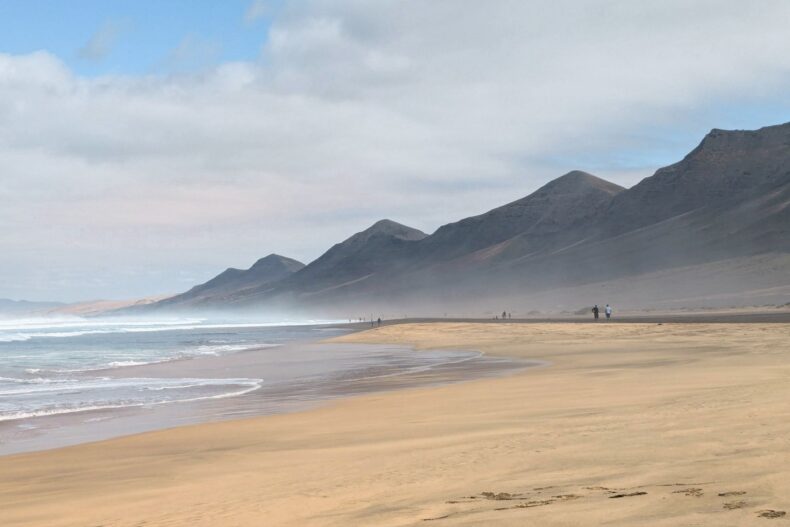
For us, Playa de Cofete is the most beautiful beach in the Canary Islands. This remote stretch of coast lies on the wild western side of Fuerteventura and still feels wonderfully untouched. The beach is enormous, the surroundings are dramatic, and there is almost nothing here to distract you from the landscape. You can reach Cofete by car, but the final part of the journey follows a rough, unpaved mountain road. Keep in mind that many rental car companies officially do not allow their cars to be driven on this route, so it is worth checking the rules before you go.
A much more enjoyable way to reach Cofete, in our opinion, is to hike there. The trail begins in the mountainous interior of the Jandía Peninsula and climbs around 300 meters over a relatively short distance. The path is easy to follow, and the scenery becomes more impressive the higher you climb. Along the way, you get beautiful views over the dry mountains and the rugged coastline below. Then, as you cross the mountain pass, Playa de Cofete suddenly appears in front of you, and the first view is easily one of the most memorable moments of the walk.
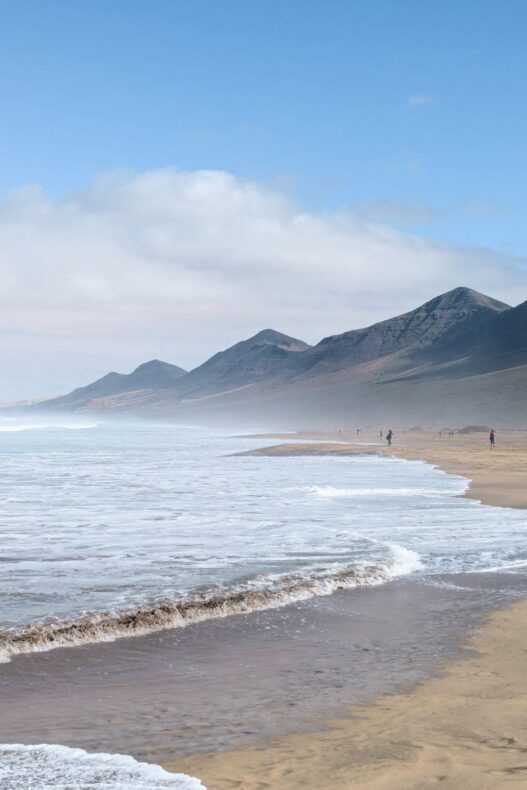
The beach itself stretches for more than 12 kilometers, with high mountains rising behind it and the wild Atlantic Ocean rolling in from the other side. It is one of those places where the scale of the landscape is difficult to understand until you are actually standing there. Even during the high season, Cofete can feel surprisingly peaceful because there is so much space and so few buildings or facilities nearby. You can walk for a long time without seeing more than a handful of other people. That feeling of being surrounded by nothing but mountains, ocean, and sand is exactly what makes Cofete so special.
There are hardly any facilities on Playa de Cofete, so bring enough water, food, and sun protection if you plan to stay for a while. Swimming is generally not recommended because the currents can be very strong and the waves are often large and unpredictable. This is not really a beach you visit for a relaxed swim or a day on a sunbed. Instead, come for the hike, the incredible views, the wild atmosphere, and the feeling of being completely away from the busy resorts. For us, it is one of those rare places where the journey is just as memorable as the beach itself.
#2 Playa de Sotavento (Fuerteventura)
Playa de Sotavento is one of the most famous beaches in Fuerteventura, and it ended up becoming our personal favorite. We returned several times during our trip and spent almost a full week here altogether. What we loved most was how different the beach looked every time we came back. The tide, wind, light, and water levels constantly changed the scenery, giving the whole place a new look from one day to the next. It is one of those beaches that never seems to feel exactly the same twice.
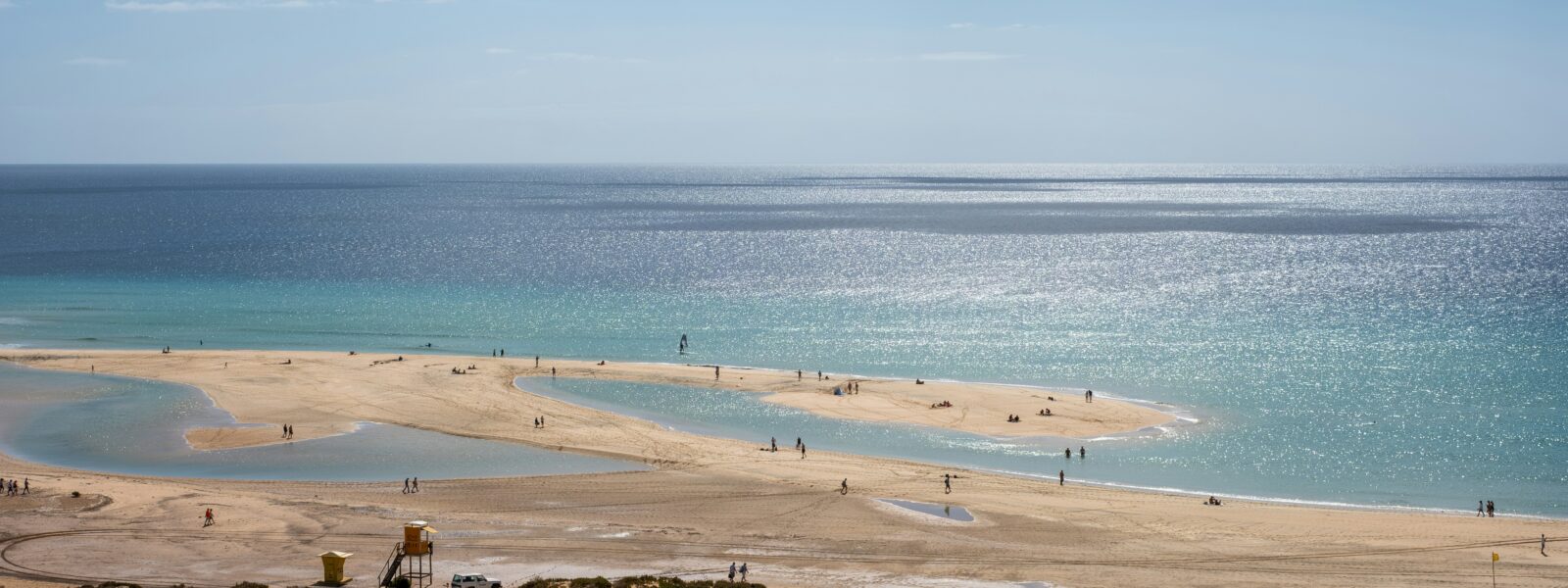
The beach is enormous and is actually made up of several stretches of sand that together form one long, open coastline. The most beautiful moment comes at low tide, when a large lagoon appears between the beach and the Atlantic Ocean. The water becomes shallow, warms quickly in the sun, and often turns a bright turquoise color. Sandbanks rise above the water, reflections shimmer across the lagoon, and the wide beach seems to stretch even farther into the distance. Because the tide keeps moving in and out, the landscape changes constantly throughout the day.
Sotavento is also one of the best places in Fuerteventura for windsurfing and kitesurfing, thanks to the steady wind that blows across the coast. Even if you have no plans to try either sport yourself, it is still great fun to watch from the beach. Colorful kites fill the sky while riders glide quickly across the shallow water, giving the lagoon a lively but relaxed atmosphere. There is always something to see, without the beach ever feeling too busy or noisy. The huge amount of open space keeps everything feeling calm and easy.
Another reason we enjoyed Playa de Sotavento so much is how peaceful it feels despite being so well known. Even in the high season, the beach rarely feels crowded because it is so wide and stretches for several kilometers. It is easy to walk a little farther and find a quiet spot with plenty of space around you. The combination of turquoise water, changing sandbanks, warm shallow lagoons, and endless open views makes this beach truly special. For us, it was one of those places we never got tired of returning to.

#3 Playa de Papagayo (Lanzarote)
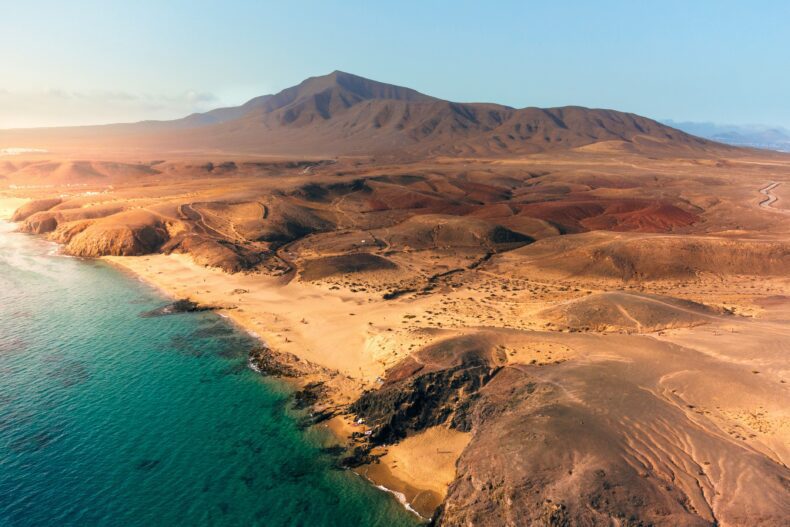
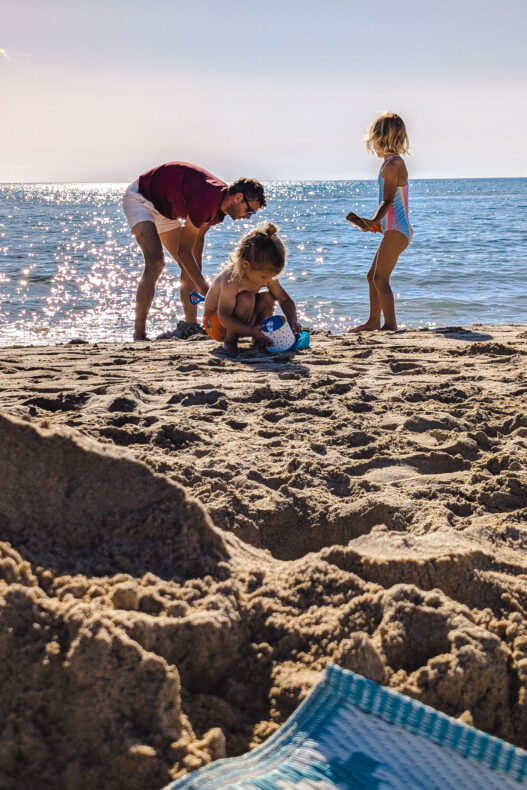
Playa de Papagayo is without doubt the most famous beach in Lanzarote, and it is easy to understand why. This beautiful golden-sand cove sits between volcanic cliffs in the Los Ajaches nature reserve, right at the southern tip of the island. The water is usually clear and calm, which makes it a lovely place for swimming and snorkeling. The sheltered setting also gives the beach a peaceful feel, especially when the sea is calm. For us, the scenery here is easily among the most beautiful on Lanzarote.
The beach itself is not very large, which adds to its charm but also explains why it can get busy. The curved bay, warm-colored sand, and rugged volcanic rocks around it create a very different atmosphere from the long open beaches elsewhere in the Canary Islands. It is especially beautiful when you look down from the cliffs above, where you get a great view over the whole cove. The contrast between the golden sand, blue water, and dark volcanic landscape makes Papagayo one of those places that immediately stands out. It is definitely one of Lanzarote’s classic beach stops.
That popularity does have a downside, though. Around the middle of the day, and especially during the high season, Playa de Papagayo can become quite crowded. If you prefer a little more space and a quieter atmosphere, it is worth exploring the neighboring beaches as well. We actually enjoyed Playa Caleta del Congrio, located right next to Papagayo, even more for that reason. It may be slightly less dramatic in terms of scenery, but it often feels much calmer and more relaxed.
Playa Caleta del Congrio also has a more natural and open feel, with fewer people and plenty of room to spread out. You should know that naturists are common here, which is something to keep in mind before visiting. It did not bother us at all, and the atmosphere felt very relaxed and respectful. If you do not mind that, it can be a great alternative to the busier Papagayo. For us, visiting both beaches made the whole area even more enjoyable.
#4 Grandes Playas & Dunas de Corralejo (Fuerteventura)
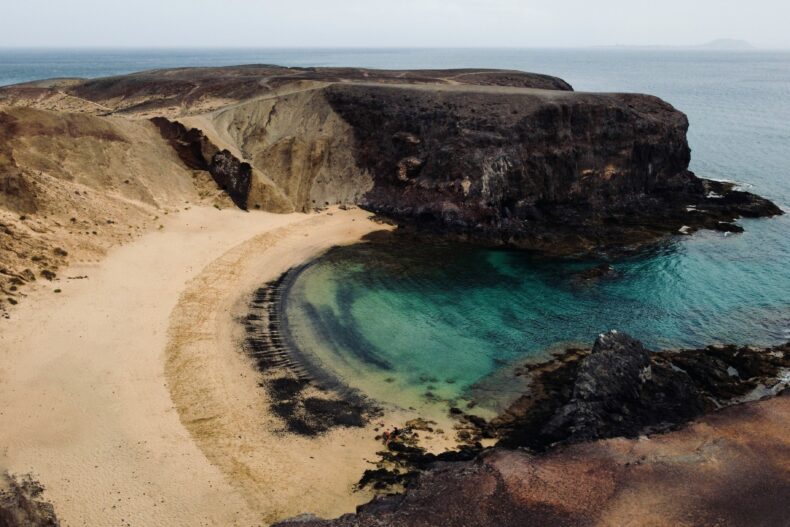
If you visit Fuerteventura, chances are you will end up at the Dunas de Corralejo at some point. These huge golden dunes are one of the island’s most iconic landscapes, and they slowly roll down toward a long stretch of wide sandy beaches and bright blue water. The scenery feels incredibly open, with nothing but sand, sea, and sky in every direction. It is one of those places that immediately gives you a sense of how wild and spacious Fuerteventura can be. The combination of dunes and coastline makes this one of the most memorable beach areas on the island.
Because the coast stretches for several kilometers, it is usually easy to find a quieter spot even when other parts of the beach are busy. From the sand, you can look across the water toward Lobos Island and the mountains of Lanzarote in the distance, which adds even more to the view. We found this one of the nicest places in Fuerteventura to spend an entire day without feeling rushed. You can walk through the dunes, go for a swim, or simply relax on the sand with the ocean in front of you. Even just watching the wind slowly move the sand across the dunes is part of what makes this place feel so special.
#5 Playa de Maspalomas (Gran Canaria)
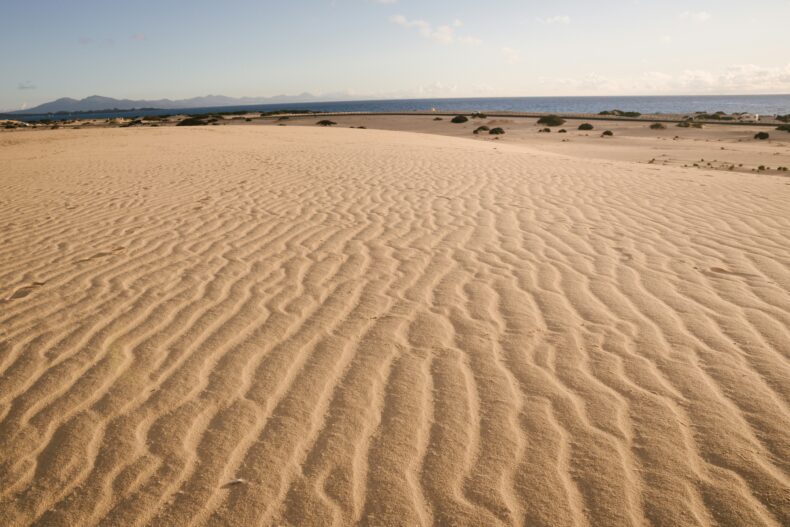
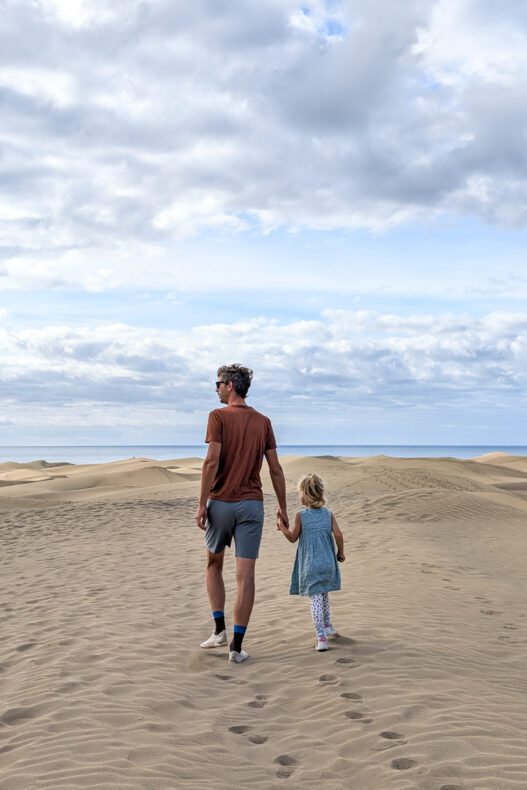
The dunes of Maspalomas are one of the most famous sights in Gran Canaria, and once you see them, it is easy to understand why. This huge protected area of rolling sand dunes stretches right down to a long sandy beach, creating a landscape that feels almost desert-like. The contrast between the warm-colored dunes and the deep blue Atlantic Ocean makes the whole area especially beautiful. The scenery changes slightly throughout the day as the light moves across the sand and the wind reshapes the dunes. For us, that combination is exactly what makes Playa de Maspalomas one of the most beautiful beaches in the Canary Islands.
One of our favorite things to do here was walk all the way from Playa del Inglés to the Maspalomas lighthouse. The route follows the shoreline for several kilometers, with the impressive dunes stretching out beside you almost the entire way. You can stop whenever you feel like it for a swim, take a break on the sand, or simply enjoy the views while walking at your own pace. Once you reach the lighthouse, you can either return along the beach or take a different route through the dunes. Another nice way to end the walk is with a drink or something to eat at one of the terraces along the promenade.
#6 Playa de Mal Nombre (Fuerteventura)
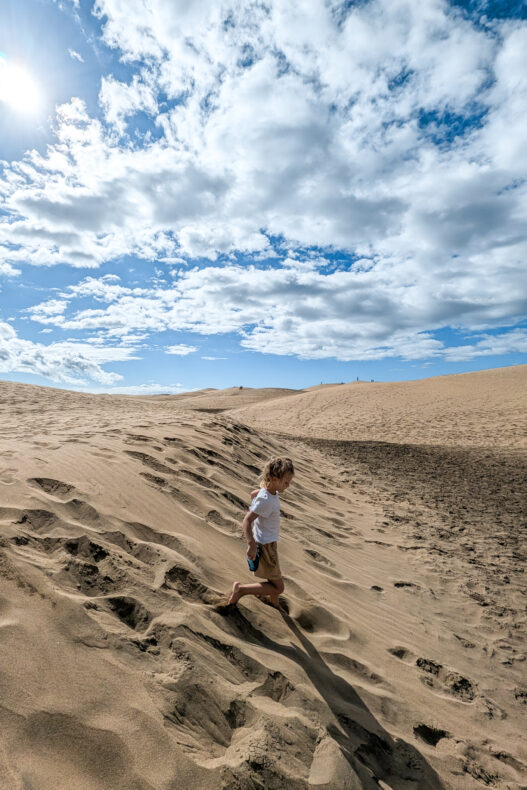
Playa de Mal Nombre may not be the biggest beach in Fuerteventura, but it is definitely one of the prettiest. From the slightly higher parking area, you get a beautiful first view over the golden sand and clear blue water below. On a sunny day, the colors are especially striking and make the whole beach look almost tropical. The coastline feels open and peaceful, with very little around to distract from the view. Even before you walk down to the sand, the scenery alone already makes this beach worth stopping for.
The beach itself is fairly small, but we were surprised by how calm and relaxed it felt during our visit. There is a beach bar where you can order something to eat or drink, although the prices are a little higher than average. Still, it is a convenient place to take a break if you plan to spend a few hours here. We also recommend walking a little farther along the coastline instead of staying only around the main beach area. The views remain beautiful in both directions, and exploring a little more on foot makes Playa de Mal Nombre feel even more special.

#7 Playa de Famara (Lanzarote)
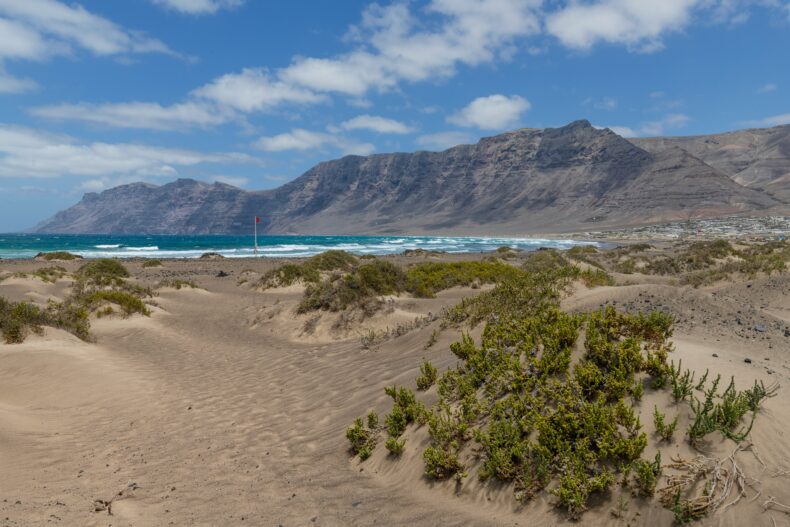
Playa de Famara is the place to go if you love surfing, or even if you simply enjoy watching surfers take on the waves. Strong winds, powerful surf, and rough currents make this a beach where swimming is often not a good idea. The sea can be dangerous, so it is much better to enjoy Famara for its wild setting and lively surf atmosphere. That is also what makes it feel so different from the calmer, more sheltered beaches elsewhere on Lanzarote. There is a real sense of energy here, with the Atlantic Ocean shaping almost everything about the experience.
The beach itself is huge and very wide, which means there is usually plenty of space even when lots of people are around. On windy days, you will quickly understand why so many visitors sit behind the low semicircles of stones that have been built into the sand over time. These simple wind shelters make a big difference and give you a much more comfortable place to sit. Even if you do not surf, Famara is still a great beach to spend a few hours. Watching the surfers ride the waves is entertaining on its own, and the open views make a walk along the sand especially enjoyable.
Afterwards, it is worth heading into the village for lunch, coffee, or something sweet. Do not expect a busy promenade lined with shops and tourist attractions, because Famara has a much more relaxed and low-key feel. Instead, you will find a small collection of cozy restaurants and cafés that suit the laid-back surf atmosphere perfectly. If you are looking for a good cup of coffee or a slice of cake, we especially recommend Beach Bar Surfer Food. It is a lovely place to slow down and end your visit after a windy beach walk or an afternoon spent watching the waves.
#8 Playa de las Teresitas (Tenerife)
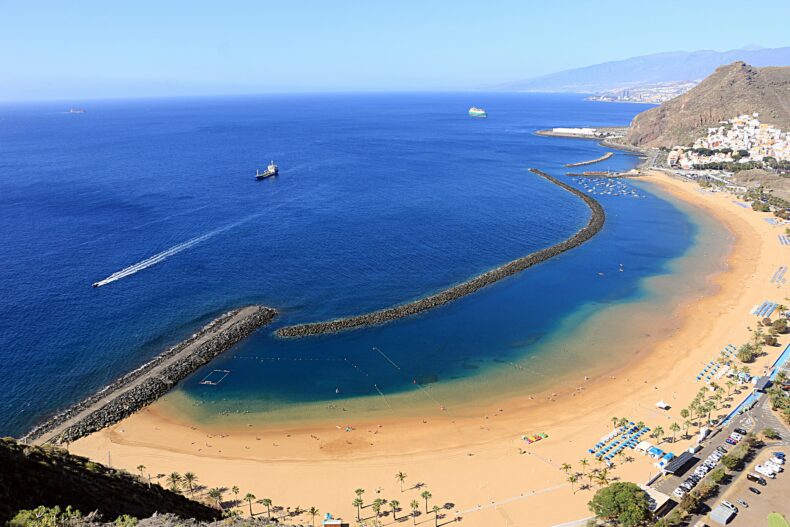
Playa de las Teresitas is, in our opinion, one of the most enjoyable sandy beaches in Tenerife. Unlike most beaches on the island, it is covered in soft golden sand brought in from the Sahara, which gives it a very different feel from Tenerife’s more common black volcanic beaches. The bay is protected by a long breakwater, so the water is usually calm, clear, and easy to swim in. That makes this a particularly good beach for families with young children or anyone who prefers gentler sea conditions. It is also a lovely place for a relaxed beach day without having to worry too much about rough waves.
We visited Tenerife several times during periods of heavy storms, and even then Playa de las Teresitas stayed remarkably calm. While the sea was rough in many other parts of the island, people could still swim here safely and the green flag was flying. That really shows how well protected the beach is by the large breakwater. For us, it was one of the few places where the weather outside the bay felt completely different from the conditions in the water. It gave us a lot of confidence, especially when visiting with children.
Playa de las Teresitas is located close to Santa Cruz de Tenerife, on the northern side of the island. Most tourists stay much farther south, around the popular resort areas, so quite a few visitors never make the trip up here. That is a shame, because the beach is spacious, beautiful, and much more peaceful than many of the busier beaches near the main resorts. If you are exploring the north of Tenerife or visiting Santa Cruz, it is definitely worth adding a few hours here. For us, it is one of the best places on the island for an easy and relaxing swim.
#9 Playa de Amadores (Gran Canaria)
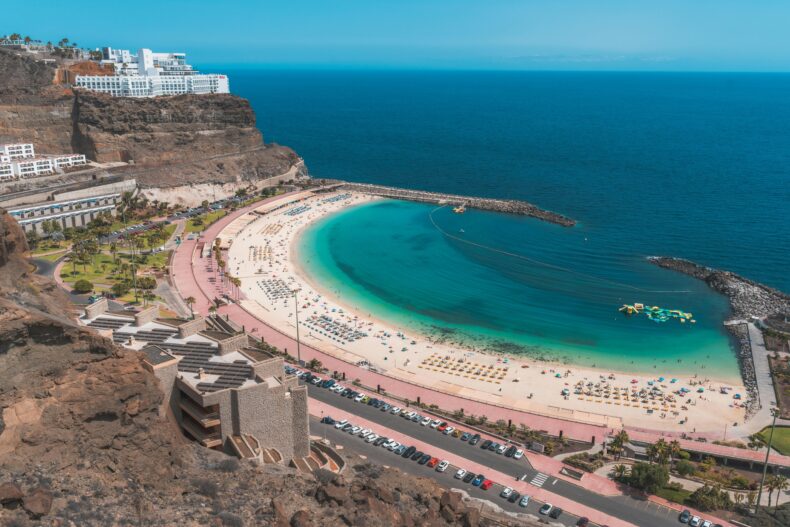
Playa de Amadores may be a little more touristy than some of the other beaches on this list, but the water here is genuinely beautiful. The beach sits in a wide, sheltered bay protected by a large breakwater, which keeps the sea calm and gives the water its clear aqua-blue color. You will rarely find strong waves here, so it is an easy and comfortable place for a swim. That also makes it a great choice for families with young children or anyone who prefers gentler sea conditions. If you are looking for a relaxed beach day with everything close by, Playa de Amadores is a very easy place to enjoy.
There are plenty of restaurants, cafés, terraces, and shops around the beach, so you can comfortably spend several hours here without needing to bring much with you. It does feel more developed than the wilder beaches elsewhere on the island, but that convenience can be very welcome on a slower travel day. You can easily stop for lunch, grab a cold drink, or take a break from the sun whenever you need to. The whole area is set up for an easy and comfortable day by the sea. For us, that makes it a nice contrast to the more remote beaches in this list.
If you want to finish your beach day with a little more scenery, we definitely recommend walking to nearby Playa de Puerto Rico. The coastal path follows the sea for most of the way and is an easy, pleasant walk without any difficult sections. Along the route, you get lovely views over the rocky coastline and the open Atlantic Ocean. It is especially nice later in the day when the light becomes softer and the coast looks even more beautiful. Combining the beach with this short walk makes a visit to Playa de Amadores feel a little more special.
#10 Caletón Blanco (Lanzarote)
Caletón Blanco is one of the most unusual and beautiful coastal spots in Lanzarote, but the timing of your visit really matters here. Try to come at low tide, when small patches of bright white sand appear between the black lava rocks and shallow natural pools begin to form. The water in these pools is often much calmer than the open sea, making them a lovely place for a refreshing swim. At high tide, the coastline looks very different and some of these little beaches almost disappear. Visiting at the right moment can completely change your impression of the place.
What makes Caletón Blanco so special is the contrast between the white sand, dark volcanic rocks, and clear blue water. On a sunny day, the colors look especially striking and the shallow pools reflect the sky beautifully. The whole area feels wild, open, and far less developed than many of Lanzarote’s better-known beaches. There are no real facilities here, so it is best to bring your own water, snacks, and anything else you may need. If you enjoy quiet beaches and unusual landscapes, Caletón Blanco is definitely worth adding to your route.
#11 Playa de Benijo (Tenerife)
Playa de Benijo takes a little more effort to reach, but the journey is part of what makes it so memorable. The beach lies in the wild north of Tenerife, deep in the Anaga Mountains and far away from the busy resorts in the south. We actually found the drive through Anaga Park one of the most beautiful road trips on the island. The road winds through thick green forest, past deep ravines, steep mountain slopes, and viewpoints that seem to appear around every corner. By the time you reach the coast, it already feels like you have seen a completely different side of Tenerife.
From the main road, drive down toward the mountain village of Almáciga and continue toward the black-sand beaches below. The steep road down is impressive in itself, with wide views over the rugged coastline and the dramatic rock formations rising from the Atlantic. It is also worth stopping at Roque de las Bodegas along the way, a photogenic rock just offshore with a path running around it. The scenery here feels raw and powerful, with the mountains dropping sharply toward the sea. Even before reaching Benijo, the route already gives you plenty of reasons to stop and take in the views.
A little farther along the coast, you will reach Playa de Benijo, one of the most dramatic black-sand beaches in Tenerife. Swimming is usually not a good idea here because of the strong currents, rough waves, and powerful Atlantic swell. A red flag is often flying, so this is definitely a place where you should respect the sea and enjoy the beach from the shore. The real reason to come is the scenery, with dark sand, steep cliffs, wild water, and striking rock formations just offshore. It is one of those beaches that feels more like a natural viewpoint than a typical swimming spot.
For us, Playa de Benijo may actually be the most beautiful beach in Tenerife when it comes to pure scenery. It feels much more remote and untouched than the beaches around the larger resorts, and simply watching the waves roll in can be impressive enough. The combination of the drive through Anaga, the mountain landscape, and the final descent toward the coast makes the whole visit feel like a small adventure. Even if you never step into the water, the journey here is more than worth it. It is one of the places on Tenerife that stayed with us long after we left.

#12 Playa del Risco (Lanzarote)
Playa del Risco may be one of the most beautiful beaches in Lanzarote that hardly anyone visits. That is not too surprising, because getting there requires a fairly demanding hike down from the cliffs. If you are willing to make the effort, though, you are rewarded with a long sandy beach that often feels almost completely empty. We decided the full hike was not the best idea with the whole family, so Sebastiaan did this beautiful route on his own instead. For him, it was absolutely worth the effort and one of the more memorable walks on Lanzarote.
If you do not feel like doing the entire hike, we would still recommend driving to the starting point of the trail. Close to the parking area, there is a wonderful viewpoint overlooking Playa del Risco and the island of La Graciosa across the water. I actually found this view just as beautiful, if not more impressive, than the famous paid viewpoint at Mirador del Río. From here, you can really appreciate the height of the cliffs, the quiet beach far below, and the blue water surrounding La Graciosa. Even if you skip the hike, the panorama alone makes the drive completely worthwhile.
#13 Playa de Nogales (La Palma)
Playa de Nogales is one of the best-known places to visit in La Palma, and getting down to the beach is part of what makes the visit so special. From the parking area, a well-maintained path winds along steep cliffs before gradually descending toward the coast. We found the walk itself one of the highlights, because the scenery keeps changing along the way. The rock walls appear in different shades and layers, clearly showing the volcanic history of the island. It is a beautiful reminder of how eruptions, wind, and erosion have shaped La Palma over time.
At the bottom, you arrive at a wide black-sand beach with powerful Atlantic waves rolling toward the shore. Because the sea can be rough, you are much more likely to see surfers here than people enjoying a relaxed swim. One detail that really surprised us was the water hose running along the entire walking path down to the beach. Thanks to that, there are even simple beach showers where you can rinse the salt and black sand off before hiking back up. We definitely did not expect to find something like that in such a remote and natural setting.
If you are mainly looking for a beach in La Palma where you can relax and swim more comfortably, the west coast is usually a better choice. The sea there tends to be calmer, and the water often feels warmer as well. We really enjoyed the black-sand beach at Playa de Puerto Naos, which has a much more relaxed atmosphere and is better suited to spending several hours by the sea. Playa de Tazacorte is another popular option, with easier conditions and more facilities nearby. Both are better choices when swimming and a laid-back beach day matter more than wild scenery.
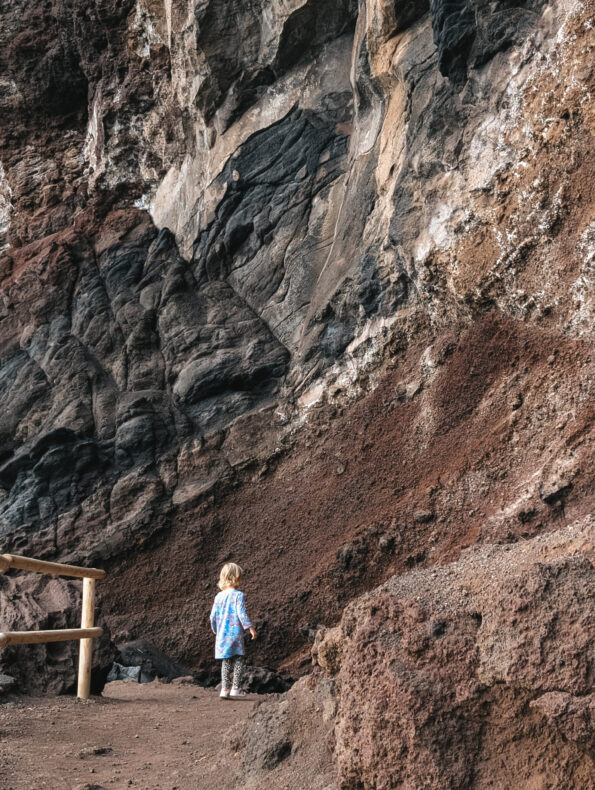

#14 Playa Jardín (Tenerife)
We honestly did not expect that much from Playa Jardín at first. The beach was created artificially, and Tenerife already has so many beautiful natural beaches that we assumed this one would feel less special. Instead, it turned out to be one of the biggest surprises of our time on the island. A large part of that is thanks to the design by famous landscape architect César Manrique. He managed to blend the black sand, tropical gardens, walking paths, and palm trees into the surroundings in a way that feels natural and beautifully balanced.
Playa Jardín is located in Puerto de la Cruz, which makes it a great place to combine sightseeing with a few relaxed hours by the sea. You can explore the town in the morning and then easily spend the afternoon on the beach without having to travel far. For families, this is also one of the nicest beaches in Tenerife. There is a playground right next to the beach, which is especially handy with children, and you are never far from restaurants, cafés, and other useful facilities. That mix of beach, greenery, and convenience makes Playa Jardín a very easy place to enjoy.

#15 Playa de los Charcos, El Cotillo (Fuerteventura)
Playa de los Charcos felt like a real discovery for us. Near the lighthouse of El Cotillo, dozens of natural pools are hidden between dark volcanic rocks along the coast. At low tide, these small “charcos” stay filled with clear seawater that can become almost perfectly still. The smooth surface and bright water create a beautiful contrast with the black lava surrounding the pools. It is a wonderfully peaceful place for a swim and feels completely different from the long open beaches elsewhere on Fuerteventura.
Because the pools are protected by the rocks, the water here is usually much calmer than in the open Atlantic. Try to visit around low tide, when the natural pools are at their best and easiest to enjoy. If you are driving to Los Charcos from El Cotillo, you will also pass Playa de la Concha along the way. This beach is closer to the village and is protected by breakwaters, making it one of the most family-friendly beaches in Fuerteventura. We definitely recommend stopping there too, especially if you are traveling with children or simply want a calmer place to swim.