We rolled into Cork right at the front of the top deck of a double-decker bus. The kids loved the ride, which meant the first sight of the day was already ticked off before we’d even arrived. That afternoon we had lunch in an old wine merchant’s that’s now a pub, wandered through the English Market and walked a lap of the walls of Elizabeth Fort. Around midday the sun came out after days of mostly rain, so after that nothing could spoil our visit to Cork.
Cork is Ireland’s second city, yet its centre is surprisingly compact: it sits on an island between two channels of the River Lee. The market, the fort, the cathedral and the best shopping streets are only a few minutes’ walk apart.
Below you’ll find what we got up to and what else is worth your time: the 11 best things to do in Cork, hotels in and around the centre, an easy way into the city without squeezing your car down narrow streets, and the best day trips in the area.
→ Check out this guided historical walking tour of Cork
What is Cork known for?
Cork is known for its food, its rebellious streak and the River Lee, which splits the city centre in two. Locals like to call it the real capital of Ireland, only half joking, and you’ll feel that pride all over town.
Its nickname, Rebel City, dates back to the late fifteenth century. Cork backed Perkin Warbeck, a young man who claimed to be the rightful heir to the English throne. It ended badly for the city, but the label stuck. Cork played a leading role again in the Irish War of Independence, which only made the name fit better.
Plenty of Irish people see Cork as the country’s food capital. Farms in the green hinterland and fishermen along the coast supply the restaurants and the English Market, which has been trading since 1788. Order a stout in a pub here and you’ll often be offered Murphy’s or Beamish, both born in Cork. Guinness doesn’t automatically win in this town.
Just west of the centre the Lee divides into a north and a south channel, which meet again further downstream. So the heart of the city is really an island, and on any walk you’ll keep crossing bridges. Lost? Head for the water and you’ll get your bearings back in no time.
How many days do you need in Cork?
We spent a full afternoon in Cork, which was enough for lunch, the market, the backstreets and the fort. If you want to see the museums and churches too, give it a whole day. That way you’ll cover the centre, Elizabeth Fort, St Fin Barre’s Cathedral and Shandon without rushing.
Two days gives you more choice. Cork City Gaol and the university are a fair way west of the centre, and Blackrock Castle is a few kilometres east. Trying to squeeze all three into one day means a lot of dashing about.
Staying longer? Cork makes a good base. Kinsale, Cobh and Blarney Castle are all within roughly half an hour’s drive.
How do you get to Cork?
Cork Airport sits just south of the city and has direct flights from a range of European cities, including Amsterdam with KLM. From there, a bus or taxi gets you into the centre quickly. Dublin has far more connections, and the drive or train from there to Cork takes around two and a half to three hours.
Arriving by car or campervan? Then the Black Ash Park & Ride is the way to go. It’s on the South Link Road, south of the centre. You pay one flat fee for the day, and that includes the bus into town. It runs Monday to Saturday roughly every fifteen minutes and stops on St Patrick’s Street, among other places. Just note the car park closes in the evening, so you can’t stay overnight.
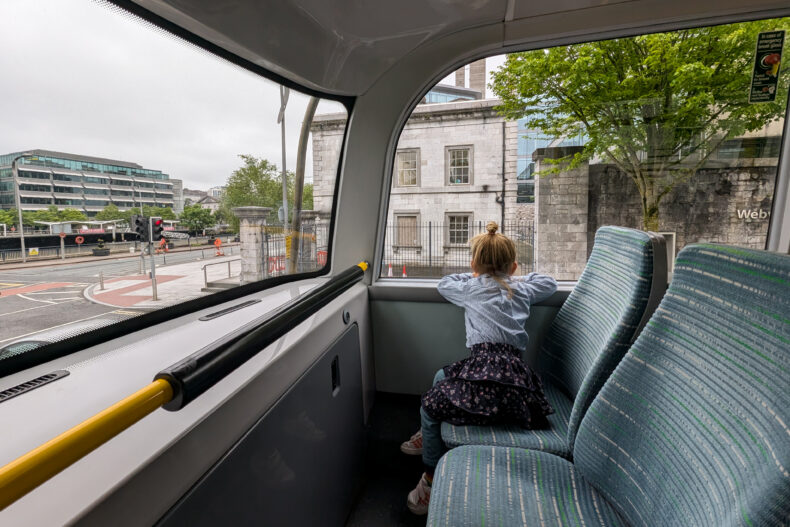
Parking outside the city sounded like a hassle to me at first. Instead, the bus ride became a highlight in its own right. The bus was a double-decker, so the kids made a beeline for the top deck, right at the front. They spent the whole ride staring out of the window, and we got into Cork without hunting for a single parking space.
Want to see a lot without walking everywhere? The open-top hop-on hop-off bus is an option. It stops at places like the English Market, Shandon, Cork City Gaol and the university.
→ Read all our tips for renting a car in Ireland
Where to stay in Cork?
Stay in or close to the centre, so you can walk everywhere. Around St Patrick’s Street and the English Market you’re in the thick of it. The Victorian Quarter on the north bank of the Lee is packed with restaurants and pubs, while the west side towards the university is greener and calmer.
#1 Hotel Isaacs occupies an old building on MacCurtain Street, right in the Victorian Quarter. You’re a few minutes’ walk over the bridge from St Patrick’s Street, and Kent Station is round the corner if you fancy the train to Cobh.
#2 Hayfield Manor is a five-star hotel in a grand manor house with gardens and a spa, right next to the university campus. It feels like a stay in the countryside, yet the English Market is only about twenty minutes away on foot.
#3 The River Lee stands on the riverbank on Western Road, halfway between the centre and the university. After a day on your feet there’s an indoor pool waiting, and some of the rooms look straight out over the water.
#4 The Montenotte sits up on Montenotte hill, about a mile and a half from the centre, so expect a steep walk back or grab a taxi. In return you get views over the whole city, a pool and even its own little cinema.
The 11 best things to do in Cork
#1 English Market: where Cork has done its shopping for centuries
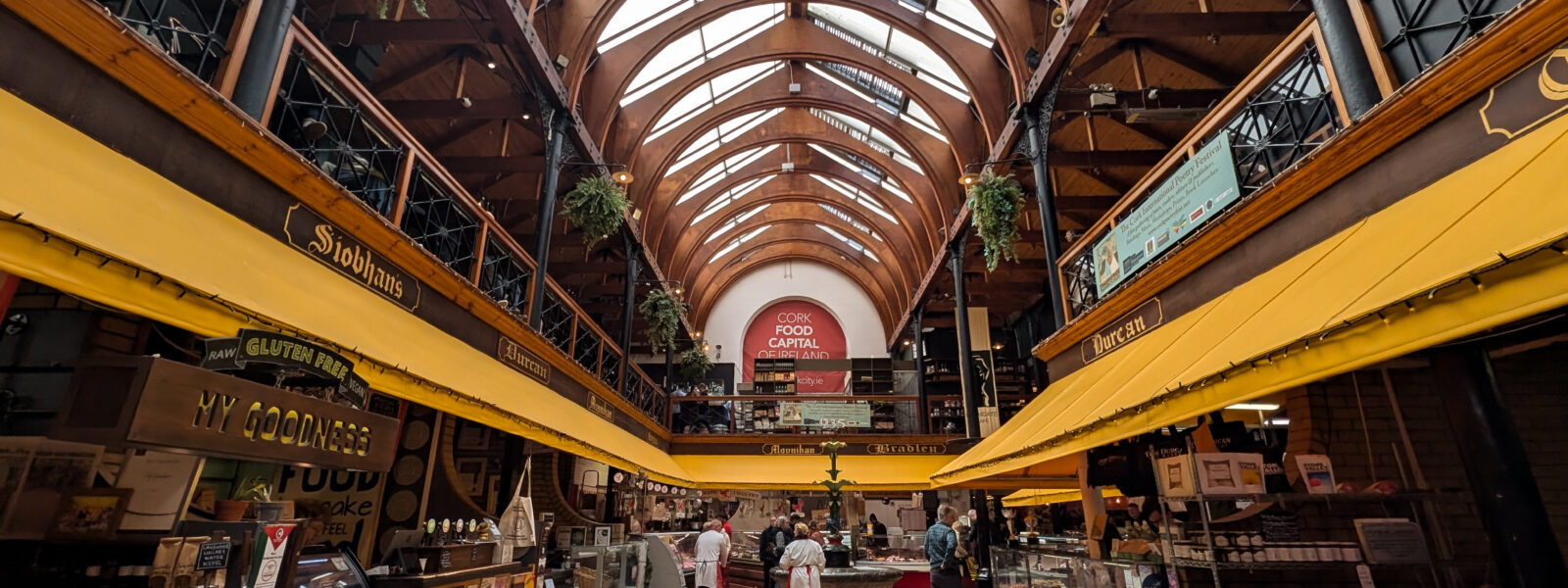
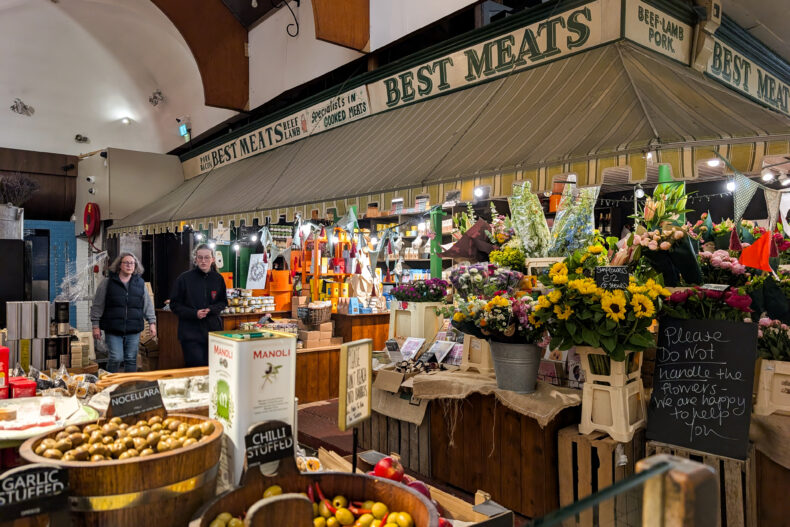
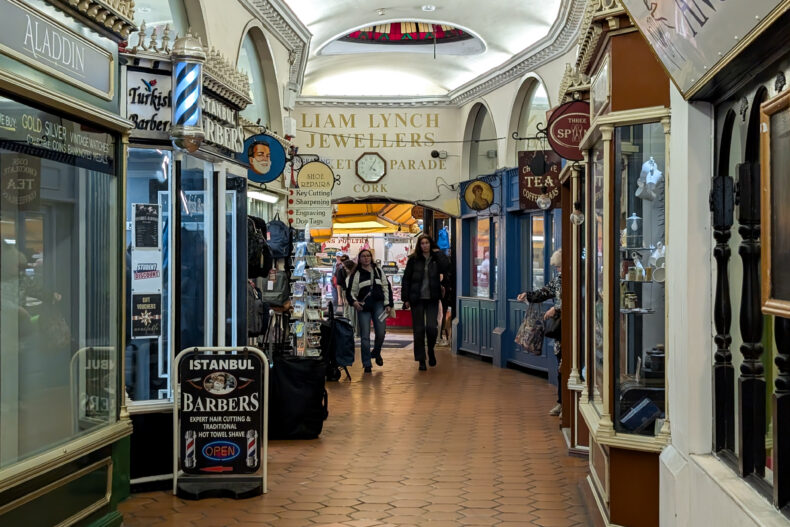
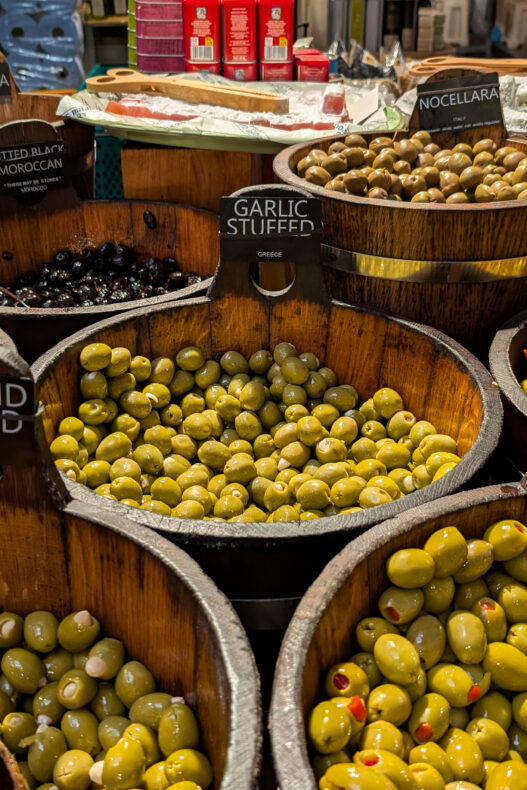
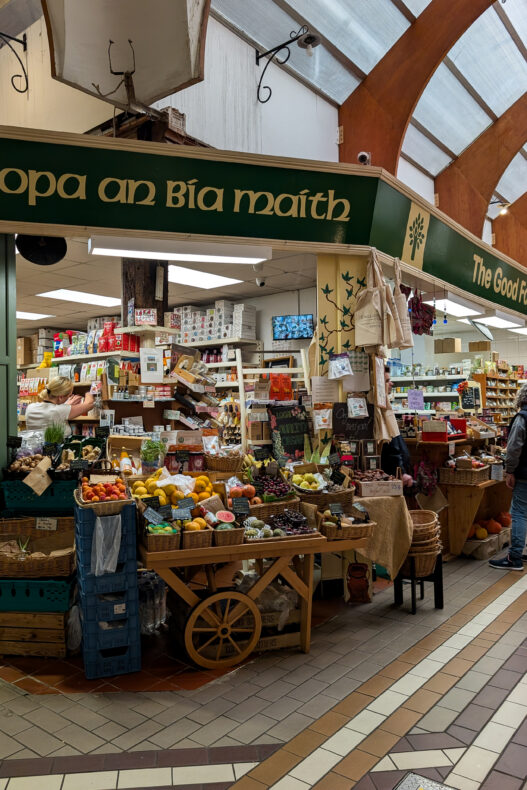
After lunch we headed into the English Market. We didn’t buy anything and only strolled through, but it was still one of the highlights of our afternoon. Under the ornate roof of the Victorian hall you’ll find stalls piled with fish, cheese, bread, olives and veg, and in between the visitors, locals are getting their weekly shop done.
The market dates from 1788. Despite the name, it has nothing to do with English produce: it refers to the English, Protestant city council that set it up. When an Irish Market opened later on, this one kept its old name. Back in the 1980s there was even a plan to turn it into a car park, which the people of Cork thankfully wouldn’t hear of.
Fancy something local? Look out for drisheen, a Cork blood sausage, or spiced beef. Up on the gallery above the stalls, the Farmgate Café cooks with produce from the market itself. Don’t come on a Sunday, because the market is closed.
#2 Elizabeth Fort: a walk around the walls with views over the city
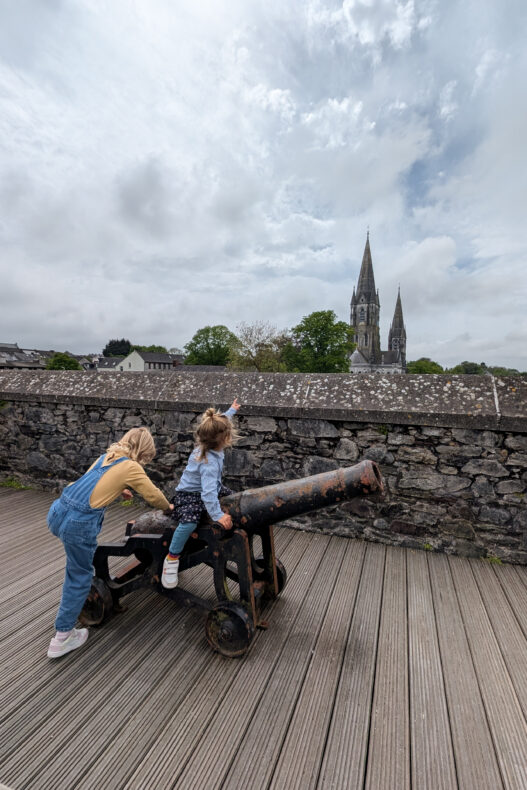
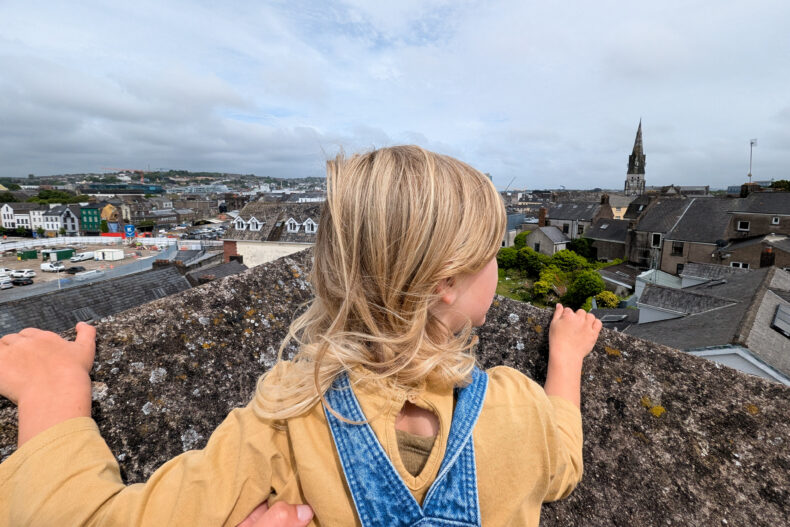
From the market we crossed the south channel of the Lee to Elizabeth Fort. From the street you’d hardly notice it, but inside you climb up onto the walls and walk all the way round. For the kids, that alone was adventure enough. One of the bastions has a cannon, and within a minute they were sitting on top of it. Meanwhile we gazed out over the rooftops of Cork, with the spires of St Fin Barre’s Cathedral right next to us. Walking the walls is free; you pay for a guided tour or the audio guide.
The first fort went up in 1601, just after the Battle of Kinsale, and was built of earth, timber and stone. Two years later, after the death of Queen Elizabeth I, after whom the fort is named, the townspeople rose up and attacked it. Once the English had restored order, the city had to pay for the repairs itself. The star-shaped stone fort you see today dates from the 1620s.
In one of the buildings there’s a small exhibition that has stayed with me. Between 1817 and 1837 the fort was a holding depot for convicts about to be shipped to Australia, sometimes with 250 people inside at once. Many were women, often convicted of petty crimes, and some had babies and young children with them. The story of the Neva is perhaps the best known. The ship left Cork in 1835 with 150 female prisoners and their children on board and was wrecked off Tasmania. Hardly anyone survived.
Back home I wanted to know more, so I read The Exiles by Christina Baker Kline, a novel about women transported from England to Australia as convicts. It isn’t set in Ireland, but the story is much the same. Not great literature, but it gave me a fuller picture of this piece of history.
#3 St Fin Barre’s Cathedral: three spires and a golden angel
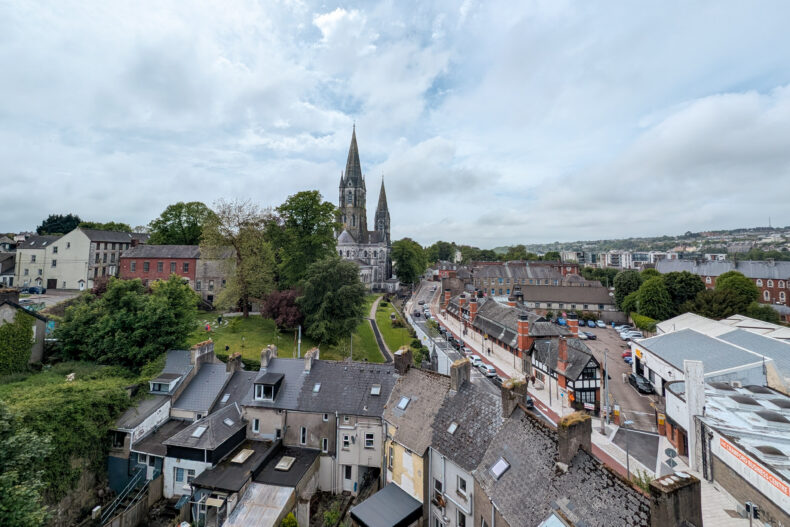
From the fort walls you get a close-up view of the three spires of St Fin Barre’s Cathedral. Tradition has it that Saint Finbarr founded a monastery on this spot in the seventh century, and he’s seen as the founder of Cork.
The cathedral itself is much younger. Architect William Burges won the design competition in the nineteenth century and was handed a budget of £15,000. He blew straight through it: by the time the cathedral was finished, it had cost more than £100,000. Step inside and you can see where the money went. Stained glass, mosaics, marble and a richly painted ceiling, with Burges designing every last detail himself.
Outside, look up at the east end of the roof. A gilded angel with a horn stands there, and legend says she’ll blow it when the end of the world arrives. There’s an entry fee for the interior. Since the cathedral is right next to the fort, it’s easy to do both.
#4 The city centre: bridges, lanes and murals
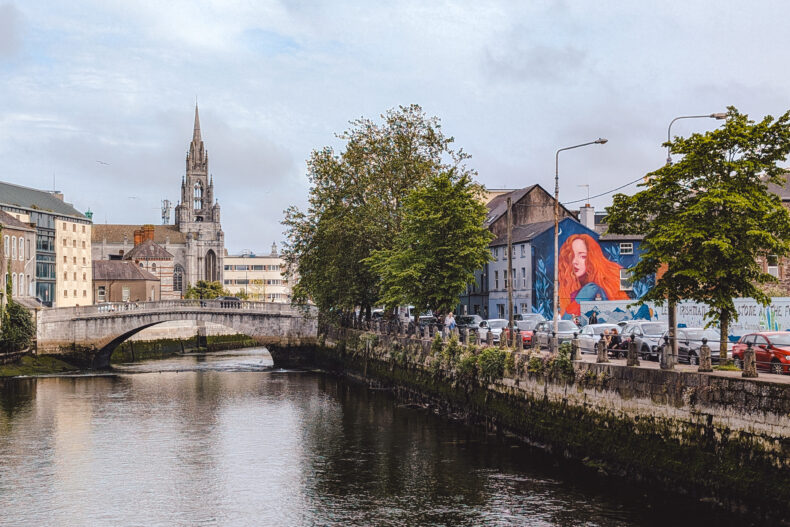
What we remember most about Cork is simply wandering through the old town itself. Over a bridge, down a lane, along the river and back to the main shopping street. When we came out of the pub the sky was still grey, but as the afternoon went on the sun broke through and the coloured house fronts along the Lee looked even more cheerful. After all those rainy days, it felt like a gift.
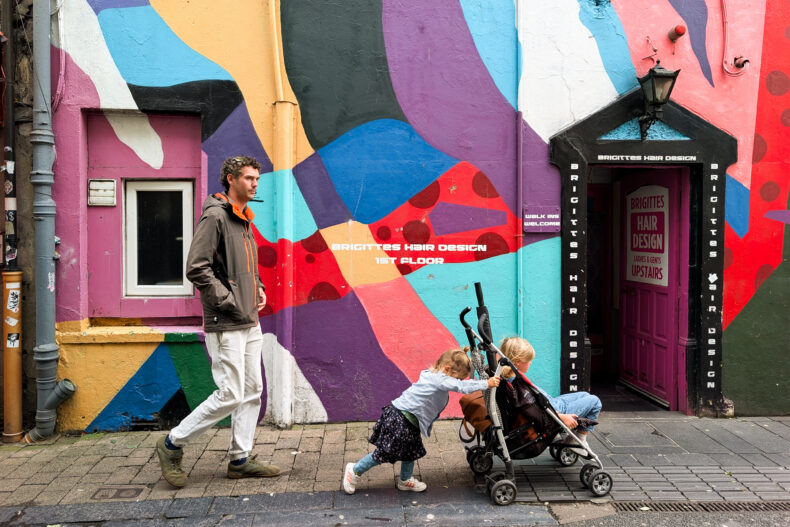
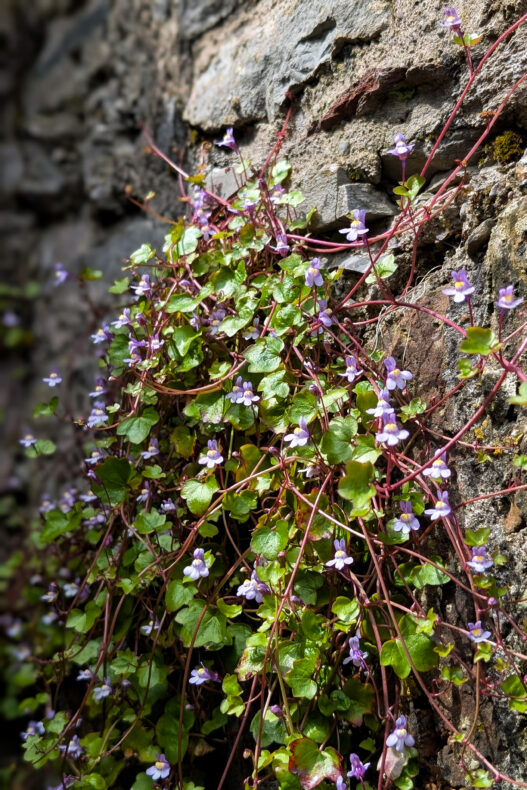
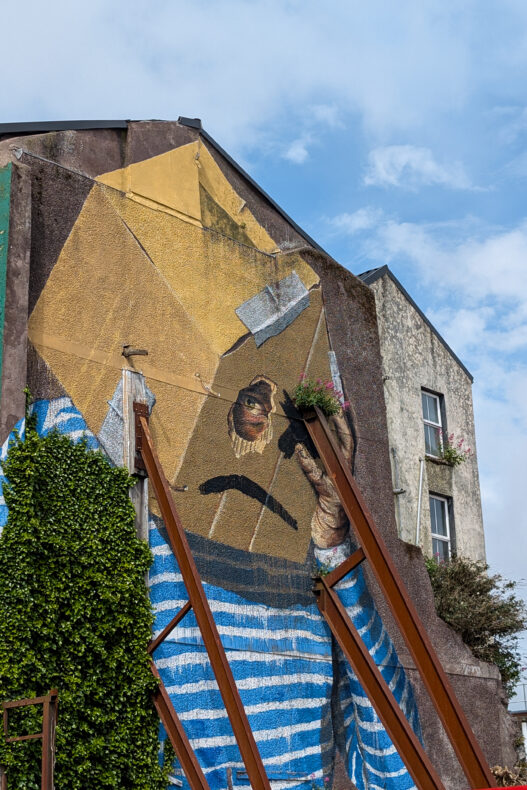
St Patrick’s Street is the main shopping street, and its gentle curve follows an old river channel that once flowed here. The best bits are just off it: the narrow lanes of the Huguenot Quarter around Paul Street and French Church Street, and Oliver Plunkett Street with its cafés and pubs. Covered arcades link the streets, so when a shower blows in you can duck straight inside. Along the way we spotted huge murals on blank walls and purple flowers sprouting from old brickwork.
If you’d like to know what you’re looking at, a guided historical walking tour is a great add-on. The stories about the merchant city and its rebels bring the streets to life.
→ Check out this guided historical walking tour of Cork
#5 The Woodford: lunch in an old wine merchant’s
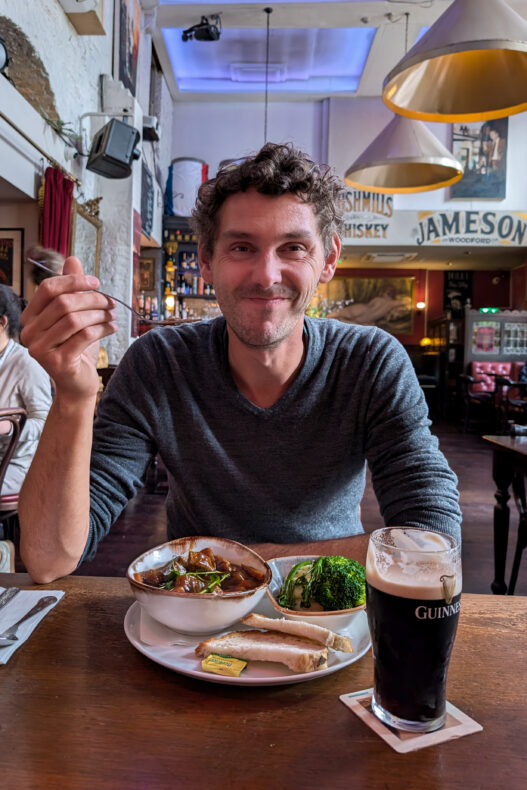
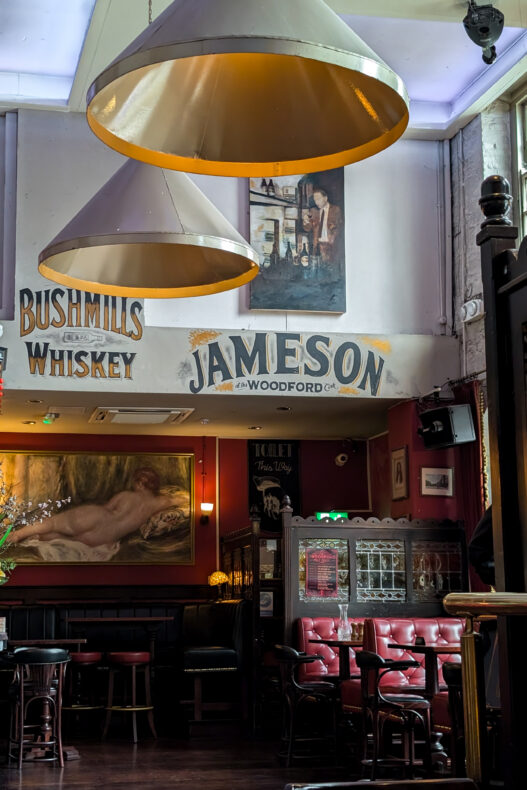
Our afternoon in Cork kicked off with lunch. We ducked into The Woodford, a pub on Paul Street in an eighteenth-century building. It was once home to Woodford Bourne, merchants in wine, spirits and tea, and you can still see it in the high ceilings, the dark wood and the long bar.
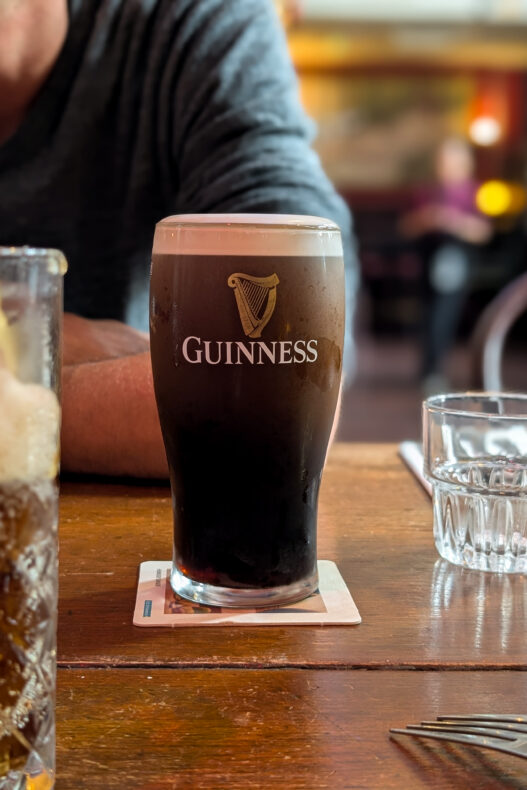
Sebastiaan went for a stew and a Guinness, I had a burger and a Coke, and the kids had chips. Nothing fancy, then, but after the bus ride and with a grey sky outside, it was exactly what we needed.
Want to drink like a local? Ask for Murphy’s or Beamish. Beer lovers can also head to the Franciscan Well on North Mall, a brewpub on the site of a medieval friary, with a beer garden that often has live music. During the day most pubs are fine with kids, although how late they’re welcome varies from place to place.
#6 Shandon: the church tower with four clock faces
North of the Lee the city climbs steeply up to Shandon, one of the oldest parts of Cork. This is where you’ll find St Anne’s Church, whose square tower is topped by a gilded salmon weathervane. The salmon is a nod to fishing on the river.
Two sides of the tower are red sandstone, the other two white limestone. According to locals, that’s where Cork’s red and white sporting colours come from. The clock has four faces that rarely show exactly the same time, which earned the tower its nickname: the Four-Faced Liar.
You can climb the tower, past the clock mechanism and the bells, to a balcony with views across the city. The stairs get narrower the higher you go, so keep little ones close.
#7 Cork City Gaol: a prison that looks like a castle
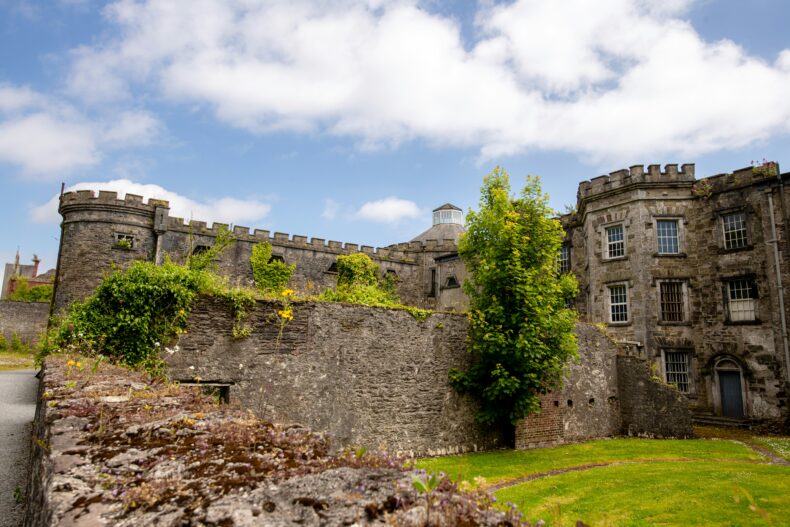
With its towers and battlements, Cork City Gaol looks more like a castle than a prison from the outside. It opened in 1824 and from 1878 held only women. During the Irish Civil War men were locked up here again, and in 1923 the gaol closed for good.
Inside you walk the corridors and peer into cells with life-size figures of prisoners and guards. One of the stories tells of a cold night in 1923, when dozens of prisoners knotted clothes and sheets together and slipped over the wall in their socks.
After it closed, the building found an unusual second career: from 1927 Irish radio broadcast from the old governor’s house, and a small radio museum tells that story. The gaol is a fairly long uphill walk west of the centre. The hop-on hop-off bus stops right outside.
→ Check out the Cork City Gaol ticket with audio guide
#8 Cork Butter Museum: how butter made the city rich
A museum about butter sounds like one to skip, but in Cork it makes more sense than you’d think. In the nineteenth century the Butter Exchange in Shandon was the centre of a worldwide trade. Butter from the surrounding countryside was graded here and shipped out through the port all over the world.
At the Butter Museum you’ll see how butter used to be made on the farm, how the trade worked and why Irish dairy still has such a good name. The oddest item in the collection is a lump of bog butter that’s around a thousand years old. The museum is next to St Anne’s Church, so it pairs easily with the Shandon tower.
#9 Fitzgerald Park and the Shakey Bridge
West of the centre, the banks of the Lee turn greener. In Fitzgerald Park you can sit on a bench, have a picnic or let the kids loose in the playground. The park takes up part of the grounds where Cork hosted big international exhibitions in 1902 and 1903.
The park is also home to the Cork Public Museum, all about the city’s history. Afterwards, walk over to Daly’s Bridge, a white suspension footbridge from 1927. Everyone in Cork calls it the Shakey Bridge, because it bounces quite a bit as you cross.
#10 University College Cork: ogham stones and contemporary art
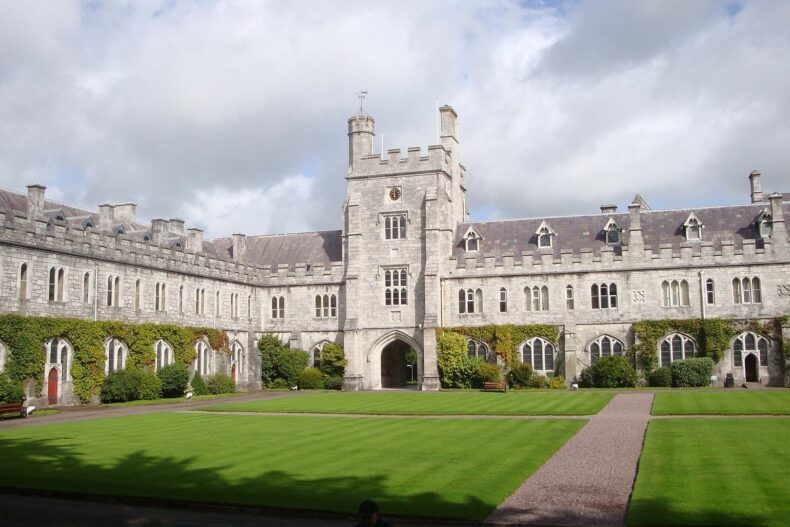
On the campus of University College Cork you stroll between Gothic Revival buildings arranged around a green courtyard, the Quad. The university started out in 1845 as Queen’s College and is a lovely place to wander, even if your student days are well behind you.
In the north wing, find the Stone Corridor. It’s lined with ogham stones, carved in the oldest written form of Irish: short notches along the edge of a stone. Without an explanation you’d walk straight past them, yet these are messages more than a thousand years old.
Among the trees by the river stands the Glucksman, a modern gallery with changing exhibitions of contemporary art. Combine the campus with Fitzgerald Park for a relaxed afternoon on the west side of the city.
#11 Blackrock Castle Observatory: from watchtower to observatory
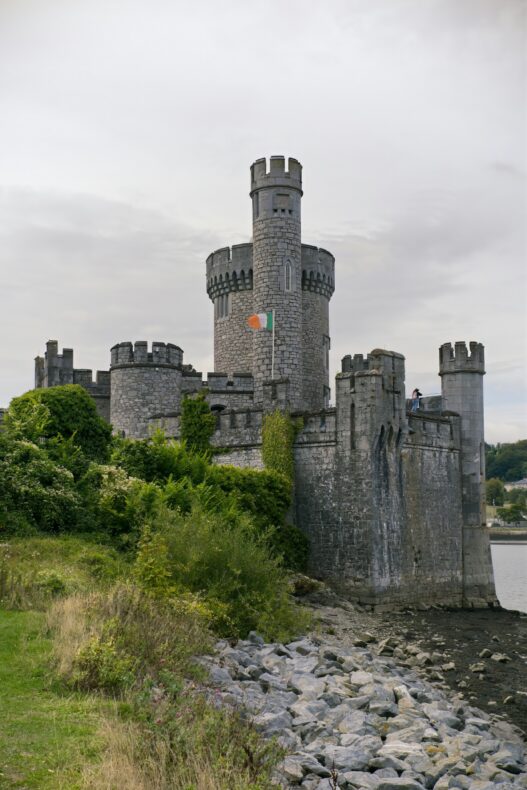
On the banks of the Lee, a few kilometres east of the centre, stands Blackrock Castle. In the sixteenth century a tower was built here to guard the harbour against pirates and other intruders. After a fire in 1827 the castle was rebuilt in Gothic Revival style.
These days it houses an observatory with an interactive exhibition on how the universe began and whether there’s life out there somewhere. A must for anyone who’s mad about space, and you can climb the tower too. Get there by bus, or walk or cycle along the Marina, a flat path beside the water.
Day trips from Cork
#1 Kinsale: painted houses and the Old Head
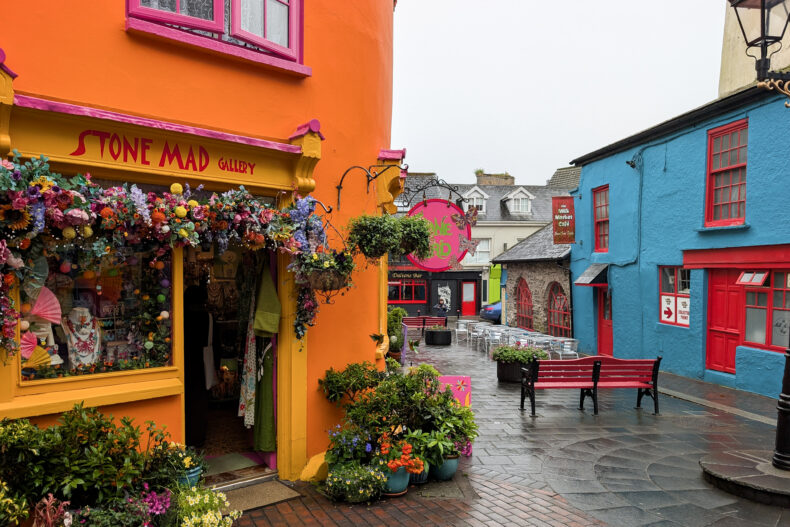
Kinsale is half an hour south of Cork and one of the most colourful towns in Ireland. We arrived on a rainy morning. That took some of the sparkle out of our stroll, although the yellow, pink and blue house fronts stayed cheerful even under a grey sky.
We set off on the Scilly Walk, the coastal path to Charles Fort, a star-shaped fort at the mouth of the harbour. Halfway there the rain got too much and we turned back. On a dry day it’s a lovely walk, with views over the water the whole way.
From Kinsale it’s about fifteen minutes’ drive to the Old Head, a rocky finger of land with cliffs on both sides. The tip belongs to a private golf course, so the clubhouse was our turning point and we admired the cliffs from that spot. Even in the rain it was worth it. At the Signal Tower just before the headland, a small museum tells the story of the Lusitania, torpedoed off this coast in 1915.
#2 Cobh: colourful houses and the Titanic’s last port of call
Cobh sits on Cork Harbour, one of the largest natural harbours in the world. The town used to be called Queenstown, and in 1912 it was the Titanic’s final port of call. The ship anchored offshore and small tenders ferried the last 123 passengers out to her.
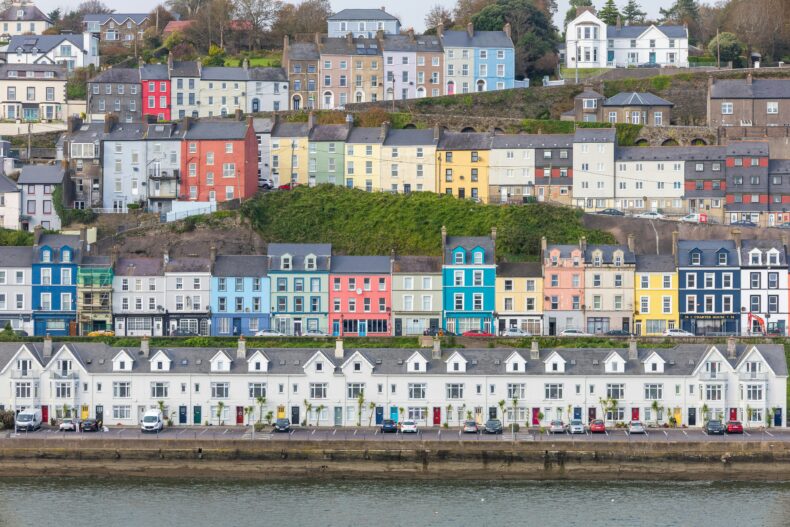
Cobh’s most famous view is the Deck of Cards: a row of brightly painted houses on a steep slope, with the huge St Colman’s Cathedral towering above. Trains run there from Kent Station in Cork, so it’s an easy day trip without a car.
From Cobh you can also take the ferry to Spike Island, whose star-shaped fort served for centuries as a military stronghold and a prison. If you want to see both the island and the town, set aside a full day.
→ Check out the Titanic Trail walking tour of Cobh
#3 Blarney Castle: the famous stone and a poison garden
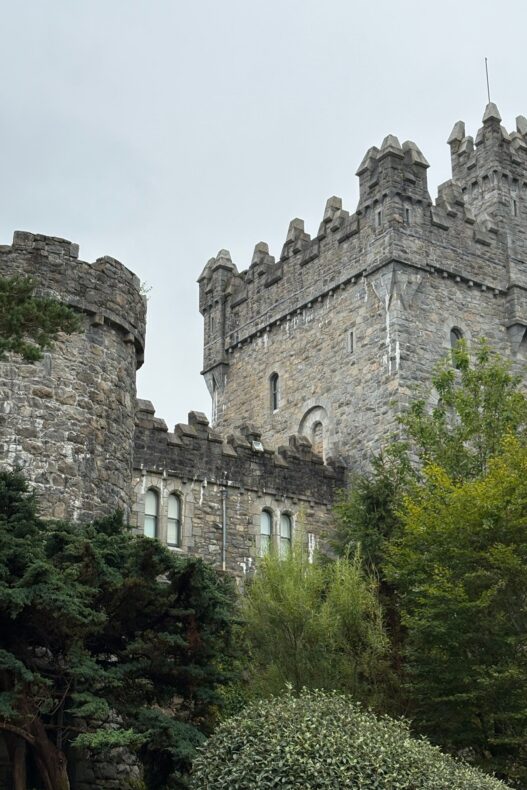
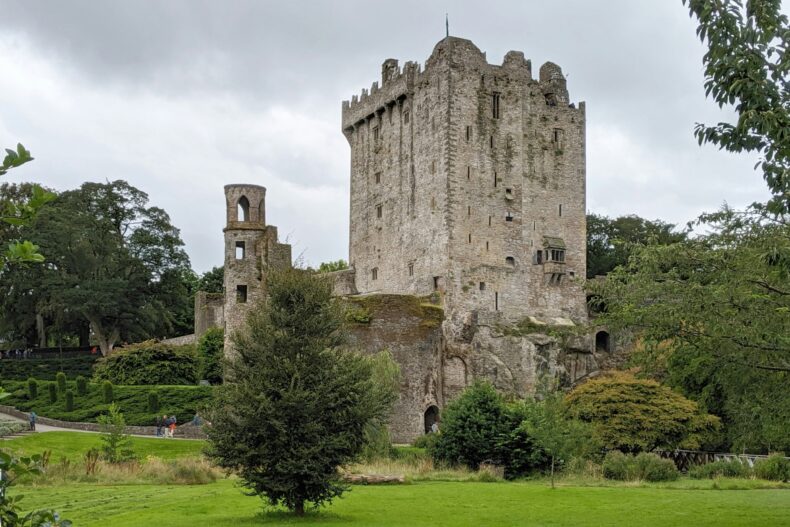
At Blarney Castle, fifteen minutes’ drive from Cork, it’s all about one stone. Kiss the Blarney Stone and you’re supposed to get the gift of the gab. It’s set high in the castle wall, though: you lie on your back and lean over backwards while a member of staff holds on to you.
Not keen? Blarney is still worth a visit. Around the ruin are sprawling gardens with ferns, ancient trees and the Poison Garden, full of plants you really shouldn’t put in your soup. Allow half a day.
#4 Midleton: whiskey at the Jameson Distillery
East of Cork lies Midleton, where Jameson makes its whiskey. At the old distillery you’re taken on a tour past enormous copper stills and warehouses, with a tasting at the end. Midleton is on the way to Ballycotton, so it’s easy to combine with a coastal walk.
#5 Ballycotton and Inch Strand: a cliff path and a seaside sauna
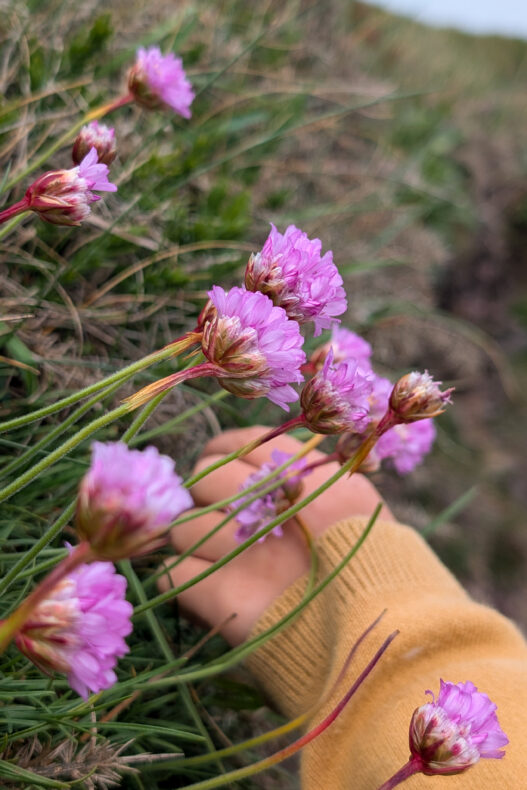
After a day in the city, a cliff walk is a welcome change. At Ballycotton you head out from the village along the coast, with the lighthouse on its little island in view. We walked a stretch out and back and picked a small bunch of wildflowers along the way. The path is narrow and not fenced everywhere, so hold on to young children.
Not far away is Inch Strand, a long sandy beach where we parked up for a night with the campervan by the water. There’s a wooden barrel sauna on the beach, and saunas like this by the sea are hugely popular in Ireland: warm up first, then into the waves. We found it pretty bleak and chilly that day, but we still saw people heading into the sea as if it were nothing. (Don’t mix it up with Inch Beach on the Dingle Peninsula, which is the one you can drive onto.)
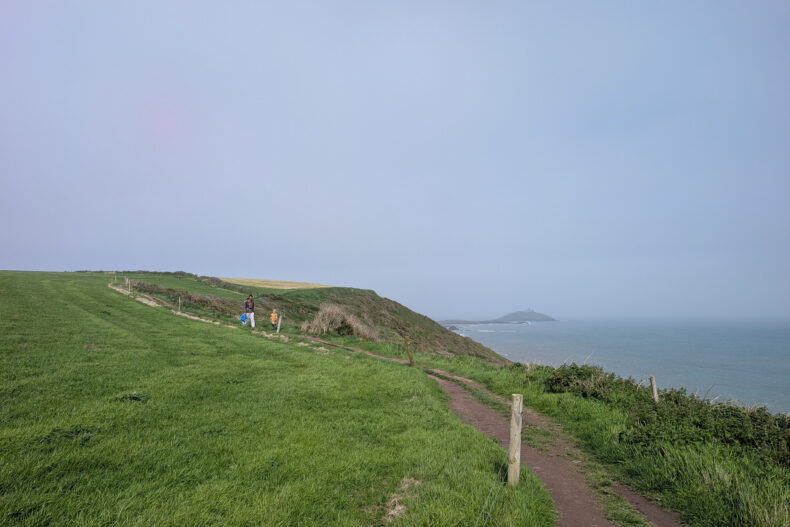
#6 Clonakilty, Mizen Head and Barley Cove: if you have more time
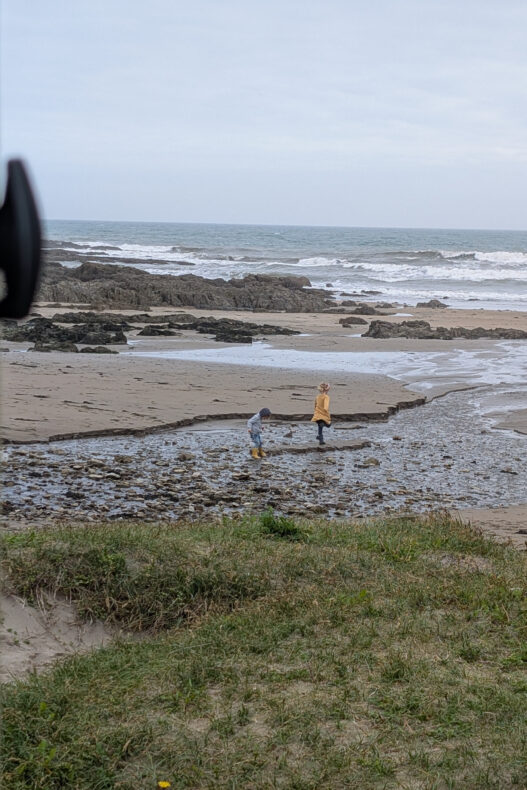
Got more time? Keep heading west. Clonakilty is a cheerful little town full of brightly painted shops, where we had scones in a bright pink tea room. A little further on is Red Strand, a beach that becomes enormous at low tide. We ended up staying there far longer one morning than we’d planned.
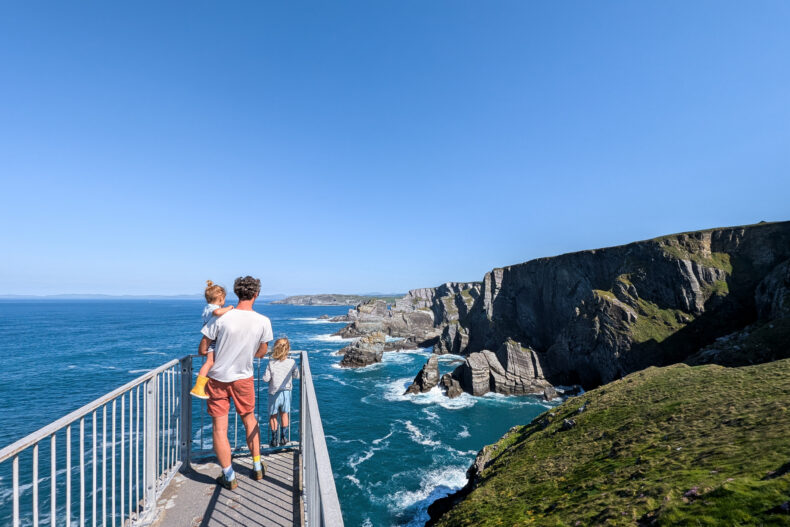
Right down in the southwest is Mizen Head, the most southwesterly point of Ireland. We spotted a dolphin in the water, and the little museum in the old signal station turned out to be far more fun than we’d expected. Still, the impressive cliffs are the main draw. Nearby is Barley Cove, for me one of the most beautiful beaches of the whole trip.
→ Discover the 18 best stops on the Wild Atlantic Way
Our tip for one day in Cork
If you’re driving, leave the car at the Park & Ride and take the double-decker into the centre. Start the morning at the English Market, just as the stalls open, then cross the river to Elizabeth Fort and St Fin Barre’s Cathedral. Around lunchtime, head back to the lanes around Paul Street, where there are plenty of pubs for a stew or a burger.
For the afternoon, pick one direction. North takes you to Shandon with its church tower and the Butter Museum, west to the university and Fitzgerald Park. On the way back, let the shopping streets and the river lead you. We’d save Cork City Gaol and Blackrock Castle for a second day.
For us it was one full afternoon, and it made for a great day. A double-decker bus, a cannon to climb on and, after days of rain, finally some sunshine: that was all the kids needed to fall for Cork.
→ Discover our 3-week Ireland road trip itinerary in 10 stops
→ Discover the 20 best places to visit in Ireland
→ Discover the 10 best stops on the Ring of Kerry