
Picture this. You’re on a dead-straight road and the car in front keeps slowing down, until you’re crawling along behind it at walking pace. You overtake. A few kilometres later, the police are waiting for you with a photo of your offence, ready to haggle over the fine. Welcome to driving in Morocco. It happened to us not once, but three times.
Still, we look back on our Moroccan road trips with a big smile. We spent six weeks in January and February driving our own campervan around the country, with a baby and a toddler in the back. From the whitewashed medina of Asilah to the red gorges of the Anti-Atlas, plus one unforgettable night at 3,000 metres. On our first trip, we rented a car in Marrakech for a few days to explore the area.
In this blog, you’ll find out what the roads are like, which traffic rules apply and how to get past the police checks without losing your cool. We also cover tolls, fuel and parking, what to look out for when you rent a car, and how to take your own car across on the ferry.
Not bringing your own car? Renting one is the easiest way to explore Morocco at your own pace. Our tip: compare prices on Discover Cars, which searches local and international rental companies in one go, and pick full coverage.
→ Compare rental cars in Morocco on Discover Cars
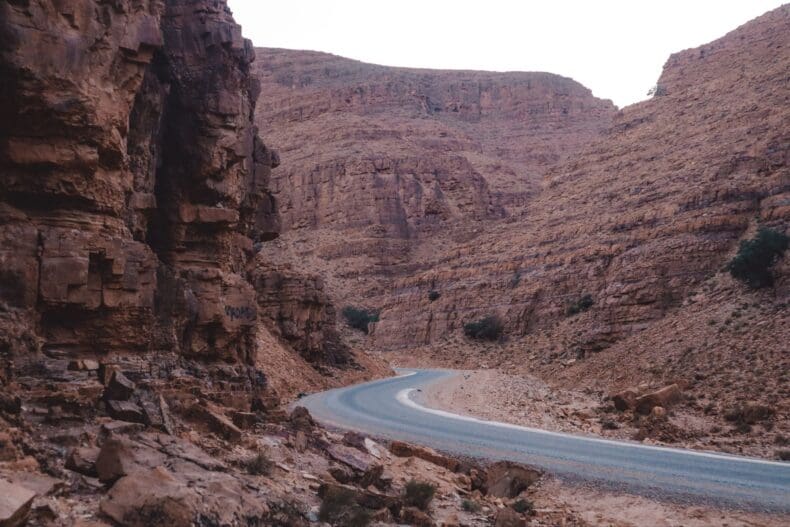
Our experience driving in Morocco
We’ve been to Morocco twice. The first time, it was just the two of us, getting around mostly by train and bus. In Marrakech we rented a car for a few days, which took us to places like the Ouzoud waterfalls and Aït Ben Haddou. It left us wanting more.
The second time, we brought our own campervan: an old six-metre motorhome with an over-cab bed. From Tanger Med we followed the coast via Asilah and Rabat to Marrakech and Essaouira. Past the surf villages around Taghazout and Tamraght we headed south into the Anti-Atlas, to the Aoukerda gorge and Tafraoute. Then on via Ouarzazate, Aït Ben Haddou and Skoura to the Dades Valley, straight through the High and Middle Atlas to Fes and Meknes, and back to the ferry via Chefchaouen.
→ Discover our 3-week Morocco road trip itinerary
Most of the driving was far easier than we’d feared. The roads are better than expected, it’s quiet outside the cities, and you take in the landscapes in a way you never would from a bus or train. The downsides? The police scams, the long distances and one particular mountain road. More on all of that below.
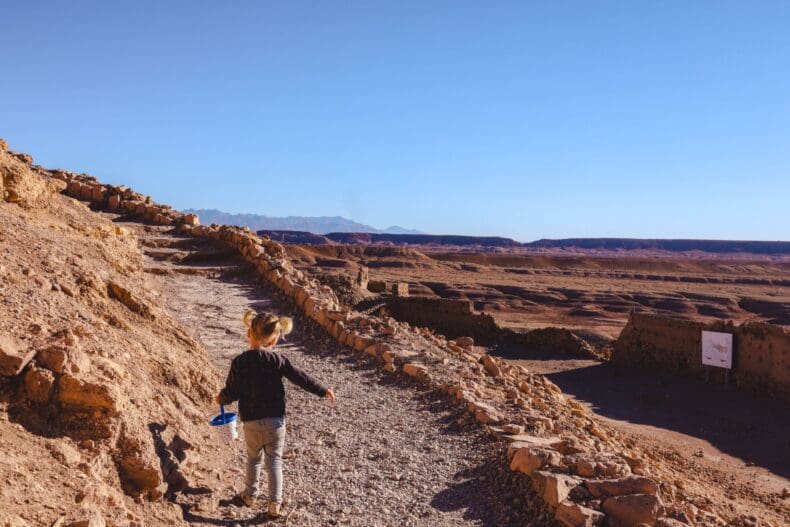
Is it safe to drive in Morocco?
Yes, as long as you have some driving experience and keep your wits about you. Traffic works differently from back home, but it’s far from impossible. Morocco does have a high number of serious accidents, so driving defensively is a good idea.
In and around the big cities, it’s busy and chaotic. Scooters zip past on both sides, pedestrians cross wherever they like and indicators are used sparingly. Honking is mostly a way of saying: watch out, I’m coming through. Keep your distance from the car in front, because it’ll regularly do something you don’t see coming. That said, we never found city driving in our campervan dangerous or stressful. In a bigger vehicle you stand out, so other drivers give you room. Just take it slow.
Once you’re out of town, things calm down a lot. On country roads, you mainly share the tarmac with lorries, cyclists, donkeys and herds of goats. We never drove after dark. Outside the cities there’s hardly any street lighting, so you’d only spot a donkey or pedestrian at the very last moment.
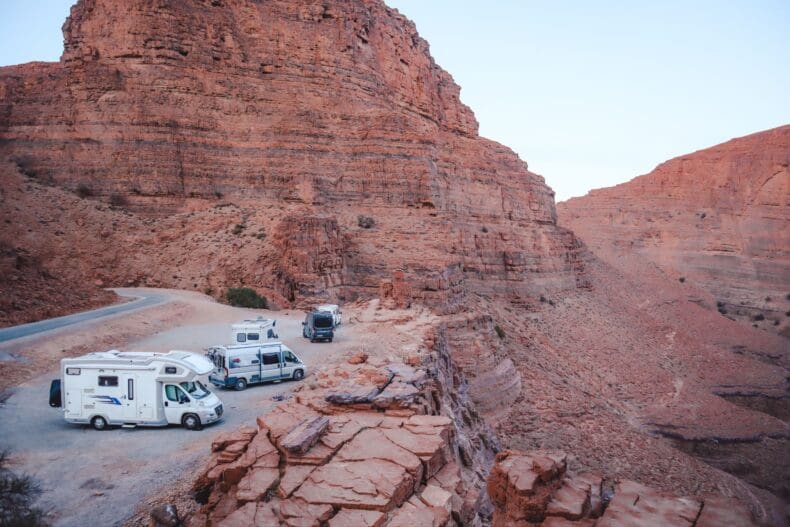
What are the roads like in Morocco?
Better than you’d think. Morocco is building new roads at a rapid pace, so much of what we drove on was smooth, fresh tarmac. Motorways link the big cities, and most national roads are in good shape too.
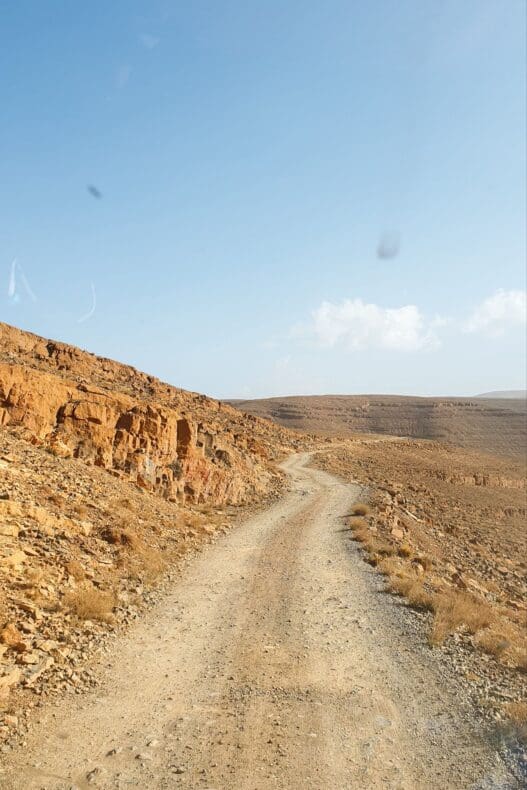
The smaller roads are a mixed bag. Often narrow, with the odd pothole, a crumbling edge or a hefty speed bump at the entrance to a village. In the mountains, a road can turn to gravel without warning.
Allow more time than your sat nav says. We used Google Maps and it works fine, but with the low speed limits, the villages and all the bends, journeys often take a lot longer. In the mountains, Google Maps also happily picks the shortest route, even if that’s a road you really don’t want to be on. Keep reading to find out how we learned that the hard way.

What are the traffic rules in Morocco?
In Morocco, you drive on the right. Road signs look much like European ones, with text in Arabic and French, so a few words of French come in handy.
The speed limits are 60 km/h in built-up areas, 100 km/h outside them and 120 km/h on motorways. Keep a close eye on the signs, because they change all the time. At the entrance to every village the limit drops, sometimes to 40, and that’s exactly where the police like to stand. No wonder speeding is the most common fine for tourists.
Everyone in the car wears a seatbelt, in the back too. Using your phone while driving is banned, and there’s zero tolerance for alcohol.
Roundabouts deserve a special mention. Where there are give-way signs, traffic already on the roundabout has priority. Where there aren’t, priority to the right applies, which means cars entering the roundabout have right of way over those already on it. In practice, everyone just squeezes in. Drive calmly, look around you and assume nobody will wait for you.
Do you need an International Driving Permit for Morocco?
Driving on an EU licence? Then you don’t need one: according to the Dutch motoring organisation ANWB, a Dutch licence is valid in Morocco, rental cars included. If your licence was issued somewhere else, check the rules for your country before you go. For UK drivers, the UK government has the latest advice.
Always carry your licence and passport in the car. Driving your own car or campervan? Then you’ll also need your vehicle registration, your green card and the import document you get from customs. More on that in the ferry section below. Funnily enough, the police never once asked to see our papers, but you’ll want them close at hand.
→ Discover 15 things to know before going to Morocco
Police checks and police scams in Morocco
If there’s one thing we want to warn you about, it’s the police scams. We’d been warned before we left, but it turned out to be worse than we’d expected. It was the least enjoyable part of our time in Morocco, and it took the fun out of driving.
At the entrance to almost every village there’s a checkpoint, and you’ll regularly see an officer with a speed gun by the roadside. Most of the time, you’re simply waved through. Always come to a complete stop at a police stop sign, though, and only drive on when you’re clearly told to. Other travellers told us you can be fined for not stopping fully, too.
The first time it went wrong was on a dead-straight 80 km/h road. A car in front of us kept slowing down until we were crawling along behind it, with a queue of impatient drivers behind us. The only way past was over the solid line, and after a while Sebastiaan went for it. What we didn’t know: that car was part of a police operation. Someone took a photo of us overtaking and sent it to the officers a few kilometres further on, who were already waiting for us.
For this set-up offence, they asked for 400 dirham. After some hard bargaining, we paid 100. Other travellers told us that haggling over fines is pretty much standard.
Later in the trip, exactly the same thing happened. This time we stayed patiently behind the crawling car, for kilometres. Infuriating, but we didn’t want a second run-in. The third time, we only overtook once the solid line had ended. We were pulled over anyway. A long discussion followed, the officers took our passports, and only after a lot of back and forth were we allowed to go. We drove off with a knot in our stomachs that stayed there for the rest of the day.
Our advice: take that solid line very seriously, even if someone ahead is deliberately braking. Stick strictly to the speed limit, especially at village entrances. If oncoming drivers flash their headlights, there’s often a checkpoint ahead. And if you do get fined? Stay calm and friendly, haggle over the amount and ask for a written ticket. Sometimes asking for one is enough to be waved on, sometimes the fine drops considerably.
→ Discover the 7 things we didn’t like about Morocco
How do toll roads work in Morocco?
Morocco’s motorways are toll roads, run by Autoroutes du Maroc. The network of around 1,800 kilometres connects the big cities: from Tangier via Rabat and Casablanca to Marrakech and Agadir, and from Rabat via Meknes and Fes towards Oujda. They’re quiet, well maintained and the tolls are reasonable.
We always paid cash at the toll booth, which works everywhere. Some toll plazas also take cards, but don’t count on it, and always keep some dirhams handy. Many Moroccans use their own lane with a Jawaz tag, but you won’t need one for a holiday.
If you want to see Morocco’s most beautiful corners, you’ll only spend part of your time on the motorway anyway. Heading south and into the mountains, you’ll be on toll-free national roads.
Filling up in Morocco: how does it work?
Getting fuel in Morocco is easier than at home. You don’t even have to get out: every petrol station has an attendant who fills up for you. Diesel and petrol cost roughly the same everywhere, motorway stations included. We mostly paid in cash.
In the cities and along the main roads, there are plenty of petrol stations. In the mountains and the south they’re further apart, so set off with a full tank. On a mountain road like the R704 between Boumalne Dades and Agoudal, for example, you won’t pass a single one.
Fun stop: on our way from the Anti-Atlas to Ouarzazate, we pulled in at a petrol station you’d never expect out there. Gas Haven, with its American sign, old pumps and rusty cars out front. Don’t count on filling up, though: it’s the film set from the 2006 horror film The Hills Have Eyes. A great photo stop if you’re passing anyway.

Parking in Morocco: how does it work?
In almost every town and at every sight, you’ll find a parking attendant, often in a hi-vis vest. He keeps an eye on your car and gets a small tip when you leave. That’s simply how it works in Morocco.
In Rabat and Marrakech, we deliberately looked for guarded car parks, which we found using the Park4Night app. With a campervan full of stuff, that felt a lot safer than parking on the street at the edge of the medina. In Fes, we did park on the street. Whatever you do, never leave bags or valuables in sight.
Driving into the medina? Don’t. The alleys are narrow and packed with people, scooters and donkey carts, and they often turn out to be dead ends. Park outside and walk the last bit.
Driving in the Atlas Mountains
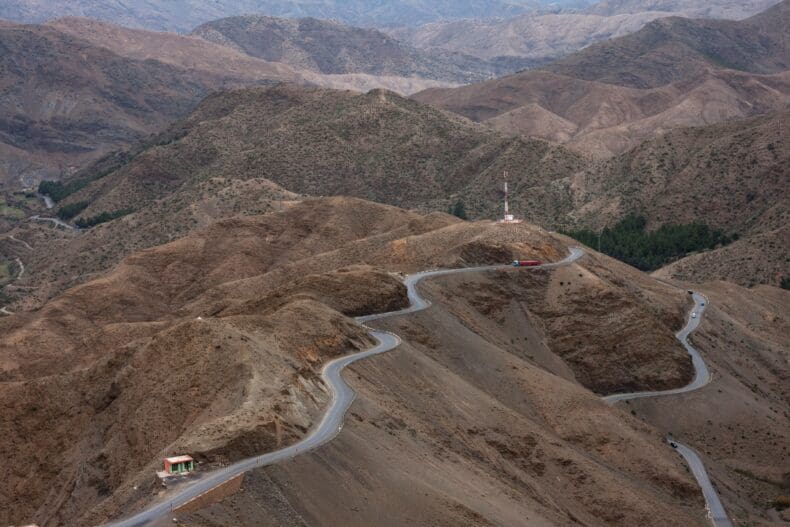
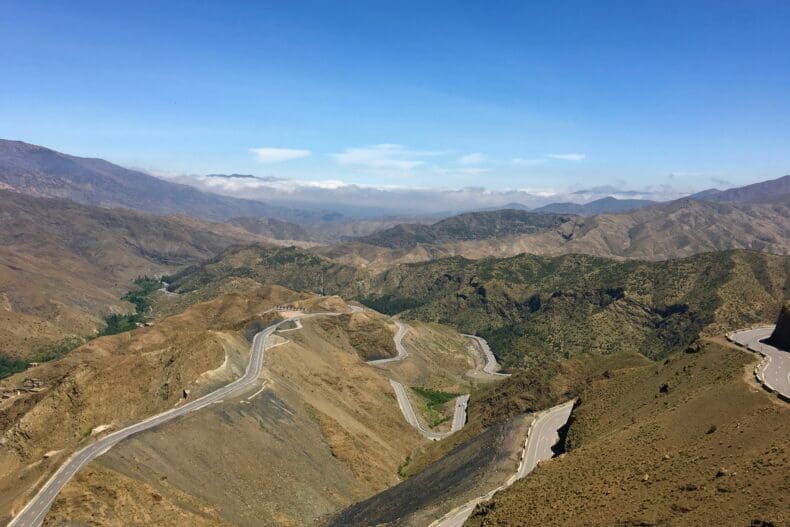
The big mountain passes are perfectly doable. The best known is the Tizi n’Tichka between Marrakech and Ouarzazate, a paved road with plenty of hairpin bends that climbs to around 2,260 metres. You’ll share it with lorries and buses, so only overtake where you can see far ahead. In winter it regularly snows up there, and the pass sometimes closes for a few days.
With the campervan, we ended up on a very different mountain road. The plan was simple: just like in the Valley of the Roses, we’d drive a short way into the Dades Gorge, head back down and then do the same in the Todra Gorge.
It didn’t quite go that way. A few misjudgements and Google Maps’ route suggestions took us all the way out of the Dades Gorge and up into the mountains on the R704 towards Msemrir and Agoudal. By the time we realised where we were, we decided to just keep going and come down the other side. Only, back then, that road was far from finished. It was never steep or dangerous, but with a six-metre campervan on an unpaved mountain road and no idea what’s round the next bend, you’re not exactly relaxed behind the wheel.
The spot we’d had in mind for the night turned out to be unsuitable, so we ended up sleeping at 3,000 metres. The next morning, there were icicles hanging from the campervan. Freezing, but wow, was it beautiful up there.
After that, we’d had enough. We skipped the Todra Gorge and the Sahara at Merzouga, which we’d both seen on our first trip anyway.
According to recent travel reports, the R704 is now mostly paved. It’s still a high mountain road, though, and in winter there’s often snow, so it sometimes closes. Heading this way? Ask in Boumalne Dades or Msemrir about the current conditions. The same goes for most small mountain roads: they can turn to gravel or get narrower than you’d like without warning.
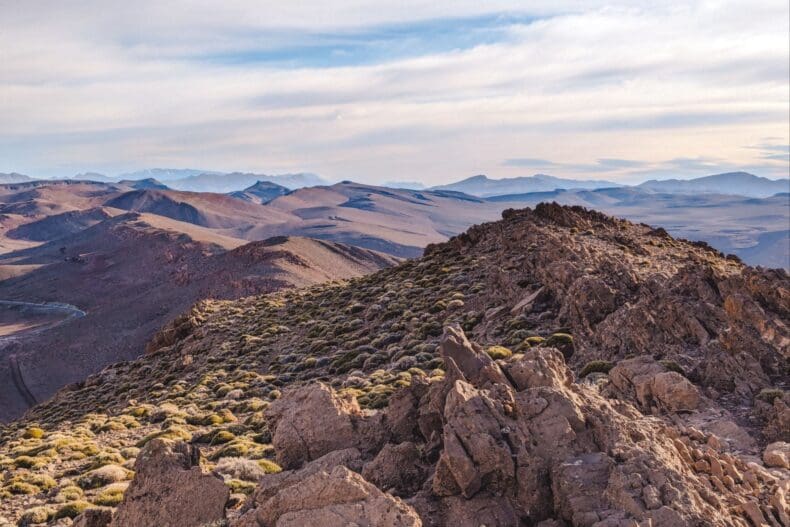
What we hadn’t expected: the mountains became the highlight of our campervan trip. We’d thought the surf villages on the coast, with their sunshine and beaches, would be the best part. But the drives through the Anti-Atlas and later through the Middle Atlas towards Fes were stunning. Up there, the drive itself was the experience.
→ Discover the 16 best things to do in the Atlas Mountains
→ Discover the Sahara Desert at Merzouga

Driving a campervan in Morocco
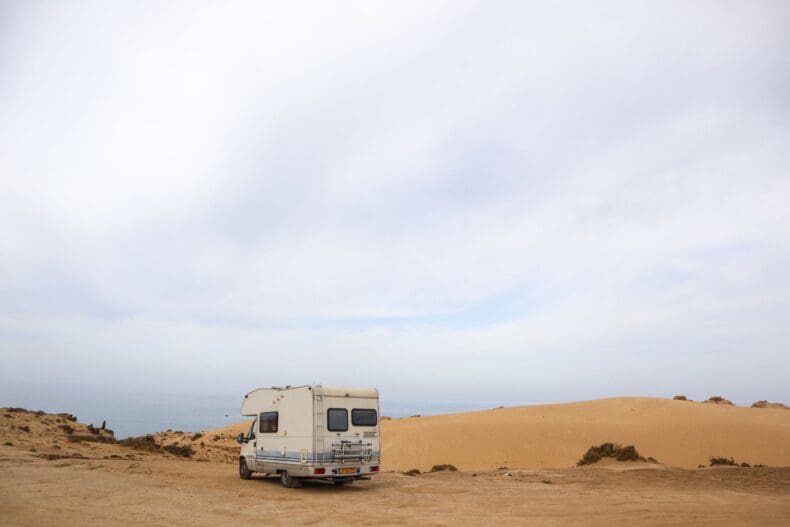
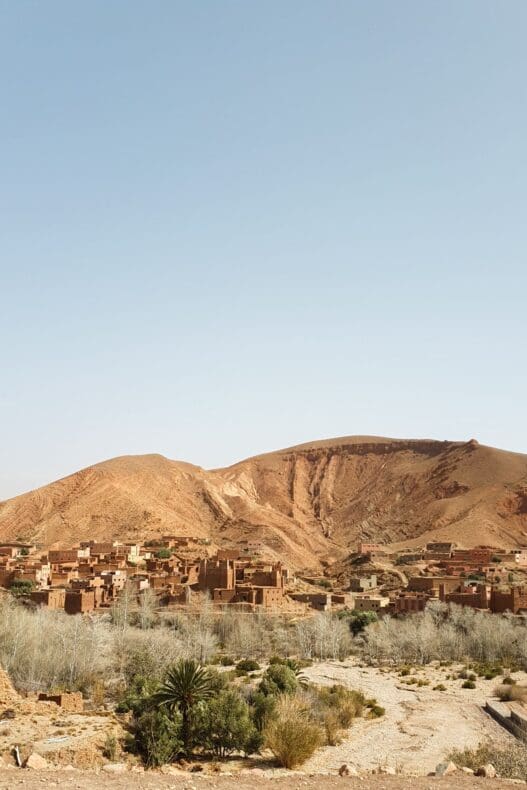
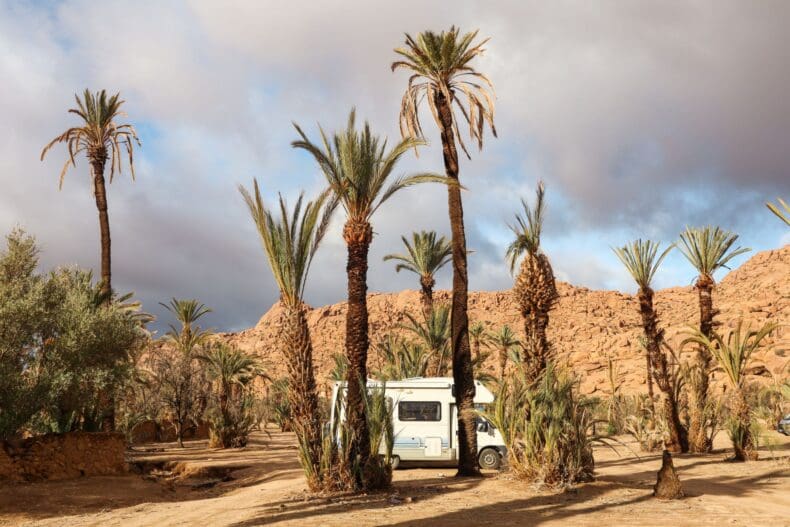
In a regular campervan, you can get almost anywhere in Morocco. Ours isn’t an off-roader, and we noticed that now and then, but the main roads, the coast and even the gorges of the Anti-Atlas were no problem at all.
What we did differently than with a rental car: we checked small mountain roads more carefully before setting off on them, and we never took the campervan anywhere near a medina. Leave it at a campsite or a guarded car park on the edge of the old town instead.
Travelling with kids? Plan short stages. Our baby loudly protested against driving whenever he wasn’t asleep, and often refused to sleep in the campervan, which made the long driving days tough on all of us. Better an extra day than a day too long behind the wheel.
→ Discover our tips for travelling Morocco by campervan
Renting a car in Morocco: what to look out for
On our first trip, we rented a car in Marrakech for a few days to visit places like the Ouzoud waterfalls and Aït Ben Haddou. We loved the freedom: stopping wherever we liked and deciding for ourselves how long to stay.
For the deposit, you’ll need a credit card in the main driver’s name; without one, you won’t be able to rent a car in Morocco. Most rental companies have a minimum age of 21, and you often need to have held your licence for a year or two.
Go for full coverage without an excess. With all the tight parking spots, scooters and potholes, a scratch or dent is easily done. We lost a hubcap without even noticing, but thanks to our cover it didn’t cost us anything extra. When you pick up the car, take photos and a video of the whole thing, including existing damage, the tyres and the fuel gauge. Ideally collect it at the airport, so you can head straight out of town instead of zigzagging between scooters for your first few kilometres.
Our tip: compare rental cars on Discover Cars. You’ll see local and international companies side by side, and you can add full coverage straight away.
→ Compare rental cars in Morocco on Discover Cars
A regular car is fine for most routes, including the Tizi n’Tichka. Unpaved tracks and off-road driving usually aren’t covered, so if you want to head into the desert or onto remote mountain roads, you’ll need a 4×4 and should read the small print carefully. You can’t take a Moroccan rental car across the border, not even to Ceuta or Melilla, so the ferry to Spain is out too. Dropping the car off somewhere else? That usually costs extra.
Rather not drive at all? Travelling between the big cities by train works really well, as we did on our first trip.
→ Discover our Morocco by train route through 6 cities

Driving your own car to Morocco: how does the ferry work?
If you’re driving your own car or campervan like we did, you’ll take the ferry. The shortest and most popular crossing is from Algeciras in southern Spain to Tanger Med, with several sailings a day. There are also ferries from Tarifa, Almería and Motril, among others.
Bring your vehicle registration document, which is called the carte grise in Morocco, and your green card. Check that the MA box for Morocco hasn’t been crossed out, because if it has, your insurance doesn’t cover you there. Take the original paper green card rather than a printout of a digital version. If your insurance doesn’t cover Morocco, you can reportedly buy short-term cover at the border.
Once you arrive at Tanger Med, customs registers your car against your passport and registration document for temporary import. Keep the import document you’re given safe: you’ll show it if asked and hand it back when you leave the country. Your car or campervan can stay in Morocco for a maximum of six months per year.
→ Discover how to prepare for the ferry to Morocco
Enjoy our travel tips? Add The Orange Backpack as a preferred source on Google and you'll see us more often in your search results.
More tips for your trip to Morocco
 Our pickHitting the road yourself? Rent a car with Discover Cars and compare local and international rental companies in one go.
 Hotels in Morocco: from a riad in the Fez medina to a kasbah on the edge of the desert
 Prefer everything arranged? Browse Morocco tours on TourRadar.
 Discover all our blogs about Morocco


