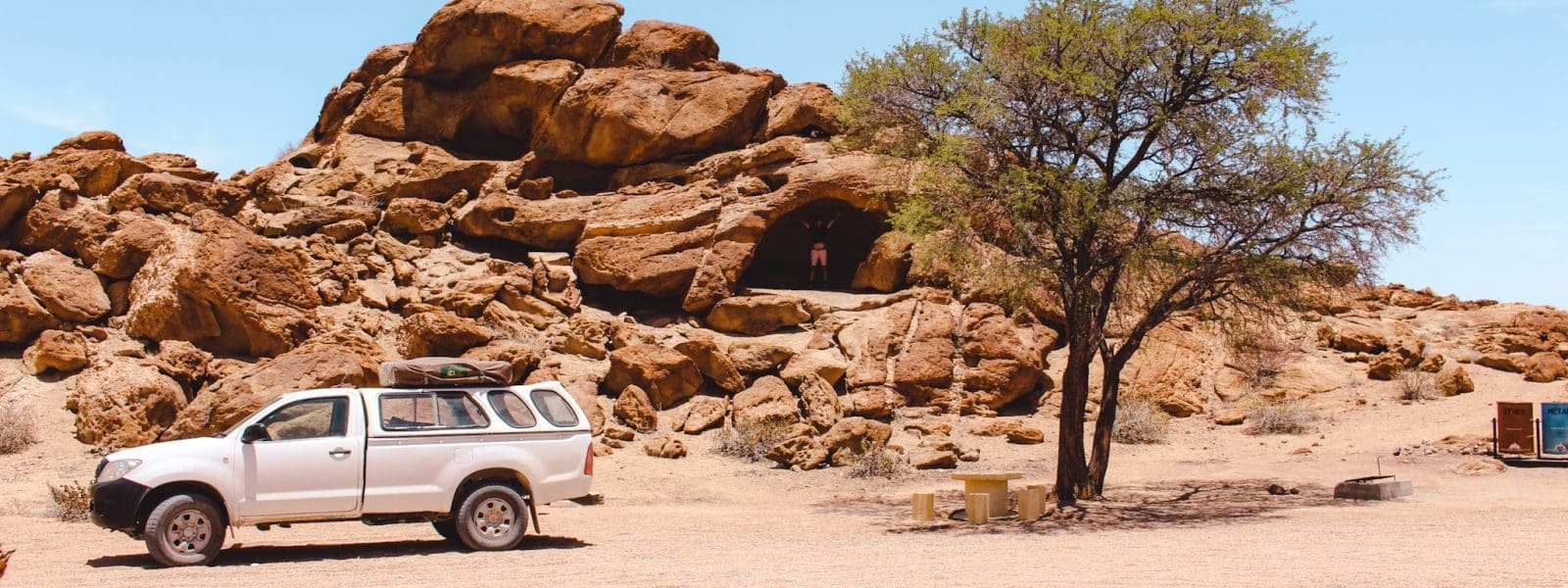
Sossusvlei, Etosha and the Fish River Canyon are on most Namibia itineraries, and they deserve to be. But in between those famous names are places where you can drive for hours without passing another car, camp without a single neighbour and find that a hike or a canoe trip turns into the best day of your week.
We drove more than 5,000 kilometres through the country in January, in a 4×4 with a rooftop tent, and left the standard route a few times along the way. Those detours gave us our best night of the whole trip, high up on an old crater, and a mountain hike on which we met nobody at all.
In this blog you’ll find six places in Namibia off the beaten track, with what to do at each one and where to sleep. After that we answer whether you need a 4×4 and how to fit these stops into your route.

What are the best places in Namibia off the beaten track?
The six places are spread across the west and south of the country, from the coast above Swakopmund down to the South African border. The map shows where each of them is.
Tip: open the map on your phone with the square at the top right, while signed in to Google. You can then find it again in the Google Maps app under You > Maps.
#1 Brukkaros: camping on a volcano
Our best night in Namibia was on Brukkaros, a huge crater that rises out of the flat south of the country. We took the 4×4 up the steep track, hiked to the crater, put up with the heat and were rewarded with the clearest night sky of our trip. No electricity, just you, the mountain and the stars.
Camping on a volcano sounds wilder than the geology really is. Brukkaros is not a cone with a lava flow. It is a crater formed a very long time ago by an explosion, when magma deep underground met groundwater. The rim stands hundreds of metres above the plain. You won’t see lava, but you will find white crystals lying loose on the ground and rock faces that glitter in the sun. Because the air is so clear, an observatory once stood here.
The mountain is in the south, north-west of Keetmanshoop. There are no facilities, so bring enough water and food for your whole stay.
→ Discover all about camping on Brukkaros
→ Discover the 11 best campsites in Namibia
#2 Skeleton Coast: a night on the wild coast
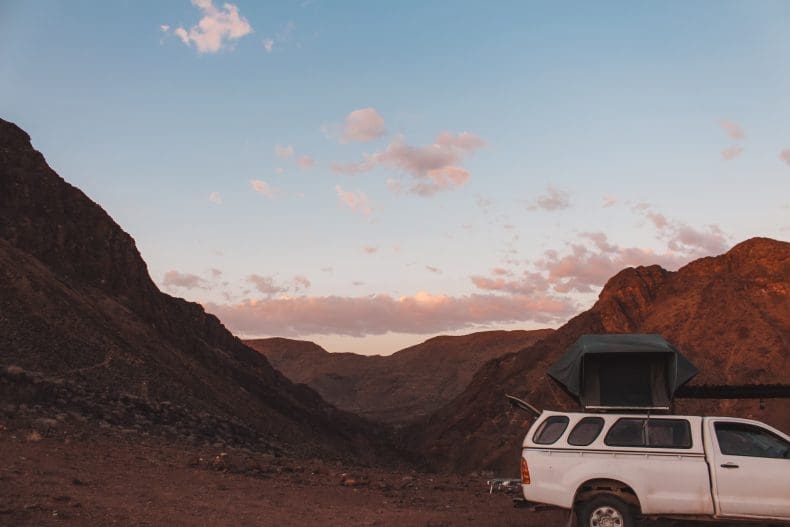
Fog often hangs over the Skeleton Coast, cold waves pound the beach and shipwrecks lie in the sand, with a great deal of nothing in between. We drove a road trip past the wrecks and the Cape Cross seal colony in January. That is how many travellers see the coast, as a day trip.
To really feel how empty it is, stay the night. Further north, inside Skeleton Coast Park, Namibia Wildlife Resorts (NWR) runs two places to sleep. At Terrace Bay you book a room, and at Torra Bay you camp right by the ocean. That campsite only opens in December and January. Falling asleep to the sound of the surf and walking the tideline in the morning without meeting anyone is what makes the long drive worthwhile.
The coast road from Swakopmund is easy to drive. For the park itself you need a permit, and the far north can only be reached on an organised tour. Rules for access and overnight stays do change, so check the NWR website shortly before you go.
→ Discover the Skeleton Coast with map, shipwrecks and tips
→ Discover the top 12 things to do in Swakopmund

#3 Naukluft: hiking in the mountains
In the Naukluft Mountains we walked the Olive Trail. First we climbed a mountain, then we scrambled back to the start through a kind of canyon. The scenery was all the more impressive because we did not see a single other hiker on the way.
Many travellers only drive past this part of Namib-Naukluft National Park on their way to Sossusvlei and see the mountains through the car window. Yet the landscape here is nothing like the dunes further on, with bare ridges, deep gorges and the odd pool of water. In the narrowest part of the gorge, chains are fixed to the rock to help you along.
The Olive Trail is a day hike, so set aside a full morning and start early because of the heat. There is a simple NWR campsite in the park. If you prefer a bed, combine the hike with a lodge near Sossusvlei.
→ Discover the 8 most beautiful spots at Sossusvlei
→ Discover 12 unique lodges near Sossusvlei and NamibRand

#4 Kolmanskop: the ghost town in the sand
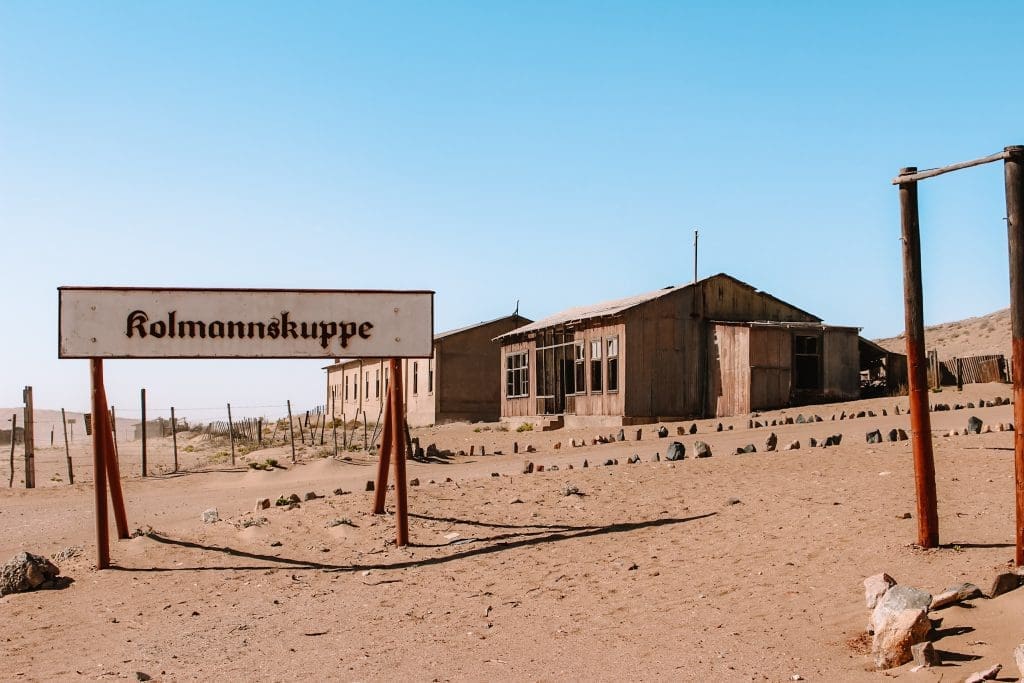
Every house in Kolmanskop has sand in it. Sometimes it is just a few centimetres on the floor, and sometimes the desert has already taken over part of a house, with sand coming in through the windows and doors. We wandered around in January and it became one of the highlights of our trip.
In the early twentieth century, during the German colonial period, Kolmanskop was a wealthy diamond town in the middle of the desert. When the yields dropped and richer deposits were found further south, the residents gradually moved away, until the town stood empty around the middle of the last century. The sand has been doing the rest ever since.
Kolmanskop is hardly unknown these days, but plenty of travellers still skip it because it sits next to Lüderitz, a long way from the usual route. From Aus you get there on a good tarred road. Combine the ghost town with a night or two in Lüderitz and the detour is well worth the kilometres.
→ Discover our tips for Kolmanskop ghost town
→ Discover 13 things to do and where to stay in Lüderitz
#5 Namib National Park: camping in the middle of nowhere
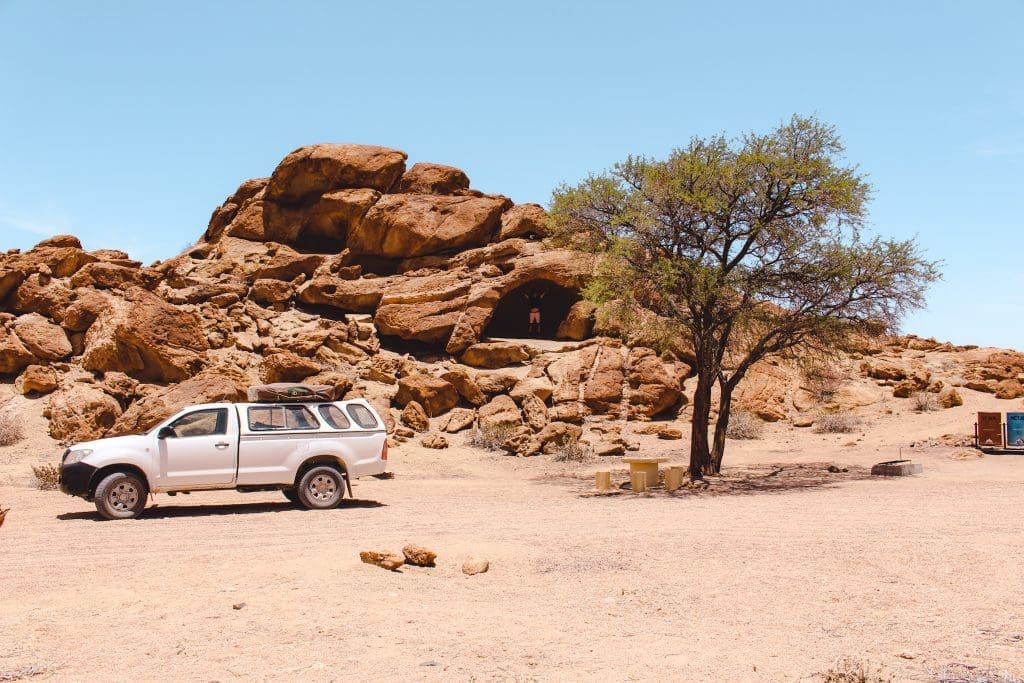
Between Swakopmund and Sossusvlei you spend hours driving through Namib National Park, the northern part of Namib-Naukluft National Park. The dune sea in the south of that park is on the UNESCO World Heritage List as the Namib Sand Sea. For most people it is simply a driving day. We drove through in January on our way to Sossusvlei, climbed the granite hill of Blutkoppe despite the afternoon heat and watched zebras, ostriches and springbok cross the plain at Ganab.
The best thing about this park is the camping. Basic campsites are scattered across the desert with little more than a braai (barbecue) spot and a stone bench, often with nobody else for miles around. Close to Swakopmund you also have the Welwitschia Drive, a loop through a moonscape and past Namibia’s most famous plant.
You can drive the main C14 and C28 roads without a permit. As soon as you want to leave them, for the campsites or the Welwitschia Drive, you need a park permit. Buy it in advance at an office of the Ministry of Environment and Tourism (MEFT), for example in Swakopmund or Sesriem. Nothing is for sale in the park, so fill up the tank and bring all your water and food.
→ Discover hiking and camping in Namib National Park
→ Discover the Welwitschia Drive with permit, map and 13 stops
→ Discover our tips for camping in Namibia with a rooftop tent
#6 Orange River: canoeing near Noordoewer
After so much dry country, the Orange River looks almost out of place, because here the water actually flows. It is one of the few rivers in Namibia that carries water all year, and it forms the border with South Africa. Near the border village of Noordoewer you paddle with Namibia on one bank and South Africa on the other.
We canoed on the Orange River near Noordoewer in late January, the day after visiting the Fish River Canyon. You can go for a half-day trip, but there are also multi-day trips on which you camp on the riverbank along the way. Several camps along the river rent out canoes and run guided trips.
Noordoewer is in the far south, on the main road to Cape Town. That makes it easy to combine with the Fish River Canyon, which is in the same corner of the country.
→ Discover the Fish River Canyon with viewpoints and hike
→ Discover 29 unique places to stay in Namibia

Do you need a 4×4 for Namibia off the beaten track?
For four of the six places, no. The road to Lüderitz and Kolmanskop is tarred, and so is the main road to Noordoewer. The coast road along the Skeleton Coast and the gravel roads to the Naukluft Mountains are manageable in a normal car too, as long as you take it slowly and keep an eye on your tyre pressure.
Brukkaros is a different story. The track up to the camping spots is steep and we were glad to have four-wheel drive. In Namib National Park a normal car copes with most of the side roads. Only around Groot Tinkas and Gemsbokwater is a 4×4 the more comfortable choice, mainly because there is almost no other traffic to help if you get stuck in the sand.
We travelled in a 4×4 with a rooftop tent ourselves and would do it the same way again, because you never depend on finding a bed and your camp is set up in minutes. Compare rental cars on Discover Cars before you book. If you want to camp as well, Namibia Nomads rents out a fully equipped 4×4 with rooftop tent and camping gear.
→ Compare rental cars in Namibia on Discover Cars
→ Discover the 4×4 with rooftop tent by Namibia Nomads
→ Discover our tips for renting a car in Namibia
How do you fit these places into your route?
None of the six asks for a completely different trip. They are all on or near the route many road trips follow anyway. You just need a few extra nights.
Driving from north to south, you start in Swakopmund. The Skeleton Coast lies to the north of town, and you cross Namib National Park anyway on the way to Sossusvlei. Give it one or two nights of camping instead of driving through in a day. The Naukluft Mountains lie south of the road to Sesriem, so allow one extra day for the Olive Trail.
From there the route heads south. Allow two extra nights for Lüderitz and Kolmanskop, because it is a long way out and the same way back. From the Fish River Canyon it is not far to Noordoewer and the Orange River. On the way back to Windhoek you pass Keetmanshoop, and from there Brukkaros makes a last night under the stars before you hand back the car. That is the order we drove it in too.
→ Discover our Namibia itinerary for 2 or 3 weeks
→ Discover 20 practical Namibia travel tips
Enjoy our travel tips? Add The Orange Backpack as a preferred source on Google and you'll see us more often in your search results.
Plan your trip to Namibia
Everything you need to book your trip, in one place. From desert lodges to a 4x4 with a rooftop tent.
 Our pickLodges and hotels in Namibia: from a desert lodge near Sossusvlei to a safari camp right outside Etosha. Pick your spot or browse all of Namibia on Booking.com
 Namibia is made for a self-drive trip. Staying in lodges? Compare rental cars with Discover Cars. Rather camp? Book a road trip with a 4x4 and rooftop tent from Namibia Nomads, route and campsites sorted.
 Dunes that tumble straight into the ocean? Book the Walvis Bay boat trip with a 4x4 ride to Sandwich Harbour with GetYourGuide.
 Prefer everything arranged? Browse Namibia tours on TourRadar.
 No flight yet? Compare flights to Windhoek.
 Discover all our blogs about Namibia


