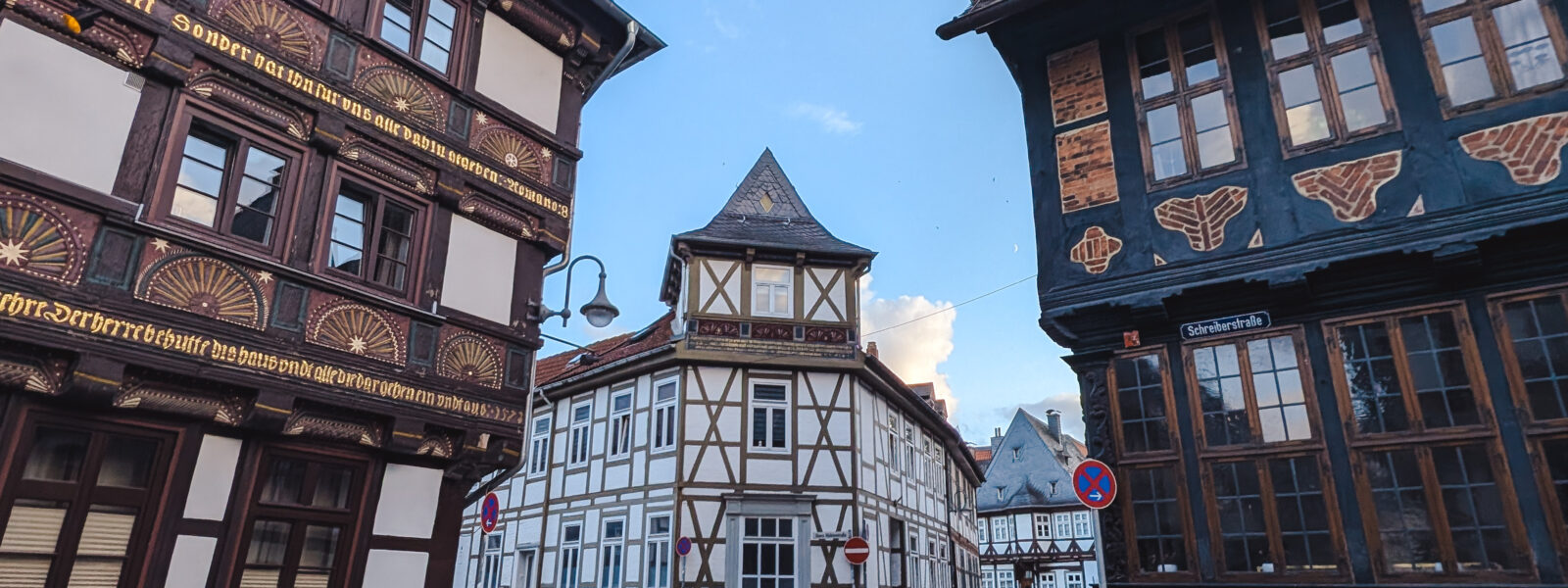
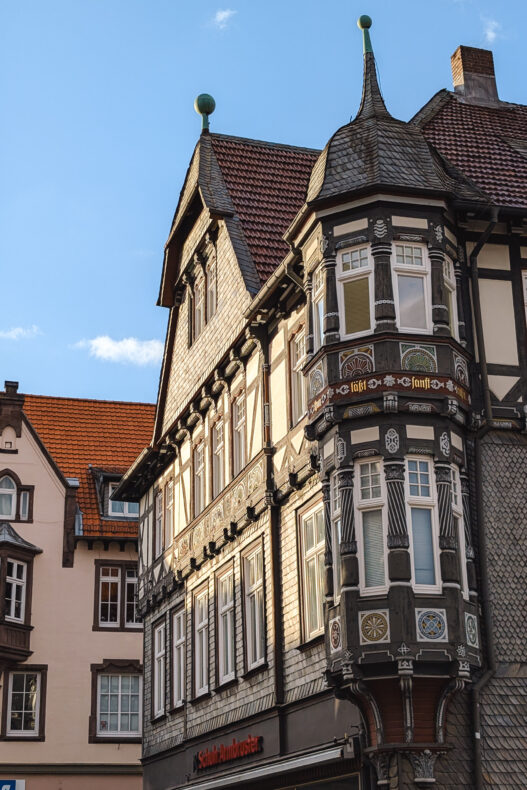
Goslar has just about everything you could hope for in a historic German town: centuries-old half-timbered houses, façades covered in dark slate, narrow winding streets and the small Abzucht river flowing right through the centre. The old town is so well preserved that the entire historic centre has been included on the UNESCO World Heritage List. But Goslar is much more than a beautiful collection of old buildings. Behind those pretty façades lies a fascinating story of mining, wealth and imperial power that shaped the town for centuries.
Much of Goslar’s prosperity came from the mines of Rammelsberg, where silver, copper and other ores were taken from the mountain for almost a thousand years. The mining industry brought enormous wealth to the town and played a major role in turning Goslar into one of the most important places in the region. That wealth attracted emperors, supported powerful merchants and helped create the impressive buildings you still see around the old town today. Wealthy families built grand homes, trade flourished and Goslar even gained a huge imperial palace, showing just how important the city once was.
Once you know a little about this history, the old town becomes even more interesting to explore. The richly decorated houses, impressive public buildings and grand streets are not just beautiful to look at; they are also reminders of the money and influence that mining brought to Goslar over the centuries. We visited Goslar during our train journey through Lower Saxony and stayed right in the middle of the Altstadt in a half-timbered house dating back to 1573. Staying in such an old building made the historic atmosphere feel even more real and meant we could step straight out into the old town each morning.
During our visit, we also tried local Gose beer and used Goslar as a base for exploring the green hills surrounding the town. That combination of historic streets, local food and drink, and easy access to nature made Goslar a particularly enjoyable stop on our journey. There is plenty to discover here, both inside the old town and in the landscape around it. In this travel guide, we share our 10 favourite sights in Goslar, along with practical tips and some of the places and experiences we enjoyed most during our stay.
Why Goslar Is Worth Visiting?
To really understand Goslar, it helps to start with what lies beneath the ground. More than a thousand years ago, miners were already working in the Rammelsberg, just outside the city, searching for silver, copper, lead and other valuable ores. The mountain turned out to be an extraordinary source of wealth. Mining transformed Goslar from a small settlement into one of the richest and most important cities in medieval Germany, and that prosperity shaped almost everything you still see in the old town today.
German kings and emperors were drawn to Goslar because of its growing importance and, in the eleventh century, they had the enormous Kaiserpfalz, or Imperial Palace, built here. The city became closely connected with royal power, while wealthy merchants and influential families also began building impressive homes of their own. Many of those houses were richly decorated with carved wood, dark slate and detailed ornamentation. Even the town hall and the churches give you a sense of how much money once passed through Goslar. The grand architecture was not simply for show; it was a direct result of the wealth created by mining and trade.
That is part of what makes walking through Goslar so interesting. The old town is beautiful, but once you know where that beauty came from, the buildings start to tell a much bigger story. What makes Goslar even more special is how much of this history has survived. Mining at the Rammelsberg continued for more than a thousand years and only came to an end in 1988. Just four years later, both the mine and Goslar’s historic old town were added to the UNESCO World Heritage List.
Over time, the protected area was expanded to include the historic water management system connected to mining in the Harz Mountains. This complex network helped support the mines for centuries and shows just how advanced and important the industry became. As a result, Goslar is much more than a collection of pretty half-timbered houses. Above ground, you can wander through a medieval imperial city filled with narrow streets, grand buildings and richly decorated façades. At the same time, beneath the city and across the surrounding landscape, you can still find traces of the mining industry that made all of that wealth possible.
For us, that connection between the city and the mines is what makes Goslar so fascinating. On the surface, it feels like a beautifully preserved historic town. But once you know the story behind it, you begin to see it as the result of more than a thousand years of mining, trade, power and ambition. That makes Goslar feel like two destinations in one: a charming medieval city above ground and a much older industrial world hidden beneath and around it.

Visiting Goslar on a Trip Through Lower Saxony
We visited Goslar as part of a multi-day train journey through Lower Saxony, combining it with stops in Celle and Hameln. It turned out to be a really enjoyable route, especially because the three towns are quite close together but each has its own very different story and atmosphere. Celle is known for its half-timbered houses and ducal history, Hameln is forever linked to the famous Pied Piper, and in Goslar, the story always seems to come back to emperors and mining.
If you are travelling by train like we did, the direct connection from Utrecht to Hanover is a very practical starting point. From Hanover, it takes around an hour to continue on to Goslar, which makes the town easy to include in a longer rail trip through the region. For the international part of the journey, we would definitely recommend reserving a seat in advance. We did not do this ourselves and soon discovered that finding a free seat was not always as easy as we had hoped. On busier stretches, seats may already be reserved for part of the route, so having your own reservation can make the journey much more comfortable.
Once you arrive in Goslar, however, getting around is very easy. You really do not need a car to explore the town itself. From the train station, you can walk straight into the historic centre, and almost all of the main sights are close enough to reach on foot.
That is one of the things we liked most about Goslar. You can arrive by train, leave your luggage at your hotel and spend the rest of the day simply wandering through the old town without having to think about buses, taxis or parking. The main exceptions are the Rammelsberg mine and hikes farther into the Harz Mountains, which take a little more planning. Even then, you can still reach these places by public transport, so travelling without a car is very doable if you prefer to explore the region by train and bus.
Of course, having a car gives you more freedom, especially if you want to combine Goslar with more places in the Harz. It makes it easier to stop in smaller villages, reach remote hiking areas, visit viewpoints and change your plans along the way without having to check timetables. Still, we really enjoyed travelling through Lower Saxony by train. Deutsche Bahn did not always make the journey as smooth as we would have liked, and delays were sometimes part of the experience, but the more sustainable side of travelling between several cities by rail really appealed to us.
There was also something very relaxing about not having to drive. Once we were on the train, we had time to read, catch up with each other and simply watch the landscape pass by outside the window. For a trip focused on historic towns, local stories and a slower way of travelling, that pace suited us very well. The train journey became part of the experience rather than just a way of getting from one place to another, and that made this route through Lower Saxony feel even more enjoyable.
Top 10 Things to Do in Goslar
#1 Wander Through the Historic Altstadt
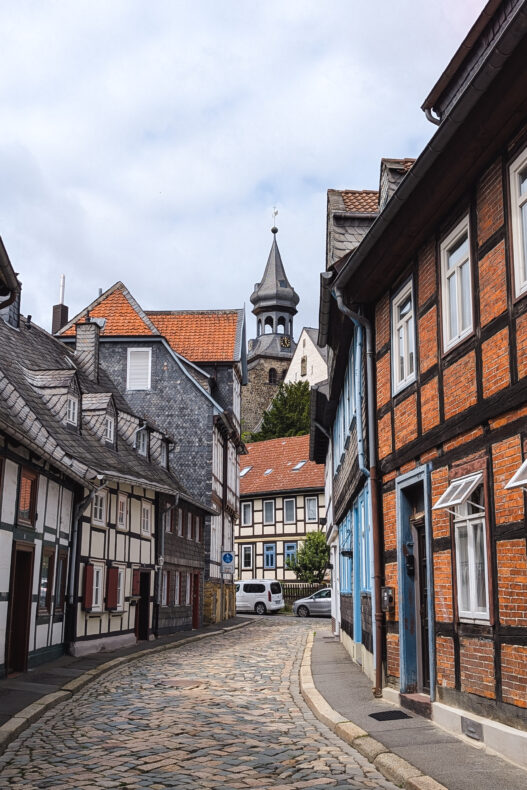
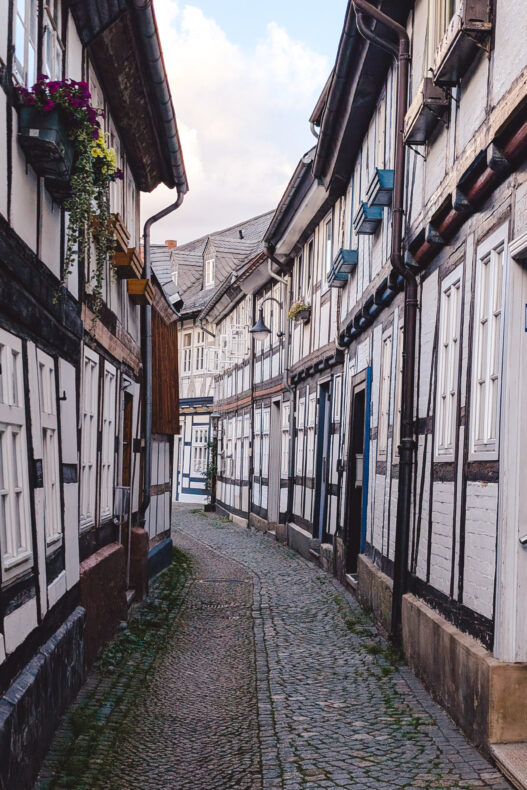
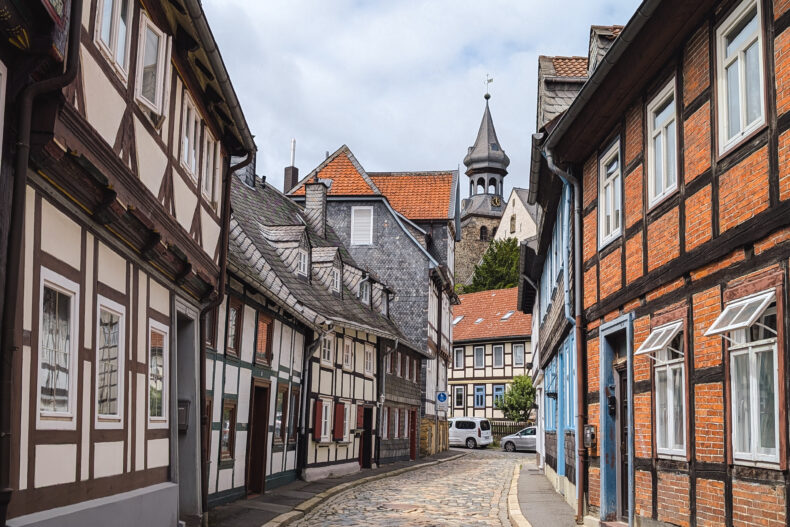
The best way to start exploring Goslar is simply to wander. The historic centre is compact, so you do not need a complicated route or a long list of sights to enjoy it. In fact, some of the nicest parts of the Altstadt are the smaller streets and narrow lanes you discover by accident along the way. As you walk, you will pass centuries-old half-timbered houses, tiny alleys and striking façades covered in dark slate. In total, the Altstadt is home to more than 1,500 half-timbered houses from different periods, which gives the old town an incredibly varied and characterful look.
Some buildings are grand and beautifully restored, while others lean slightly to one side after standing here for hundreds of years. That mix is part of what makes Goslar so enjoyable to explore. The town does not feel too polished or perfect; instead, it has a real sense of age and history. Make sure to look up as you walk, because many of the most interesting details are above eye level. You will spot carved wooden decorations, old sayings, small figures and symbolic details worked into the façades. Some houses are simple, while others are covered in so much decoration that you could easily spend several minutes looking at a single building.
You can also clearly see the wealth created by Goslar’s long mining history. The money that came from the Rammelsberg mines helped merchants and wealthy families build large and impressive homes, and many of those former merchant houses still stand in the old town today. Once you know a little about that background, the streets become even more interesting. These are not just pretty historic houses; many of them are reminders of the period when Goslar was one of the richest and most important cities in the region.
The historic centre has been preserved so well that the entire Altstadt, together with the Rammelsberg mine, is included on the UNESCO World Heritage List. Walking through the streets, it is easy to understand why. What we especially liked about Goslar is that the historic atmosphere does not stop after one beautiful square. You keep finding old houses, narrow streets and charming corners wherever you go. Street after street still feels like part of the same historic townscape.
That makes Goslar very different from places where the old centre is limited to just a few photogenic streets. Here, the historic character feels much more complete, and simply walking around becomes one of the main attractions. So give yourself plenty of time to explore without rushing. You do not need to follow a strict route. Turn into the smaller streets, take a few unexpected detours and stop whenever a façade, courtyard or detail catches your eye.
Tip: While wandering through the old town, stop by the courtyard at Hoher Weg 7, near the Große Heilige Kreuz. Behind the historic façade, you will find a lovely hidden courtyard with small workshops and shops run by local craftspeople. We enjoyed browsing the little spaces here and taking a closer look at the handmade products, including some beautiful glassware. It is a peaceful and atmospheric place to step away from the busier streets for a while and discover a more local and creative side of Goslar.
For us, this was exactly the kind of small discovery that makes wandering without a fixed plan so rewarding.
#2 See the Marktplatz and Watch the Glockenspiel
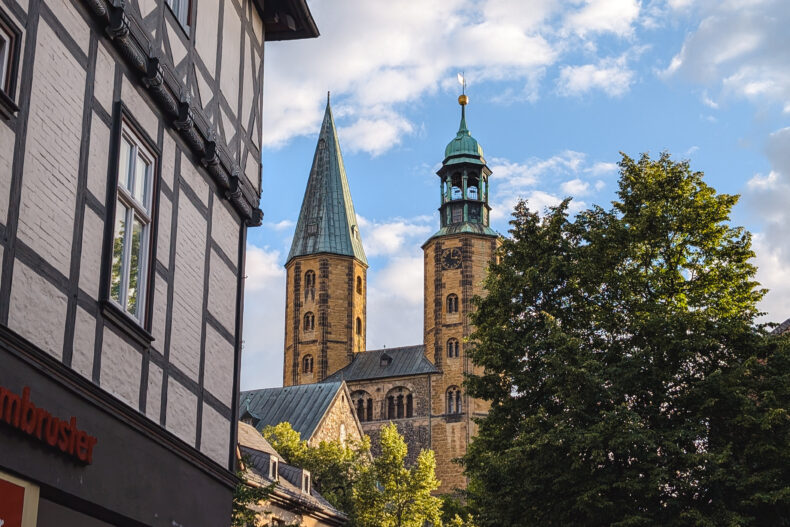
Goslar’s central square is one of the prettiest and most atmospheric places in the city. The Marktplatz is surrounded by some of the old town’s most impressive historic buildings, including the Rathaus, the striking red façade of the Kaiserworth, and several centuries-old merchant houses. It is the kind of square where it is worth slowing down for a while rather than simply walking through. There are beautiful façades on every side, plenty of small architectural details to notice, and a strong sense of just how important this part of Goslar once was.
In the middle of the square stands the Marktbrunnen, a historic fountain topped by a golden eagle. The eagle has long been a symbol of Goslar’s status as an imperial city and is a small reminder of the town’s close connection with kings and emperors. A few times a day, the atmosphere on the square changes as more people begin to gather for the Glockenspiel. At set times, moving figures appear from the façade and tell the story of mining at the Rammelsberg in just a few minutes.
The performance shows how miners once worked inside the mountain and how mining techniques changed over the centuries. You see the story unfold through the moving figures, making it an easy and visual introduction to the industry that shaped Goslar for so long. If you are planning to visit the Rammelsberg mine later, the Glockenspiel is a nice little preview of that history. It helps connect what you see in the old town with the mining world just outside the city.
There is no denying that it is quite touristy. You will probably be standing among plenty of other visitors waiting for the show to begin, and it is clearly one of those attractions that everyone stops to see. Still, we thought it was worth watching at least once. The performance is short, easy to fit into your visit, and adds a playful touch to a much bigger historical story.
The Marktplatz itself is also worth spending some time on, even if you are not there for the Glockenspiel. Between the historic buildings, the fountain, the golden eagle and the lively atmosphere, it is one of the best places to pause and take in the character of Goslar before heading deeper into the Altstadt.
#3 Visit the Kaiserpfalz
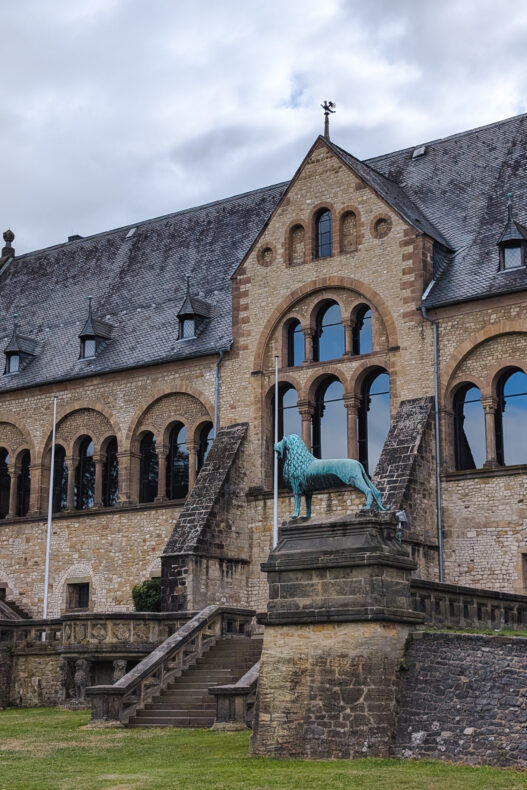
At the edge of Goslar’s Altstadt stands a building that feels almost surprisingly large compared with the small half-timbered houses and cosy streets around it. The Kaiserpfalz, or Imperial Palace, was built in the eleventh century for Emperor Henry III and became one of the most important royal residences in the medieval German Empire. That may sound as if the emperor lived here permanently, but that was not how things worked at the time. German kings and emperors did not rule from one fixed capital. Instead, they travelled through the empire with their court, moving from one royal residence to another.
Goslar became an especially important stop on that route because of the enormous wealth coming from the nearby Rammelsberg mines. The city had money, influence and strategic importance, so emperors returned here regularly and held major imperial assemblies in the palace. It is definitely worth going inside if you have the time. Unfortunately, we ran out of time during our own visit, which is something we would do differently next time. I would especially have loved to see the impressive Kaisersaal, or Imperial Hall.
The walls of the Kaisersaal are almost completely covered with large nineteenth-century paintings showing emperors, battles and key moments from German history. The paintings are not original medieval decorations, but that does not make the room any less impressive. From the photos alone, it looks grand, dramatic and completely different from the small-scale charm of the old town outside. The Kaiserpfalz is also a good place to understand just how important Goslar once was. After walking through narrow lanes and admiring merchant houses, this huge palace suddenly gives you a much clearer sense of the city’s political role during the Middle Ages.
Outside, you will also find the burial chapel connected to Emperor Henry III. His body was buried elsewhere after his death, but his heart was brought back to Goslar and is buried here. It is a small but memorable detail that says a lot about the emperor’s connection with the city. Even centuries later, the Kaiserpfalz still feels like one of the clearest reminders that Goslar was once far more than a wealthy mining town: it was also a place at the heart of imperial power.

#4 Stay Overnight in a Half-Timbered House from 1573
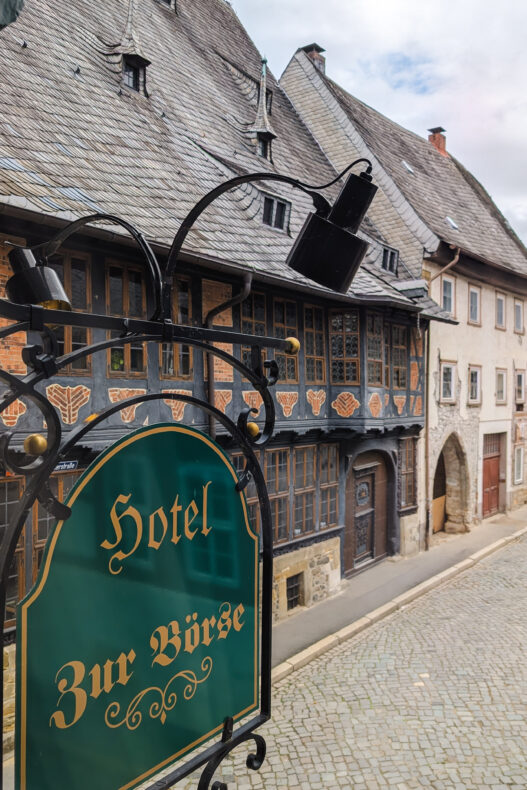
In Goslar, you do not have to admire all those beautiful half-timbered houses only from the outside. You can actually stay in one yourself. We spent the night at Hotel Zur Börse, right in the heart of the Altstadt, inside a beautiful historic building dating back to 1573. The house was originally built for the bell founder Magnus Karsten, and its age is still easy to see from the street. The façade is full of historic details, so it is worth stopping for a proper look before you even step inside. Pay attention to the carved wood, the golden inscriptions and the old family coat of arms, all of which give the building plenty of character.
Inside, it has of course been converted into a hotel and offers the comfort you would expect today, but the history of the house has not disappeared. Slightly crooked walls, uneven lines and small original details still give you a sense of just how old the building really is. That is part of what made staying here so enjoyable for us. After spending the day walking through streets lined with centuries-old houses, it felt special to return to one in the evening and have it as our own base for the night.
The location is also hard to beat. As soon as you step outside, you are right in the middle of Goslar’s historic streets, with the Marktplatz only a few minutes away on foot. That makes it very easy to explore the old town early in the morning or later in the evening, when the streets are often quieter and the atmosphere feels even more charming. You also do not have to walk far to find another important historic house. Almost next door stands the Siemenshaus, built in 1693. This photogenic half-timbered building is the ancestral home of the famous Siemens family and is another lovely façade to stop and admire while exploring this part of the Altstadt.
For us, staying at Hotel Zur Börse added something extra to the trip. We had already spent hours looking at half-timbered houses, noticing their carved details and learning about the people who once lived in them. Being able to spend the night inside one made that history feel a little more real. Instead of only walking through Goslar’s past during the day, we got to sleep right in the middle of it. And for a town where historic houses are such an important part of the experience, that felt like the perfect place to stay.

#5 Go Underground at the Rammelsberg Mine
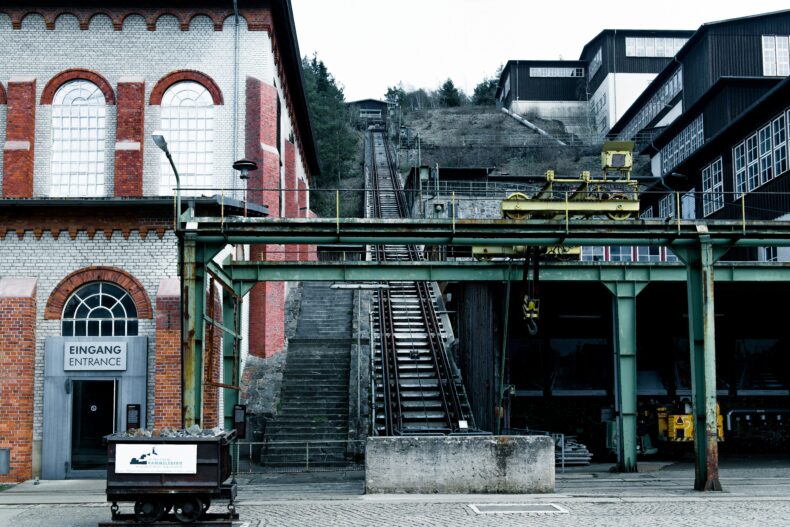
Almost everything you see in Goslar can be traced back to one place: the Rammelsberg. For more than a thousand years, miners worked inside this mountain in search of silver, copper, lead and other valuable ores. Mining finally came to an end in 1988, after shaping not only Goslar itself, but the entire surrounding region for centuries.
Today, the former mine is part of the UNESCO World Heritage Site Rammelsberg and is one of the most important places to visit if you want to understand the city’s history. There is a museum where you can learn about the development of mining over the centuries, but the most memorable experience is, of course, going underground yourself. Several guided tours take you through old tunnels and former working areas inside the mountain. Along the way, you can see historic machinery, mining equipment and technical installations, while learning how miners once worked deep below the surface.
Being underground gives you a much better sense of how hard and physical the work must have been. The narrow spaces, the darkness and the heavy equipment make it much easier to imagine what daily life was like here, especially in the centuries before modern technology made mining safer and more efficient. A visit to the Rammelsberg also changes the way you look at Goslar itself. The grand merchant houses, impressive churches, richly decorated façades and huge Kaiserpfalz did not appear by chance. Much of that wealth was built on the valuable resources taken from this mountain.
Once you have seen where that prosperity came from, the connection between the mine and the old town becomes much clearer. The Rammelsberg is not just another attraction outside the centre; it is the reason Goslar became the wealthy and powerful city you see today. If you only have a limited amount of time in Goslar, we would still put the Rammelsberg high on your list. It adds essential context to the rest of the city and makes the history you see above ground much easier to understand.
Without the Rammelsberg, Goslar would never have developed into such an important imperial city. Visiting the mine gives you the chance to experience the source of that wealth for yourself, rather than only seeing the beautiful results of it in the Altstadt. For us, that connection between what lies underground and what you see in the historic centre is exactly what makes the Rammelsberg such an important part of a visit to Goslar.
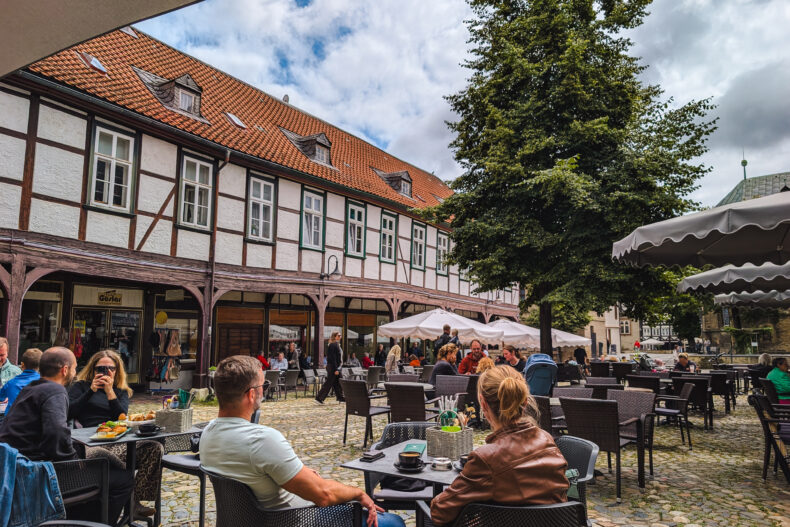
#6 Have Lunch on the Charming Schuhhof
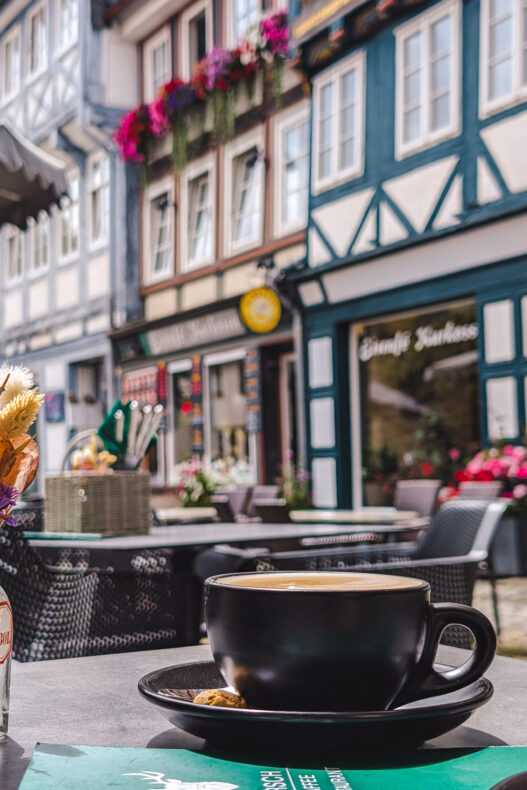
Just behind the Marktplatz, you will find the Schuhhof, a small historic square surrounded by beautiful half-timbered houses. We thought this was one of the most charming corners of Goslar, especially when the terraces are set up outside and the square feels lively but still relaxed. It is the kind of place that invites you to slow down for a while. After walking through the old town and taking in all the historic buildings, the Schuhhof is a lovely spot to sit, have something to eat and simply enjoy the atmosphere around you.
A great place to stop is Hirsch Kaffee. The menu feels surprisingly fresh and modern compared with the traditional German setting around it, with a nice selection of lunch dishes, good coffee and cakes. The café itself is stylish too, with a bright and contemporary interior that creates a fun contrast with the centuries-old façades outside. It feels modern without taking away from the historic atmosphere of the square.
Still, if the weather is even slightly on your side, we would definitely choose a table on the terrace. Sitting outside means you are right in the middle of the Schuhhof, surrounded by half-timbered houses and all the character of the old town. For us, that setting made the stop especially enjoyable. You are not just having lunch somewhere convenient; you are sitting in one of the prettiest little squares in Goslar, with historic buildings all around you and plenty to watch as people pass by.
The combination of a modern café and such an old setting works really well. It is a nice reminder that Goslar is not only about history and sightseeing, but also about taking the time to enjoy the city as it is today. For us, lunch at the Schuhhof was exactly that kind of travel moment: good food, a beautiful setting and a chance to slow down between all the sights.

#7 Look for Goslar’s Typical Slate-Covered Façades
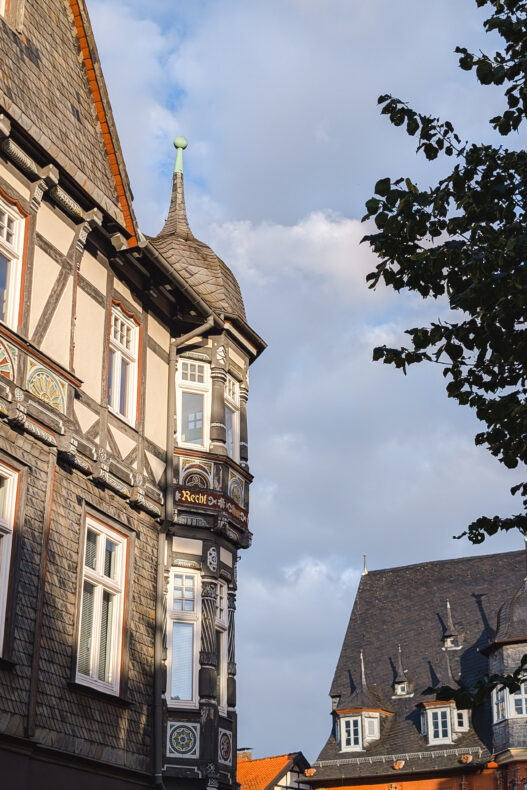
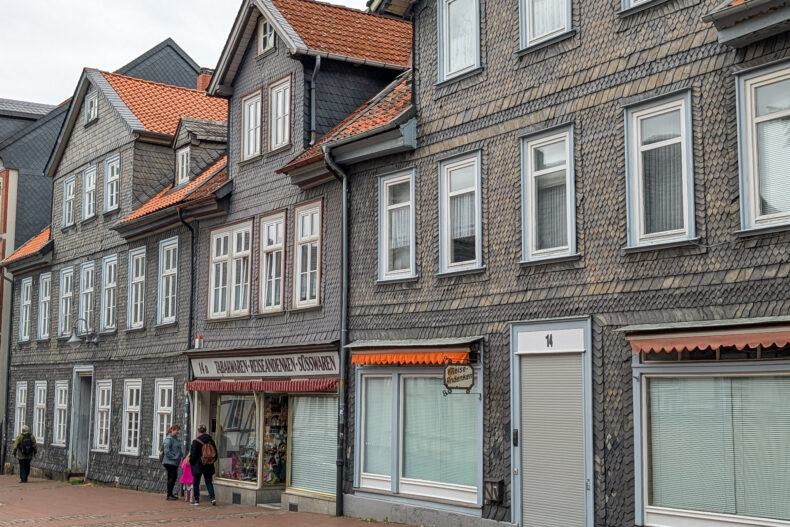
Among all the half-timbered houses in Goslar, there is another architectural detail that quickly catches your eye: the many façades covered almost entirely in dark slate. Some are arranged in neat, straight rows, while others use the stone in much more decorative ways, with curved shapes, scale-like patterns and small ornamental details. Slate was widely available in the Harz Mountains, so it made sense to use it as a local building material. It was also very practical. The stone helped protect houses from rain, wind and snow, which was especially useful in this mountain region.
That is why slate was used not only on rooftops, but also across complete façades. The result gives Goslar a very different look from other historic towns in the area. Compared with the colourful half-timbered houses of Celle, for example, Goslar feels darker, more rugged and a little more dramatic. That darker look also fits the surrounding landscape surprisingly well. With the Harz Mountains nearby and the city’s long mining history, the slate-covered houses feel very much part of Goslar’s character rather than simply a decorative choice.
As you walk through the old town, make sure to look closely at the details. Some façades use different shapes and shades of slate to create complete patterns, decorative borders and even small figures. Once you start paying attention, it becomes clear that slate was used for much more than weather protection. Homeowners also used it to give their houses personality and make them stand out from their neighbours.
That is one of the things we liked most about these façades. A material that started out as something practical became part of the city’s visual identity, and in some cases almost turned into a form of decoration in its own right. After a while, you start noticing slate everywhere in Goslar, and it becomes one of those small architectural details that helps the city feel different from other historic German towns.
For us, the slate-covered façades added another layer to the old town experience. Between the timber frames, carved details and dark stone patterns, there is always something new to notice if you remember to look up.
#8 Follow the Abzucht Through the City
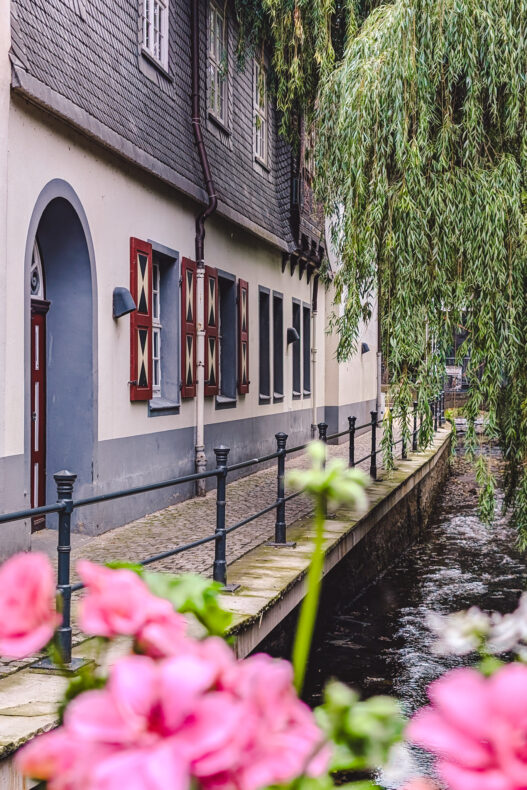
The Abzucht runs right through Goslar’s historic centre, winding quietly between old houses, narrow streets and small bridges. Following the river for a while is an easy way to discover a calmer side of the Altstadt and makes for a lovely little walking route through the city.
As you walk along the water, you will pass half-timbered houses standing close to the river, charming bridges and pretty views along the banks. It feels noticeably quieter here than around the Marktplatz and the busier parts of the old town, which makes it a nice place to slow down for a while. The Abzucht was also much more important in the past than its peaceful appearance might suggest. The water comes down from the Rammelsberg and played an important role in both mining and local crafts for centuries.
Watermills were powered by the river, and the water was also used during the processing of ore. In that sense, the Abzucht was closely connected to the industry that brought so much wealth to Goslar and helped the city grow into the important place it became. Not far from the historic centre, you can still find one of these old watermills today. Seeing it makes it easier to picture how useful the river once was and how closely everyday life in Goslar was linked to the water flowing through the city.
We really liked this mix of scenery and history. One moment you are walking through a centuries-old town beside gently flowing water, and the next you catch a glimpse of the green hills of the Harz in the distance. That combination gives this part of Goslar a very relaxed atmosphere. It feels quite different from the grand squares, churches and imperial buildings elsewhere in the city, and that contrast is exactly what makes the walk so enjoyable.
For us, following the Abzucht was one of the nicest ways to see a quieter and more peaceful side of Goslar, while still staying right in the middle of the historic town.

#9 Head Into the Harz Mountains
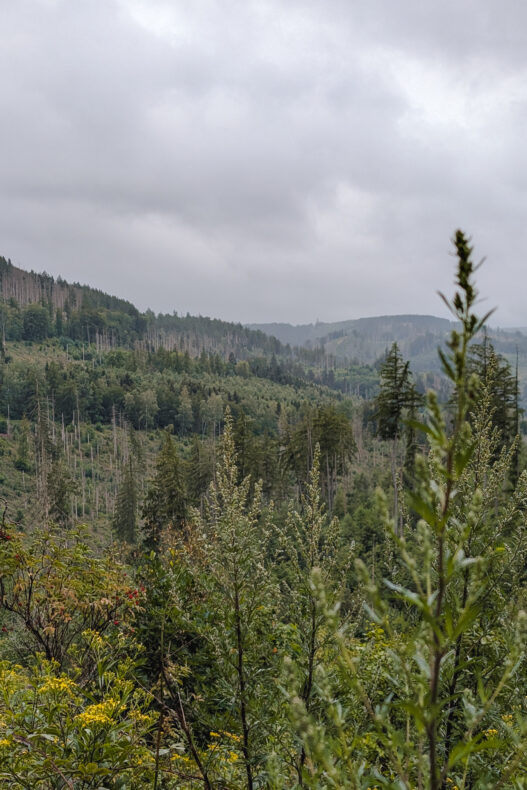
One of the best things about Goslar is just how close the Harz Mountains are to the Altstadt. You can leave the historic centre on foot, walk towards the hills and, before long, find yourself surrounded by trees with views back towards the city. That easy connection between town and nature is one of the things that makes Goslar such an enjoyable place to visit. You can spend the morning exploring medieval streets and historic buildings, then head into the hills in the afternoon without needing to travel far.
We walked towards Steinberg Alm and Maltermeister Turm, both of which sit above Goslar and make good destinations for a hike from the city. The route takes you away from the old town and gradually into a greener, quieter landscape. At Steinberg Alm, you can stop for something to eat or drink and take a proper break before continuing. It is a nice place to sit down for a while, especially if you have already spent several hours walking through the city.
Maltermeister Turm, meanwhile, is known for its views over Goslar and the surrounding hills. Unfortunately, the weather was not really on our side that day. We had plenty of rain, so the panorama was much less impressive than it would be in clear weather. Still, we enjoyed the walk itself and the chance to see a completely different side of Goslar. Even with grey skies, it felt good to leave the streets behind for a while and spend some time in the green hills.
If you have more time, Goslar also works very well as a base for exploring more of the Harz Mountains. This low mountain range is known for its dense forests, hiking trails, reservoirs, old mining towns and beautiful natural scenery. One of the most famous places in the region is the Brocken. At 1,141 metres, it is the highest mountain in northern Germany and one of the best-known destinations in the Harz.
If you have your own car or a rental car, you will have the most freedom to explore the wider region. From Goslar, it is easy to plan a full day in the Harz, combine several places and stop at viewpoints or smaller towns along the way. A car is especially useful if you want to reach more remote hiking areas or visit several different parts of the mountains in one day. It gives you much more flexibility than relying only on public transport. Even without a car, though, there is plenty of nature within easy reach of Goslar itself. You do not need to plan a long or difficult hike to experience the Harz.
Even if you only have one day in the city, we would still try to walk at least a short distance into the hills. The change in scenery happens surprisingly quickly, and that contrast is part of what makes Goslar feel so special. One moment you are surrounded by centuries-old half-timbered houses and medieval streets, and not long after, you are walking among trees with the green Harz stretching out around you.
For us, that easy transition from historic city to nature was one of the highlights of Goslar. The Harz is not just a day trip from the city. It feels like a natural extension of it, and it is literally within walking distance from the Altstadt.

#10 Try the Local Gose Beer
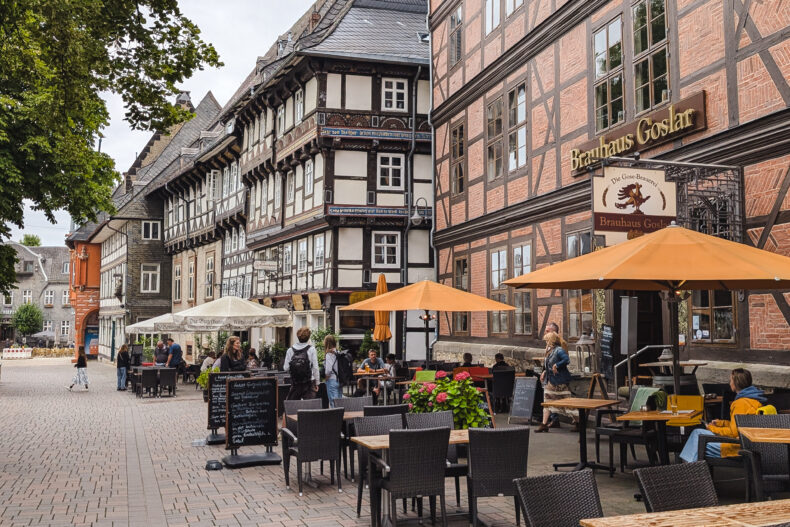
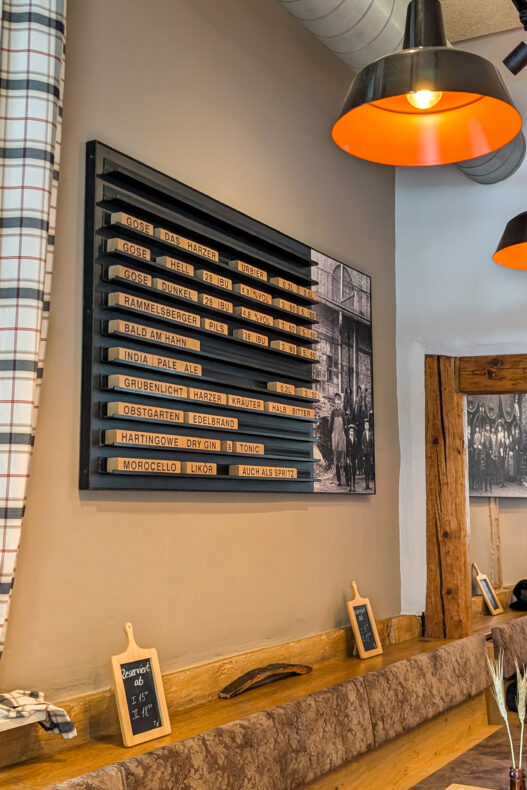
After all that walking, we felt we had definitely earned a local beer. If you want to try something that is truly connected to Goslar, head to Brauhaus Goslar on the Marktplatz and order a glass of Gose, a historic beer style that has its roots right here in the city. Even the name tells part of the story. Gose takes its name from the River Gose, which rises near Goslar. The beer was already being brewed here in the Middle Ages and later became especially popular in Leipzig, where the style developed a strong reputation of its own.
Gose is quite different from the standard German lager you may expect. Traditionally, it is a light wheat beer with a slightly sour taste, a subtle salty note and a hint of coriander. That mix gives it a fresh and unusual flavour that immediately sets it apart from more familiar German beer styles. At Brauhaus Goslar, the local Gose is once again brewed in the city where the style originally began. Of course, we had to try it ourselves, and we decided to turn it into dinner as well.
That made it a very easy and enjoyable way to end the day. After hours of walking through the Altstadt, learning about mining history and exploring the hills around Goslar, sitting down on the Marktplatz with a local beer felt exactly right. What we liked most was the connection to the city itself. This is not just a random beer you can find anywhere in Germany. It has a story that goes back centuries and is closely tied to Goslar’s own history.
Even if you are not a big beer drinker, we still think Gose is worth trying at least once while you are here. The flavour is different, the history is interesting and it gives you one more small way to experience the city beyond its buildings and museums. For us, a glass of Gose at the end of the day was the perfect final stop: local, relaxed and full of character, just like Goslar itself.

We made this trip at the invitation of ‘9 Cities + 2 in Lower Saxony’, a partnership between some of the most interesting and enjoyable cities in the region. Feeling inspired to plan your own trip through Lower Saxony? You can find plenty of ideas, practical inspiration and suggestions for places to visit at 9staedte.de.


