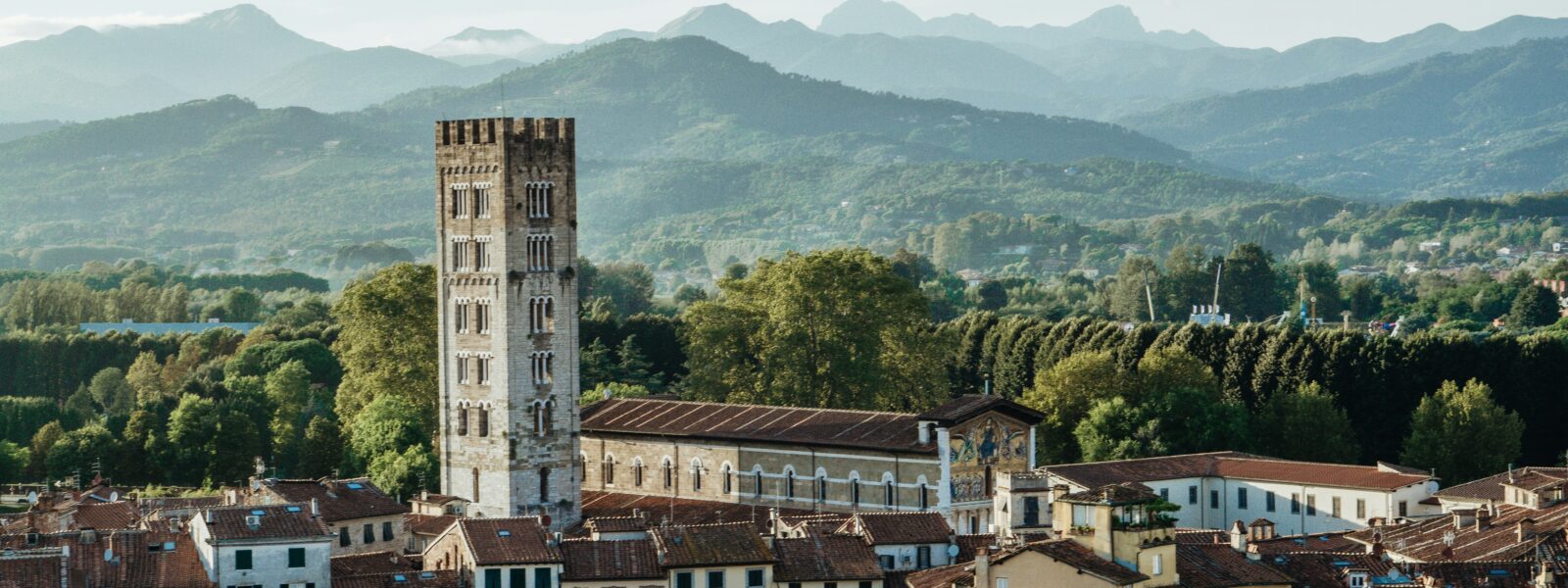
Are you looking for a charming Tuscan town where you can escape the crowds but still enjoy medieval charm, cozy streets, and centuries-old squares? Then Lucca is the perfect choice. This compact city, less than half an hour from Pisa, feels like a well-kept secret. Inside its impressive city walls, you will find a maze of churches, towers, elegant townhouses, and hidden gems, all conveniently within walking distance of one another.
Unlike many other Tuscan towns, Lucca is not packed with iconic landmarks that you feel you must tick off your list, yet there is still plenty to see and do. For us, visiting Lucca is above all about soaking up the typical Italian atmosphere, the gentle pace of the city, and the mix of culture, history, and delicious local food. While Lucca is certainly a Tuscan gem and does attract tourists, you can enjoy a more authentic glimpse of local life here than in famous hotspots like Pisa or Florence.
In this blog, we will take you through Lucca’s most beautiful sights. From towers with trees growing on their rooftops to quiet churches, elegant palaces, and panoramic city walks, these are the places you will not want to miss during your visit to Lucca.
Where is Lucca located in Italy?
Lucca is situated in the northwest of Tuscany, tucked between the mountains and the coast. The city rests in a wide valley along the Serchio River, only about twenty kilometers from the sea. This makes it not just beautiful, but also a perfectly convenient base. From Lucca, you can reach the famous city of Pisa in under half an hour, and by train or car, you can be in the heart of Florence in just over an hour. It is an ideal spot for exploring Tuscany without having to move to a new town every night.
There is plenty to see and do in the surrounding area. To the west lies Pisa, of course famous for its Leaning Tower, but also delightful for its lively squares and vibrant student atmosphere. To the east is Florence, the artistic and cultural heart of the region. If you prefer nature, the Garfagnana is a wonderful choice, a mountainous area filled with castles, forests, and quiet villages. And for a day by the sea, both Viareggio and Forte dei Marmi are easily reachable from Lucca. This way, you can enjoy a perfect mix of culture, nature, and the coast without having to travel far.
What is Lucca known for?
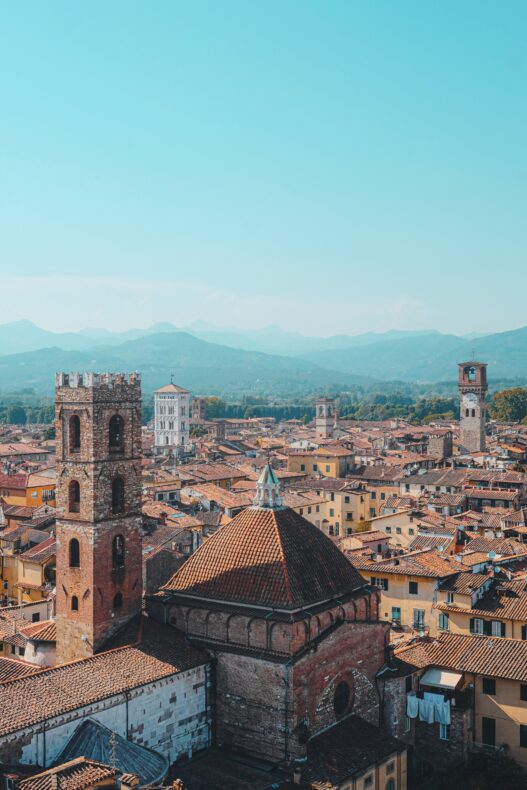
Lucca has something truly rare: a perfectly preserved medieval center, completely surrounded by thick city walls that you can walk or cycle along. The city is also known for its winding streets, dozens of churches, a skyline dotted with towers, the classical music of Giacomo Puccini, and a rich, hearty local cuisine. There is no rush, no crowds of tourists, just a more authentic and relaxed experience.
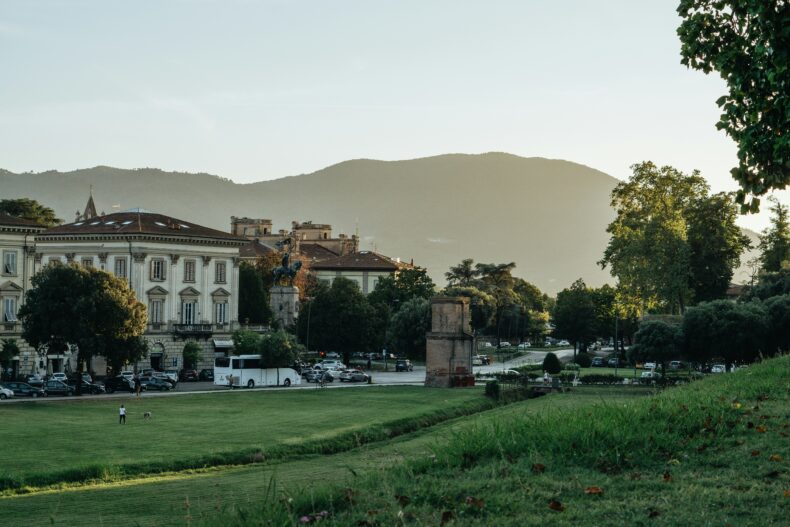
The city walls are perhaps the most impressive feature. They stretch for four kilometers, lined with bastions, trees, and lookout points. While other cities chose to tear down their walls, Lucca preserved them and transformed them into a park. Today, they are pleasant paths for walking and cycling, where you can explore the city from above, shaded by leafy trees. And the best part is that they completely encircle the historic center, making the heart of Lucca feel like a world of its own, a unique cocoon full of history.
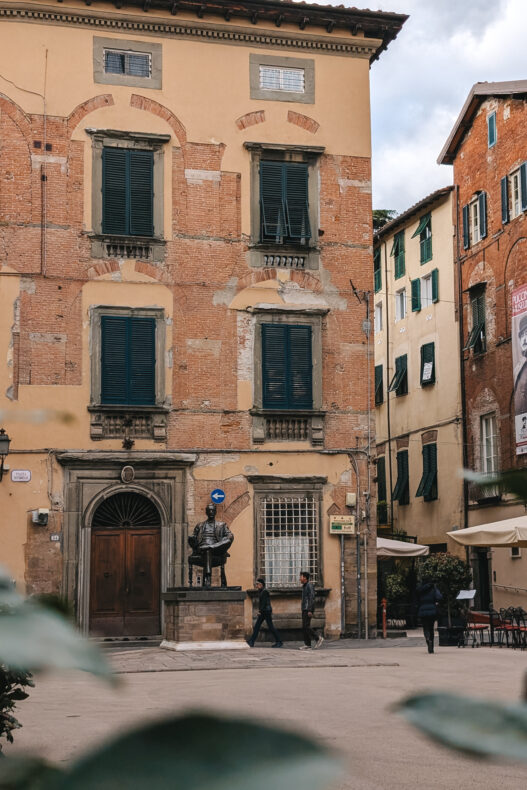
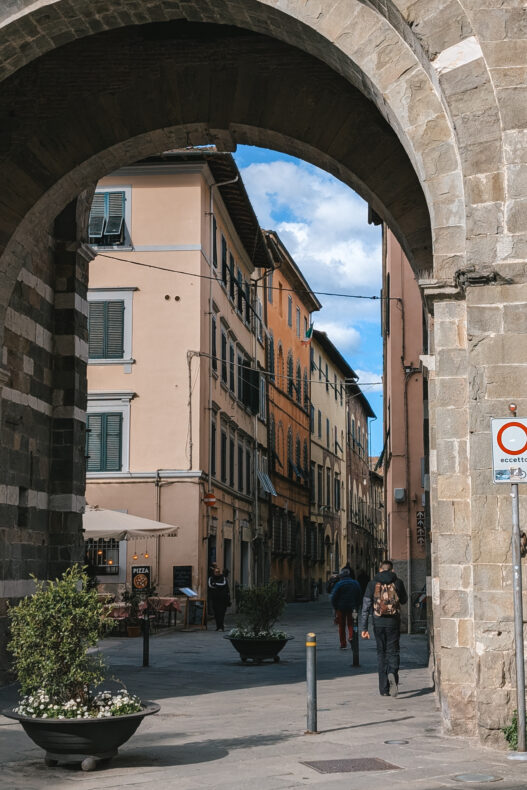
Inside these walls, it feels as if time has stood still. The historic center is a perfectly preserved medieval town. Its streets follow a grid that dates back to Roman times, neat and orderly. What stands out most is how compact and easy to navigate the city is. There are no steep hills or long flights of stairs, just a flat town where you can stroll peacefully between small squares, local shops, and colorful houses. Everything feels charming, just like the scenes you see in Italian films.
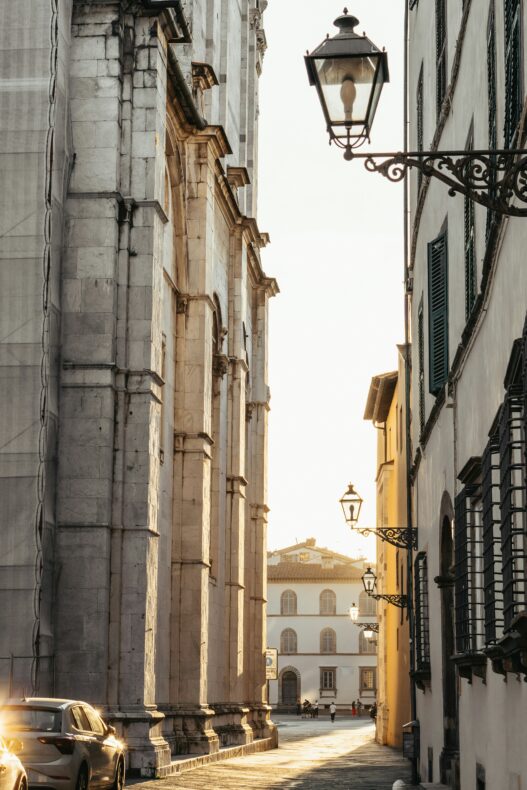
What makes Lucca truly special is its remarkable number of churches. It is no surprise that Italians call it the “city of a hundred churches.” Almost every street corner has one. Some are open to visitors, others remain closed, and a few have been transformed into exhibition spaces or concert halls. Yet all of them reflect a long and deeply rooted religious tradition that is visible everywhere: in the architecture, in the artwork, and throughout the streets themselves.
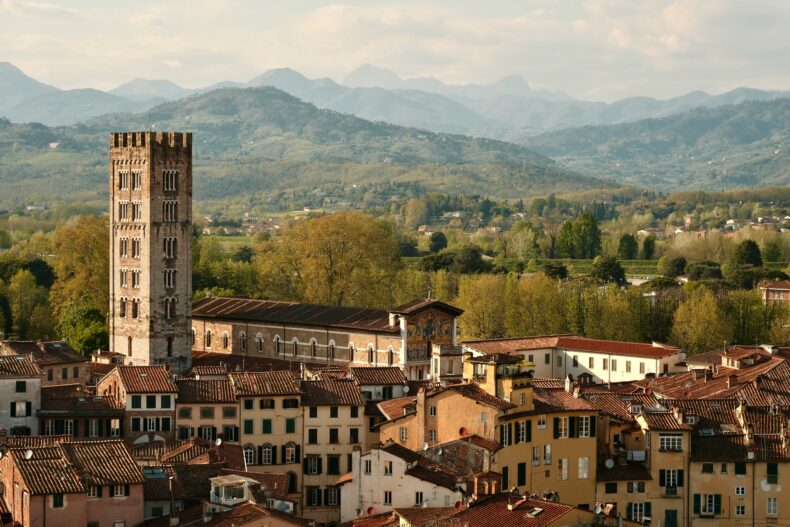
Equally striking are the medieval towers. In the Middle Ages, wealthy families in Lucca built their own residential towers, the taller the better. Not to impress visitors, but to show other families who held the power. Most of these towers have vanished over time, but a few remain instantly recognizable. The Torre Guinigi, with its trees growing on the rooftop, is perhaps the most famous example. The Torre delle Ore, with a clock still wound by hand, is another iconic symbol of the city.
Lucca is also the birthplace of Giacomo Puccini. The world-famous composer was born and raised here before taking the great opera houses by storm. His name is celebrated everywhere, from museums to concerts. In the summer, it is often possible to attend a performance, usually in small churches or charming inner courtyards, adding a magical touch to the experience.
And of course, there is the local cuisine. As you would expect in Tuscany, everything here focuses on simple, pure ingredients. Yet Lucca has its own beloved classics. Tordelli lucchesi, for example, are pasta pockets filled with meat and served with a rich sauce. Or try buccellato, a sweet bread flavored with anise, which often fills the streets with its delightful aroma as you pass by a bakery.
Tourist Map of Lucca
[googlemaps https://www.google.com/maps/d/u/1/embed?mid=1c6BMGsfRRKuaQnxyyyvv0a_yswzWos4&ehbc=2E312F&w=790&h=480]Top Things to Do in Lucca
#1 Torre Guinigi
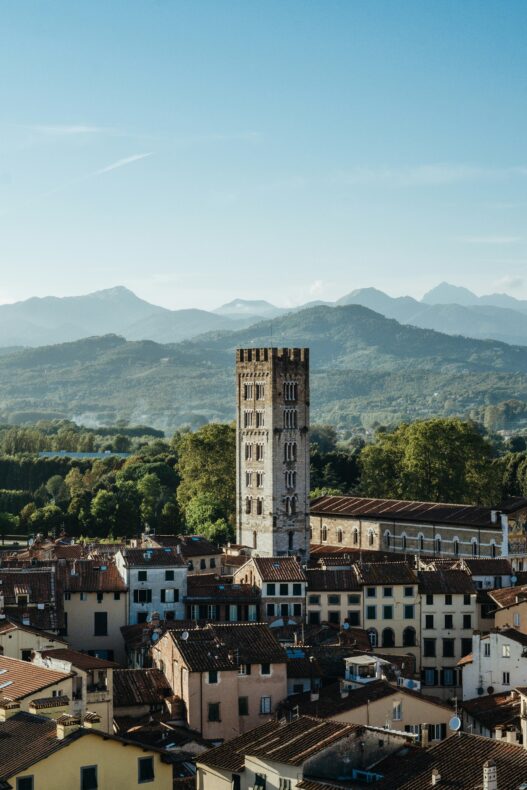
Lucca is dotted with medieval towers, but the Torre Guinigi stands out as the most famous. What makes this remarkable tower truly unique is the small grove of oak trees growing on its roof. It was built in the fourteenth century by the powerful Guinigi family, wealthy silk merchants who wanted to display their status. In those days, the rule was simple: the taller your tower, the more important you were. This tower rises forty meters high, standing proudly above most of Lucca’s rooftops.
Since the fifteenth century, Holm oaks have crowned the tower, symbolizing strength and renewal. To reach the top, you must climb more than two hundred steps, but the effort is more than worth it. From above, you are treated to a breathtaking view of the entire city and the rolling hills that surround it. The tower is made of brick, simple in style, yet solid and impressive. Tickets cost just a few euros and can usually be purchased right at the entrance.
#2 Duomo di San Martino (Cathedral of Lucca)
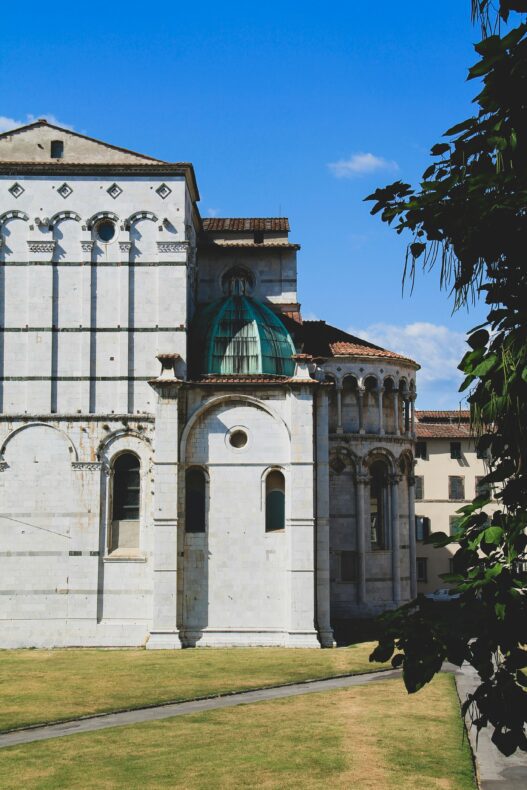
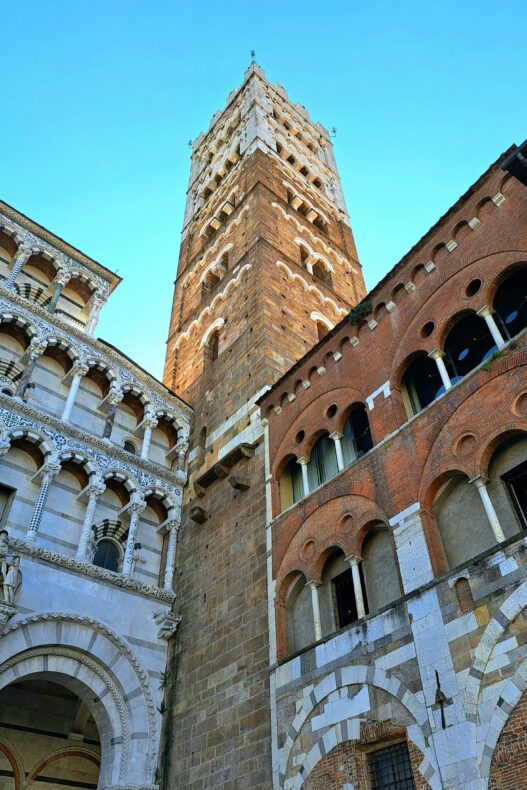
The Duomo di San Martino sits just off the busiest streets of Lucca’s city center, opening onto a spacious and charming square. The church was built in 1060 at the initiative of Bishop Anselmo, who later became Pope Alexander II. Its façade is striking: white marble, richly decorated, with three layers of arches rising above one another. A delightful detail is that, because the tower was already in place, the main entrance on the right side is slightly narrower.
Inside, visitors are drawn to the Volto Santo, a wooden crucifix that, according to tradition, was carved by Nicodemus himself. For centuries, this sacred figure has been the religious heart of Lucca and is celebrated each year on September 14th during a grand procession. In a side chapel, you can admire the tomb of Ilaria del Carretto, a young noblewoman who died prematurely, exquisitely sculpted by Jacopo della Quercia in 1406. The cathedral also features works by renowned Italian artists, including Tintoretto. The church is open daily to visitors, and admission requires a ticket.
#3 City Walls of Lucca
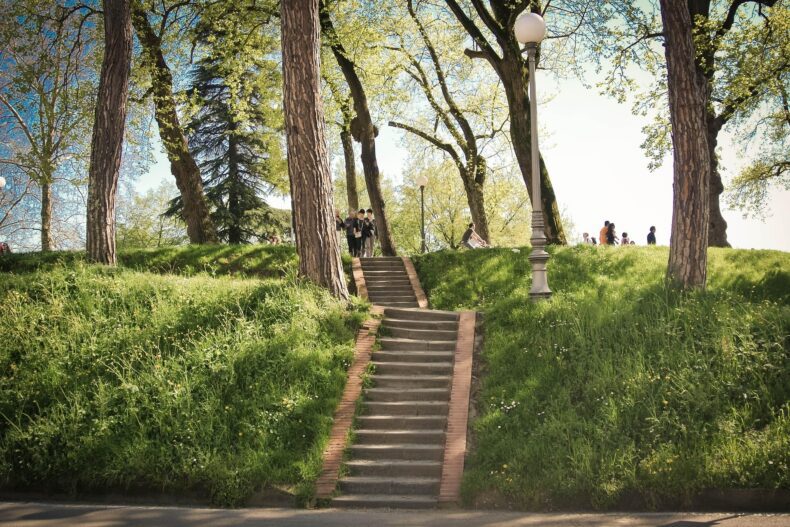
A visit to Lucca almost always begins or ends with a walk or bike ride along the city walls. This four-kilometer ring encircling the historic center was built in the sixteenth and seventeenth centuries, featuring thick ramparts and eleven bastions. They were designed to protect the city from attacks, particularly from powerful Florence, but they were never actually put to the test. As a result, they have remained completely intact.
In the nineteenth century, a decision was made not to demolish the walls but to open them as a public park. Today, a wide path runs along the top, lined with trees and grass, offering views of both the historic center and the surrounding neighborhoods. You can see locals walking their dogs, children cycling, and people enjoying picnics on the bastions. There are multiple access points, with stairs or ramps, and entry is completely free. Bikes, or more commonly four-person rental pedal carts for tourists, can be hired at spots such as Porta San Pietro or Porta Santa Maria. It is a delightful way to see Lucca from above while enjoying a leisurely walk at the same time.
#4 Piazza dell’Anfiteatro
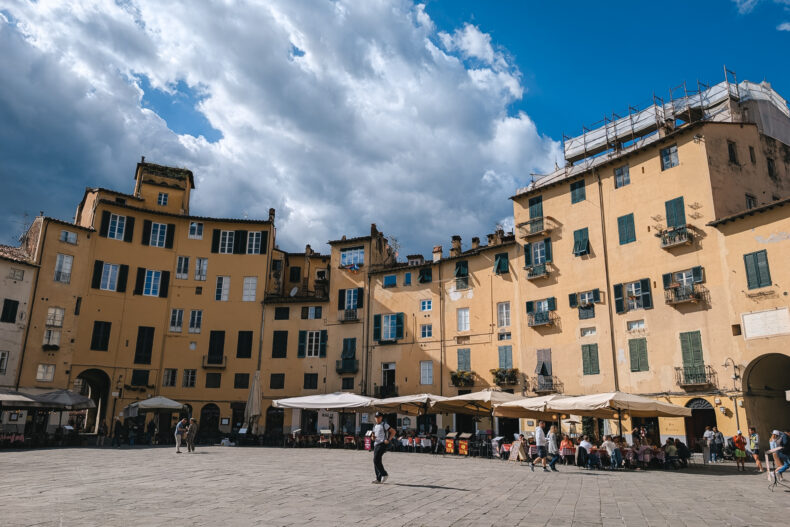
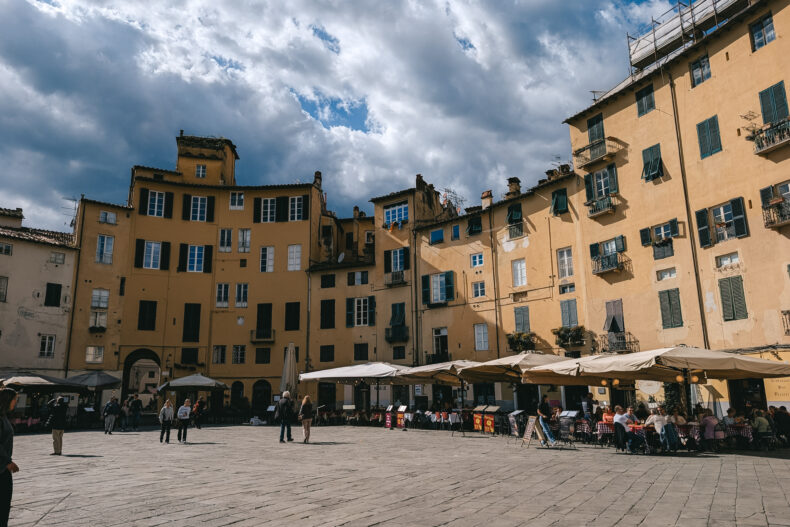
You might not notice it at first, but the moment you step onto Piazza dell’Anfiteatro, you are literally walking on centuries of history. The oval shape of this square gives it away: it once stood as a Roman amphitheater dating back to the second century AD. Back then, around 10,000 spectators would gather here to watch gladiator fights and other spectacles. The construction was financed by the powerful Roman senator Quintus Vibius Crispus, and the theater remained in use well into late antiquity.
During the Middle Ages, the building fell into disrepair. What remained standing was gradually built over with houses, workshops, and even a prison. It was not until the nineteenth century that the area was restored. Architect Lorenzo Nottolini had much of the later construction removed while carefully preserving the shape of the ancient amphitheater. This gave rise to the square as we see it today, with colorful houses perfectly tracing the contours of the original structure.
Today, it is a lively and welcoming spot, full of terraces and cozy restaurants. You enter the square through four arched gateways, stepping straight into the heart of the activity. Take a moment to notice the arches and wall structures in the façades, as some are original parts of the Roman theater. This is the perfect place to pause, sip a cappuccino, and appreciate the fact that you are literally standing atop two thousand years of history.
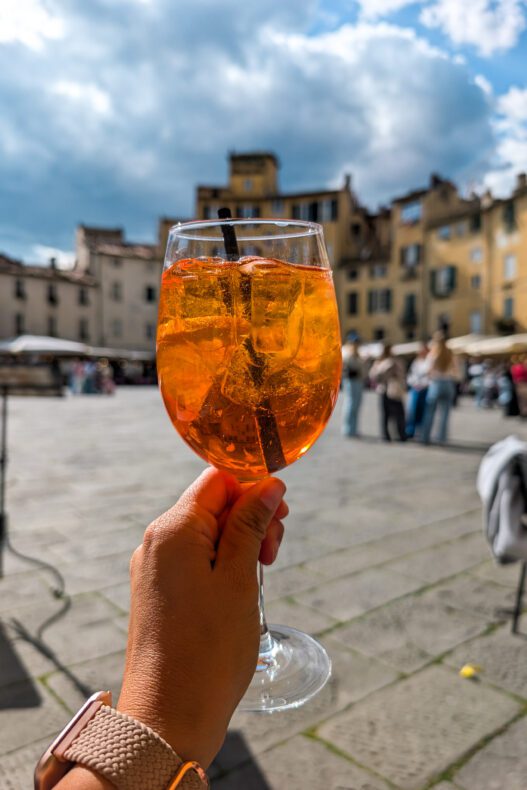
Tip: because the restaurants compete heavily with one another, they all offer tempting deals for visitors, like a pizza margherita for just €5 or an aperol spritz for €3. We certainly took advantage of this, cheers!
#5 San Michele in Foro
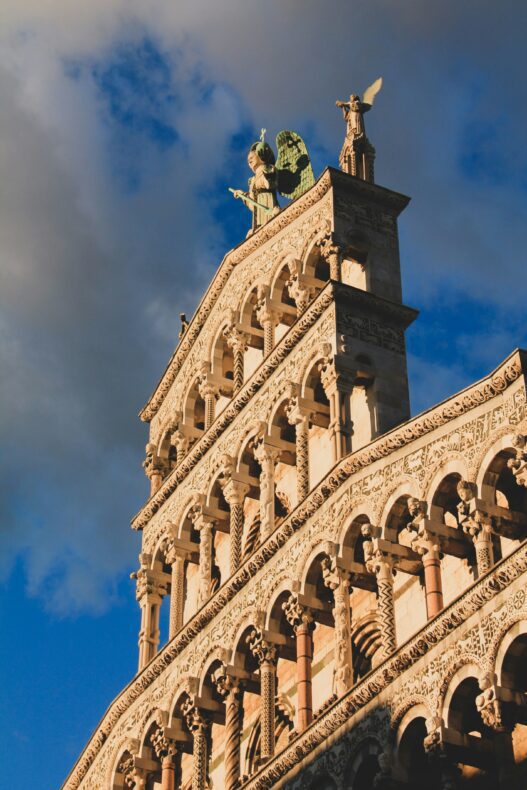
Anyone wandering through the center of Lucca will almost inevitably arrive at Piazza San Michele, the city’s historic Roman market square. At its center stands the striking church of San Michele in Foro. Construction began as early as the eleventh century, led by Bishop Anselmo, who later became Pope Alexander II. The church is dedicated to the archangel Michael, and he is impossible to miss: a four-meter-high statue towers above the façade, wings outstretched and a sword held firmly in hand.
Local legend says a precious diamond is hidden in his breastplate. The façade itself is remarkable, with four tiers of marble arches, delicate columns, and sculpted figures, all showcasing the Pisan-Romanesque style. Each column is carved with a unique pattern or motif, as if the stoneworkers were competing to outshine one another.
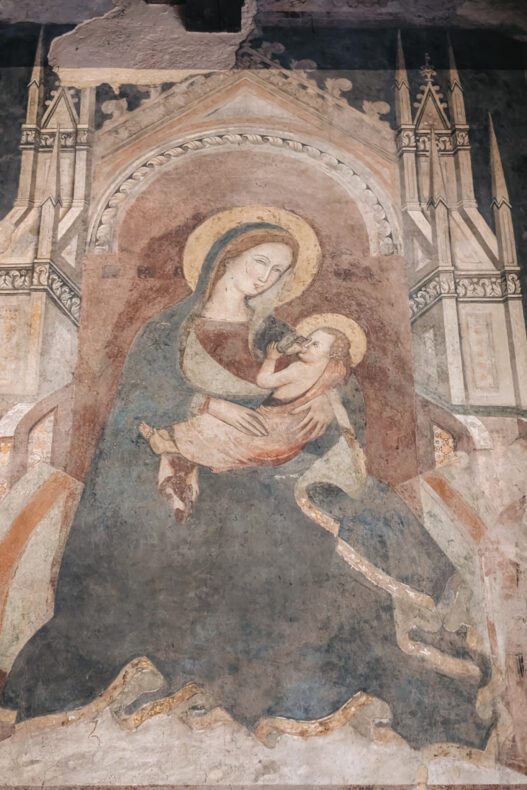
Inside, the atmosphere is simpler, and to our surprise, the interior shows signs of wear, with leaks, mold, and damp spots. The layout follows a classic Romanesque basilica design, with three naves, a cruciform plan, and minimal decoration. Yet there are still a few treasures to discover, such as a ceramic Madonna and Child by Andrea della Robbia and an altarpiece by Filippino Lippi featuring four saints. The church is open daily and free to enter.
#6 Basilica of San Frediano
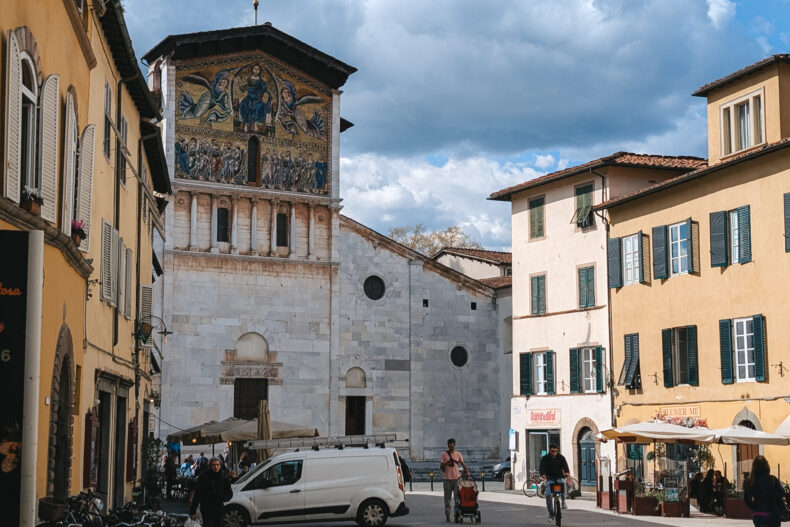
Walking north from Via Fillungo, you will naturally find yourself at the Basilica of San Frediano. This is one of Lucca’s oldest churches, founded in the sixth century by Bishop Frediano, an Irish monk who was later canonized. The first thing that immediately draws your attention is the enormous mosaic on the otherwise simple façade. It depicts the Ascension of Christ and dates back to the thirteenth century. The golden background and vibrant colors make this artwork a true gem in Tuscany.
The church itself is built in a restrained Romanesque style, with a spacious central nave flanked by two side aisles. The columns are topped with modest capitals, some decorated with figures or leaves. One of the highlights is the baptismal chapel, which houses a twelfth-century baptismal font. The reliefs on this font illustrate biblical stories and are surprisingly detailed for their time.
Throughout the interior, you will also encounter frescoes and paintings by local masters, thoughtfully placed across the walls and chapels. The basilica is open to visitors daily, with a small admission fee, and it is well worth a visit to experience a place that preserves Lucca’s rich spiritual and artistic heritage for over a thousand years.
#7 Torre delle Ore (Clock Tower)
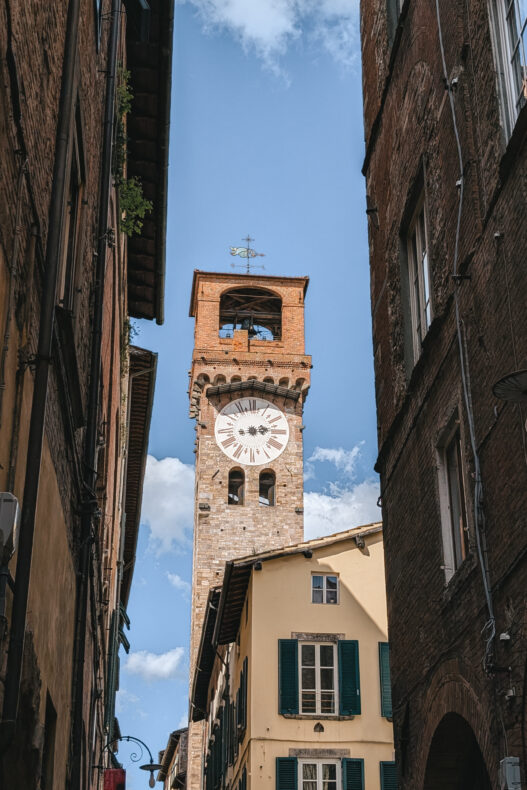
In the heart of Lucca, along the lively Via Fillungo, the Torre delle Ore soars above the city. At fifty meters, it is the tallest tower in Lucca. In the Middle Ages, the city boasted over a hundred similar towers. Wealthy families built them both as symbols of status and for protection, giving them a safe retreat during conflicts. Most of these towers have vanished over time, but the Torre delle Ore remains standing proudly.
The tower was constructed in the thirteenth century and passed through several owners. In 1390, the city decided to place a clock on it. The first clock was crafted by a local goldsmith, while the current mechanism, dating from the eighteenth century, was made by the Swiss clockmaker Louis Simon. Remarkably, it still keeps perfect time and is wound by hand, a rarity among European towers.
Visitors can climb the tower using 207 wooden steps. Along the way, you can look directly into the clock’s inner workings and watch the intricate gears turn. At the top, you are rewarded with breathtaking panoramic views over Lucca: the rooftops, the towers, the city walls, and beyond, the rolling green hills of the surrounding countryside. Tickets cost just a few euros, and you can also opt for a combination ticket that includes this tower, the Torre Guinigi, and the botanical garden.
#8 Casa di Puccini
Any lover of classical music should not miss Casa di Puccini. Nestled on the peaceful Corte San Lorenzo, this house is the birthplace of Giacomo Puccini, one of the most celebrated composers in opera history. Born here in 1858, he grew up surrounded by music before leaving for Milan at a young age to pursue his studies. Today, the house has been carefully transformed into an intimate museum that brings his life and work vividly to life.
Stepping inside, you are transported directly into Puccini’s world. The original Steinway piano on which he composed his final opera, Turandot, takes center stage, surrounded by handwritten scores, letters, family photographs, and furniture from his time. The rooms are arranged to make it feel as though he could walk in at any moment. Costumes from his operas are also on display, including an original piece from the premiere of Turandot in New York in 1926, giving visitors a real sense of the grandeur and artistry of his creations.
#9 Piazza’s van Lucca
Lucca is a city of squares: some bustling and lively, others quiet and tucked away like hidden gems. Each square has its own personality and story to tell. You may already be familiar with Piazza dell’Anfiteatro or Piazza San Michele, but there are many more that are well worth discovering.
Begin at Piazza Napoleone, the largest square in the city. It was laid out in the early nineteenth century by Elisa Bonaparte, Napoleon’s sister, who held power in Lucca at the time. She cleared entire city blocks to make way for this grand project. At one edge stands the Palazzo Ducale, once her residence and now partially used as a government building. In the summer, the square comes alive as an open-air stage for concerts, often featuring performances by well-known musicians and artists.
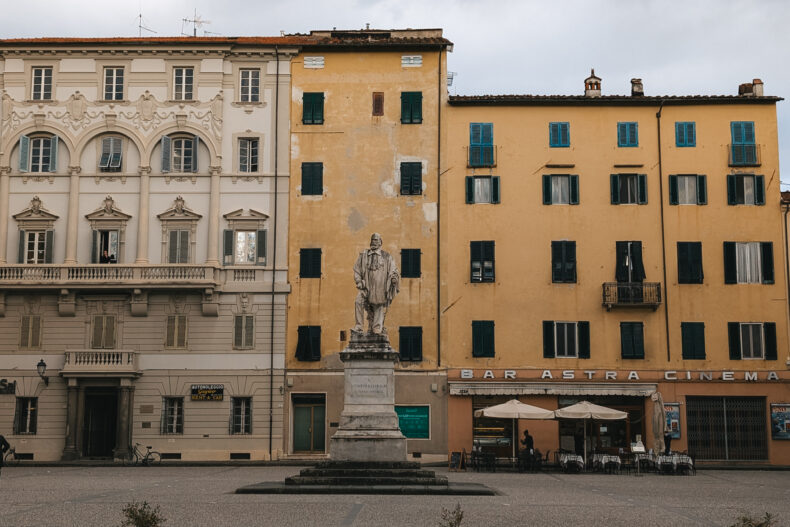
Just as atmospheric, though smaller, is Piazza San Frediano, right in front of the basilica of the same name. Here, you can admire the stunning mosaic on the façade while taking a moment to enjoy an espresso. There are also charming, more intimate squares such as Piazza San Salvatore and Piazza Cittadella, where statues of Puccini stand among historic façades.
#10 Via Fillungo
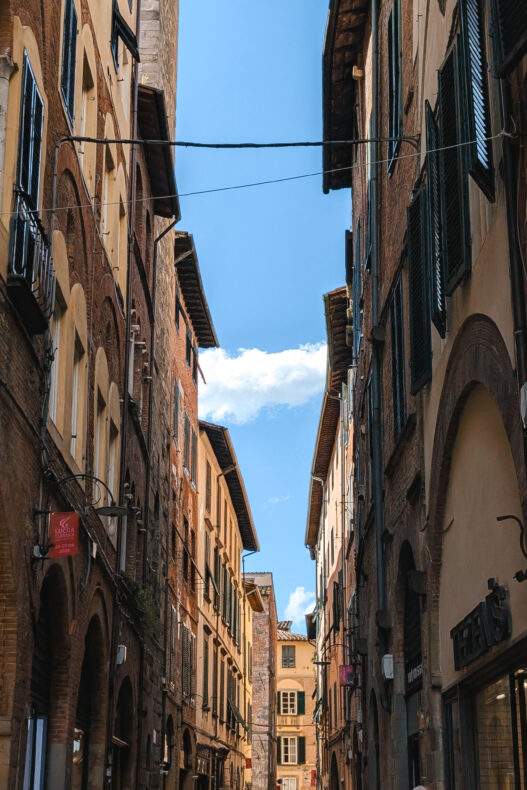
Via Fillungo is the main street of Lucca and the lively heartbeat of daily life in the city. This medieval avenue winds through the center, lined with an inviting mix of shops, cafés, boutiques, and bakeries. You can find everything you need here, from well-known Italian fashion labels to small artisan stores offering local delicacies or handmade jewelry.
At the same time, Via Fillungo is steeped in history. On both sides of the street, medieval and Renaissance buildings catch your eye, often adorned with original details in the masonry or windows. Looking up as you walk is a delight. Some houses proudly display ancient family crests on their façades, while others feature old frescoes or beautifully crafted balconies.
Amid the bustling shops, historical treasures often appear unexpectedly, such as the Torre delle Ore or the church of San Cristoforo, where only the façade survives. With the street closed to traffic, you can stroll at a relaxed pace, enjoying the mix of everyday life, charming architecture, and the layers of history that make Via Fillungo such a special place.
#11 City Palaces of Lucca
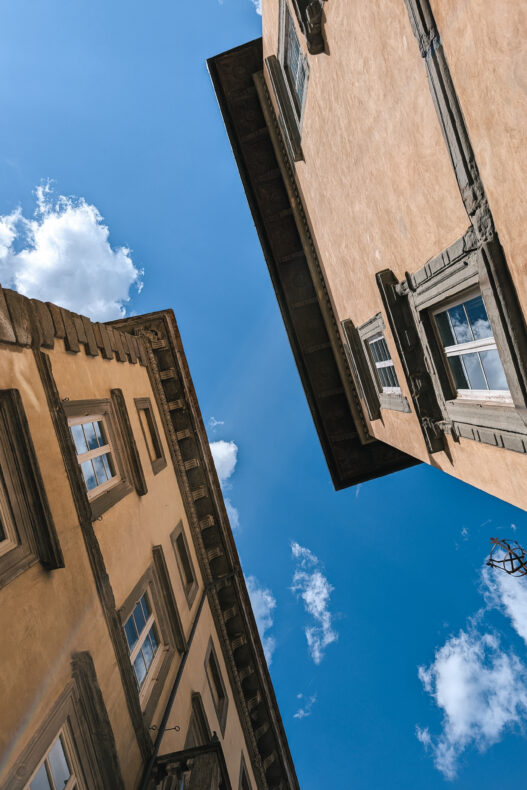
If you take the time to really notice while wandering through Lucca, you soon realize the city has far more to offer than just churches and towers. Scattered throughout the historic center are a number of elegant city palaces, each offering a fascinating glimpse into Lucca’s wealthy and aristocratic past. Among them, two stand out as absolute must-sees: Palazzo Ducale and Palazzo Pfanner.
Palazzo Ducale dominates the expansive Piazza Napoleone and carries a dramatic history. It was once the site of the Fortezza Augusta, the personal fortress of Castruccio Castracani, a military leader who briefly ruled Lucca in the early fourteenth century. Following his death, much of the fortress was dismantled. In the sixteenth century, the building was transformed into its present form by the celebrated architect Bartolomeo Ammannati, who was also well-known in Florence. Today, the palace primarily houses government offices, yet its grand courtyards, elegant arches, and sweeping staircases continue to radiate the magnificence of its past.
A very different charm can be found at Palazzo Pfanner, located on the edge of the historic center. Built in 1660 by the Moriconi family, it later passed into the hands of the Viennese physician Felix Pfanner, who even established a small brewery on the premises, which is rare in Italy. The palace is best known for its stunning baroque garden at the rear. Imagine perfectly symmetrical flowerbeds, statues of mythological figures, and fountains that bubble gently amidst lush greenery. Inside, parts of the palace are open to visitors, revealing antique furniture, old medical instruments, and frescoed walls that offer a vivid sense of life in centuries past.
#12 Other Churches of Lucca
AIf you spend even a little time wandering through Lucca, one thing quickly becomes clear: you can hardly take a step without coming across a church. It is no wonder the city is often called “the city of a hundred churches.” While the cathedral, San Michele in Foro, and San Frediano are the most well-known, there are many other churches that are just as worth discovering.
Take San Cristoforo, for instance, located along the bustling Via Fillungo. From the outside, its sturdy thirteenth-century Romanesque façade immediately catches the eye, with its clean stonework and graceful rounded arches. The church no longer holds regular services, but it has been repurposed as an exhibition space. Step inside when the doors are open, and you might unexpectedly find yourself surrounded by a temporary art exhibition, all set within a historic interior that has stood for centuries.
Another church not to be missed is San Romano, just a short walk from Piazza San Michele. Its exterior may seem modest at first glance, but inside lies a large, austere space that is both striking and serene. Today, it is used for concerts and cultural events, offering a quiet and elegant setting where the beauty of music and art is enhanced by the church’s historic atmosphere.
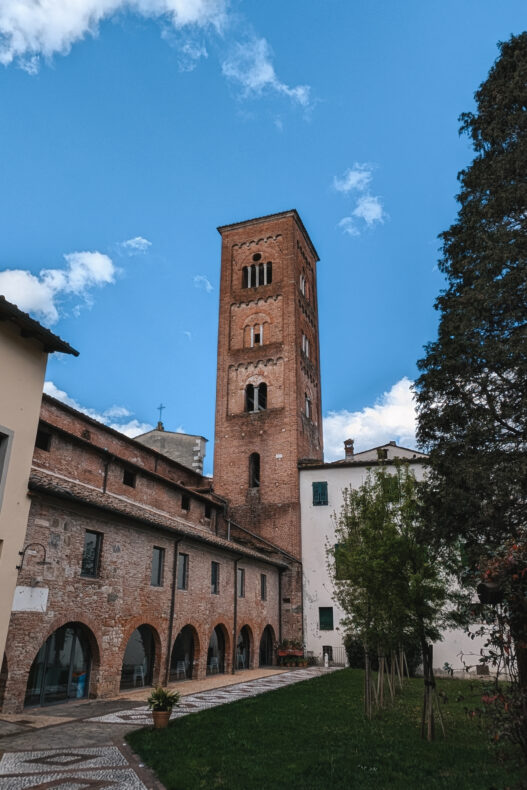
Further to the east is San Francesco, a Gothic church with a tranquil inner courtyard. Inside the adjoining monastery rests the tomb of Paolo Guinigi, an influential ruler of Lucca in the fifteenth century. In recent years, the church has been carefully restored and is now frequently used for university events, lectures, and weddings, creating a space that is both lively and serene at the same time.
Nearby, you will find San Giusto and San Pietro Somaldi, two churches with long and fascinating histories dating back to the eleventh or twelfth centuries. In these buildings, you can clearly observe the shift from Romanesque to early Gothic architecture. Their exteriors are modest and unassuming, yet the interiors reveal unexpected richness, featuring medieval statues, wooden altarpieces, and ancient frescoes that hint at the artistic heritage preserved within.
Many of these churches are conveniently located along the routes you naturally follow while exploring Lucca. Most are free to enter or open during special events. Even if you do not consider yourself religious, these spaces offer a captivating window into the city’s spiritual history and allow you to appreciate the role these sacred places have played over the centuries.


