February back home in the Netherlands: grey, wet and lucky if the sun shows up for an hour. No wonder that by half term all you want is somewhere you can leave your coat at home. The good news? You don’t have to go far. Within three to five hours of take-off you can be sitting on a terrace in Seville, walking barefoot on a Canarian beach or getting lost in the souks of Marrakech.
We’ve been heading south in winter and early spring for years, usually with the kids and our camper. Four months around the Canary Islands, a month in Sardinia in March, long stretches in Andalusia and two winter months in the Algarve. By now we have a pretty good idea where February already feels like summer, and where you’re better off waiting until Easter.
Below are 15 destinations for February half term sun in and around Europe, each with the temperature you can expect, the flight time and what there is to do. That way you can pick the place that suits your family and the kind of weather you’re after.


Where is it warm in February half term?
In mid to late February it’s warmest in the Canary Islands, Madeira, Cyprus and southern Spain, with daytime highs of 18 to 23 degrees. Want it warmer still? Then Egypt or Jordan’s Red Sea coast are your best bets, at 23 to 26 degrees. Marrakech is a little fresher at around 20 degrees, but sunny.
| Where | February | April | From London |
|---|---|---|---|
| Tenerife and Gran Canaria | 22° | 23° | 4¼ h |
| Lanzarote and Fuerteventura | 21° | 23° | 4 h |
| Madeira | 19° | 21° | 3¾ h |
| Cyprus | 18° | 23° | 4½ h |
| Andalusia | 18° | 24° | 2¾ h |
| Algarve | 17° | 21° | 2¾ h |
| Malta | 16° | 20° | 3¼ h |
| Sicily | 16° | 20° | 3 h |
| Sardinia | 15° | 20° | 2½ h |
| Crete | 16° | 20° | 4 h |
| Ibiza | 16° | 20° | 2½ h |
| Puglia | 14° | 19° | 2¾ h |
| Marrakech | 20° | 26° | 3¾ h |
| Jordan (Aqaba) | 23° | 30° | 5 h |
| Egypt (Red Sea) | 23° | 28° | 5 h |
Temperatures are average daytime highs in °C for the second half of February and for April. Flight times are rounded and based on direct flights from London where they exist; from elsewhere in western Europe they’re much the same. In the desert and the mountains it gets chilly at night, and in the Canaries the south is sunnier and drier than the north.
Around the Mediterranean, things change quickly once March arrives. In February it’s often around 16 degrees in Malta, Sicily and Crete: great for wandering old towns and hiking, not so much for the beach. By April most places reach 20 degrees, and in May it already feels like summer. After years of spending our winters in southern Europe, we’ve learned that the gap between February and April is bigger than you’d think. Travelling at Easter instead? Then you have a lot more choice.
Prefer to sort everything yourself? Then book just your flight and pick your own hotel or apartment. You can compare flights on Skyscanner, and below each destination you’ll also find package holidays and tours if you’d rather have it all arranged in one go.
→ Discover 15 places for winter sun in January
→ Discover the 20 best winter sun destinations in Europe
Spring is a wonderful time to travel anyway. The beaches are quiet, the cities aren’t packed yet and the countryside is in bloom. Think long days outdoors, lunch on a sunny terrace and, for the brave ones, that first swim of the year.


Sunny places in Europe for February half term
We start with the places that are already warmest in February and finish with the ones that really shine from March and April.
#1 Tenerife and Gran Canaria: the safest bet for February sun
In the Canary Islands, February is basically summer with the edges rounded off. We spent four months exploring them with our camper and the kids, from Tenerife and La Palma all the way to Lanzarote. In the south of Tenerife and Gran Canaria it’s around 22 degrees during the day, with the sea at about 19.
On Tenerife you can drive from the beach to the lunar landscape around Mount Teide, the highest mountain in Spain, in about an hour. Up north you hike through the laurel forests of Anaga, and in Garachico you swim in natural lava pools. From Los Cristianos the ferry takes you to La Gomera, the greenest and most authentic island of the group. Travelling with children? Have a look at our tips for Tenerife with kids.
Gran Canaria is often called a continent in miniature, and it’s easy to see why. The south has the dunes of Maspalomas, the interior is full of mountain villages and gorges, and in Las Palmas you walk straight from the city onto Las Canteras beach. One day you’re by the sea, the next you’re hiking through pine forest high in the mountains to Roque Nublo.
Flights from London take about four and a quarter hours. In February, stay in the south of the islands: the north is greener but cloudier. Can’t decide between the two? We compare them in Tenerife or Gran Canaria. On the Beach has package holidays to both islands, or you can book just a flight and choose your own place to stay.
→ Discover the 12 best places to stay in Tenerife
→ Discover the 8 best places to stay in Gran Canaria
→ Browse Tenerife holidays on On the Beach
→ Browse Gran Canaria holidays on On the Beach
→ Compare flights to the Canary Islands

#2 Lanzarote and Fuerteventura: volcanoes, wind and endless beaches
East of Gran Canaria lie the two driest Canary Islands, and you notice it straight away. On Lanzarote and Fuerteventura it hardly rains in February and daytime temperatures sit at 21 to 22 degrees. The wind does pick up regularly, so pack a jumper for the evenings.
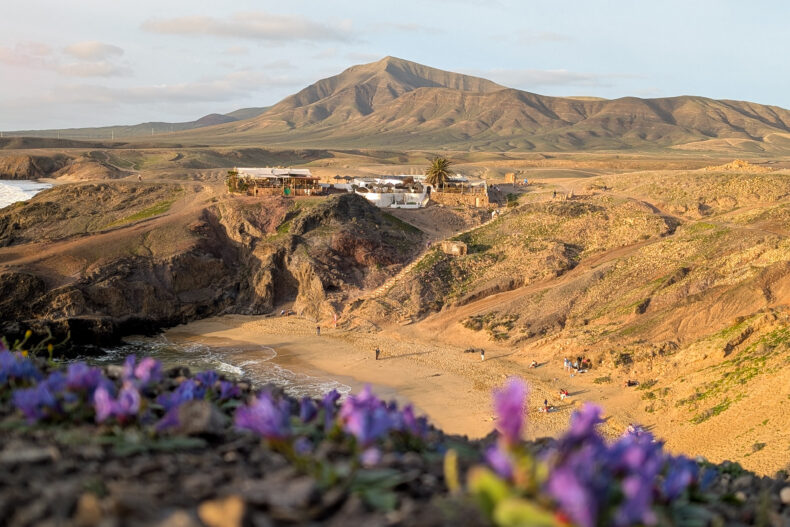
Lanzarote belongs to the volcanoes and to artist César Manrique, whose touch you see all over the island. You drive through the black lava fields of Timanfaya, hike into the crater of Caldera Blanca and swim in the sheltered coves of Papagayo near Playa Blanca. Kids love it here: think of the narrow lava gorge of Las Grietas, or diving with a real submarine. More ideas in Lanzarote with kids.
Fuerteventura is all about space. The dunes of Corralejo roll right down to the sea, El Cotillo has calm lagoons and the beach at Sotavento is so wide that at low tide you can walk for kilometres. Torn between the two? In Lanzarote or Fuerteventura we compare their nature, beaches and atmosphere.
Flights from London take around four hours. The ferry from Playa Blanca to Corralejo takes just half an hour, so combining both islands in one trip is easy.
→ Discover the 7 best areas to stay in Lanzarote
→ Discover the 6 best areas to stay in Fuerteventura
→ Browse Lanzarote holidays on On the Beach
→ Browse Fuerteventura holidays on On the Beach
#3 Madeira: a blooming hiking island in the Atlantic
There’s a reason Madeira is called the island of eternal spring. Temperatures hover around 20 degrees all year, and in February and March the island is covered in blossom. You’ll need your swimsuit less than your walking boots.
Walking the levadas, the old irrigation channels, is the way to explore Madeira. Some routes lead through dense laurel forest and past waterfalls, others take you up rugged peaks with views above the clouds. Not in the mood for hiking? Drive the coast road and stop at Cabo Girão, one of the highest sea cliffs in Europe, where you can stand on a glass platform above the drop. In Funchal you take the cable car up to Monte and ride back down in a wicker toboggan.
Flights from London take about three and three quarter hours. A hire car is handy, as the best walks start outside town. The weather varies from one side of the island to the other: if clouds hang over the north, the south is often sunny.
→ Discover the 8 best areas and unique hotels in Madeira
→ Browse Madeira holidays on On the Beach
→ Compare flights to Madeira

#4 Cyprus: the warmest island in the Mediterranean
Cyprus sits so far east that the Middle East is practically next door, and the climate shows it. In February it’s already around 18 degrees during the day, rising to 23 or more in April. We stretched our summer there by a few months and explored the whole island, from the Greek south to Northern Cyprus.
Start in Paphos, where you wander among the Tombs of the Kings and Roman mosaics. Then head up into the Troodos Mountains with their cool villages and painted Byzantine churches, or seek out the quiet coves of the Akamas peninsula. In the north you’ll find the old harbour of Kyrenia and crusader castles perched on the rocks. The border between the two parts runs right through the capital Nicosia, and you can simply cross it on foot.
Flights from London to Larnaca or Paphos take around four and a half hours, and a hire car is well worth it. Most of the rain falls in winter, but a full day of it is rare.
→ Browse Cyprus holidays on On the Beach
→ Find tours of Cyprus on TourRadar

#5 Andalusia: Moorish palaces and sunny terraces
Southern Spain in spring is hard to beat. In Seville and Málaga it’s already around 18 degrees in February, and by April you’re sitting outside at 24 degrees, still without the summer crowds. Over three trips we’ve spent a total of eight months here, and we keep coming back.
In Seville the orange trees are heavy with fruit in February, and you can walk from the royal Alcázar to the Giralda tower for a view over the whole city. In Córdoba you stand in the forest of columns inside the Mezquita, a mosque with a cathedral later built inside it. And in Granada the Alhambra awaits, with the snowy Sierra Nevada behind it. Book your palace tickets well ahead on the official Alhambra website.
Fancy the beach instead? The Costa del Sol has Marbella and Nerja, with white villages like Frigiliana in the hills above. Feeling active? Walk the Caminito del Rey, a path pinned to the walls of a deep gorge. Flights to Málaga or Seville take less than three hours from London. Andalusia is made for a road trip, but trains and buses get you from city to city just fine too.
→ Discover the 15 most beautiful places in Andalusia
→ Browse Costa del Sol holidays on On the Beach
→ Find tours of Andalusia on TourRadar

#6 Algarve: golden cliffs and empty beaches
The Algarve is one of the sunniest corners of Europe. We’ve been three times, including two winter trips of a month each. In February it’s around 17 degrees during the day and about 21 in April. With the Atlantic at roughly 15 degrees, swimming in half term is only for the truly hardy, but it’s perfect weather for hiking and long beach walks.
Start in Lagos at the rock formations of Ponta da Piedade, then drive on to Praia da Marinha. That’s also where the Seven Hanging Valleys Trail begins, in our opinion the most beautiful coastal walk in the Algarve. Further east, Tavira still has that laid-back feel, and you can cycle or walk through the lagoons of Ria Formosa. Want more walks? See our routes for hiking in the Algarve.
Flights to Faro take under three hours from London. A hire car is a must if you want to see more than the big resorts, because the surf villages in the west and the castle town of Silves are hard to reach by public transport.
→ Discover the 7 best places to stay in the Algarve
→ Discover the 10 most beautiful beaches in the Algarve
→ Browse Algarve holidays on On the Beach
→ Compare flights to Faro

#7 Malta: small islands packed with history
Malta may be small, but it’s crammed with forts, churches and turquoise bays. In February it’s around 16 degrees during the day, about 20 in April. Distances are short and you never spend long in the car or on the bus, which makes it an easy choice with kids. Our favourite family outings are in Malta with kids.
The whole of Valletta is on the UNESCO World Heritage list, and it feels like an open-air museum of narrow streets, mighty bastions and one of the finest natural harbours in the Mediterranean. Hop on a little boat to the Three Cities, wander the silent streets of Mdina and visit the Sunday fish market in Marsaxlokk among the colourful fishing boats. Can’t wait for beach weather? The best beaches in Malta have plenty of spots to dip your toes in come April.
Don’t skip the green sister island of Gozo either. It’s quieter than Malta and at least as beautiful: we ended up staying a whole week. Flights from London take just over three hours, so Malta works for a long weekend as well as a full half term.
→ Discover the 9 best areas to stay in Malta
→ Browse Malta holidays on On the Beach
→ Compare flights to Malta

#8 Sicily: baroque towns and a smoking volcano
Sicily is Italy turned up to eleven: raw landscapes, noisy markets, baroque towns and food you never tire of. In February it’s around 16 degrees, rising to about 20 in April. Ideal weather for getting around without melting.
Start in Palermo, our favourite city in southern Italy, where life plays out in the markets and back streets. Grab arancini from a street stall and drive up to the golden mosaics of Monreale cathedral. On the other side of the island lies Catania, with Mount Etna as its backdrop. In February there’s often still snow on the summit, which makes climbing Etna extra special.
Then drive on to Taormina, with its Greek theatre high above the sea, or to the baroque town of Noto in the south-east. On the south coast you’ll find the Valley of the Temples in Agrigento, where almond trees blossom between the Greek temples in February. Flights to Palermo or Catania take about three hours, and with a hire car the whole island is within reach.
→ Discover the 28 most beautiful places in Sicily
→ Compare flights to Sicily
→ Find flight and hotel deals on Expedia

#9 Sardinia: Caribbean-blue water without the crowds
Sardinia feels like a tropical island, only a short flight away. We spent a whole month travelling around it in March and were blown away by the white beaches, sand dunes and wild cliffs. In February and March it’s 15 to 17 degrees during the day, around 20 in April and heading towards 24 in May. Perfect for a coastal road trip or a proper hike in the mountains.
The coves of the Maddalena archipelago, the rock spire of Cala Goloritzé and the turquoise water of the Costa Smeralda look straight out of a brochure. Yet Sardinia is much more than beaches. Alghero has an old town with Catalan influences, Bosa is one of the most colourful towns in Italy, and inland you’ll find mountain villages and nuraghi, prehistoric stone towers you won’t see anywhere else.
You fly into Cagliari, Olbia or Alghero in about two and a half hours. In winter there are fewer direct flights, so you may need a connection. With a hire car you can cross the island in a few hours.
→ Discover the 14 most beautiful beaches in Sardinia
→ Discover where to stay in Sardinia
→ Compare flights to Sardinia

#10 Crete: the southernmost Greek island
We spent a whole winter in Greece with our camper, and had to conclude that in February the country isn’t really a sun destination. Crete is the southernmost of all the Greek islands and sees around 16 degrees in February, but it only really comes alive from April. Travelling at Easter or in May? Then you can expect up to 24 degrees and beaches that are still quiet.
Start in Chania or Rethymnon, two harbour towns with a mix of Venetian and Ottoman influences. Wander the lanes, grab a table on a terrace and order dakos, a kind of Greek bruschetta with tomato and feta. Active types can hike the famous Samaria Gorge, which usually opens in May. Rather relax? The beaches of Elafonissi and Balos look like postcards, with pink sand and turquoise water.
Flights to Heraklion or Chania take about four hours from London. There are plenty of direct flights from spring onwards, while in winter you’ll often go via Athens. Crete is big, so a hire car is no luxury.
→ Compare flights to Crete
→ Find tours of Greece on TourRadar

#11 Ibiza: the quiet island in bloom
Out of season, Ibiza is a completely different island from the summer party spot. No packed clubs, just quiet coves, sleepy villages and, in February, white and pink almond blossom in the valley around Santa Agnès. Daytime temperatures are around 16 degrees, rising to about 20 in April.
Rent a car and go cove-hopping. From Cala d’Hort you look out over the mysterious rock of Es Vedrà, and Cala Xarraca in the north feels like a secret bay. In Ibiza Town you wander through Dalt Vila, the walled old town on the hill overlooking the harbour. On a sunny afternoon, grab a table by the marina and you’ll forget it’s still winter back home.
Flights from London take about two and a half hours, though direct routes are limited outside the season. Pick a countryside finca or a little house by the sea: in spring you see Ibiza the way the locals know it, relaxed, sunny and green.
→ Compare flights to Ibiza
→ Find flight and hotel deals on Expedia

#12 Puglia: trulli, cliffs and pasta made in the street
Puglia is Italy at its best, without the crowds of Tuscany or the Amalfi Coast. It is a destination for later in spring though: around 14 degrees in February, about 19 in April and an easy 24 in May. If you’re travelling at Easter or in May, you’re in for a treat.
In the old town of Bari you’ll see women making orecchiette, little ear-shaped pasta, by hand in the alleys. Polignano a Mare sits dramatically on cliffs above the sea, and in Monopoli you stroll past a white old town right on the water. Inland, Alberobello is full of trulli, white houses with conical roofs you won’t find anywhere else in Italy.
Further south lies Lecce, the Florence of the south, full of baroque churches and squares. Near Otranto you’ll find Baia dei Turchi and Torre dell’Orso, beaches that wouldn’t look out of place in the Caribbean. Flights to Bari or Brindisi take a little under three hours, and a hire car is essential, as the best spots are tucked away among the olive groves.
→ Discover the 20 most beautiful places in Puglia
→ Discover the 6 best areas to stay in Puglia
→ Find tours of Puglia on TourRadar
→ Compare flights to Bari

Sunny places just outside Europe
#13 Marrakech: souks, riads and the Atlas Mountains on your doorstep
Marrakech throws you straight into another world. Narrow streets lined with stalls, souks where you can wander for hours and riads where you unwind after a day full of impressions. In February it’s around 20 degrees during the day and about 26 in April. Do bring a jumper though, because it cools down fast once the sun has gone.
Start on Jemaa el-Fnaa square, where storytellers, musicians and food stalls create a chaotic but fascinating show. Stroll through the souks, visit the Bahia Palace and walk around the Majorelle Garden, laid out by French painter Jacques Majorelle and later rescued by Yves Saint Laurent. Tickets for the garden are only sold on the official Jardin Majorelle website.
Marrakech works well for a short break and makes a handy base for day trips from Marrakech. Head up to the snowy peaks of the Atlas Mountains. With more time, spend a few days travelling on to the Merzouga desert for a night under the stars. We spent six weeks driving around Morocco in our camper, and that mix of city, mountains and desert was what we loved most. Flights from London take under four hours.
→ Discover the 20 most beautiful places in Morocco
→ Find tours of Morocco on TourRadar
→ Compare flights to Marrakech

#14 Jordan: Petra, Wadi Rum and floating in the Dead Sea
Jordan feels like it’s straight out of an adventure story, with rock-cut cities, red deserts and hidden temples. Keep the altitude in mind though: in Amman and Petra it’s only around 14 degrees in February, while the Dead Sea and Aqaba are already at 23. For a full round trip, March and April are the best months, with pleasant temperatures everywhere.
The absolute highlight is Petra, the city the Nabataeans carved out of the rock and one of the best-known UNESCO World Heritage Sites on the planet. You walk through the narrow gorge of the Siq and suddenly find yourself face to face with the Treasury. In Wadi Rum you bounce in a jeep past giant red rocks and sleep in a camp under an incredible sky full of stars.
Don’t miss the Dead Sea either: the lowest point on earth, with water so salty you float without trying. Near Aqaba you snorkel over colourful coral reefs in the Red Sea. A hire car gets you everywhere easily, and the Jordan Pass covers your visa and entry to Petra in one go. Flights from London to Amman take around five hours.
→ Discover our ultimate Jordan itinerary
→ Find tours of Jordan on TourRadar
→ Compare flights to Jordan

#15 Egypt: guaranteed warmth in February
If you want real warmth in February half term, Egypt is your best bet. On the Red Sea it’s around 23 degrees in February and in Luxor even 26, climbing towards 30 to 35 degrees by April.
For a relaxing beach holiday, Hurghada, Marsa Alam and Sharm el-Sheikh are the best-known spots. You’ll find long beaches and resorts there, but the real highlight is underwater: snorkelling or diving among the coral reefs and tropical fish of the Red Sea.
More of a culture lover? In Cairo you come face to face with the pyramids of Giza and the Sphinx, and visit the new Grand Egyptian Museum right next to them. Travel on to Luxor for the Valley of the Kings and the giant columns of Karnak, and don’t skip Aswan, the base for the rock temples of Abu Simbel.
Flights from London to Hurghada, Marsa Alam or Luxor take around five hours. The best trip combines both sides of the country: temples and tombs first, then a few days of snorkelling on the coast. Sounds like the perfect half term, doesn’t it?
→ Discover the perfect two-week Egypt itinerary
→ Browse Red Sea holidays on On the Beach
→ Find Egypt tours and Nile cruises on TourRadar

Enjoy our travel tips? Add The Orange Backpack as a preferred source on Google and you'll see us more often in your search results.